
IJCNC 04
EFFICIENT ENERGY-BASED CLUSTER HEAD ELECTION AND ROUTING PROTOCOL IN WSNS
Ahmad Abuashour
Department of Information Technology and Computing, Arab Open University, Arab Open University, Kuwait City, Kuwait
ABSTRACT
Wireless Sensor Networks (WSNs) comprise spatially distributed sensor nodes with limited energy and processing capabilities. Energy efficiency remains a critical concern in WSNs, as it directly impacts network stability and lifetime. Extensive research has demonstrated that clustering techniques enhance energy efficiency by improving communication reliability and extending operational longevity. In clustering, designated Cluster Heads (CHs) perform intra-cluster data aggregation and inter-cluster communication with other CHs or the sink node. This article introduces the Efficient Energy-Based Cluster Head Election (EECHE) protocol, which dynamically selects CHs based on two key criteria: residual energy and inter-CH distance. Re-clustering is initiated whenever these criteria are violated. Additionally, we propose the Efficient Energy-Based Routing (EEPR) protocol, which facilitates forwarding of aggregated data from Cluster Members (CMs) to the sink via candidate CHs. The optimal forwarding route is selected by evaluating both the shortest route and energy link stability, quantified through the longest expected route energy lifetime. By integrating these protocols with topology-aware constraints, the proposed approach achieves balanced energy distribution and maximizes the network performance. Mathematical analysis and simulation results demonstrate that the proposed protocols significantly enhance network performance—achieving higher throughput, lower delay, and improved packet delivery ratio—when compared to conventional protocols such as LEACH, ELEACH, Q-LEACH, and FLQLEACH. Simulation results show that the proposed EECHE–EEBR framework improves throughput by up to 50%, reduces energy consumption by approximately 47%, and decreases end-to-end delay by nearly 35% compared with the LEACH protocol. These results confirm the effectiveness of integrating energy awareness, spatial constraints, and route stability into a unified framework for clustering and routing
KEYWORDS
WSN, Energy-based, CH election, routing, LEACH, EECHE, EEBR.
- INTRODUCTION
A Wireless Sensor Network (WSN) is a fundamental component of the Internet of Things (IoT), consisting of small, resource-constrained sensor nodes integrated into network infrastructures. Due to limited energy, storage, and processing capabilities, these nodes mainly perform data sensing, buffering, and forwarding operations. WSNs support a wide range of applications, including environmental monitoring, industrial automation, smart agriculture, and healthcare systems [1–3]. Typically, a WSN comprises spatially distributed sensor nodes that cooperatively collect physical or environmental data and transmit it to a Base Station (BS) or sink for further analysis [4–6].
Since WSNs are often deployed in remote or unattended environments, sensor nodes are typically powered by non-rechargeable batteries. Consequently, energy efficiency becomes a critical concern in both the design and operation of these networks. Each sensor node is responsible for two primary functions: sensing and collecting data from the surrounding environment, and relaying that data through neighboring nodes until it reaches the BS [7-9].
Among various network architectures, clustered topology is widely adopted in WSNs due to its scalability and energy efficiency. In this structure, sensor nodes are organized into hierarchical clusters consisting of Cluster Heads (CHs) and Cluster Members (CMs), where CHs are responsible for data aggregation and forwarding to the sink. By optimizing communication and reducing redundant transmissions, clustering effectively lowers energy consumption, particularly in dense network deployments [10].
In clustered WSNs, clustering approaches are generally classified into two categories: stationary clustering and dynamic clustering. In stationary clustered networks, the sensing area is partitioned into predefined subregions of equal size. After sensor nodes are randomly deployed, a CH election process is initiated within each subregion. Each static region functions as a cluster and selects a single CH, while the remaining nodes serve as CMs. The CH selection is typically based on one or more criteria such as the node’s distance from the cluster center, node mobility parameters, residual energy, or estimated node lifetime [11–18, 24].
Conversely, dynamic clustering does not rely on predefined cluster boundaries. Instead, clusters are formed on-the-fly based on the selection of CHs. Various methods have been proposed for CH election in dynamic clustering. The most basic technique involves random selection from the entire set of nodes, while more advanced approaches incorporate factors such as node location, energy level, and other performance-related metrics [18–25].
Table 1 presents a summary of the key CH election and routing criteria used in the most popular
clustered WSNs, along with the strengths and limitations of each method.
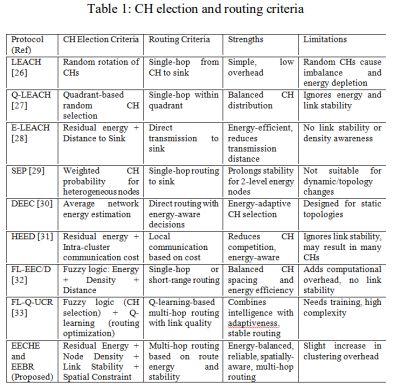
Routing strategies in WSNs aim to improve energy efficiency and communication reliability. Protocols such as LEACH [26] and SEP [29] employ single-hop transmission from Cluster Heads (CHs) to the sink, which often leads to rapid energy depletion, especially for distant CHs. QLEACH [27] enhances CH distribution using quadrant-based clustering but does not support multi-hop routing. E-LEACH [28] considers residual energy and distance in CH selection but still relies on direct communication. DEEC [30] and HEED [31] introduce energy-aware mechanisms but neglect link quality and network dynamics. FL-EEC/D [32] applies fuzzy logic to incorporate energy and node density, while FL-Q-UCR [33] combines fuzzy inference with Q-learning to enable adaptive routing. However, these intelligent approaches impose high computational overhead. Therefore, a lightweight and robust routing protocol that integrates energy efficiency, topological awareness, and link stability remains essential.
Based on the analysis presented in Table 1, the proposed Efficient Energy-Based Cluster Head Election (EECHE) protocol selects Cluster Heads (CHs) using residual energy and inter-cluster distance to achieve balanced cluster formation. In parallel, the Efficient Energy-Based Routing (EEBR) protocol employs a multi-hop strategy guided by route energy evaluation to ensure reliable and energy-efficient data transmission. By integrating optimized clustering with energyaware and stable routing, the proposed framework enhances network stability, robustness, and lifetime while ensuring fair resource distribution.
The remainder of this article is structured as follows: Section 2 presents a comprehensive review of related work. Section 3 introduces the system and mathematical models underlying the proposed protocols. Section 4 : Performance metrics calculation and numerical validation of the approach. Section 5 describes the implementation of the proposed solution in MATLAB and compares the analytical findings with simulation results. Section 6 discusses the performance evaluation and presents a detailed analysis of the results. Finally, Section 7 concludes the study and outlines potential directions for future research.
2. RELATED WORK
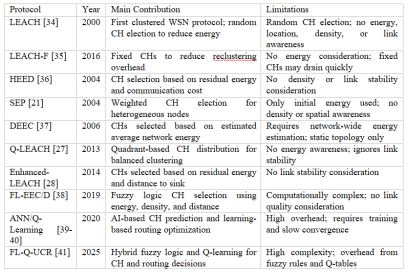
The Low-Energy Adaptive Clustering Hierarchy (LEACH) protocol [34] is one of the earliest cluster-based routing approaches for WSNs, designed to reduce energy consumption through periodic rotation of Cluster Heads (CHs). However, its random CH election mechanism often leads to uneven cluster distribution and inefficient energy usage, as it ignores important factors such as residual energy, node location, network density, and link quality.
The limited energy supply, constrained computational resources, and lack of fixed infrastructure in WSNs necessitate the development of efficient and intelligent clustering protocols. A major challenge is the selection of suitable Cluster Heads (CHs) that can support data aggregation and transmission while extending network lifetime. Several improvements have been proposed to address this issue. For example, LEACH-F [35] employs fixed CHs to reduce reclustering overhead; however, this approach does not adapt to dynamic energy depletion, which may lead to early node failure.
The Hybrid Energy-Efficient Distributed Clustering (HEED) protocol [36] selects Cluster Heads (CHs) based on residual energy and intra-cluster communication cost; however, it neglects node density and link stability. The Stable Election Protocol (SEP) [37] improves network stability by assigning weighted CH election probabilities according to initial energy levels, but it assumes static energy distributions and lacks adaptive re-evaluation. The Distributed Energy-Efficient Clustering (DEEC) protocol [38] dynamically estimates average network energy for CH selection, making it suitable for static topologies, although it does not consider link quality or node density.
Table 2 provides a comparative overview of key cluster-based routing protocols developed for WSNs. The table highlights the evolution from early approaches like LEACH, which introduced basic clustering concepts, to more advanced techniques incorporating energy awareness, spatial distribution, and intelligent decision-making using fuzzy logic and machine learning. While many protocols have made significant strides in addressing energy efficiency and clustering optimization, several still suffer from limitations such as high computational complexity, lack of adaptability, or limited consideration of network dynamics. This comparison underscores the need for a balanced, low-overhead protocol that integrates energy, topology, and stability considerations.
Table 2: A comparative overview of key cluster-based routing protocols
3. SYSTEM AND MATHEMATICAL MODEL
In WSNs, the performance of routing protocols is largely influenced by their energy efficiency, scalability, and adaptability to dynamic environments. To evaluate the proposed Efficient Energy-based Cluster Head Election (EECHE) and Efficient Energy-based Routing (EEBR) protocols, a well-defined mathematical and system model is essential. These models formally represent the processes of cluster formation, cluster head (CH) selection, multi-hop routing, and energy-aware communication. They enable accurate characterization of network behavior and serve as the analytical foundation for simulation and performance comparison against existing protocols such as LEACH, Q-LEACH, E-LEACH, and FL-Q-UCR.The EECHE and EEBR protocols are specifically designed to extend network lifetime by integrating multiple intelligent criteria into CH selection and routing decisions. These include residual energy, node density, link stability, and spatial separation between CHs. Additionally, the EEBR protocol employs a multihop routing mechanism that reduces transmission energy consumption while ensuring high data throughput and reliable delivery.The following subsections present the mathematical formulation of the two fundamental phases of the EECHE and EEBR protocols: (1) cluster formation and Cluster Head (CH) election, and (2) multi-hop routing with corresponding energy and performance metrics.
3.1. Cluster formation and Cluster Head (CH) election.
The design of the EECHE protocol is based on the following assumptions:
- A dynamic clustering strategy is employed, allowing clusters to be formed and updated
based on current network conditions.
- A total of N sensor nodes are randomly distributed within a sensing field of size M×M
meters. - CH selection is selected by two main constraints:
(1) the distance between already selected CHs to ensure spatial separation, and
(2) the residual energy level of each candidate node.
- The energy of each sensor node depletes over time due to data transmission and reception
activities. - Sensor nodes are powered by limited, non-rechargeable energy sources, while the Base
Station (BS) is assumed to have unlimited energy resources.
Figure 1, it visually illustrates the clustering mechanism and threshold-based validation used in the EECHE (Efficient Energy-based Cluster Head Election) protocol. It presents three clusters— Cluster A, Cluster B, and Cluster C—each with a randomly selected Cluster Head (CH A, CH B, and CH C). The solid circular boundary around each CH denotes the maximum transmission range, which defines the area in which the CH can potentially communicate with its member nodes. Meanwhile, the dashed inner circle represents the threshold boundary, a spatial constraint applied to ensure the CH is not too close to the cluster center or to other CHs.
In accordance with the EECHE protocol, after CHs are selected randomly, their spatial validity is assessed. If a CH lies within the threshold boundary (i.e., too close to other CHs or centrally located nodes), it is considered invalid due to poor spatial distribution. Such a CH is discarded, and a new CH is reselected randomly. This mechanism ensures balanced and well-spread CH placement, promoting effective coverage, better load distribution, and minimizing cluster overlap. The figure thus supports EECHE’s commitment to energy-efficient and spatially aware cluster formation.
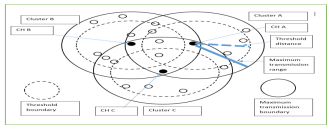
Figure 1: Cluster Head Election Boundary
3.1.1. Network Initialization
Network initialization is the foundational phase of the EECHE protocol, where the WSN is deployed, and all nodes are prepared for operation. During this phase, each node is assigned rand an initial residual energy level, typically selected randomly within a predefined range to simulate heterogeneous energy availability across the network. The BS is positioned outside or within the field to collect aggregated data from CHs. The initial setup also includes defining important parameters such as transmission range, the percentage of CHs, and minimum spacing constraints between CHs to avoid overlapping coverage and reduce energy contention.
Network initialization ensures that the topology is both realistic and ready for the next critical stage—cluster formation and CH election—where the EECHE protocol’s core energy-aware logic is applied to begin efficient communication and routing across the WSN.
Let us define the cluster formation and Cluster Head (CH) election phase using the following notations: N is the total number of sensor nodes, and let each node have a spatial position given by:
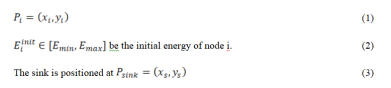
Where
𝑃𝑖 , 𝑃𝑠𝑖𝑛𝑘 denote to the position of node i and the sink in x and y coordination.
𝐸𝑖 𝑖𝑛𝑖𝑡 is randomly assigned within the range of 𝐸𝑚𝑖𝑛 𝑡𝑜 𝐸𝑚𝑎𝑥
3.1.2. Cluster Head (CH) Election Set:
A Valid Cluster Head (CH) Set refers to the group of nodes selected as CHs that satisfy predefined spatial and energy constraints. Each CH must be at least a minimum distance away from others to ensure proper cluster distribution, and must have residual energy above a certain threshold to maintain stability. This validation ensures balanced energy consumption and reliable communication throughout the network.
The target number of CHs is
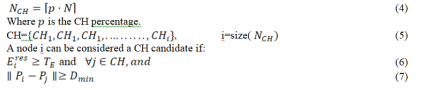
where: 𝑇𝐸 is the energy threshold and is the minimum spacing between CHs.
3.1.3. Cluster assignment
Each node i assigns a cluster by selecting the 𝑗 ∈ 𝐶𝐻 such that:

Where: 𝑅𝑡 is maximum transmission range
3.1.4. Cluster Validity Constraint
After assignment, average residual energy per cluster c is:
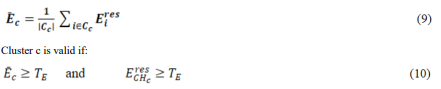
Otherwise, CH election and cluster assignment are repeated.
3.2. EEBR protocol with corresponding energy and performance metrics.
This section describes the routing mechanism of the EEBR protocol and presents the mathematical models used for performance evaluation. After cluster formation, data is forwarded from CHs to the BS using a multi-hop strategy guided by residual energy, link stability, and distance to the sink. The protocol is evaluated using key performance metrics, including residual energy, throughput, end-to-end delay, and PDR. The following subsections provide the corresponding analytical formulations for these metrics.
3.2.1. Multi-hop routing decision
In the EEBR protocol, routing decisions aim to ensure reliable and energy-efficient communication between CHs and the sink. Instead of direct transmission, a multi-hop strategy is adopted, where each CH selects the optimal next-hop based on residual energy, link stability, and proximity to the sink. This mechanism reduces energy consumption, extends network lifetime, and enhances routing robustness in resource-constrained WSN environments.
Each CH first identifies a set of candidate CHs based on three main criteria: (1) the candidate must lie within the transmission range, (2) it must be closer to the sink than the current CH, and (3) it must have equal or higher residual energy than the current CH. For the first two criteria we need to define the formula to find the distance between the current CH and other CH, and from other CH to the sink, to find the distance between 2 WSN nodes we use the formula that defined in equation 11.

Where:
- 𝑅𝑡 : transmission range
- 𝐸𝑗 ≥ 𝐸𝑖 : ensures energy stability by selecting nodes with equal or higher residual energy
- 𝑑(𝑗, 𝑆) < 𝑑(𝑖, 𝑆) : ensures the candidate CH is closer to the sink
- 𝒞 ⊆ 𝑁 ∶ set of cluster heads (CHs)
- 𝑁 : total number of nodes
- 𝑆 : sink node location
- 𝐸𝑖 : residual energy of node i
3.2.2. Route Energy Lifetime Estimation
Route Energy Lifetime Estimation refers to the process of quantifying the stability and sustainability of a forwarding path between CHs. It is computed as the minimum residual energy along the path, which determines how long the route can reliably function. This metric helps in selecting energy-stable routes that minimize the risk of early link failure. Define the Route Energy (RE) from node i through j to the sink:

The candidate 𝑗 ∗ that maximizes route energy and minimizes total hop distance is selected:
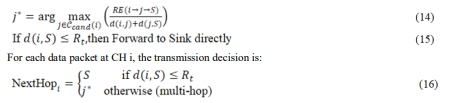
This ensures energy-aware routing, progress toward the sink, and stable links with higher energy lifetime.
4. PERFORMANCE METRICS CALCULATION AND NUMERICAL RESULTS
This section presents the performance evaluation framework used to assess the proposed protocols. It introduces the adopted energy model, throughput computation, delay estimation, and reliability metrics, followed by numerical analysis and discussion.
4.1. Energy Consumption Model:
The energy consumption model in the EEBR protocol is designed to realistically represent the power usage of sensor nodes during communication and clustering activities. Energy is primarily consumed in two operations: transmitting and receiving data. The model incorporates distancebased energy dissipation, where energy required for transmission increases with the square or fourth power of the distance, depending on the communication range. EEBR protocol also accounts for the energy spent during cluster formation, cluster head operation, and multi-hop routing. By integrating this model into the simulation, we can effectively evaluate how different clustering and routing decisions impact network lifetime and energy balance across the network. We used the first-order radio model to transmit energy from node i to node j over distance d:

Where: k: packet size (bits), 𝐸𝑒𝑙𝑒𝑐 : energy per bit for electronics, and 𝜖𝑎𝑚𝑝: energy for amplifier.
4.2. Throughput Calculation
Throughput in EECHE represents the successful delivery of data packets from Cluster Heads (CHs) to the sink node over time. It serves as a critical performance metric for evaluating the efficiency and reliability of the routing protocol. The throughput calculation considers the number of CHs that manage to establish valid multi-hop routes to the sink and transmit data without packet loss. By tracking throughput over multiple rounds, the EEBR protocol ensures that both energy efficiency and consistent data delivery are achieved across the network.

Where: 𝑇𝑟 : number of packets received by sink in round r, and : duration of round r.
4.3. End-to-End Delay
Delay is measured as the average number of hops taken for a data packet to reach the sink from the originating Cluster Head (CH). It reflects the time efficiency of the routing path. Lower hop counts indicate faster data delivery and are desirable for time-sensitive applications. For each packet from to sink:

4.4. Packet Delivery Ratio (PDR):
PDR is defined as the ratio of successfully received data packets at the sink to the total packets sent by source nodes. It reflects the reliability and robustness of the communication protocol.

4.5. Numerical results and assumptions
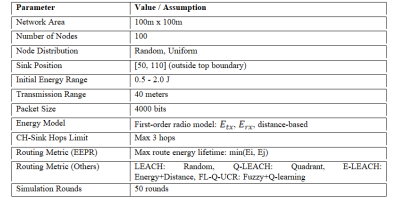
Table 3 provides a concise summary of the main simulation assumptions adopted across all evaluated protocols. These parameters were uniformly applied to ensure a fair and consistent comparison of performance metrics.

4.5. Numerical results and assumptions
Table 3 provides a concise summary of the main simulation assumptions adopted across all evaluated protocols. These parameters were uniformly applied to ensure a fair and consistent comparison of performance metrics.
Table 3: Simulation assumptions
In Table 4, we present the numerical results obtained through MATLAB simulations for the proposed EEPR protocol in comparison with other existing protocols, including LEACH, QLEACH, E-LEACH, and FL-Q-UCR. The evaluation focuses on key performance metrics such as throughput, residual energy, delay, and PDR. These results demonstrate the effectiveness and efficiency of the EEPR protocol in optimizing energy usage and ensuring reliable data delivery in WSN.
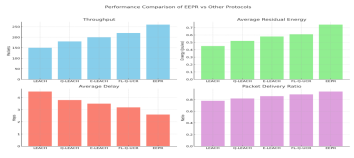
Figure 2 . Performance comparison of EEBR vs Other protocols
5. IMPLEMENTATION OF THE EECHE AND EEBR PROTOCOLS
This section presents the Cluster Head election process and the clustering process.
5.1. Cluster Head election:
The final implementation of the EECHE protocol incorporates the developed mathematical model into a practical clustering algorithm. Sensor nodes are initially randomly deployed within a 100 × 100 m² area. Each node computes a Cluster Head Score (CH_Score) based on two key factors: its residual energy and the distance to other selected CHs. During the CH selection process, a spatial constraint is enforced to ensure that any two CHs are separated by a minimum distance of 25 meters, and that each selected CH satisfies a minimum energy threshold. This constraint prevents excessive clustering in a localized area and helps maintain balanced cluster distribution, thereby minimizing resource contention and improving overall energy efficiency.
Once CHs are selected and validated for spatial separation, the remaining sensor nodes are assigned to their nearest CH, provided they fall within the defined communication transmission range. After all nodes are clustered, the protocol computes the average residual energy of the members within each cluster and also checks the residual energy of the respective CH. If both the average energy of a cluster and the CH’s individual energy exceed a predefined energy threshold, the cluster is deemed valid, and the protocol proceeds to data transmission. However, if any cluster fails to meet these energy constraints, the system triggers re-clustering from the beginning to ensure stable and energy-efficient communication.
This decision-making process is illustrated in the EECHE Protocol Flowchart that shown in Figure 3. The flowchart begins with node deployment and proceeds to CH scoring, followed by CH selection with spatial separation (this process is referred as selected cluster CH validity in the flowchart). It then visualizes cluster formation, energy validation checks, and the conditional loop for re-clustering if constraints are violated (this process referred as cluster formation validity in the flowchart). This flowchart helps in clearly understanding the logic and sequence of operations that define the robustness of the EECHE protocol.
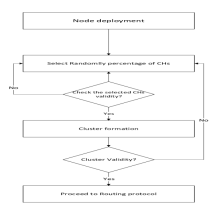
Figure 3 . Flowchart CH election and CH formation validity
To ensure energy-efficient and balanced clustering in WSNs, the EECHE protocol incorporates a re-clustering mechanism. In Figure 4, the pseudocode explains the process that verifies the validity of each cluster by checking if the residual energy of the CH or the average energy of its members falls below a predefined threshold. If any cluster is deemed invalid or if some nodes remain unclustered, the algorithm triggers a new round of CH selection and cluster formation. The pseudocode below outlines this validation and re-clustering logic.
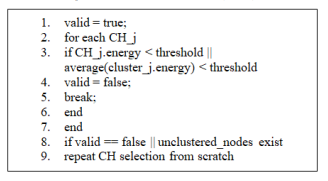
Figure 4 . The pseudocode for reclustering.
5.2. Clustering process
In the EEPR protocol, the routing process is designed to forward aggregated data from CHs to the sink using energy-aware and stability-optimized multi-hop paths. Each CH first identifies a set of candidate CHs based on three main criteria: (1) the candidate must lie within the transmission range, (2) it must be closer to the BS than the current CH, and (3) it must have equal or higher residual energy than the current CH. In Figure 5, the flowchart presents the following processes and decisions to set the candidate CH list. This ensures that data is forwarded only to energysufficient and strategically located CHs, promoting network longevity.
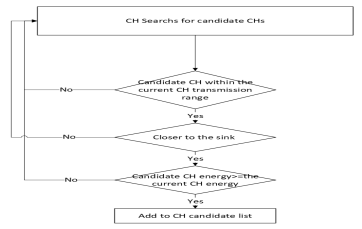
Figure 5 . flowchart for Candidate CH selection .
After identifying candidate Cluster Heads (CHs), the optimal forwarding path is selected using the Route Energy metric, defined as the minimum residual energy between the current CH and the candidate. This metric represents the expected energy lifetime of the route. The EEPR protocol evaluates both energy stability and distance to the sink by computing the ratio of route energy to total hop distance, and selects the candidate with the highest score as the next hop. If the sink is within direct communication range, data is transmitted directly. As illustrated in Figure 6, this adaptive decision-making process improves throughput, reduces delay, and ensures stable communication paths throughout the network lifetime.
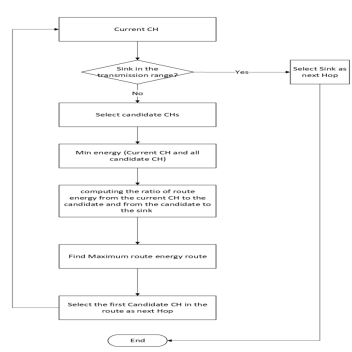
Figure 6 . flowchart of decision-making process by EEBR protocol
- DISCUSSES THE PERFORMANCE EVALUATION AND PRESENTS A DETAILED ANALYSIS OF THE RESULTS.
This section presents a comprehensive evaluation of the proposed EECHE and EEBR protocols in comparison with existing clustering-based routing protocols, including LEACH, Q-LEACH, E-LEACH, and FL-Q-UCR. The performance metrics considered are Throughput, Residual Energy, End-to-End Delay, and PDR. These metrics were selected to capture the protocols’ efficiency in throughput, energy utilization, delay, and packet delivery ratio.
The simulation was conducted using MATLAB R2016a. in Table 5, it shows the assumed parameter values and the description for each. Each protocol was executed for 50 independent runs over 20 rounds per run to obtain statistically significant averages. For a fair comparison, identical initial network conditions were maintained, such as node deployment, sink location, and transmission parameters. In EECHE, the routing decision is based on residual energy, node density, and link stability, while ensuring spatial constraints during CH selection. In contrast, LEACH employs random CH election; Q-LEACH uses quadrant-based segmentation; E-LEACH incorporates energy and distance to the sink; and FL-Q-UCR integrates fuzzy logic and Qlearning to optimize routing.
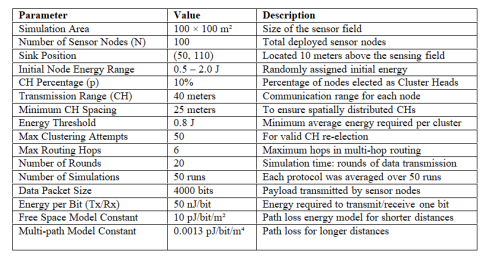
Table 5 : .Simulation parameter
Figure 7 presents a comparative analysis of five routing protocols—LEACH, Q-LEACH, ELEACH, FL-Q-UCR, and the proposed EECHE and EEBR—evaluated across four key performance metrics: Throughput, Residual Energy, Average Delay, and Packet Delivery Ratio (PDR).
The proposed EECHE and EEBR protocols achieve the highest throughput, delivering approximately 72 packets, representing a 50% improvement over LEACH (about 48 packets). This performance gain demonstrates the effectiveness of integrating residual energy, node density, and link stability into the multi-hop routing strategy. In terms of energy efficiency, EECHE and EEBR retain the highest residual energy (0.45 J), compared with LEACH (approximately 0.34 J), indicating balanced energy consumption. Moreover, the proposed protocols record the lowest average delay (about 2.2 hops), whereas LEACH exhibits the highest delay (approximately 3.4 hops), reflecting the benefits of optimized clustering and routing decisions.
Finally, in terms of Packet Delivery Ratio (PDR), EECHE and EEBR lead with a value of approximately 0.93, followed by FL-Q-UCR at 0.88, while LEACH achieves only 0.77. This high PDR underscores the reliability of the proposed protocols in successfully delivering packets, even in multi-hop communication scenarios.
The Numerical Comparison results in Table 6 provide a detailed evaluation of the proposed EECHE and EEBR protocol against several benchmark routing protocols, including LEACH, QLEACH, E-LEACH, and FL-Q-UCR. This table highlights the performance of each protocol across four key metrics: throughput, residual energy, average delay, and packet delivery ratio (PDR). By presenting the numerical values side by side, the table offers a transparent and quantitative foundation for assessing the efficiency, reliability, and energy awareness of the proposed solution compared to existing approaches.
To quantitatively evaluate the improvement achieved by the proposed EECHE and EEBR protocol over existing benchmark protocols, we calculate the percentage performance gain for each key metric: throughput, residual energy, delay, and PDR. These metrics provide a comprehensive view of energy efficiency, data reliability, and latency performance. The percentage gain is computed relative to each baseline protocol to highlight the advantages brought by the advanced clustering and routing mechanisms introduced in EECHE and EEBR. The following formulas are used to compute the gains and reductions:
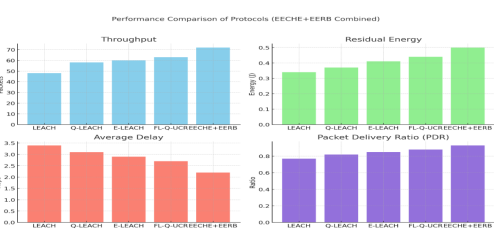
Figure 7: . Performance comparison of protocols


