
IJCNC 06
A PREDICTIVE ADAPTIVE LIFETIME ENHANCEMENT OPTIMIZATION FRAMEWORK FOR ENERGY-EFFICIENT WIRELESS SENSOR NETWORKS
S.Dineshkumar 1 and N. Muthumani 2
1 Department of Computer Science, PPG College of Arts and Science Coimbatore-35, Tamil Nadu, India
2 Principal, PPG College of Arts and Science Coimbatore-35, Tamil Nadu, India
ABSTRACT
One of the challenges associated with the applications of Wireless Sensor Networks (WSNs) is prolonging the operational lifetime of sensor networks. Simple techniques such as clustering, fixed-area scheduling, and distance-based routing can lead to nbalanced energy consumption and premature network partitioning. To address these limitations, this research proposes Predictive Adaptive Lifetime Enhancement Optimization (PALEO), which integrates residual energy prediction, adaptive node activation and deactivation, and lifetime-based routing to enhance network lifetime.The algorithm makes predictions for future residual energy of every node and adaptively switches nodes between sleep and work modes. The cost-effective paths are generated using the modified Dijkstra-based routing algorithm considering residual energy, communication range and local congestion. Extensive simulations conducted under various node densities and packet sizes demonstrate that PALEO consistently outperforms benchmark protocols, achieving up to 99.9% packet delivery, significant energy savings and a 36% enhancement in network duration.
KEYWORDS
Wireless Sensor Networks, Network Lifetime Optimization, Energy Prediction, Adaptive Scheduling, PALEO Algorithm.
1. INTRODUCTION
Wireless Sensor Network (WSN) technology has been considered one of the key technologies for various applications in domains such as environmental monitoring, smart agriculture, industrial automation and disaster detection. Such networks are characterized by the deployment of sensors that are energy-constrained and spatially distributed in nature and which work together to sense, process ,and forward data to a sink node. Lifetime extension of the Wireless Sensor Network is one of the main concerns in WSNs since the sensor nodes normally use batteries which cannot be easily replaced in hard -to -reach areas. This existing methodology is termed network lifetime optimization ,which refers to the efficient use of energy for maximizing the period during which the WSN is expected to befunctional in terms of sensing and communication. However, realizing this goal is not an easy task due to some problems such as unequal energy drain, redundant transmission of data and ineffective routing algorithms. The early failure of nodes reduces the network lifetime as well as coverage and data dependability. A hybrid cluster-head selection method was proposed to improve WSN lifetime and energy efficiency [1]. An energy-efficient optimization technique was developed for network lifetime maximization [2]. A base-station location strategy was introduced to reduce energy imbalance and extend network lifetime [3]. A mobile-sink data collection scheduling method was proposed for lifetime enhancement [4]. A joint routing and energy-harvesting strategy was developed to improve energy utilization and network lifetime [5]. A mathematical optimization
model was proposed for lifetime maximization with intruder detection [6]. A heterogeneous clustering protocol was introduced to improve energy efficiency and lifetime [7]. A neighborhood-based estimation algorithm was developed using activity scheduling and adjustable sensing ranges for lifetime maximization [8]. A statistical Grey Wolf Optimization routing method was proposed for efficient path selection and lifetime enhancement [9]. An efficient routing approach was developed for IoT-based WSNs in 5G and beyond environments [10].
A metaheuristic approach was proposed to improve coverage and network lifetime [11]. An energy-efficient clustering and routing model was developed to reduce energy consumption and extend lifetime [12]. A population-based iterated greedy algorithm with sleep–wake scheduling was introduced for lifetime maximization [13]. A hybrid genetic algorithm with bidirectional mutation was proposed for heterogeneous WSN lifetime optimization [14]. A Gravitational Search Algorithm-based clustering and routing approach was developed for underwater WSN lifetime enhancement [15]. A fuzzy-logic LEACH-based Particle Swarm Optimization method was proposed for cluster-head selection and lifetime improvement [16]. A modified DEEC protocol was developed using adaptive power levels and threshold-based cluster-head selection [17]. An IoT-based clustering and smart-leader selection method was proposed for efficient routing [18]. An energy-aware framework integrating faulty-node replacement, duty cycling, clustering and adaptive routing was developed for WSN optimization [19]. A dynamic low-power traffic strategy was proposed to reduce energy consumption and improve efficiency in energyconstrained WSNs [20]. The solution to such problems is provided by the introduction of Predictive Adaptive Lifetime Enhancement Optimization (PALEO), the new algorithm that combines predictive energy modeling, adaptive node scheduling and lifetime-sensitive routing.
The rationale underlying PALEO is that the future energy consumption trend must be estimated, after which the node status (sleep mode/active mode) should be determined and a routing system designed that would minimize energy, distance and congestion costs. Unlike clustering-based approaches, PALEO maintains a flat architecture of the network and aims at flexible energy awareness, which, together with its dynamic nature and heterogeneity, makes it applicable for dynamic and heterogeneous WSN environments.
The research contributes to the following points
- Energy prediction model that estimates the energy states in order to control the node activity.
- Nodal state adaptation that which provides an optimal energy consumption and coverage
- A Temporary routing algorithm that is developed based on the Dijkstra’s algorithm but enhanced with lifetime awareness.
- The results of simulation researches and ablation tests have provided improved results in terms of packet delivery, power saving and network lifetime.
The Motivation behind this research arises out of the need to have an efficient and scalable protocol that adapts itself to changing conditions. The proposed protocol has filled all those important gaps that exist in research and is thus providing a practical approach for future implementations of WSNs.
The related works on network lifetime optimization are described in section 2 of this research.The algorithms PALEO is discussed in section 3. Section 4 covers the results discussion. The conclusion of this research is presented in Section 5.
2. RELATED WORK
Table 1: Comparison Table on Maximizing Network Lifetime in WSN
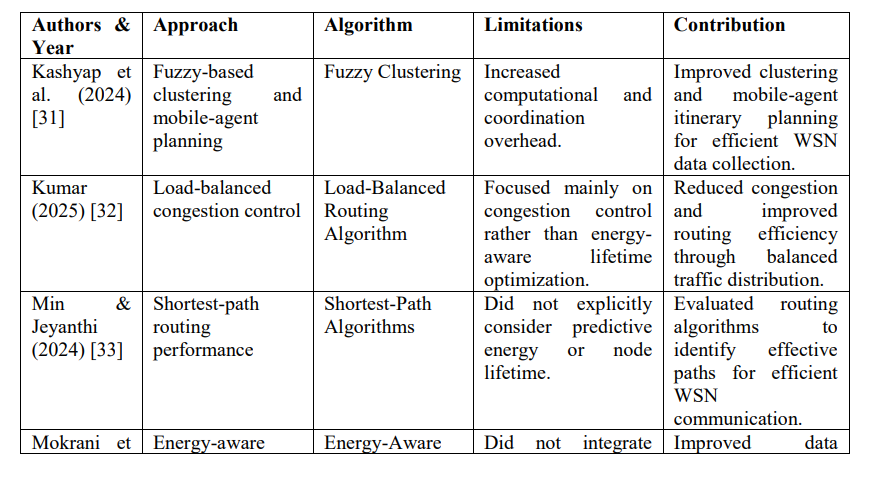
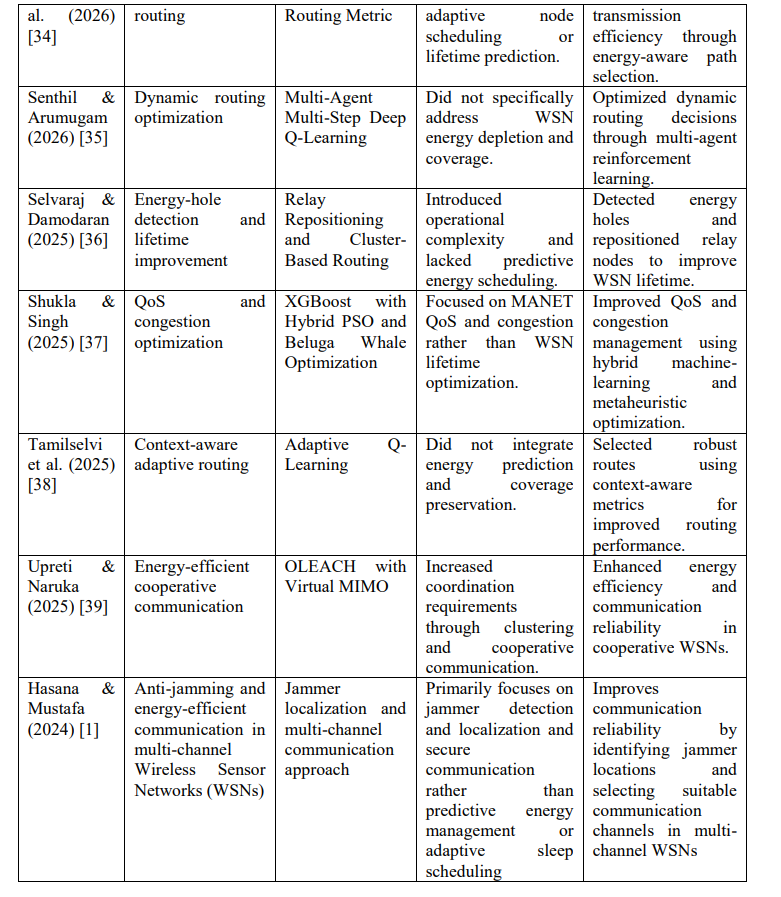
The above table 1,to evaluate the effectiveness of the PALEO algorithm, four widely-used WSN protocols have been selected as references, such as Low-Energy Adaptive Clustering Hierarchy (LEACH) [16], Hybrid Energy-Efficient Distributed Clustering (HEED) [39], Thresholdsensitive Energy Efficient Sensor Network protocol (TEEN) [40] and Distributed EnergyEfficient Clustering (DEEC) [17]. These Protocols have been widely-studied and are considered as energy-efficiency and lifetime maximization references.
- LEACH is one of the oldest hierarchical protocols that uses the rotation of cluster headsin a random manner to maintain energy utilization balance. This protocol is considered to be a good point of reference but it does not have any adaptability or energy prediction capabilities.
- The HEED protocol is an enhancement to the LEACH algorithm because it uses the residual energy and the cost of communication for cluster head selection. However, one major drawback of the algorithm is that it is static when making decisions and is not dynamic in relation to traffic and future energy consumption.
- The TEEN is a response-based and time-sensitive model and it reduces the power consumption since it moves the information after the specified threshold values are reached; however, it can result in loss of data and lack of flexibility in the continuous monitoring process. Conversely, the PALEO keeps on sensing and making energy management decisions.
- DEEC utilizes residual energy and average energy for selection of a cluster head in a heterogenous environment. Even though it is more adaptive compared to the LEACH and the HEED algorithms, it works on similar fundamentals as that of clustering. The DEEC does not usea sleep scheduling mechanism and neither does it predict future energy resources.
The comparison between PALEO and the above mentioned four schemes, it can establish the superiority of the above mentioned protocol from various perspectives including its network lifetime, energy consumption, packet delivery ratio, transmission delay and packet loss ratio. It is also used to show the scalability, adaptability and non-clustered efficiency of PALEO in homogeneous and heterogeneous WSN deployments.
3. PROPOSED METHODOLOGIES
This research proposes the PALEO algorithm that can optimize the lifetime of WSNs. This process starts with node placement and initialization and ends with the estimation of energy and adaptive node scheduling. This is then succeeded by coverage and connectivity test as well as routing through modification of the Dijkstra algorithm, which takes into account factors like energy, distance and congestion. Every round involves performing data transmission and energy update operations, where performance is evaluated to ensure that the process is stopped when the critical failure is experienced. The PALEO algorithm can be seen as a mechanism that is put in place to make sure that there is no abuse of the energy in the network.
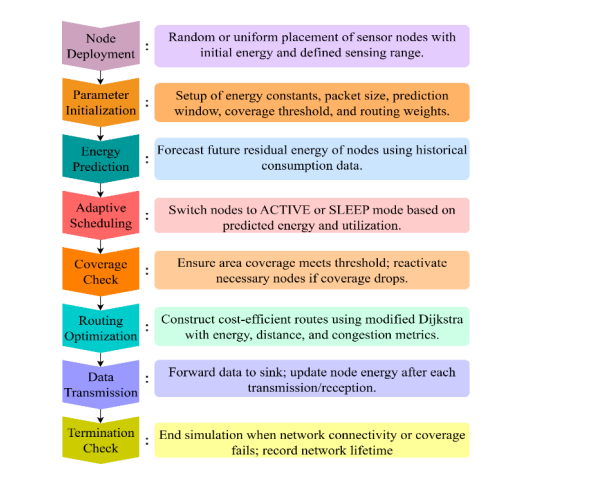
Figure 1: Overall Architecture
The PALEO framework at each level is depicted in figure 1 in order to explain the complete framework structure for creating optimal WSNs throughout the lifetime. The framework starts from the initial setup of sensor nodes as well as the establishment of parameters related to energy and routing. Then, in order to balance the coverage and maximize efficiency, the framework predicts the future energy of nodes and adapts the schedule planning. Covering Check is one of the ways used to ensure that sensing is achieved by using backup nodes where necessary. Modified Dijkstra algorithm is used which considers factors like energy, distance and congestion to route. Finally, it is a system in which information is passed in the system; energy levels and blocks are updated in case there is no connectivity or coverage. So, the life span of the network comes to an end.
3.1. Lifetime Optimization using Predictive Adaptive Lifetime Enhancement Optimization
It is also feasible to use WSN in the inaccessible area where the battery changing process does not apply. Lifetime optimization, whose objective is the maximum usage of the network despite the lack of any visible performance deterioration in the case of limited energy, is essential for the performance of energy harvesting systems. The algorithm proposed PALEO is predictive and adaptive in nature and thus extends the life cycle of WSNs. There is no energy wastage at all or due to early failure of the nodes as this algorithm predicts the energy consumption pattern and assigns nodes along the energy minimizing paths. This algorithm does not require any cluster head and therefore is scalable.
The PALEO approach utilizes the future energy status of sensor nodes, where low energy or underutilized sensor nodes are put to sleep mode adaptively, data is transferred via energy-aware routes and at the same time, the complete coverage of the monitored area is maintained. Rather than solving the limitations of existing energy-aware routing algorithms, PALEO addresses all the limitations includingenergy imbalances, static routing and early node failures by using future energy status prediction, adaptive decisions and scalable coverage-aware communication.
In the initial phase of PALEO implementation, 𝑁 sensor nodes are deployed either randomly or in a uniform grid pattern within a predefined two-dimensional monitoring area, typically of size 500×500 meters. Each node 𝑖 is initialized with a fixed energy level𝐸𝑖𝑛𝑖, along with parameters such as transmission range 𝑅𝑡and sensing range 𝑅𝑠 , which determine its communication and coverage capabilities, respectively. The coordinates (𝑥𝑖, 𝑦𝑖)of each node are assigned using a uniform distribution for random deployment, 𝑥𝑖 , 𝑦𝑖 ~𝑈(0, 𝐴), Where 𝐴 represents the length of the deployment area in meters. A sink node (base station) is placed at a fixed position, commonly at the center of the area, i.e., (𝐴/2,𝐴/2) or at the boundary depending on application requirements. This deployment sets the foundation for energy-aware communication and monitoring in the WSN.
Every sensor node 𝑖 is then placed after the placement phase and assigned its initial value of energy𝐸𝑖𝑛𝑖, which represents the amount of battery energy used by the node for sensing, transmission and reception processes. The node is then marked ACTIVE, implying that it is ready to participate in communications and sensing operations. Furthermore, each sensor node maintains a blank log representing its transmission history and energy consumption that can be updated during the simulation process for decision making purposes. The simulation environment is configured with the following parameters:
- 𝐸𝑒𝑙𝑒𝑐is electronic circuitry that consume energy for transmitting or receiving one bit (typically in nJ/bit).
- 𝜀𝑎𝑚𝑝is the power amplifier which use energy during transmission over a distance (typically in pJ/bit/mn).
- 𝑘 is packet size in bits, representing the size of data being transmitted per communication cycle.
- W is the prediction window size, denoting the number of previous rounds used for forecasting energy consumption (e.g., 5–10 rounds).
- 𝜃 refers to coverage threshold, indicating the minimum acceptable percentage of area coverage (e.g., 80%) to maintain sensing reliability.
- α,β,γ are the weighting factors in energy-aware routing cost function, which control the influence of residual energy, distance and traffic congestion respectively. The routing cost between two nodes 𝒊 and 𝒋 is computed as:

Where, 𝐸𝑖 is the current residual energy of node 𝑖 , 𝑑𝑖,𝑗 is the Euclidean distance between node 𝑖 and node𝑗, 𝜌𝑗 is the traffic load (number of forwarded packets) handled by node𝑗. Equation (1) is initialized with the parameters𝐶𝑖,𝑗 to form the foundation for energy prediction𝛾, sleep scheduling, routing and performance evaluation in the subsequent stages of the PALEO algorithm.
In energy prediction, each node performs the predictive analysis of its future energy level to proactively manage its operational status and routing role. The prediction is based on the energy consumption trend over a defined historical window𝑊, which includes the energy used in the last 𝑊 communication rounds. For each node𝑖, the predicted energy for the next round 𝑡 + 1 is calculated using a simple linear regression or exponential smoothing technique based on the past residual energy values. A basic energy prediction equation (2) is expressed as:

Where, 𝐸𝑟𝑒𝑠(𝑖) is the current residual energy of node𝑖 and 𝐶𝑖 (𝑊)is theaverage energy consumption per roundfor node 𝑖 over the last 𝑊 rounds. This predicted energy serves as a means to identify if the node falls into the category of those likely to deplete the energy prematurely and these nodes have been pre-planned to be put to sleep or not to participate in activities requiring high energy expenditure. This proactive method of energy prediction performs an essential part in the conservation of energy and also prevents the over utilization of low energy nodes. Based on the prediction made about the energy level from the existing step, the decision is taken by the Adaptive Sleep Scheduler (ASS) whether the node has to remain in the ACTIVE state or sleep state. The goal is to conserve energy by selectively deactivating low-energy or underutilized nodes without compromising the overall coverageand connectivity of the network. For each node 𝑖 and the threshold 𝜌𝑖 , if the predicted residual energy 𝐸𝑝𝑟𝑒𝑑(𝑖)(𝑡 + 1)falls below a predefined threshold𝐸𝑡ℎ or if the node’s recent transmission rate is below a traffic threshold 𝜌𝑚𝑖𝑛, then the
node is placed into sleep mode. The decision rule is defined as:

In order to make sure that the network coverage is not reduced, Coverage Monitor Module (CMM) is used in parallel for validating whether the active nodes provide coverage to the required area of sensing. When the coverage becomes lower than the threshold θ, then only the sleeping nodes covering important areas are activated. The adaptive scheme provided by the mechanism 𝑆𝑡𝑎𝑡𝑢𝑠𝑖 equation (3) ensures that only the node clusters that are the most energy efficient and have minimal functionality are kept alive by keeping it awake. This can ensure a reduction in energy waste and extend the life span of the network.
The formation of the Lifetime-Aware Routing Engine (LRE) happens when the ACTIVE nodes have been identified. This leads to the formation of efficient multi-hop routing paths formed dynamically from the source nodes to the sink node. The path selection process depends on the cost function formulated during the initialization (Equation (1)) with regards to three vital parameters. These include residual energy, distance between nodes and traffic load.
The algorithm considers all the paths that exist according to the cost function at each iteration and implements a variant of the Dijkstra algorithm for selecting the minimum cost path for the data to be transmitted. Nodes with low residual energy and high congestion are given negative weights in the path selection process. This energy sensitive process of routing ensures that the packets of information are routed through the most reliable path, which consumes least energy and use s achieve the goal of optimizing the lifetime of WSN.
After the determination of optimum energy aware routes, the process of transmission of data ensues in which, each active sensor node transmits its sensed data to the sink node along the multi-hop path thus determined. By first-order radio model, the energy utilization of each transmission is calculated and both the transmission and reception energy are taken into consideration. The energy that node i is required to use when sending a data packet of k bits to node j at distance d(i,j) is denoted by:

Equation (4) allows PALEO to track and deduct realistic energy usage𝑬𝒕𝒙(𝒊,𝒋) from nodes(𝒊,𝒋) during data forwarding and to influence the routing by penalizing long-distance 𝒅𝒊,𝒋𝒏 or highenergy-cost paths. Similarly, the energy consumed by node 𝒋 to receive the packet is:

Where,𝑬𝒆𝒍𝒆is the energy required to run the transmitter or receiver circuit, 𝜺𝒂𝒎𝒑 is the energy for the transmission amplifier and 𝒏 is the path loss exponent (typically 𝒏 = 𝟐for free space). Reception is also a source of energy drain, especially for nodes in routing path or those acting as relays. Equation (5) ensures that both the transmission and reception costs are accounted for updating the residual energy of each node. After each round, the residual energy 𝐸𝑟𝑥(𝑗)of every participating node is updated by subtracting the total energy spent for transmitting, receiving and processing. Nodes whose energy falls to zero or below are marked as DEADand excluded from future operations. This energy update ensures that the network accurately reflects current energy availability for the next round’s prediction, scheduling and routing, thereby maintaining the adaptive behavior and energy balance central to PALEO algorithm.
In each step of the data transmission and energy update, the algorithm known as PALEO executes a process to validate coverage and connectivity in order to ensure the effective operation of the network. Coverage Monitor Module checks whether the active sensors collectively provide at least the minimum area of coverage, θ. The coverage metric depends on the sum of all sensing ranges R_s of active nodes compared with the total area, thus ensuring that there are no regions of interest remaining without sensing. Simultaneously, the algorithm confirms the network connectivity through one-to-one communication with each path leading to the sink node.
The coverage level must go below 0 for the node to become disconnected from its neighboring nodes. Therefore, when there are no more available nodes, the algorithm tries to awaken other nodes within the vicinity that have coverage capability or trace the paths back. If nothing else works, then the simulation ends and the network lifetime of the round is recorded. This way, it uses to maintain the functioning of the network and make it reliable as per PALEO’s objective of smart network lifetime improvement.
The final stage of the PALEO algorithm is the testing of the WSN for checking if the system has entered its terminable mode that marks the end of its operational life cycle. Simulation/ deployment would be stopped on account of the following conditions being met:
- Coverage of the network does not meet the specified threshold value θ, implying that the important regions are no more properly covered.
- Nodes do not have connectivity with the sink, which hinders data transfer.
- There is a predefined percentage of nodes that become DEAD because of energy depletion.
- The simulation is set in such a way that the number of rounds run exceeds a maximum value.
The moment any one of the above criteria is met, the algorithm can set the last round, t, as the network lifetime and terminate the simulation process. The objective of doing so is to ensure that the analysis of PALEO accounts for real-life limitations and allows for comparison with the other schemes.
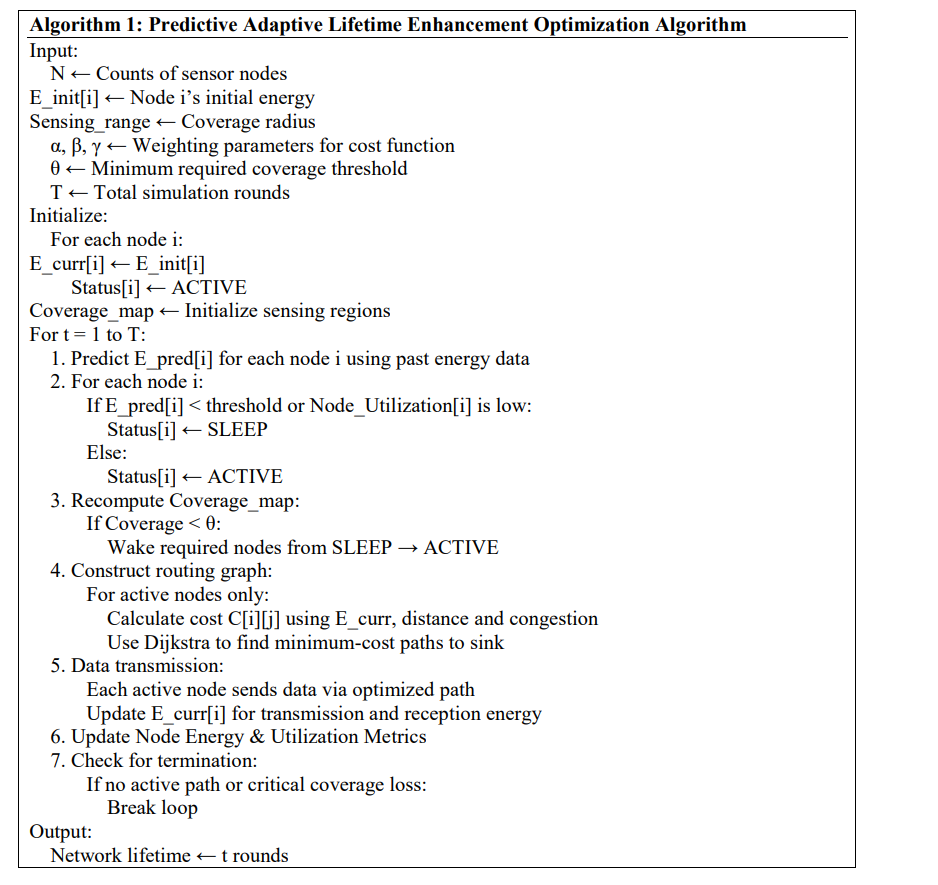
Algorithm 1 describes the execution of the PALEO framework for lifetime optimization in WSNs. The algorithm first initializes all the nodes with energy and activation state. Then, it runs the following process for every round of simulation. In each round, it decides whether to activate a node or let it remain in sleep mode based on its future energy value. The coverage can be kept track of to maintain the reliable detection and routing can be done by taking into account energy based cost function. The best path for data transfer can be determined and energy of the node can be updated. The process terminates on those occasions when the network is out of coverage or connectivity and is the number of rounds executed counted and equals the number of charges in the network.
5. RESULTS AND DISCUSSION
The performance of the described and explained PALEO algorithm is examined in accordance to the vast range of simulations in the presented work principally by contrasting it to four other WSN protocols namely LEACH, HEED, TEEN and DEEC. Robustness and scalability are evaluated by the experiments being performed under different packet sizes and packet numbers at different network settings. Such key performance indicators are Packet Delivery Ratio (PDR), Packet Loss Rate, Transmission Delay, Energy Consumption and Network Lifetime. The simulations are performed with a non-arbitral fixed size of 500 m x 500 m.On which, the sensor nodes are randomly deployed and the central sink placed in the middle of the area. Initially, all the nodes are equipped with the same amount of energy and during communication.There is the energy-based transmission model. The outcomes illuminate the way PALEO increases the network stability and lifetime with varying data traffic.
Table 2: Simulation Parameter Lists
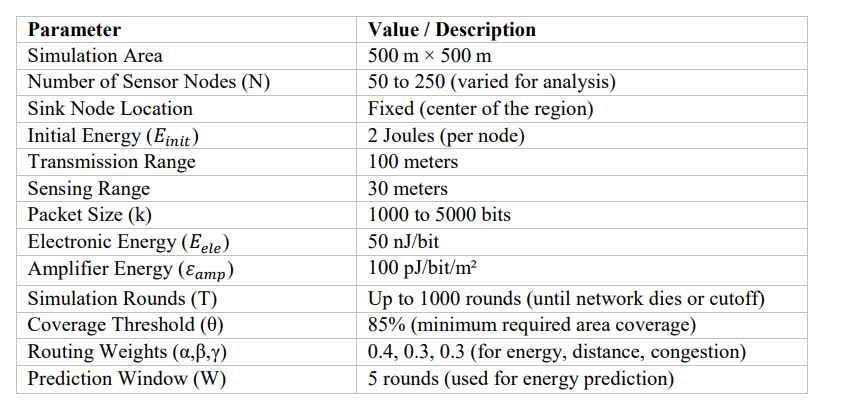
The parameters of the simulation as presented in table 2 are meant to depict the actual situation of a WSN. The node densities are varied and a 500 m x 500 m area is tested to achieve scalability and each sensor node is initialized at 2J of energy. To test the energy efficiency, the communication parameters related to the energy namely electronic energy and the amplifier energyare assigned standard values. The packet size and simulation rounds are varied to analyse the performance under different traffic loads. Routing weights and a prediction window are included to support PALEO’s adaptive and lifetime-aware mechanisms.
Table 3: Comparison Table on Throughput
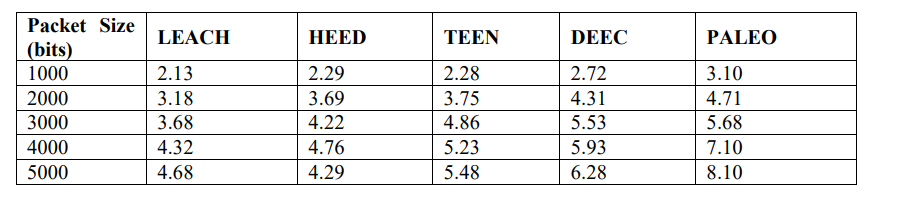
Table 3 shows that as packet size increases, the packet loss rate rises for all protocols due to higher transmission overhead and congestion.The existing protocols such as Low-Energy Adaptive Clustering Hierarchy (LEACH) and HEED have moderate losses, whereas energyefficient routing is the main reason for the improvement in the performance of TEEN and DEEC. In order to support lifetime enhancement and energy-aware adaptive routing, PALEO has slightly higher loss at larger packet size. Nevertheless, the overall network performance and reliability are still strong.
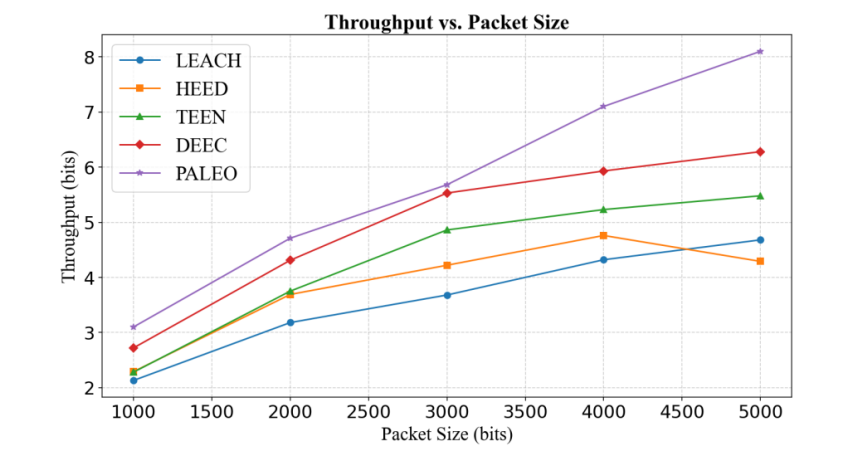
Figure 2: Throughput Comparison Chart
Figure 2 shows the comparison of Packet Loss Rate for different protocols as LEACH, Hybrid Energy-Efficient Distributed (HEED), TEEN, DEEC and proposed PALEO. Here, x-axis represents the packet size and y-axis as the throughput values in bits.
Table 4: Comparison Table on Energy
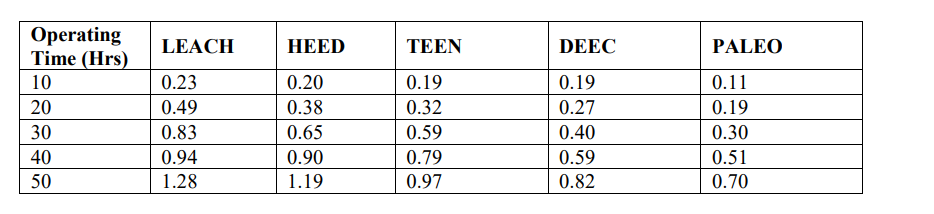
Table 4 highlights the total energy consumption over time. LEACH consumes the most due to frequent re-clustering. HEED and Threshold-sensitive Energy Efficient Sensor Network (TEEN) improve slightly but still consume more as runtime increases. DEEC reduces energy drain via efficient clustering. PALEO consumes the least energy by utilizing sleep scheduling, energy prediction and adaptive routing to significantly extend the network life
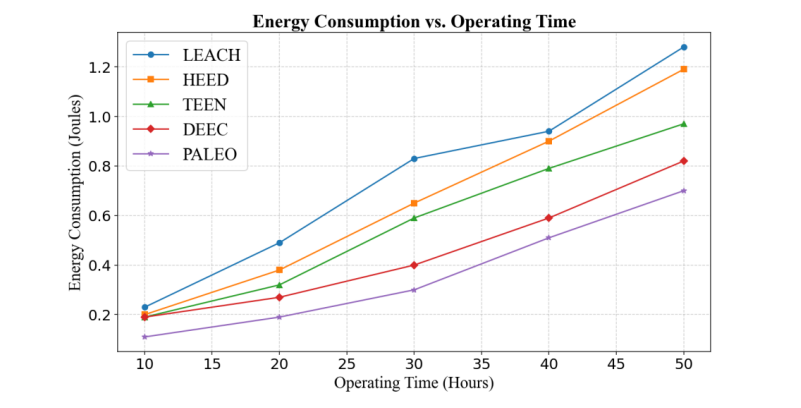
Figure 3: Energy Comparison Chart
Figure 3 illustrates the energy consumption comparison using LEACH, HEED, TEEN, Distributed Energy-Efficient Clustering (DEEC) and the proposed PALEO. On this chart, x-axis is the operating times, y-axis is the energy displayed in joules.
Table 5: Comparison Table on Transmission Delay
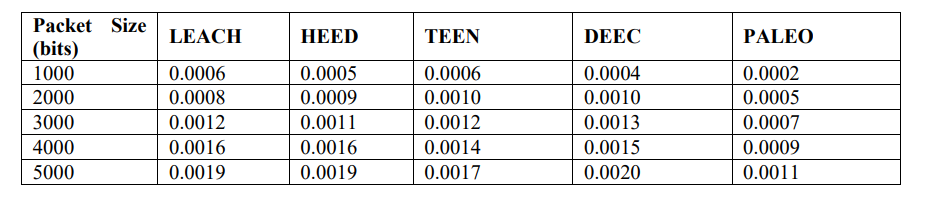
Table 5 captures the transmission delay; the time taken for a packet to reach the sink. Existing protocols exhibit rising delay as packet size increases due to routing overhead and congestion. PALEO consistently has the lowest delay,regarding its dynamic routing and predictive traffic control, ensuring faster data delivery even with larger packets.
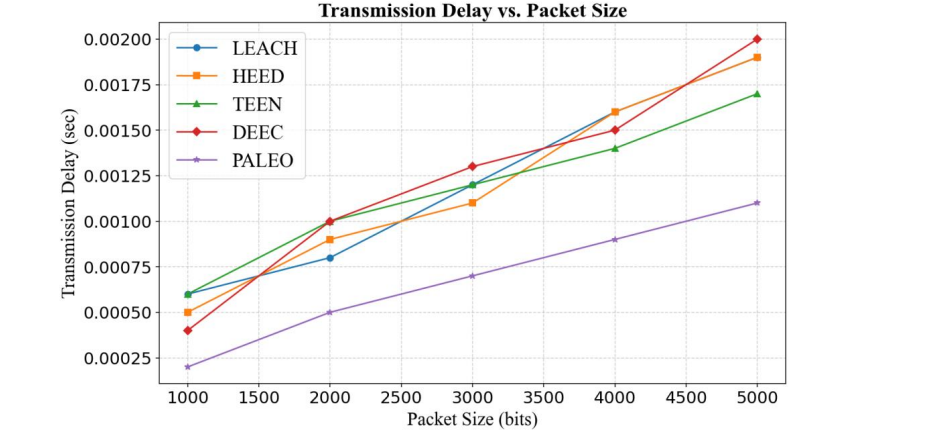
Figure 4: Delay Comparison Chart
Figure 4 illustrates the transmission delay comparison using LEACH, HEED, TEEN, DEEC andthe proposed PALEO. Here, x-axis shows the packet size, y-axis represents the delay.
Table 6: Comparison Table on Packet Delivery Ratio
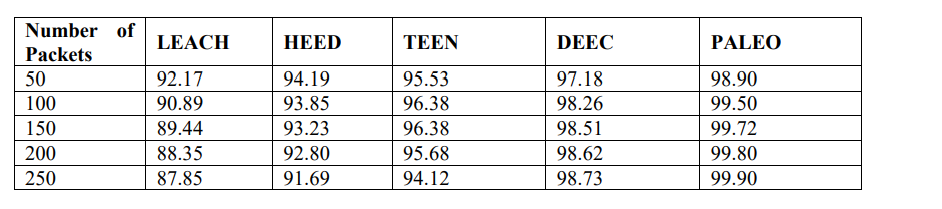
Table 6 shows the PDR, which indicates the successful delivery of packets. Existing protocols like LEACH and HEED exhibit a decreasing trend as packet load increases due to congestion and energy depletion. DEEC maintains the higher stability through energy-aware routing. PALEO consistently outperforms all methods, in spite of its predictive energy model and adaptive path
selection, achieving near-perfect delivery even at high loads.
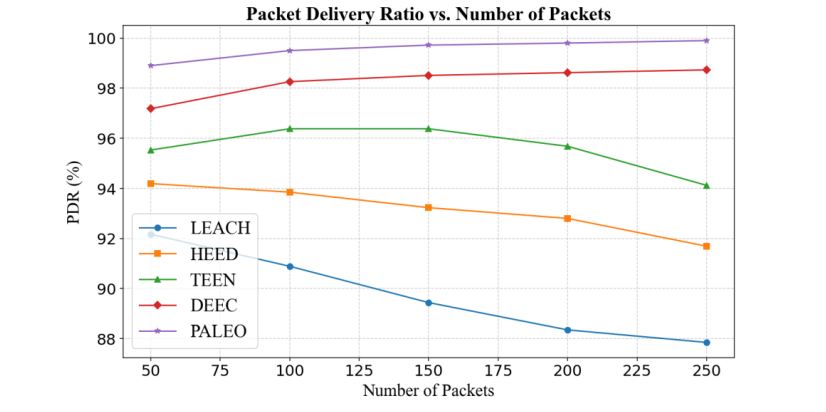
Figure 5: PDR Comparison Chart
Figure 5 illustrates the PDR comparison using LEACH, HEED, TEEN, DEEC and the proposed PALEO. In the above chart, the x-axis displays the number of packets and the number of PDRs is explained by y-axis in percentage.
Table 7: Comparison Table on Packet Loss Rate
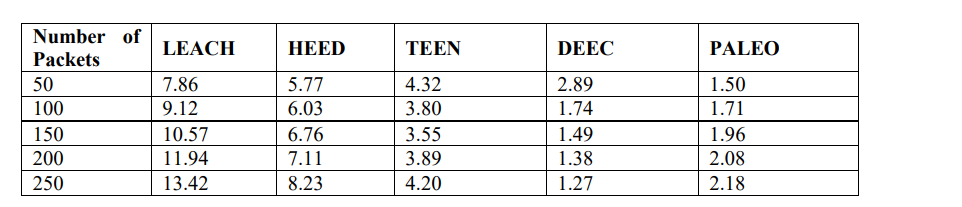
Table 7 measures the packet loss rate, the inverse of delivery efficiency. LEACH and HEED show the rising loss rates as the number of packets increases. TEEN performs better due to threshold-based transmission. DEEC minimizes loss through balanced energy routing. Although PALEO shows a slight increase in loss, it maintains lower rates than most others, balancing coverage and energy optimally in dense traffic.
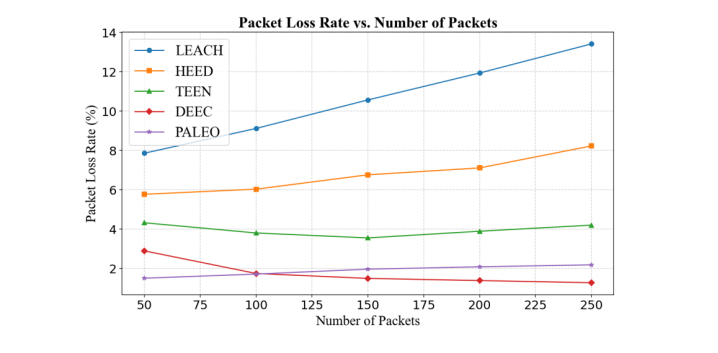
Figure 6: Packet Loss Rate Comparison Chart
Figure 6 presents a comparison of Packet Loss Rate with LEACH, HEED, TEEN, DEEC and the proposed PALEO.In this plot, the number of packets is indicated by x-axis and the Packet Loss Rate in percentage is shown by y-axis.
Table 8: Comparing Network Lifetime under Various Densities of Nodes
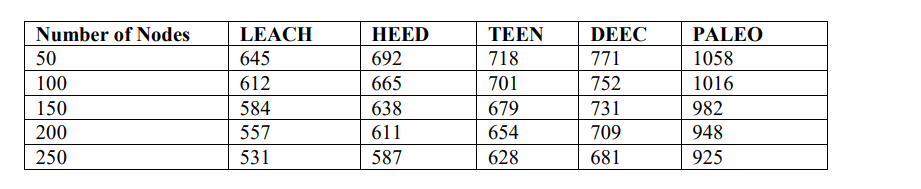
Table 8 shows a comparison of network lifetimes obtained using varying node densities. With an increase in the density of the deployed sensor nodes, all three schemes show decreased lifetimes due to increased overheads and energy consumption. Nevertheless, the PALEO scheme is able to obtain longer lifetimes compared to the other schemes because of the advantages it provides.
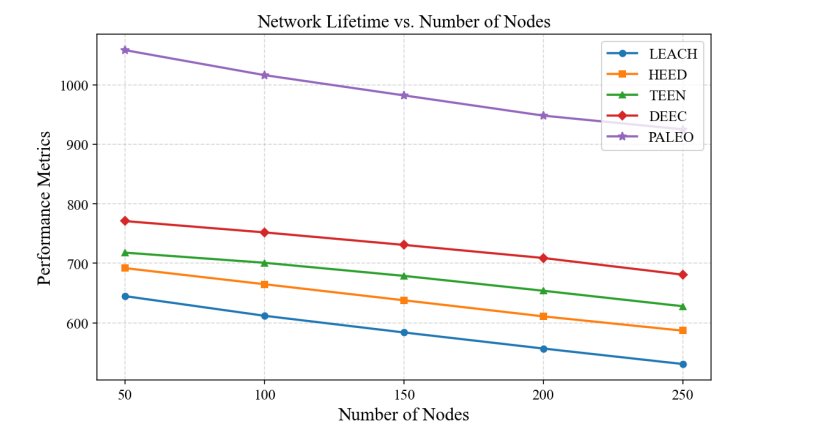
Figure 7: Graph of Network Lifetime for Various Protocols
The graph shown in Figure 7 shows the network lifetime analysis of LEACH, HEED, TEEN, DEEC and the proposed protocol PALEO for various node densities. Here, the x-axis denotes the node density whereas the y-axis represents network lifetime in simulation rounds.
Table 9: Active Sleep Scheduling Efficiency
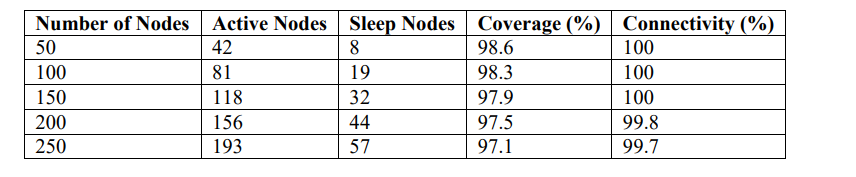
The above table 9 is performance of the adaptive sleep scheduling algorithm used in PALEO is mentioned the above table. With an increase in the network size, there can be an increased number of nodes that can be put into sleep mode in order to conserve energy while still providing high network coverage and connectivity. It can be seen from the table below that the energy conservation and communication needs have been achieved through PALEO.
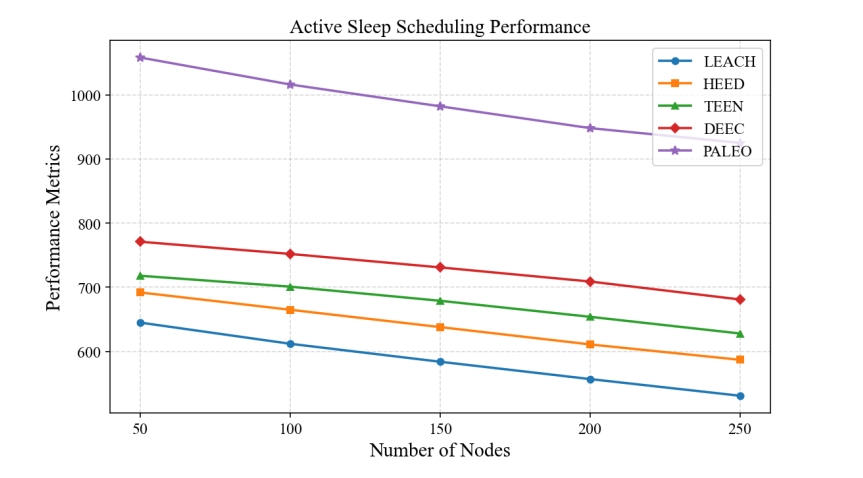
Figure 8: Active Sleep Scheduling Efficiency Graph
This figure 8 shows the Active Sleep Scheduling efficiency of the proposed PALEO framework for different network sizes. The X-axis denotes the number of sensor nodes, whereas the Y-axis denotes the active nodes, sleep nodes, coverage percentage and connectivity percentage.
6. CONCLUSION
In this research, a new proposed algorithm called PALEO is introduced for the resolution of the major problem of efficient and reliable communication in WSNs. PALEO is different from conventional clustering techniques since it includes three main components which are prediction of energy consumption, node scheduling and lifetime-aware routing. PALEO provides remarkable results in terms of prolonging the life time of the network and increasing its reliability. A large number of simulations under various conditions and loads on networks have been performed and PALEO has been compared with the recent protocols like LEACH, HEED, TEEN and DEEC. It is clearly evident from the results that the performance of PALEO is superior to the baseline approaches with regard to PDR (99.9%), reduced packet loss, reduced energy consumption and increased network lifetime (920 rounds). In addition to this, a real-world application based on the implementation of smart agriculture proved that PALEO is feasible in energy-limited and coverage-dependent conditions. PALEO shows good scalability because it performs equally well whether large packets and high node densities are used or just the WSN alone. Future research would involve incorporating mobility in the PALEO protocol and implementing PALEO in heterogeneous sensor networks.
CONFLICTS OF INTEREST
The authors declare that it have no relevant financial or non-financial interests to disclose.
REFERENCES
[1] Dattatraya, K. N., & Rao, K. R. (2022). Hybrid based cluster head selection for maximizing network lifetime and energy efficiency in WSN. Journal of King Saud University – Computer and Information Sciences, 34(3), 716–726. https://doi.org/10.1016/j.jksuci.2019.04.003
[2] Vijayalakshmi, K., Maheshwari, A., Saravanan, K., Vidyasagar, S., Kalyanasundaram, V.,Sattianadan, D., & Narayanamoorthi, R. (2025). A novel network lifetime maximization technique in WSN using energy efficient algorithms. Scientific Reports, 15(1), 10644. https://doi.org/10.1038/s41598-025-94751-2
[3] Mukase, S., Xia, K., & Umar, A. (2021). Optimal base station location for network lifetime maximization in wireless sensor network. Electronics, 10(22), 2760. https://doi.org/10.3390/electronics10222760
[4] Habib, M. A., Saha, S., Razzaque, M. A., Mamun-Or-Rashid, M., Hassan, M. M., Pace, P., & Fortino, G. (2020). Lifetime maximization of sensor networks through optimal data collection scheduling of mobile sink. IEEE Access, 8, 163878–163893. https://doi.org/10.1109/ACCESS.2020.3021623
[5] Yu, C. M., Tala’t, M., Chiu, C. H., & Huang, C. Y. (2019). Joint balanced routing and energy harvesting strategy for maximizing network lifetime in WSNs. Energies, 12(12), 2336. https://doi.org/10.3390/en12122336
[6] Çorapsız, M. F. (2024). Lifetime maximization of wireless sensor networks while ensuring intruder detection. Soft Computing, 28(5), 4197–4215. https://doi.org/10.1007/s00500-024-09692-1
[7] Rawat, P., Chauhan, S., & Priyadarshi, R. (2021). A novel heterogeneous clustering protocol for lifetime maximization of wireless sensor network. Wireless Personal Communications, 117, 825–841. https://doi.org/10.1007/s11277-020-07898-8
[8] Chen, Z. G., Lin, Y., Gong, Y. J., Zhan, Z. H., & Zhang, J. (2021). Maximizing lifetime of rangeadjustable wireless sensor networks: A neighborhood-based estimation of distribution algorithm. IEEE Transactions on Cybernetics, 51(11), 5433–5444. https://doi.org/10.1109/TCYB.2020.2977858
[9] Khudor, B. A. A. Q., Hussein, D. M., Kheerallah, Y. A., Alkenani, J., & Alshawi, I. S. (2023). Lifetime maximization using grey wolf optimization routing protocol with statistical technique in WSNs. Informatica, 47(5). https://doi.org/10.31449/inf.v47i5.4601
[10] Jothikumar, C., Ramana, K., Chakravarthy, V. D., Singh, S., & Ra, I. H. (2021). An efficient routing approach to maximize the lifetime of IoT-based wireless sensor networks in 5G and beyond. Mobile Information Systems, 2021, 9160516. https://doi.org/10.1155/2021/9160516
[11] Rao, A. N., Naik, B. R., & Devi, L. N. (2021). An efficient coverage and maximization of network lifetime in wireless sensor networks through metaheuristics. International Journal of Informatics and Communication Technology, 10(3), 159–170. https://doi.org/10.11591/ijict.v10i3.pp159-170
[12] Savitha, S., Lingareddy, S. C., & Chitnis, S. (2020). Energy efficient clustering and routing optimization model for maximizing lifetime of wireless sensor network. International Journal of Electrical and Computer Engineering, 10(5), 4798–4808.
https://doi.org/10.11591/ijece.v10i5.pp4798-4808
[13] Bouamama, S., Blum, C., & Pinacho-Davidson, P. (2022). A population-based iterated greedy algorithm for maximizing sensor network lifetime. Sensors, 22(5), 1804. https://doi.org/10.3390/s22051804
[14] Li, J., Luo, Z., & Xiao, J. (2020). A hybrid genetic algorithm with bidirectional mutation for maximizing lifetime of heterogeneous wireless sensor networks. IEEE Access, 8, 72261–72274. https://doi.org/10.1109/ACCESS.2020.2988368
[15] Shyamsundar, R., & Harshavarthan, M. (2025). A cluster based routing for maximizing the lifetime of underwater wireless sensor network using gravitational search algorithm. Results in Engineering, 25, 104470. https://doi.org/10.1016/j.rineng.2025.104470
[16] Gamal, M., Mekky, N. E., Soliman, H. H., & Hikal, N. A. (2022). Enhancing the lifetime of wireless sensor networks using fuzzy logic LEACH technique-based particle swarm optimization. IEEE Access, 10, 36935–36948. https://doi.org/10.1109/ACCESS.2022.3163254
[17] El-Sayed, H. H., & Hashem, Z. M. (2023). Comparison of the new version of DEEC protocol to extend WSN lifetime. EURASIP Journal on Wireless Communications and Networking, 2023, 56.https://doi.org/10.1186/s13638-023-02265-0
[18] Abujassar, R. S. (2024). Enhancing traffic routing inside a network through IoT technology & network clustering by selecting smart leader nodes. International Journal of Computer Networks and Communications, 16(2). https://doi.org/10.5121/ijcnc.2024.16201
[19] Alamelu, R. M., et al. (2024). ENIAO: Energy aware faulty node re-placement integrated with duty cycling and improved harmony search based clustering through adaptive fish school search routing for WSN optimization. International Journal of Computer Networks and Communications, 16(5). https://doi.org/10.5121/ijcnc.2024.16506
[20] Alauthman, A. (2025). Dynamic low-power traffic pattern for energy-constrained wireless sensor networks. International Journal of Computer Networks and Communications, 17(5). https://doi.org/10.5121/ijcnc.2025.17504
[21] Alauthman, A., & Wan Nik, W. N. W. (2025). A novel cluster head selection algorithm to maximize wireless sensor network lifespan. International Journal of Computer Networks and Communications, 17(1). https://doi.org/10.5121/ijcnc.2025.17108
[22] Abuashour, A. (2026). Efficient energy-based cluster head election and routing protocol in WSNs. International Journal of Computer Networks and Communications, 18(2). https://doi.org/10.5121/ijcnc.2026.18204
[23] Binh, L. H., et al. (2024). IRLR: An improved reinforcement learning-based routing algorithm for wireless mesh networks. International Journal of Computer Networks and Communications, 16(4).https://doi.org/10.5121/ijcnc.2024.16408
[24] Boudi, R., et al. (2025). Delay and throughput aware cross-layer TDMA approach in WSN-based IoT networks. International Journal of Computer Networks and Communications, 17(2). https://doi.org/10.5121/ijcnc.2025.17205
[25] Boukhobza, M. A., et al. (2025). A novel stable path selection algorithm for enhancing QoS and network lifetime in RPL-Contiki-based IoT networks. International Journal of Computer Networks and Communications, 17(1). https://doi.org/10.5121/ijcnc.2025.17103
[26] Chu Hai, H. T., et al. (2024). A topology control algorithm taking into account energy and quality of transmission for software-defined wireless sensor network. International Journal of Computer Networks and Communications, 16(2). https://doi.org/10.5121/ijcnc.2024.16207
[27] Darshan, B. D., & Prashanth, C. R. (2024). EECRPSID: Energy-efficient cluster-based routing protocol with a secure intrusion detection for WSN-assisted IoT. International Journal of Computer Networks and Communications, 16(3). https://doi.org/10.5121/ijcnc.2024.16307
[28] Dey, B., et al. (2025). Multimodal QoS aware load balanced clustering in 5G-enabled IoT sensor network. International Journal of Computer Networks and Communications, 17(6). https://doi.org/10.5121/ijcnc.2025.17602
[29] Harakannanavar, S. S., et al. (2026). RERESDA: An energy-efficient redundancy elimination and secure data aggregation framework for wireless sensor networks. International Journal of Computer Networks and Communications, 18(2). https://doi.org/10.5121/ijcnc.2026.18207
[30] Hiep, L. H., et al. (2026). RLIOT: Reinforcement learning-based network resource optimization using IoT sensor data. International Journal of Computer Networks and Communications, 18(4). https://doi.org/10.5121/ijcnc.2026.18401
[31] Kashyap, N., et al. (2024). Fuzzy-based clustering of wireless sensor networks for multiple mobile agent itinerary planning. International Journal of Computer Networks and Communications, 16(6). https://doi.org/10.5121/ijcnc.2024.16604
[32] Kumar, J. (2025). Enhancing congestion control using a load-balanced routing algorithm for distributed networks. International Journal of Computer Networks and Communications, 17(1). https://doi.org/10.5121/ijcnc.2025.17102
[33] Min, K. T., & Jeyanthi, N. (2024). Routing performances in wireless sensor networks: Determining shortest path algorithms effectiveness. International Journal of Computer Networks and Communications, 16(6). https://doi.org/10.5121/ijcnc.2024.16606
[34] Mokrani, S., et al. (2026). Energy aware routing metric for efficient data transmission in low-power and lossy networks. International Journal of Computer Networks and Communications, 18(2).https://doi.org/10.5121/ijcnc.2026.18205
[35] Senthil, N., & Arumugam, S. (2026). Optimizing dynamic routing in 6G networks using a multiagent multi-step deep Q-learning algorithm. International Journal of Computer Networks and Communications, 18(3).https://doi.org/10.5121/ijcnc.2026.18302
[36] Selvaraj, S., & Damodaran, A. (2025). An energy hole detection and relay repositioning in cluster based routing protocol for improving lifetime of WSN. International Journal of Computer Networks and Communications, 17(4). https://doi.org/10.5121/ijcnc.2025.17404
[37] Shukla, D., & Singh, R. (2025a). Optimizing QoS and congestion in MANETs using XGBoost with hybrid PSO and Beluga Whale strategies. International Journal of Computer Networks and Communications, 17(5). https://doi.org/10.5121/ijcnc.2025.17505
[38] Tamilselvi, P., et al. (2025). Adaptive Q-learning-based routing with context-aware metrics for robust MANET routing (AQLR). International Journal of Computer Networks and Communications, 17(5). https://doi.org/10.5121/ijcnc.2025.17506
[39] Upreti, S., & Naruka, M. S. (2025). Energy efficient virtual MIMO communication designed for cluster based on cooperative WSN using OLEACH protocol. International Journal of Computer Networks and Communications, 17(3). https://doi.org/10.5121/ijcnc.2025.17305
[40] [39] Hasana, M., & Mustafa, H. A. (2024). An anti-jamming technique by jammer localization for multi-channel wireless sensor networks. International Journal of Computer Networks & Communications, 16(4), 87–107.https://doi.org/10.5121/ijcnc.2024.16405


