
IJNSA 03
ADAPTIVE POST-QUANTUM ZERO TRUST FRAMEWORK FOR CLOUD INFRASTRUCTURE: A
POLICY-BASED CRYPTO-AGILITY MODEL AND BENCHMARK-DRIVEN PERFORMANCE EVALUATION
Ali Rasool Bakhsh
Nour Internet Company for Telecommunications and Information Technology, Riyadh,
Saudi Arabia
ABSTRACT
The emergence of quantum computing poses a significant threat to the cryptographic foundations that secure modern cloud infrastructures. Existing deployments of Zero Trust Architecture (ZTA) are largely built on classical cryptographic techniques such as the RSA algorithm and elliptic curve cryptography, which are vulnerable to future quantum attacks. Moreover, current studies offer limited guidance on how PQC can be integrated into cloud-native Zero Trust environments while guaranteeing operational efficiency and addressing adaptive security needs. The present study introduces an Adaptive Post Quantum Zero Trust (Adaptive PQC-ZT) Framework by combining the NIST recommended post quantum cryptographic algorithms with a policy based Crypto-Agility Engine for algorithm dynamic selection based upon Security Sensitivity, Algorithm Characteristics, and Latency. The framework was evaluated using a publicly available PQC benchmark dataset containing 37,004 key encapsulation mechanism (KEM) records and 71,456 digital signature records. The analysis examined latency, communication overhead, security levels, and workload suitability for ML-KEM and ML-DSA algorithm families across representative cloud deployment scenarios. The results demonstrate that ML-KEM algorithms provide quantum-resistant key establishment with sub-millisecond latency, while ML-DSA algorithms significantly outperform SPHINCS+ variants in execution efficiency and communication overhead. The proposed Crypto-Agility Engine helps match cryptographic configuration with the needs of different workloads. This allows web applications to run with low latency, while also giving stronger protection to high-security systems such as financial databases. The proposed framework contributes a unified cloud-native security model that blends Zero Trust principles, post-quantum cryptography, benchmark-driven evaluation, and adaptive crypto-agility. This shows practical migration to quantum-safe cloud infrastructures can be done with manageable performance hits. Organizations get a solid path to boost their long-term defense against future quantum threats.
KEYWORDS
Post-Quantum Cryptography, Zero Trust Architecture, Cloud Security, Crypto-Agility, ML-KEM, ML-DSA, Quantum-Safe Networking, Cloud Infrastructure Security, Benchmark Analysis, Quantum-Resilient Computing
1. INTRODUCTION
The rapid evolution of quantum computinghas raised a fundamental threat to cryptographic security underpinning today’s cloud computing infrastructures. Modern public-key cryptographic systems such as Rivest–Shamir–Adleman (RSA) and Elliptic Curve Cryptography (ECC) are based on so-called intractable problems, namely computational problems that are believed to be too difficult for classical computers. However, Shor’s algorithm showed that an efficient quantum computer could break the integer factorization and discrete log problems in polynomial time, which would render many commonly used asymmetric cryptographic systems insecure (Shor, 1997). Simultaneously Grover’s algorithm is a quadratic speedup for brute-force attacks on symmetric cryptographic primitives, decreasing the effective security parameter of the traditional encryption methods (Grover, 1996). While such large-scale fault-tolerant quantum computers that can crack the existing cryptographic systems are not yet practical, it is no longer just a possibility. Adversaries can already capture and store encrypted communications today with the intention of decrypting them in the future when quantum capabilities become available. This strategy, commonly known as Harvest Now, Decrypt Later (HNDL), poses a significant risk to sensitive information requiring long-term confidentiality, including financial records, healthcare data, government communications, and intellectual property (Campagna et al., 2015; Mosca, 2018).
The cloud environment in particular is very vulnerable to these new risks, as it heavily depends on classical cryptographic techniques for security, user and service authentication, and trust enforcement on distributed infrastructure. Cryptographic algorithms are used in transport layer security (TLS) and certificate-based authentication, mutual TLS (mTLS), identity federation
protocols, application programming interfaces (APIs), and service mesh architectures, all of which may be vulnerable in a post-quantum era (Sikeridis et al., 2020). Any compromise of these mechanisms would not only impact external communication, but could also impact internal trust relationships across cloud infrastructures, such as east-west traffic between microservices, orchestration platforms, and control-plane components. As a result, cloud operators are tasked with ensuring operational efficiency while at the same time investing in getting ready for quantum-resistant security architectures.
In addition to cryptographic issues, cloud infrastructures have a particular set of security problems that make it difficult to implement effective protection measures. Multi-tenancy involves sharing resources, including physical resources, between multiple organizations, which can lead to isolation failures, side-channel attacks, privilege escalation incidents (Saxena & Rekha, 2023). Network boundaries and communication paths are continually changing, whether in the form of dynamic resource allocation, elastic scaling, or containerized workloads, and static trust assumptions are becoming less effective with these shifts (Creane & Gupta, 2022). In addition, with the rise of cloud-native apps providing massive amounts of east-west traffic between internal services, there are a ton of opportunities for lateral movement if one workload is compromised (Noormohammadpour & Raghavendra, 2018). Traditional perimeter-based security models that rely on the idea that after an external threat is filtered off the internal network can be trusted are therefore no longer adequate in today’s cloud environment where workloads, users, devices, and services interact across highly distributed infrastructures.
To address these challenges, Zero Trust Architecture (ZTA) has emerged as a dominant security paradigm for modern enterprise and cloud environments. Formalized in NIST Special Publication 800-207, Zero Trust is founded on the principle of “never trust, always verify,” eliminating implicit trust based on network location or ownership (Rose et al., 2020). Instead, every access request is continuously evaluated according to contextual factors such as user identity, device posture, workload characteristics, and behavioral indicators. Core concepts of Zero Trust are continuous authentication and authorization, least-privilege access control, micro-segmentation and assuming that breaches may already exist within the environment (Kindervag, 2010). These ideas have also been demonstrated in practice, for example, BeyondCorp by Google, which aims to move the security enforcement away from network boundaries and towards identity-centric policy controls (Ward & Beyer, 2014). Although Zero Trust is used in practice, the actual deployments are reliant on traditional cryptographic techniques such as RSA, ECC, ECDHE and traditional certificate infrastructures. As a result, existing Zero Trust deployments remain vulnerable to future quantum-enabled attacks even though their architectural principles remain valid.
Given these risks, substantial research has been put into developing and standardizing postquantum cryptography (PQC). The National Institute of Standards and Technology (NIST) has adopted ML-KEM for key encapsulation, ML-DSA for digital signatures, and SLH-DSA as a stateless hash-based signature scheme (NIST, 2024a, 2024b, 2024c), respectively, through an extensive multi-year evaluation process. The algorithms are developed to be resistant to both classical and quantum attacks, and are suitable for implementation in existing communication systems. The industry uptake has also been accelerating via Open Quantum Safe (liboqs), hybrid TLS implementations and large-scale testing by cloud providers and network operators such as Cloudflare. These advancements show that post-quantum migration is possible but also reveal some difficulties with respect to computational overhead, interoperability, deployment complexity, and selecting algorithms for various workload environments. Furthermore, the shift from classical cryptographic infrastructures to quantum-resistant cryptographic systems demands crypto-agility, that is, the capability to easily switch, upgrade, and support several cryptographic algorithms as standards shift and security needs vary (Barker et al., 2021). Crypto-agility is gaining momentum as an essential demand for organizations ready to transition to post-quantum security, especially in cloud settings with various workloads and requirements.
Recent studies have explored various aspects of integrating PQC into cloud and network security architectures. Research on PQC-enabled TLS has demonstrated the operational feasibility of quantum-resistant key exchange and authentication mechanisms (Paquin et al., 2020). Other studies have proposed Zero Trust extensions for edge computing environments and federated trust frameworks for distributed systems (Autry et al., 2024; Hussain et al., 2024). However, several important limitations remain. First, most existing approaches evaluate PQC algorithms in isolation rather than integrating them into comprehensive Zero Trust architectures for cloud infrastructures. Second, current studies rarely consider workload-aware algorithm selection despite the significant performance differences among PQC schemes. Third, limited research has examined crypto-agility mechanisms capable of dynamically selecting cryptographic algorithms according to operational requirements, risk levels, and latency constraints. Finally, benchmarkdriven evaluations that connect PQC performance characteristics with practical cloud deployment scenarios remain relatively scarce.
These limitations reveal a significant research gap at the intersection of post-quantum cryptography, Zero Trust networking, and cloud infrastructure security. Existing frameworks generally provide static cryptographic configurations, lack workload-sensitive adaptation mechanisms, and offer limited guidance for organizations transitioning from classical cryptography toward quantum-resistant environments. Consequently, there is a need for a cloudnative framework that combines Zero Trust principles with post-quantum cryptographic protection while enabling practical and policy-driven crypto-agility.
To address these challenges, this study proposes an Adaptive Post-Quantum Zero Trust Framework for Cloud Infrastructure that incorporates a policy-based Crypto-Agility Engine capable of selecting appropriate cryptographic configurations according to workload characteristics, security requirements, and operational constraints. The framework integrates Zero Trust principles with NIST-standardized post-quantum algorithms while maintaining flexibility for hybrid migration scenarios.
The primary contributions of this paper are summarized as follows:
- Adaptive Post-Quantum Zero Trust Framework: A cloud-oriented Zero Trust architecture incorporating a policy-driven Crypto-Agility Engine that supports dynamic selection of post-quantum cryptographic mechanisms.
- Workload-Aware Crypto-Agility Model: A structured decision model that aligns workload characteristics, security sensitivity, and latency requirements with suitable PQC algorithm configurations.
- Benchmark-Driven Performance Evaluation: A quantitative assessment based on publicly available PQC benchmark datasets, supported by findings from liboqs benchmark studies and NIST performance documentation, evaluating latency, communication overhead, and security-performance trade-offs across representative cloud workload scenarios.
- Comprehensive Threat Model and Attack Mitigation Analysis: An extended Dolev–Yao adversary model incorporating quantum capabilities together with a systematic evaluation of threats including HNDL attacks, quantum-enabled man-in-the-middle attacks, credential replay, insider threats, and key compromise scenarios.
- Practical Migration Roadmap: A phased strategy for transitioning from classical cryptographic infrastructures to hybrid and fully post-quantum Zero Trust deployments within cloud environments.
The remainder of this paper is organized as follows. In Section 2, the literature related to postquantum cryptography, Zero Trust Architecture and cloud security is reviewed with a structured gap analysis. Section 3 presents the proposed Adaptive Post-Quantum Zero Trust Framework, its architecture, and its crypto-agility model and its threat analysis. Section 4 details the methodology for evaluating the benchmarks and the results of the performance analysis. Section 5 discusses implementation considerations, migration challenges, limitations, and comparative insights. Finally, Section 6 concludes the paper and outlines directions for future research.
2. BACKGROUND AND RELATED WORK
2.1. Quantum Threats to Cloud Infrastructure
Quantum computing is one of the greatest threats to the modern cybersecurity landscape. Publickey cryptographic systems like RSA and Elliptic Curve Cryptography (ECC) are heavily used in contemporary cloud infrastructures to provide communication security, entity authentication, and establishing trust relationships in distributed settings. However, Shor’s algorithm showed that it is possible for quantum computers to be powerful enough to efficiently solve the mathematical problems behind both RSA and ECC, making these two commonly used cryptographic systems vulnerable (Shor, 1997). Moreover, Grover’s algorithm has the property of lowering the complexity of brute force attacks to symmetric cryptographic systems, thus decreasing the level of security of the conventional cryptographic systems (Grover, 1996).
Although practical large-scale quantum computers are not yet available, organizations face an immediate risk arising from Harvest Now, Decrypt Later (HNDL) attacks. In this attack model, attackers are intercepting and storing encrypted communications today, hoping to decrypt such messages when quantum technologies become viable (Mosca, 2018). This threat is particularly relevant to cloud environments because sensitive information often remains valuable for extended periods. Financial data, medical records, government secrets, intellectual property, and long-term archive information can be confidential for decades and would be interesting targets for future quantum-enabled adversaries (Campagna et al., 2015).
Cloud infrastructures are particularly susceptible, as a new element of cryptographic capability pervades layers of the technology stack. Cryptographic primitives are required by transport layer security (TLS), mutual TLS (mTLS), certificate-based authentication systems, identity federation services, service mesh architectures, and API communications, which could be susceptible in the post-quantum era (Sikeridis et al., 2020). A successful deployment of a quantum computer with cryptographic significance, therefore, would not only render external communications insecure but also undermine internally established trust relationships, which are a cornerstone of most current cloud architectures.
2.2. Zero Trust Architecture Fundamentals
Traditional security architectures were largely based on perimeter-oriented models that assumed internal networks could be trusted once external threats were excluded. However, the widespread adoption of cloud computing, remote work, mobile devices, and distributed applications has significantly weakened the effectiveness of this approach. As a result, Zero Trust Architecture (ZTA) has emerged as a dominant security paradigm for modern enterprise and cloud environments.
NIST Special Publication 800-207 defines Zero Trust as a cybersecurity framework that eliminates implicit trust and continuously validates every access request regardless of network location (Rose et al., 2020). The core principle of Zero Trust is commonly summarized as “never trust, always verify.” Under this model, users, devices, applications, and workloads must continuously demonstrate their trustworthiness before access is granted.
Key principles of Zero Trust include continuous authentication and authorization, least-privilege access control, micro-segmentation, policy-driven enforcement, and continuous monitoring. Rather than relying on static trust assumptions, access decisions are dynamically evaluated using contextual information such as user identity, device posture, behavioral patterns, workload sensitivity, and environmental risk factors (Kindervag, 2010). Industry implementations such as Google’s BeyondCorp further demonstrate the feasibility of identity-centric security enforcement beyond traditional network boundaries (Beyer et al., 2014).
Even with these benefits, most existing Zero Trust deployments remain using classic cryptographic algorithms. Therefore, the architecture principles of Zero Trust are still relevant in the quantum world, but the cryptographic basis of the existing solutions will need to be
modernised.
2.3. NIST Post-Quantum Cryptography Standards
Recognizing the urgency of quantum-resistant security, the National Institute of Standards and Technology (NIST) initiated a global standardization effort to identify cryptographic algorithms capable of resisting both classical and quantum attacks. Following multiple evaluation rounds involving security analysis, performance assessment, and implementation testing, NIST standardized three primary post-quantum cryptographic algorithms.
The first standard, ML-KEM (Module-Lattice-Based Key Encapsulation Mechanism), was published as FIPS 203 and is designed to provide quantum-resistant key establishment capabilities (NIST, 2024a). ML-KEM is derived from the CRYSTALS-Kyber algorithm and is currently regarded as the primary mechanism for secure key exchange in post-quantum environments. The second standard, ML-DSA (Module-Lattice-Based Digital Signature Algorithm), was published as FIPS 204 and provides quantum-resistant digital signature functionality (NIST, 2024b). ML-DSA is based on the CRYSTALS-Dilithium algorithm and offers a balance between security and computational efficiency.
The third standard, SLH-DSA (Stateless Hash-Based Digital Signature Algorithm), was standardized as FIPS 205 and provides an alternative signature mechanism based on hash-based cryptographic constructions (NIST, 2024c). Unlike lattice-based approaches, SLH-DSA derives its security primarily from cryptographic hash functions and offers a different security design philosophy.
Together, these standards establish the foundation for future quantum-resistant communication systems and represent the primary building blocks for post-quantum cloud security architectures. The security of these post-quantum algorithms is grounded in mathematical problems that are currently considered resistant to both classical and quantum attacks, providing the theoretical basis for long-term cryptographic resilience (Zong, 2024).
2.4. Post-Quantum Security in Cloud Environments
Recent research has increasingly explored the integration of post-quantum cryptography into cloud infrastructures. Early efforts primarily focused on evaluating the performance characteristics of PQC algorithms and assessing their suitability for deployment within existing communication protocols. Studies investigating post-quantum TLS implementations have demonstrated the feasibility of integrating quantum-resistant key exchange and authentication mechanisms into secure communication channels (Paquin et al., 2020; Sosnowski et al., 2023). Several cloud-oriented security frameworks have also been proposed. Ukwuoma et al. (2022) developed a post-quantum cloud security framework incorporating quantum-resistant cryptographic mechanisms into cloud service architectures. Similarly, Amoateng et al. (2024) proposed a Zero Trust Post-Quantum Encryption Framework (ZT-PQEF) that combines Zero Trust principles with quantum-resistant encryption techniques for adaptive network security. Nalluri et al. (2025) further extended this direction by introducing AI-enhanced Zero Trust models that incorporate quantum-resilient security considerations.
While these studies demonstrate important progress, most existing solutions address specific aspects of the problem. Some focus primarily on algorithm performance, whereas others emphasize security architecture, migration planning, or trust management. Comprehensive frameworks that simultaneously integrate cloud-native deployment, Zero Trust enforcement,workload-aware adaptation, and benchmark-driven evaluation remain limited.
2.5. Crypto-Agility and Migration Strategies
As organizations prepare for post-quantum migration, crypto-agility has emerged as a critical requirement for long-term cybersecurity resilience. Crypto-agility refers to the ability of systems to efficiently replace, upgrade, or coexist with multiple cryptographic algorithms without requiring substantial infrastructure redesign (Barker et al., 2021).
Several recent studies have emphasized the importance of crypto-agility during the transition to post-quantum security. Hasan et al. (2023) proposed a migration framework based on security dependency analysis, highlighting the complexity of replacing deeply embedded cryptographic components across enterprise environments.Furthermore, successful post-quantum migration requires structured transition planning, interoperability assessment, and phased deployment strategies to minimize operational disruption while maintaining security continuity (Dekkaki et al., 2024). Similarly, Sikeridis et al. (2023) introduced the Enterprise-Level Cryptographic Agility (ELCA) framework to support policy-driven cryptographic transitions in post-quantum
settings.
Government agencies have also emphasized the importance of crypto-agility. The National Security Agency’s Commercial National Security Algorithm Suite 2.0 identifies cryptographic agility as a foundational requirement for successful post-quantum migration because organizations will likely operate hybrid classical and post-quantum systems for many years before complete transition becomes feasible (NSA, 2022).
Despite growing recognition of crypto-agility, existing approaches generally focus on migration governance rather than workload-aware algorithm selection integrated with Zero Trust decisionmaking processes. This limitation motivates the development of adaptive policy-based mechanisms capable of dynamically selecting cryptographic configurations according to operational requirements.
2.6. Comparative Analysis of Existing Studies
Table 1 presents a comparative analysis of representative studies across six key dimensions relevant to post-quantum cloud security.
Table 1. Comparative Evaluation of Existing Studies Across Post-Quantum Cryptography, Zero Trust, Cloud-Native Deployment, Benchmark Evaluation, and Crypto-Agility Dimensions
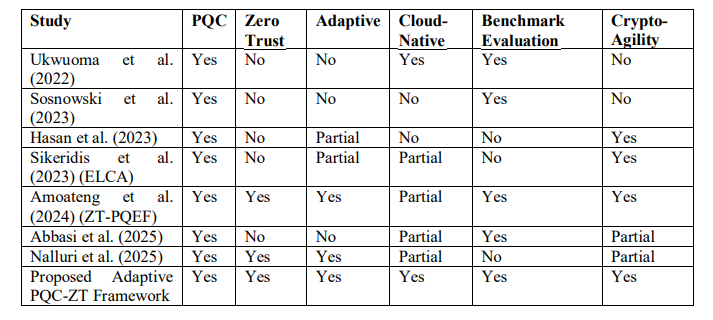
The comparison demonstrates that prior research has largely focused on individual dimensions of post-quantum security. While benchmark studies provide valuable performance insights and migration frameworks emphasize cryptographic transition strategies, no existing solution comprehensively integrates cloud-native deployment, Zero Trust enforcement, policy-based crypto-agility, workload-aware adaptation, and benchmark-driven evaluation within a unifiedframework.
2.7. Benchmark Sources and Research Gap
The performance evaluation presented in this study utilizes a publicly available PQC benchmark dataset obtained from Kaggle as the primary data source. To improve validity and contextual interpretation, benchmark observations are further supported through published performance studies from Open Quantum Safe (liboqs), NIST standardization documentation, and publicly available deployment findings reported by Cloudflare.
The literature review reveals a clear research gap. Existing studies independently investigate post-quantum cryptographic performance, Zero Trust security architectures, migration strategies, and crypto-agility frameworks. However, limited research integrates these dimensions into a unified cloud-native security framework capable of dynamically selecting post-quantum cryptographic algorithms according to workload characteristics, security requirements, and performance constraints. Consequently, there remains a need for a benchmark-driven, policybased, and cloud-oriented post quantum Zero Trust framework that addresses both security effectiveness and practical deployment considerations.
3. PROPOSED ADAPTIVE PQC-ZERO TRUST FRAMEWORK
3.1. Architecture Overview
This study proposes an Adaptive Post-Quantum Cryptography Zero Trust (Adaptive PQC-ZT) Framework to address the emerging security challenges posed by quantum computing in cloud environments. The framework combines the principles of Zero Trust Architecture with postquantum cryptographic mechanisms and an adaptive crypto-agility capability to support secure and flexible cloud operations. Unlike conventional Zero Trust deployments that rely on static cryptographic configurations, the proposed framework dynamically selects cryptographic mechanisms according to workload requirements, risk conditions, and performance constraints. The overall architecture of the framework is illustrated in Figure 1. The security workflow begins when a user, application, or cloud workload requests access to protected resources. Authentication is performed through an Identity Provider (IdP), which validates user credentials and establishes workload identities. The authentication information is subsequently processed by the Trust Evaluation Engine, which continuously assesses contextual parameters including workload sensitivity, operational risk, behavioural indicators, and latency requirements. The calculated trust attributes are forwarded to the Policy Decision Point (PDP), where Zero Trust access policies are enforced.
A key feature of the proposed architecture is the Crypto-Agility Engine. This component dynamically selects the most suitable post-quantum cryptographic configuration according to the trust evaluation outcome. Depending on workload requirements, the engine may deploy MLKEM-512, ML-KEM-768, or ML-KEM-1024 for key establishment together with appropriate ML-DSA signature variants. The selected cryptographic profile is then applied to cloud resources, including microservices, containers, service meshes, and cloud-native applications. Through this adaptive process, the framework enables continuous verification while maintaining an effective balance between security and operational performance.
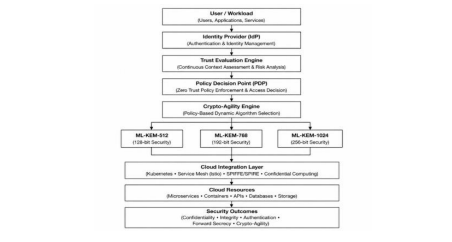
Figure 1. Adaptive Post-Quantum Zero Trust Framework Architecture
3.2. Policy-Based Crypto-Agility Engine
The Crypto-Agility Engine constitutes the primary contribution of the proposed framework. Existing post-quantum security deployments generally employ fixed cryptographic configurations that do not account for variations in workload sensitivity, security requirements, or latency constraints. Such static approaches may either introduce unnecessary computational overhead or provide insufficient protection for highly sensitive workloads.
To address this limitation, the proposed framework incorporates a policy-based decision model that dynamically selects cryptographic algorithms according to workload context. Four primary factors are considered during the decision process: workload type, data sensitivity, risk level, and latency requirements. These factors are combined into a Trust Score (TS) that guides algorithm selection.
The Trust Score is calculated as:
TS = 0.5R + 0.3S + 0.2L
where (R) represents the assessed risk level, (S) denotes workload sensitivity, and (L) corresponds to latency tolerance. The weighting scheme assigns greater importance to risk assessment while still accounting for sensitivity and performance considerations. For decisionmaking purposes, the values of risk (R), sensitivity (S), and latency tolerance (L) were normalized to a 0–1 scale. Higher values indicate greater security requirements or tolerance for additional cryptographic overhead. The resulting Trust Score therefore ranges between 0 and 1 and provides a consistent basis for workload-aware cryptographic selection.
The decision logic implemented within the Crypto-Agility Engine is summarized in Table 2.
Table 2. Policy-Based Crypto-Agility Decision Matrix
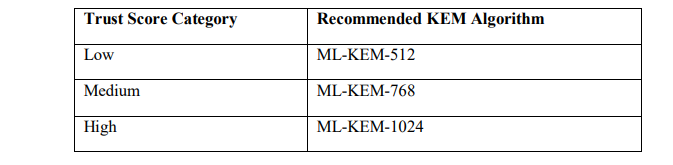
The benchmark results presented in Section 4 support this adaptive selection strategy. ML-KEM512 achieved the lowest average latency of 0.0369 ms, making it suitable for latency-sensitive applications. ML-KEM-768 provided a balanced trade-off between security and performance with an average latency of 0.0501 ms. ML-KEM-1024 offered the highest security level (256-bit equivalent) with an average latency of 0.0715 ms and communication overhead of 1536 bytes, making it appropriate for highly sensitive workloads such as financial systems and critical cloud services. Consequently, the proposed engine enables workload-aware cryptographic adaptation rather than relying on a single security configuration across all deployment scenarios.
3.3. Cloud Integration Layer
The proposed framework is designed for seamless integration with contemporary cloud-native technologies. Rather than requiring fundamental modifications to existing cloud infrastructures, the framework operates as an adaptive security layer that enhances cryptographic resilience while preserving operational compatibility.
Within Kubernetes environments, the framework can protect communications among containers and microservices through dynamically selected post-quantum cryptographic mechanisms. In service mesh deployments, such as Istio, the framework can influence mutual authentication and encryption policies for east-west traffic communications. Integration with SPIFFE and SPIRE
enables secure workload identity management across distributed environments, while confidential computing technologies provide hardware-assisted protection for sensitive cryptographic operations and trust evaluation functions.
This integration strategy supports practical adoption by cloud operators while reducing migration complexity. Furthermore, the architecture aligns with current Zero Trust principles and allows organizations to progressively transition from classical cryptographic systems toward fully quantum-resistant infrastructures.
3.4. Threat Model
The proposed framework assumes a cloud environment in which adversaries may possess both classical attack capabilities and future quantum-enabled resources. The threat model extends conventional Zero Trust assumptions by explicitly considering the Harvest Now, Decrypt Later (HNDL) attack scenario, whereby encrypted communications intercepted today may be decrypted
in the future using quantum computers.
The primary assets protected by the framework include session keys, identity tokens, application programming interface (API) communications, and cloud workloads. Four categories of adversaries are considered. The first category comprises external attackers attempting unauthorized access through network-based attacks. The second includes insider attackers with legitimate credentials or privileged access. The third consists of malicious tenants operating within shared cloud infrastructures. The fourth category represents future quantum-capable adversaries capable of exploiting weaknesses in classical cryptographic systems. The security objectives of the framework include maintaining confidentiality, preserving data integrity, ensuring strong authentication, supporting forward secrecy, and enabling crypto-agility for future cryptographic transitions. By combining continuous trust verification with postquantum cryptographic protection, the framework seeks to reduce exposure to both present-day and future attack vectors.
3.5. Attack Mitigation Analysis
The security benefits of the proposed Adaptive PQC-ZT Framework are summarized in Table 3. Compared with conventional Zero Trust deployments, the proposed framework significantly improves resilience against both classical and quantum-era threats through the integration of post-quantum cryptographic algorithms and adaptive policy enforcement mechanisms.
Table 3. Attack Mitigation Analysis
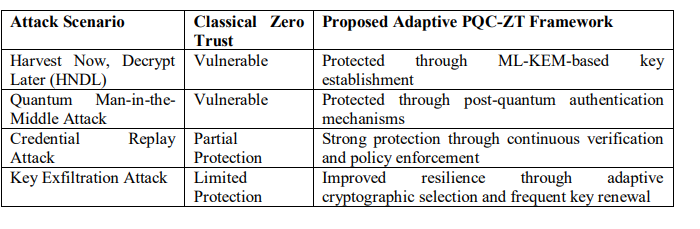
The analysis demonstrates that the proposed framework strengthens cloud security by combining Zero Trust principles with quantum-resistant cryptographic protection. In particular, the introduction of crypto-agility enables dynamic adaptation to changing threat conditions, thereby reducing dependence on static cryptographic configurations and supporting long-term migration toward post-quantum cloud security architectures.
4. BENCHMARK-DRIVEN PERFORMANCE EVALUATION
4.1. Dataset Description
To evaluate the feasibility of integrating post-quantum cryptography within Zero Trust cloud environments, a benchmark-driven analysis was conducted using publicly available post-quantum cryptographic performance datasets. The primary data source was the PQC Algorithms Benchmark Dataset published on Kaggle by Qayyum (2025), which contains extensive benchmark measurements collected from multiple post-quantum cryptographic implementations. The dataset provides performance information for key encapsulation mechanisms (KEMs) and digital signature algorithms across varying message sizes and security levels.
The evaluation focused on the NIST-standardized ML-KEM and ML-DSA algorithm families because these algorithms have been formally selected for post-quantum standardization and are expected to form the foundation of future quantum-resistant communication infrastructures (NIST, 2024a; NIST, 2024b). Supporting benchmark observations from Open Quantum Safe (liboqs) implementations and publicly available deployment reports were used to contextualize the findings and validate practical relevance.
The benchmark datasets include measurements for key generation, encapsulation, decapsulation, signature generation, verification, ciphertext size, signature size, communication overhead, and total execution time. Performance data were collected across message sizes ranging from 0.5 KB to 128 KB, enabling evaluation under representative cloud workload conditions.
Table 4.Dataset Description
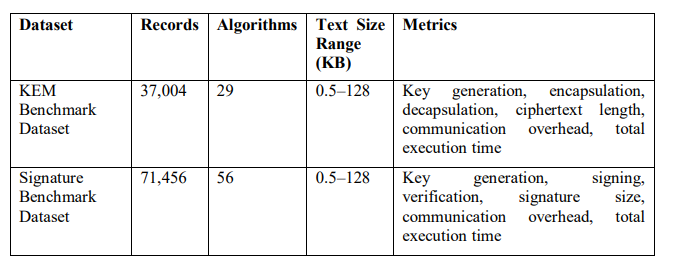
The large number of benchmark observations provides a statistically meaningful basis for comparing security-performance trade-offs among different post-quantum algorithms and evaluating their suitability for cloud-native Zero Trust environments.
4.2. Evaluation Methodology
The benchmark analysis was conducted using Python-based data analytics tools. Data preprocessing and aggregation were performed using Pandas and NumPy, while statistical calculations were conducted using SciPy. Visualization and graphical analysis were generated using Matplotlib.
The evaluation process consisted of four stages. First, benchmark records associated with the NIST-standardized ML-KEM and ML-DSA algorithms were extracted from the original datasets. Second, performance metrics were aggregated to obtain representative values for each algorithm configuration. Third, descriptive statistical measures were calculated to quantify central tendency and variability. Finally, workload-oriented comparisons were performed to assess the suitability of individual algorithms for different cloud deployment scenarios.
The following statistical measures were used throughout the analysis:
Mean execution time
Standard deviation
Communication overhead
Security level comparison
95% confidence intervals
Confidence intervals were calculated to assess the stability and reliability of benchmark measurements. This approach provides greater statistical rigor than relying solely on average performance values and enables a more reliable comparison between competing post-quantum algorithms.
4.3. Workload Scenarios
To evaluate the practical applicability of the proposed Adaptive PQC-ZT Framework, four representative cloud workload scenarios were defined. These scenarios reflect common deployment environments encountered in modern cloud infrastructures and serve as the basis for workload-aware cryptographic selection.
Scenario S1: Web Applications
This scenario represents latency-sensitive web services and front-end applications that process a high volume of short transactions. Performance efficiency is prioritized while maintaining an adequate security level. Consequently, lower-overhead cryptographic algorithms are expected to be preferable.
Scenario S2: IoT-to-Cloud Communications
This scenario models Internet of Things (IoT) devices transmitting telemetry and sensor data to cloud platforms. Such environments typically involve constrained devices and frequent communications. The selected cryptographic mechanisms must therefore balance security and computational efficiency.
Scenario S3: Multi-Tenant SaaS Environments
This scenario reflects Software-as-a-Service (SaaS) platforms supporting multiple tenants within shared cloud infrastructures. Security requirements are higher because of increased exposure to insider threats and cross-tenant attacks. Balanced security-performance characteristics are therefore desirable.
Scenario S4: High-Security Financial Workloads
This scenario represents financial databases, critical business applications, and highly sensitive cloud services that require long-term confidentiality and strong protection against future quantum attacks. In these environments, security is prioritized over latency considerations, making highersecurity algorithm configurations more appropriate.
The workload scenarios are subsequently used to evaluate the decision-making capability of the proposed Crypto-Agility Engine and to determine how post-quantum cryptographic algorithms can be dynamically matched to operational requirements.
4.4. Results and Analysis
The benchmark evaluation was conducted to examine the security-performance characteristics of NIST-standardized post-quantum cryptographic algorithms and to assess their suitability for adaptive deployment within Zero Trust cloud environments. The analysis focused on latency, communication overhead, security levels, and workload-specific applicability.
4.4.1. Performance Analysis of ML-KEM Algorithms
Table 5 presents the performance characteristics of the ML-KEM family. The results indicate a clear relationship between security level and computational cost. ML-KEM-512 achieved the lowest average total latency of 0.0369 ms while providing 128-bit security. ML-KEM-768 increased latency moderately to 0.0501 ms and delivered 192-bit security. ML-KEM-1024 achieved the highest security level of 256 bits with an average latency of 0.0715 ms.
Table 5.ML-KEM Performance Summary
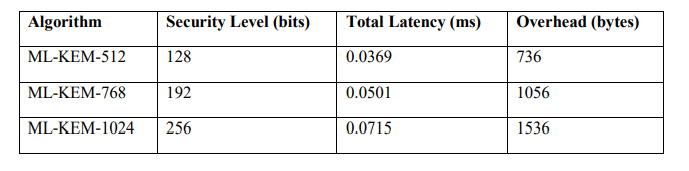
Figure 2 further illustrates the latency comparison among ML-KEM variants. Although latency increases with higher security levels, the observed values remain below 0.1 ms for all configurations. This suggests that the computational impact of ML-KEM deployment is relatively small for cloud-native applications.
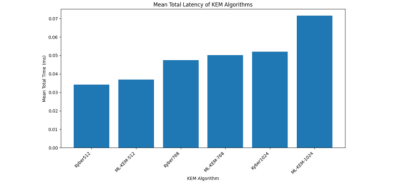
Figure 2. Mean Total Latency of ML-KEM Algorithms
The communication overhead results shown in Figure 3 indicate a gradual increase in ciphertext expansion as security levels rise. ML-KEM-512 introduced an average overhead of 736 bytes, while ML-KEM-1024 required 1536 bytes. Although larger security parameters increase network overhead, the resulting communication costs remain manageable for most cloud workloads.
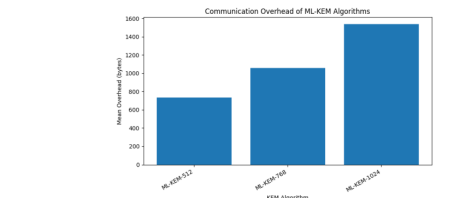
Figure 3. Communication Overhead of ML-KEM Algorithms
The security-performance trade-off illustrated in Figure 4 demonstrates that ML-KEM-768 provides the most balanced operating point. While ML-KEM-512 offers the lowest latency, MLKEM-768 significantly improves security with only a modest performance penalty. ML-KEM1024 provides maximum security but incurs the highest computational and communication costs.
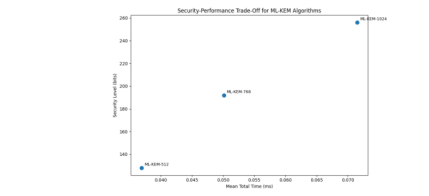
Figure 4.Security-Performance Trade-Off for ML-KEM Algorithms
The workload-based latency analysis shown in Figure 5 further confirms the stability of MLKEM algorithms across representative message sizes. The average latency of ML-KEM-512 remained between approximately 0.035 ms and 0.050 ms, while ML-KEM-1024 remained below 0.072 ms across all tested message sizes. These findings suggest that message size has only a limited effect on ML-KEM performance, making the algorithms suitable for dynamic cloud environments
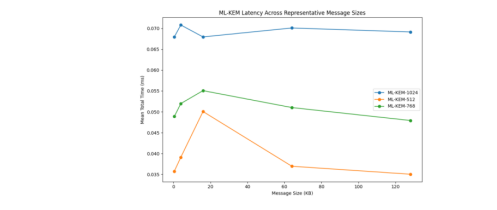
Figure 5.ML-KEM Latency Across Representative Message Sizes
4.4.2. Performance Analysis of Digital Signature Algorithms
Table 6 summarizes the benchmark results for digital signature algorithms. The ML-DSA family demonstrated substantially lower latency than SPHINCS+ variants across all security levels. MLDSA-44 achieved an average latency of 0.5253 ms, whereas ML DSA-87 required 0.9062 ms. In contrast, SPHINCS+ configurations exhibited significantly larger execution times ranging from
390.04 ms to 678.75 ms.
Table 6 Digital Signature Performance Summary
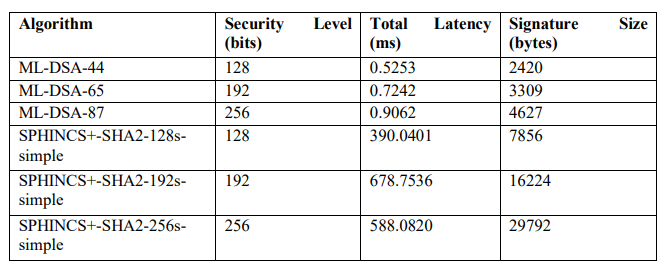
The latency comparison presented in Figure 6 reveals substantial performance differences between lattice-based and hash-based signature schemes. ML-DSA algorithms consistently outperformed SPHINCS+ by several orders of magnitude, indicating their greater suitability for cloud-native authentication workloads.
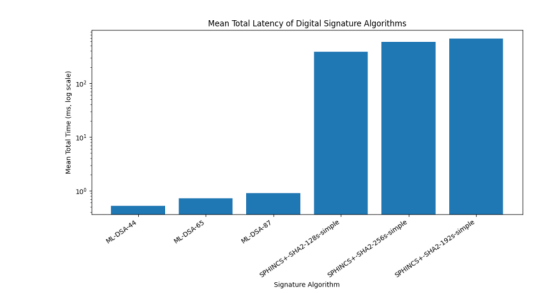
Table 6 Mean Total Latency of Digital Signature Algorithms
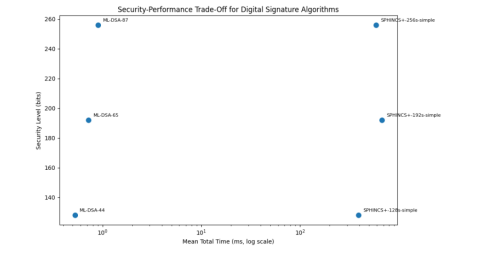
Figure 7 highlights the security-performance trade-off among digital signature schemes. Although SPHINCS+ provides strong security assurances based on hash-based constructions, its computational overhead is significantly greater than that of ML-DSA. Consequently, ML-DSA variants offer a more practical balance between security and operational efficiency in most cloud deployment scenarios.
Table 7 Security-Performance Trade-Off for Digital Signature Algorithms
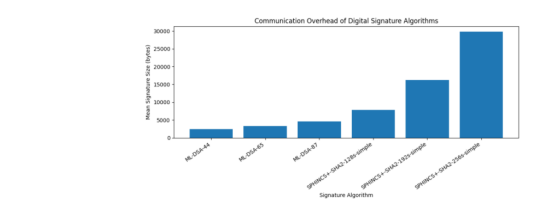
Communication overhead analysis shown in Figure 8 indicates that signature sizes increase substantially with stronger security configurations. Nevertheless, ML-DSA signatures remain considerably smaller than SPHINCS+ signatures, further supporting their suitability for largescale cloud deployments
Table 8 Communication Overhead of Digital Signature Algorithms
4.4.3. Confidence Interval Analysis
The confidence interval analysis presented in Tables 7 and 8 demonstrates a high degree of measurement consistency across benchmark observations. For example, ML-KEM-512 exhibited a 95% confidence interval ranging from 0.0367 ms to 0.0371 ms, while ML-KEM-1024 remained within 0.0710 ms to 0.0721 ms. Similar stability was observed for ML-DSA algorithms.
The narrow confidence intervals indicate that the benchmark results are statistically reliable and that the observed performance differences are unlikely to be caused by random measurement variation. Consequently, the benchmark dataset provides a robust basis for workload-aware cryptographic decision-making.
4.4.4. Evaluation of the Crypto-Agility Engine
The proposed Crypto-Agility Engine was evaluated using four representative cloud workload scenarios. The workload-specific recommendations generated by the policy model are summarized in Table 9.
The results demonstrate that the proposed policy-based framework can dynamically align cryptographic configurations with workload requirements. Low-risk, latency-sensitive workloads are assigned lightweight cryptographic mechanisms, while high-value workloads receive stronger protection through higher-security algorithm variants. This adaptive behaviour represents a significant improvement over static post-quantum deployments and supports the practical implementation of crypto-agility within Zero Trust cloud environments.
4.5. Discussion
The benchmark evaluation shows that the post-quantum cryptographic algorithms can be integrated into the Zero Trust environment with attractive performance features within the cloud. The results reveal a clear security-performance trade-off across both key encapsulation and digital signature algorithms, highlighting the importance of adaptive cryptographic selection rather than a one-size-fits-all deployment strategy.
For the ML-KEM family, latency increased as security levels increased. ML-KEM-512 achieved the lowest average latency (0.0369 ms), while ML-KEM-1024 provided the strongest security guarantees with an average latency of 0.0715 ms. Despite this increase, all ML-KEM variants remained below 0.1 ms, indicating that the computational overhead associated with post-quantum key establishment is relatively small in cloud-native environments. The results are in line with recent benchmarking studies, which claimed lattice-based cryptographic schemes to be efficient and identified ML-KEM as a potential candidate for a large-scale deployment (Abbasi et al., 2025; Rios et al., 2025; Sharma & Birla, 2025). The findings are also consistent with the NIST standardization process that focussed on the relationship between security and efficiency of lattice-based algorithms (NIST, 2024a).
The digital signature evaluation revealed considerably larger differences among algorithm families. The ML-DSA variants consistently outperformed SPHINCS+ configurations in terms of execution time, while maintaining substantially smaller signature sizes. For example, ML-DSA44 achieved an average latency of 0.5253 ms, whereas SPHINCS+-SHA2-128s-simple required approximately 390 ms. Similar trends were observed across higher security levels. These findings align with previous studies showing that lattice-based signature schemes provide superior operational efficiency for cloud services, authentication systems, and public key infrastructures, while hash-based signatures often incur substantially higher computational costs (Raavi et al., 2025; Sosnowski et al., 2023). Although SPHINCS+ offers strong cryptographic assurances based on conservative hash-based constructions The workload-oriented analysis also shows the benefit of the proposed Crypto-Agility Engine. Rather than applying a single cryptographic configuration across all cloud services, the framework dynamically selects algorithms according to workload characteristics and security requirements. Low-risk web applications were assigned ML-KEM-512 and ML-DSA-44 because of their minimal latency overhead. In contrast, high-security financial workloads were assigned
ML-KEM-1024 and ML-DSA-87 to maximize protection against future quantum threats. Medium-risk scenarios such as IoT telemetry and multi-tenant SaaS applications were assigned ML-KEM-768 and ML-DSA-65, which offer a balanced trade-off between security and performance. This adaptive behaviour directly addresses one of the major shortcomings identified in previous studies, namely the lack of workload-aware cryptographic selection mechanisms within post-quantum security architectures (Barker et al., 2021; Jena, 2025).
From a cloud deployment perspective, the results suggest that post-quantum migration does not necessarily require abandoning existing Zero Trust principles. Instead, Zero Trust and postquantum cryptography can be viewed as complementary security strategies. While Zero Trust continues to offer identity-centric access control, constant verification, and micro-segmentation, post-quantum cryptography offers long-term backwards compatibility of confidentiality and integrity of communications. Recent Zero Trust studies have focused on integrating identitybased security approaches with novel cryptographic security to tackle the evolving threat landscape marked by complex attack surfaces (Ahmadi, 2024; Mushtaq et al., 2025; Sarkar et al., 2022). The proposed Adaptive PQC-ZT Framework helps achieve this goal by providing a practical approach to integrating quantum-resistant cryptography into Zero Trust environments that are cloud-native.
The findings also have important implications for organizations preparing for the quantum transition. The Harvest Now, Decrypt Later threat means that sensitive data intercepted today may remain vulnerable for years before large-scale quantum computers become available (Kagai et al., 2025). Consequently, organizations responsible for long-term data protection cannot afford to delay migration planning. The benchmark results highlight that hybrid & adaptive deployment strategies offer meaningful quantum resistance at an affordable cost without significant performance penalties. This observation finds support from the recent recommendations to embrace quantum readiness and recommend the use of crypto-agility, phased migration solutions and ongoing cryptographic inventory management as necessary enablers of a quantum readiness program (Barker et al., 2021; Jena, 2025; Le et al., 2025).
The overall results indicate that the deployment of adaptive post-quantum cryptographic solutions is technically viable and is beneficial from an operational perspective for cloud infrastructures. The proposed framework enhances the ability of systems to withstand future attacks using quantum technology while allowing organizations to tailor cryptographic protection to the specific needs of their workloads. Together with Zero Trust principles, with the use of quantumsafe post-quantum cryptography and policy-driven crypto-agility, it offers a practical basis for secure cloud operations during the transition to a quantum-safe digital world.
5. PRACTICAL IMPLICATIONS AND MIGRATION STRATEGY
5.1. Implementation Challenges
Although the benchmark results demonstrate the practical feasibility of post-quantum cryptography within cloud-native Zero Trust environments, several implementation challenges remain. The first challenge relates to the maturity of post-quantum cryptographic ecosystems. While NIST has standardized ML-KEM, ML-DSA, and SLH-DSA, large-scale enterprise adoption is still in its early stages, and many production systems continue to depend on classical cryptographic infrastructures (NIST, 2024a; NIST, 2024b; NIST, 2024c).
A second challenge concerns computational and communication overhead. The benchmark results showed that stronger security configurations generally increase latency and message size. Although the observed overhead remained acceptable for cloud deployments, large-scale environments handling millions of transactions may still experience operational impacts. Similar concerns have been reported in recent benchmarking studies and post-quantum migration assessments(Abbasi et al., 2025; Baseri et al., 2025).
Interoperability and compatibility also present significant challenges. The vast majority of cloud architectures, identity management systems, certificate authorities, service meshes and APIs were developed to handle RSA and ECC-based cryptography. In this context, classical and post quantum cryptographic mechanisms need to be managed carefully during migrations to the organization (Barker et al., 2021; Le et al., 2025).
Lastly, cloud operators need flexibility in the long term when it comes to cryptographic security. Post-quantum cryptography is an ongoing process, and organizations should not perform an upor-down deployment strategy that may result in future migration challenges. For this challenge, it is essential to consider crypto-agility as a strategic ability, not just a technical capability (Jena,
2025).
5.2. Migration Roadmap
Given the complexity of transitioning toward quantum-safe infrastructures, a phased migration strategy is recommended. Instead of completely replacing existing cryptographic systems all at once, organisations should take a progressive approach that reduces disruption to operation over the short-term but strengthens security resilience over the long-term.
Table 10 Proposed Migration Roadmap for Quantum-Safe Cloud Deployment
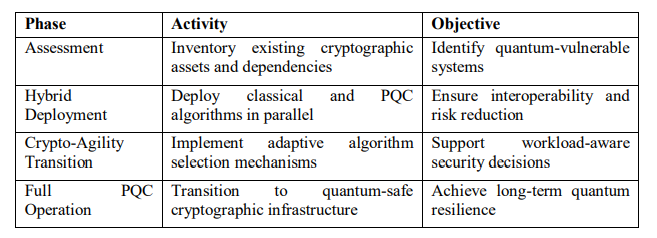
The assessment phase focuses on identifying cryptographic dependencies across cloud services, applications, APIs, and communication channels. While in the hybrid deployment phase, both classical algorithms and the post-quantum algorithm are running concurrently to minimize migration risk. The third phase is designed to include capabilities for crypto-agility, dynamically
choosing cryptographic configurations based on operational requirements. At last, organizations can gradually migrate towards fully quantum resistant infrastructures as standards, implementations and operational practice evolve.
This roadmap follows recent NIST, NSA and industry migration plans and guidance focusing on phased migration, cryptographic inventory management and transition to quantum-safe infrastructures (Baseri et al., 2025; Barker et al., 2021; Dekkaki et al., 2024)
5.3. Comparison with Existing Frameworks
A number of studies in recent years have discussed the adoption of post-quantum cryptography along with the Zero Trust and cloud security adaptive mechanism. However, existing approaches generally address only subsets of these requirements. Some frameworks combine Zero Trust and post-quantum cryptography but provide limited benchmark evaluation, whereas others focus on performance benchmarking without integrating adaptive security architectures.
Table 11 Comparison with Existing Frameworks
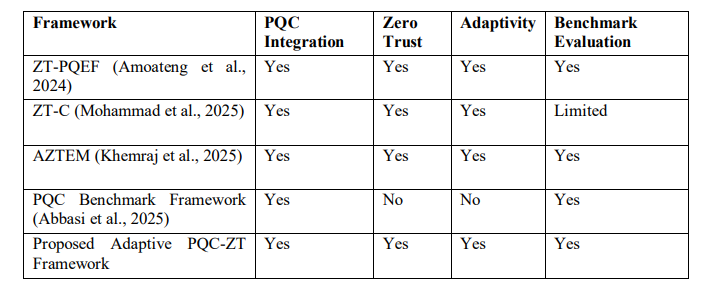
The comparison highlights an important distinction between existing studies and the proposed framework. ZT-PQEF and AZTEM provide adaptive Zero Trust capabilities but do not offer workload-driven crypto-agility based on benchmark-informed algorithm selection. In contrast, research work that compares with benchmarks like Abbasi et al. (2025) offer a thorough evaluation of performance, but are unable to include Zero Trust elements or adaptive decisionmaking elements. The proposed framework brings together various aspects of post-quantum cryptography, Zero Trust security, workload-aware crypto-agility, and benchmark-driven evaluation together in a single, cloud-native framework that mitigates gaps identified during the literature review.
5.4. Limitations
Despite its contributions, this study has several limitations. First, the evaluation was conducted using publicly available benchmark datasets, so there are no actual production cloud deployments involved. Benchmark-driven analysis provides a controlled and repeatable testing environmentbut actual performance may differ based on configurations, infrastructure and load characteristics.
The second is that the benchmark datasets are software-only implementations and won’t cover future hardware-only technologies able to have truly significant impact on the performance capabilities of post-quantum cryptography. It is therefore important to note that the latency and overhead reported must be interpreted as being baseline figures rather than definitive long term figures.
Thirdly the proposed framework is not tested with large scale cloud platforms like Amazon Web Services, Microsoft Azure or Google cloud Platform. Real-world deployment studies could give further insight in the scalability, operational complexity and policy management aspects.
Finally, the threat model assumes future quantum adversaries but does not incorporate experimental validation using actual quantum hardware. Given the current limitations of quantum computing technologies, such validation remains beyond the scope of this study. To this end, future research is expected to cover the implementation and large-scale testing, as well as the formal verification, of adaptive post-quantum Zero Trust architectures. Moreover, the benchmark dataset does not include all deployment variables like variation in network, hardware differences or cloud-provider optimizations.
6. CONCLUSION
This study proposed an Adaptive Post-Quantum Zero Trust (Adaptive PQC-ZT) Framework for securing cloud infrastructures against emerging quantum computing threats. The framework aligns with Zero Trust principles and supports NIST standardized post quantum cryptographic algorithms, while incorporating a policy-based Crypto-Agility Engine that can dynamically choose cryptographic configurations in line with the characteristics of the workload, security requirements and latency constraints.The benchmark-driven evaluation demonstrated that MLKEM and ML-DSA algorithms provide practical performance for cloud-native environments while delivering quantum-resistant security. The results showed that ML-KEM-512 offers the lowest latency for performance-sensitive workloads, ML-KEM-768 provides an effective balance between security and efficiency, and ML-KEM-1024 is suitable for highly sensitive applications requiring stronger protection. Likewise, the execution time and communication efficiency were far superior for ML-DSA variants than for SPHINCS+. This makes them more suitable for largescale cloud scenarios. The workload-based analysis also confirmed that the proposed cryptoagility Engine is very effective in associating the cryptographic mechanisms to the operational requirements.
Overall, the proposed framework addresses several key gaps identified in existing researchby integrating the post-quantum cryptography with Zero Trust Architecture, adaptivity based on workload and benchmark-based evaluation in a single cloud-based security model. The results indicate that one can achieve enhanced long-term cyber resilience without intolerable performance overhead from adaptive deployment of postquantum cryptography. Further research is required on AI-based trust scoring mechanisms, concrete implementation and testing of the proposed architecture in cloud platforms, formal verification using tools like ProVerif or Tamarin, and inclusion of recently developed technologies, e.g., Quantum Key Distribution (QKD), to advance the robustness of quantum-safe cloud security. The proposed Adaptive PQCZT Framework therefore offers a practically scalable underpinning for realizing quantumresilient Zero Trust cloud infrastructures in the post-quantum era.
REFERENCES
[1] Abbasi, M., Cardoso, F., Váz, P., Silva, J., & Martins, P. (2025). A practical performance benchmark of post-quantum cryptography across heterogeneous computing environments. Cryptography, 9(2), 32. https://doi.org/10.3390/cryptography9020032
[2] Ahmadi, S. (2024). Zero trust architecture in cloud networks: Application, challenges and future opportunities. Journal of Engineering Research and Reports, 26(2). https://doi.org/10.9734/JERR/2024/v26i21083
[3] Autry, C. P., Henderson, W., Magal, M., & Roscoe, A. W. (2024). dOISP: Rapidly Deployable
Quantum-Resistant, Fully Decentralized Layer 3 Authentication and Encryption for True Zero-Trust
Networking in Disparate Complex Networks. 2024 International Conference on Electrical, Computer and Energy Technologies (ICECET, 1–8. https://doi.org/10.1109/icecet61485.2024.10698231
[4] Barker, W., Polk, W., & Souppaya, M. (2021). Getting Ready for Post-Quantum Cryptography: Exploring Challenges Associated with Adopting and Using Post-Quantum Cryptographic Algorithms. https://doi.org/10.6028/nist.cswp.15
[5] Bernstein, D. J. (2025). Post-quantum Cryptography. Encyclopedia of Cryptography, Security and
Privacy, 1846–1847. https://doi.org/10.1007/978-3-030-71522-9_386
[6] Campagna, M., Chen, K., Dagdelen, Ö., Ding, J., Ferrick, J. K., & Gisin, N. (2015). Quantum safe
cryptography and security. ETSI White paper 8.
[7] Creane, B., & Gupta, A. (2022). Kubernetes Security and Observability. O’Reilly Media.
[8] Dekkaki, K. C., Tasic, I., & Cano, M. D. (2024). Exploring post-quantum cryptography: Review and
directions for the transition process. Technologies, 12(12), 241.
https://doi.org/10.3390/technologies12120241
[9] Grover, L. K. (1996). A fast quantum mechanical algorithm for database search. In Proceedings of
the 28th Annual ACM Symposium on Theory of Computing (STOC ’96) (pp. 212–219). ACM.
[10] Hasan, K., Simpson, L., Baee, M., Islam, C., Rahman, Z., Armstrong, W., Gauravaram, P.,
&McKague, M. (2024). A framework for migrating to post-quantum cryptography: Security
dependency analysis and case studies. IEEE Access, 12, 23427–23450.
https://doi.org/10.1109/ACCESS.2024.3360412
[11] Hussain, M., Pal, S., Jadidi, Z., Foo, E., & Kanhere, S. (2024). Federated Zero Trust Architecture
using Artificial Intelligence. IEEE Wireless Communications, 31(2), 30–35.
https://doi.org/10.1109/mwc.001.2300405
[12] Jena, J. (2025). The quantum security deadline: Building crypto-agility against Harvest Now, Decrypt
Later threats. European Journal of Computer Science and Information Technology, 13(5), 235–252.
https://doi.org/10.37745/ejcsit.2013/vol13n523552
[13] Kagai, F., Branch, P., But, J., & Allen, R. (2025). Harvest-now, decrypt-later: A temporal
cybersecurity risk in the quantum transition. Telecom, 6(4), 100.
https://doi.org/10.3390/telecom6040100
[14] Khemraj, I. A., Buckshumiyan, A., Balassem, Z., Shekar, A., Arunkumar, B., Ali, G., & Jabborov, N.
(2025). AZTEM: A Self-Evolving Zero Trust Model for Adaptive Cloud Security Using AI-Driven
Threat Mitigation and Quantum-Resilient Encryption. 2025 IEEE 2nd International Conference on
Green Industrial Electronics and Sustainable Technologies (GIEST), 1-6.
https://doi.org/10.1109/giest66547.2025.1138759
[15] Kindervag, J. (2010). Build security into your network’s DNA: The zero trust network architecture.
Forrester Research.
[16] Le, T. D., Hao, P., Dinh, T., & Pham, V. D. (2025). Are enterprises ready for quantum-safe
cybersecurity? arXiv. https://doi.org/10.48550/arXiv.2509.01731
[17] Mohammad, F. H., Mohammad, A., Chouhan, Y., Rambabu, B., Madhavan, J., & Kumar, R. D.
(2025). Zero-Trust Aware Quantum Resources Allocation (ZT-C): a Post-Quantum Cryptography
Framework for Multi-Tenant Cloud System. 2025 2nd International Conference on Software,
Systems and Information Technology (SSITCON), 1-6.
https://doi.org/10.1109/ssitcon66133.2025.11342118
[18] Mosca, M. (2018). Cybersecurity in an era with quantum computers: Will we be ready? IEEE
Security & Privacy, 16(5), 38–41.
[19] Mushtaq, S., Mohsin, M., & Mushtaq, M. M. (2025). A systematic literature review on the
implementation and challenges of zero trust architecture across domains. Sensors, 25(19), 6118.
https://doi.org/10.3390/s25196118
[20] Nalluri, S., Malyala, M., Kandagiri, H., Jakku, P., &Kandagiri, K. (2025). AI-enhanced Zero Trust
architecture for cloud security with quantum resilience. 2025 6th International Conference on
Intelligent Communication Technologies and Virtual Mobile Networks (ICICV), 1085–1092.
https://doi.org/10.1109/ICICV64824.2025.11085906
[21] National Institute of Standards and Technology. (2024a). FIPS 203: Module-lattice-based keyencapsulation mechanism standard (ML-KEM). U.S. Department of Commerce.
https://doi.org/10.6028/NIST.FIPS.203
[22] National Institute of Standards and Technology. (2024b). FIPS 204: Module-lattice-based digital
signature standard (ML-DSA). U.S. Department of Commerce.
https://doi.org/10.6028/NIST.FIPS.204
[23] National Institute of Standards and Technology. (2024c). FIPS 205: Stateless hash-based digital
signature standard (SLH-DSA). U.S. Department of Commerce.
https://doi.org/10.6028/NIST.FIPS.205 [24] National Security Agency. (2022). Commercial National Security Algorithm Suite 2.0 (CNSA 2.0).
National Security Agency. https://media.defense.gov/2022/Sep/07/2003071836/-1/-
1/0/CSA_CNSA_2.0_FAQ.PDF
[25] Noormohammadpour, M., & Raghavendra, C. S. (2018). Datacenter Traffic Control: Understanding
Techniques and Tradeoffs. IEEE Communications Surveys & Tutorials, 20(2), 1492–1525.
https://doi.org/10.1109/comst.2017.2782753
[26] Paquin, C., Stebila, D., & Tamvada, G. (2020). Benchmarking Post-quantum Cryptography in
TLS. Lecture Notes in Computer Science, 72–91. https://doi.org/10.1007/978-3-030-44223-1_5
[27] Qayyum, T. (2025). PQC Algorithms Benchmark Data. Kaggle.Com.
https://www.kaggle.com/datasets/ranatariq09/pqc-algorithms-benchmark-data
[28] Raavi, M., Khan, Q., Wuthier, S., Chandramouli, P., Balytskyi, Y., & Chang, S. Y. (2025). Security
and performance analyses of post-quantum digital signature algorithms and their TLS and PKI
integrations. Cryptography, 9(2), 38. https://doi.org/10.3390/cryptography9020038
[29] Rios, R., Montenegro, J. A., Muñoz, A., & Ferraris, D. (2025). Toward the quantum-safe web:
Benchmarking post-quantum TLS. IEEE Network, 39(1), 247–253.
https://doi.org/10.1109/MNET.2025.3531116
[30] Rose, S., Borchert, O., Mitchell, S., & Connelly, S. (2020). Zero trust architecture (NIST Special
Publication 800-207). National Institute of Standards and Technology.
[31] Sarkar, S., Choudhary, G., Shandilya, S. K., Hussain, A., & Kim, H. (2022). Security of zero trust
networks in cloud computing: A comparative review. Sustainability, 14(18), 11213.
https://doi.org/10.3390/su141811213
[32] Saxena, D., & Rekha, S. (2023). Defensive Countermeasures Towards Addressing Cloud Security
Attacks. Authorea Preprints.
[33] Sharma, R., & Birla, A. (2025). Post-quantum lattice cryptography: Theory, applications and
standardization analysis. In 2025 12th International Conference on Computing for Sustainable
Global Development (INDIACom) (pp. 1–7). IEEE.
https://doi.org/10.23919/INDIACom66777.2025.11115331
[34] Shor, P. W. (1999). Polynomial-time algorithms for prime factorization and discrete logarithms on a
quantum computer. SIAM review, 41(2), 303-332.https://doi.org/10.1137/S0036144598347011
[35] Sikeridis, D., Kampanakis, P., & Devetsikiotis, M. (2020). Post-quantum authentication in TLS 1.3:
A performance study. Cryptology ePrint Archive.https://eprint.iacr.org/2020/071
[36] Sikeridis, D., Ott, D., Huntley, S., Sharma, S., Dhanasekar, V., Bansal, M., Kumar, A., Anwitha, U.
N., Beveridge, D., &Veeraswamy, S. (2023). ELCA: Introducing enterprise-level cryptographic
agility for a post-quantum era. IACR Cryptology ePrint Archive, 2023, 1539.
[37] Sosnowski, M., Wiedner, F., Hauser, E., Steger, L., Schoinianakis, D., Gallenmüller, S., & Carle, G.
(2023). The performance of post-quantum TLS 1.3. Companion of the 19th International Conference
on Emerging Networking Experiments and Technologies. https://doi.org/10.1145/3624354.3630585
[38] The Istio Authors. (2024). “Security Configuration” in Istio Service Mesh
Documentation. https://istio.io/latest/docs/concepts/security/
[39] Ukwuoma, H., Gabriel, A., Thompson, A., &Alese, B. (2022). Post-quantum cryptography-driven
security framework for cloud computing. Open Computer Science, 12, 142–153.
https://doi.org/10.1515/comp-2022-0235
[40] Ward, R., & Beyer, B. (2014). Beyondcorp: A new approach to enterprise security. login, 39(6), 6-
11.https://cloud.google.com/beyondcorp
[41] Zong, C. (2024). The mathematical foundation of post-quantum cryptography. Research, 8.
https://doi.org/10.34133/research.0801


