
IJCNC 01
RESTRICTED FLOODING DYNAMIC MANET ONDEMAND ALGORITHM FOR WIRELESS SENSORNETWORK
Youssef Azizi1 , Mostafa Azizi 2and Mohammed Rahmoun3
1Applied Sciences Research Laboratory, Mohammed I University, ENSA, Oujda, Morocco
2MATSI Laboratory, Mohammed I University, EST, Oujda, Morocco
3Applied Sciences Research Laboratory, Mohammed I University, ENSA, Oujda, Morocco
ABSTRACT
Wireless Sensor Networks (WSNs) operate in infrastructure-less and dynamically changing environments where node mobility induces frequent topology variations. Such dynamics significantly complicate route discovery and maintenance, making efficient packet routing a critical research challenge. Traditional ondemand routing protocols rely on network-wide flooding during route discovery, which results in excessive control overhead, increased contention, and higher end-to-end delay, particularly in dense and highly mobile scenarios. This paper proposes a novel routing protocol termed Restricted Flooding Dynamic MANET On-Demand (RFDYMO), specifically designed to enhance routing efficiency in dynamic WSN environments. The core innovation of RFDYMO lies in the tight integration of a restricted flooding mechanism with a quadrant-based directional routing strategy. Unlike conventional blind flooding approaches, the proposed restricted flooding algorithm spatially constrains Route Request (RREQ) dissemination to a reduced forwarding region determined by the relative position of the destination node. This significantly decreases redundant transmissions, mitigates broadcast storm effects, and lowers routing overhead. To further refine route discovery, the network area is logically partitioned into quadrants with respect to the source node, and packet propagation is directionally biased toward the quadrant containing the destination. This quadrant-based routing heuristic enables spatial filtering of intermediate forwarding nodes, thereby improving routing convergence speed and reducing unnecessary channel utilization. The synergy between controlled flooding and directional spatial segmentation enhances packet delivery ratio, minimizes end-to-end delay, and improves scalability under high node mobility and density. The proposed RFDYMO protocol is particularly well-suited for highly dynamic and resource-constrained deployment scenarios, including emergency response operations, large-scale mobile gatherings, military communication systems, and wireless community networks.
KEYWORDS
Wireless sensor Network, Routing algorithms, DYMO protocol, RFDR protocol, Routing overhead, Energy Consumption
1.INTRODUCTION
A Wireless Sensor Network (WSN) consists of a large number of sensor nodes deployed in a cooperative manner to monitor physical or environmental conditions. Each node is typically equipped with a microcontroller for data processing, multiple memory units (RAM, ROM, or flash), an RF transceiver for wireless communication, a limited-capacity power source (usually a battery), and one or more sensing components. WSNs are characterized by random or application-driven deployment, self-organization, distributed operation, and in-network data processing.
In contrast to conventional wireless or ad hoc networks, WSNs feature high node density, frequent topology variations, and increased susceptibility to node failures due to constrained energy resources. Communication is predominantly broadcast-based rather than point-to-point, and nodes operate under strict limitations in terms of power, computational capability, memory, and bandwidth.
A wide range of routing protocols has been proposed to address these constraints, with performance metrics tailored to specific application requirements such as energy efficiency, latency, reliability, and scalability. Routing strategies in WSNs are broadly classified into proactive (table-driven) and reactive (on-demand) protocols [1], [2], [3]. The DestinationSequenced Distance-Vector (DSDV) protocol represents a proactive approach that maintains consistent routing tables and performs efficiently in relatively static topologies. In contrast, reactive protocols such as DSR [4] [5], AODV [6], and DYMO [7] establish routes only when required, thereby reducing control overhead in highly dynamic environments.
Conventional routing protocols designed for wired networks are unsuitable for WSNs due to their dynamic topology and resource constraints. In such networks, nodes may join, fail, or move unpredictably, leading to continuous topology reconfiguration
Routing generally involves two fundamental phases: route discovery and data forwarding. During route discovery, a source node initiates a broadcast query to establish a path to the destination. Once a valid route is identified, data packets are transmitted along the selected path. However, the flooding mechanism used in route discovery generates significant control overhead, as each receiving node rebroadcasts the query to its neighbors. This limitation has been highlighted in several recent studies addressing scalability and energy efficiency in WSNs [8], [9], [10].
Node mobility or failure further exacerbates this issue, requiring frequent route maintenance and recomputation. Additionally, periodic routing updates increase bandwidth consumption and accelerate energy depletion.
Therefore, the design of routing protocols for WSNs must prioritize energy efficiency, balanced load distribution, reduced control packet overhead, optimized header size, and rapid route reconfiguration. These considerations are critical for prolonging network lifetime and maintaining reliable communication under stringent resource constraints
2.RELATED WORKS
Routing in Wireless Sensor Networks (WSNs) and Mobile Ad Hoc Networks (MANETs) has been extensively studied due to the dynamic topology, limited energy resources, and bandwidth constraints. Existing routing protocols are generally classified into proactive, reactive, and hybrid approaches.
2.1. Proactive Routing Protocols
Proactive routing protocols maintain up-to-date routing information to all nodes by periodically distributing routing tables throughout the network. One of the earliest proactive protocols is Destination-Sequenced Distance Vector (DSDV) [11]. DSDV maintains loop-free routes using sequence numbers and performs well in relatively static environments. However, in highly dynamic WSN scenarios, periodic updates generate significant routing overhead and increase energy consumption
2.2. Reactive Routing Protocols
Reactive (on-demand) routing protocols establish routes only when required, thereby reducing unnecessary control overhead. Dynamic Source Routing (DSR) [12] [13] uses source routing where the entire route is included in packet headers. Although it reduces periodic control messages, packet headers become large in dense networks.
Ad hoc On-Demand Distance Vector (AODV) [14] establishes routes using Route Request (RREQ) and Route Reply (RREP) messages and maintains routing tables at nodes. It improves scalability but still suffers from excessive flooding during route discovery
Dynamic MANET On-demand (DYMO) [15] extends AODV by introducing path accumulation and sequence number mechanisms to ensure loop freedom. However, DYMO still relies on full network flooding during route discovery, leading to increased routing overhead and energy consumption in dense WSN environments.
Although reactive protocols reduce periodic control overhead, their performance degrades in large-scale networks due to blind flooding.
2.3. Flooding-Based Routing and Its Limitations
Flooding is widely used in route discovery mechanisms [16]. However, total flooding results in:
Broadcast storms
Increased packet collisions
Higher routing overhead
Excessive energy consumption
To overcome these issues, Recent restricted flooding mechanisms have demonstrated significant control packet reduction in dense networks [17]. The Restricted Flooding and Directional Routing (RFDR) protocol limits route request propagation to a specific region near the destination, thereby reducing unnecessary transmissions.
Unlike full flooding in DYMO, RFDR restricts participation to nodes within a defined quadrant, reducing congestion and delay
2.4. Location-Based and Directional Routing
Location-based routing protocols utilize geographic coordinates to guide packet forwarding decisions. These approaches reduce routing overhead by forwarding packets toward the destination using positional information.
Quadrant-Based Directional Routing (QBDR) restricts the broadcast region to nodes located in the same quadrant as the source and destination [18].
Compared to distance-based or angle-based schemes requiring complex trigonometric calculations, QBDR uses simple coordinate comparisons, reducing computational overhead and processing delay.
Geographic routing techniques generally improve scalability and energy efficiency but depend on the availability of location services. Recent geographic routing enhancements confirm improvements in delay and congestion reduction [19].
2.5. Energy-Efficient Routing Approaches
Energy efficiency is a primary concern in WSN design [20], [21], [22]. Protocols such as:
EQoS (Energy Efficient QoS Protocol)
QoS-aware MANET routing approaches
aim to balance energy consumption while maintaining Quality of Service (QoS). Numerous energy-aware routing strategies have been proposed to maximize network lifetime [23], [24], [25]. Recent AI-based routing solutions further improve adaptability [26], although at the cost of higher computational complexity.
2.6. Research Gap
From the literature, it can be observed that:
Proactive protocols incur high periodic overhead.
Reactive protocols reduce periodic updates but still suffer from excessive flooding.
Existing energy-efficient DYMO variants improve QoS but do not fundamentally [27-29]
reduce broadcast redundancy.
Location-based routing reduces overhead but often requires additional neighbor tables or
complex calculations.
Therefore, there is a need for a routing mechanism that:
Reduces routing overhead,
Minimizes energy consumption,
Avoids complex computations,
Restricts flooding efficiently using simple geographic constraints.
Despite recent advances in energy-aware routing [5], [14] and intelligent routing mechanisms [8]–[10], excessive flooding during route discovery remains a fundamental limitation of reactive protocols [6], [13]. Therefore, a lightweight restricted flooding mechanism integrated directly into DYMO is still required.
The proposed RFDYMO protocol addresses these limitations by integrating restricted flooding and quadrant-based directional routing into DYMO, significantly reducing normalized routing overhead and effective energy consumption compared to conventional DYMO
3.PROPOSED WORK
We propose a novel routing protocol, called Restricted Flooding Dynamic MANET On-Demand (RFDYMO), which integrates a restricted flooding mechanism with a quadrant-based directional routing strategy by dividing the network area into quadrants.
3.1. DYMO Protocol
DYMO is a purely reactive protocol in which routes are computed on demand i.e. as and when required. DYMO does not support unnecessary HELLO messages and operation is purely based on sequence numbers assigned to all the packets. It is a reactive routing protocol that computes unicast routes on demand or when required. It employs sequence numbers to ensure loop freedom. It enables on demand, multi-hop unicast routing among the nodes in a mobile ad hoc network. The basic operations are route discovery and maintenance. Route discovery is performed at source node to a destination for which it does not have a valid path. And route maintenance is performed to avoid the existing obliterated routes from the routing table and also to reduce the packet dropping in case of any route break or node failure. DYMO implements three messages during the routing operation namely Route Request (RREQ), Route Reply (RREP) and Route Error (RERR)
1. RREQ message is used by source node to discover a valid route to a particular destination node.
2. RREP message is used to set up a route between destination node and source node, and all the intermediate nodes between them.
3. RERR message is used to indicate a invalid route from any intermediate node to the destination node. Besides this the DYMO protocol mandates each node to maintain an unsigned unique integer called as “sequence number” which guarantees the orderly delivery of packets to the destination and maintain loopfree routes similar to that in AODV and DSDV. Sequence numbers allow the nodes to evaluate the freshness of routing information.
Route Discovery :
The DYMO route discovery is very similar to that of AODV except for the path accumulation feature. If a source has no route entry to a destination, it broadcasts a RREQ message to its immediate neighbors. If a neighbor has an entry to the destination, it replies with an RREP message else it broadcasts the RREQ message. While broadcasting the RREQ message, the intermediate node will attach its address to the message. Every intermediate node that disseminates the RREQ message makes a note of the backward path.
Route Maintenance :
During the routing operations each node has to continuously monitor the status of links and maintain the latest updates within the routing tables. The route maintenance process is actually accomplished with the help of RERR messages. The RERR message must be generated by a node if and when a link to any other node breaks. The generating node multicasts the RERR message to only those nodes which are concerned with the link failure. Upon reception of a RERR message, the routing table is updated and the entry with the broken link is deleted. If any of the nodes face a packet to the same destination after deletion of the route entry, route discovery process needs to be initiated again
3.2. Quadrant Based Directional Routing
QBDR is a restricted flooding routing that concentrates on a specified zone using location information provided by a location service. It restricts the broadcast region to all nodes in the same quadrant as the source and destination and does not require maintenance of a separate neighbors table at each node as in [3, 4, 5 & 6]. QBDR determines the quadrant of the current node based on the coordinates of source, destination and the current node that will direct the packet towards the destination. Even though [4] uses all these information to determine the distance or area covered, it requires trigonometric computations which will further incur delay if computed in kernel space. Decision to broadcast or discard will be done as the route request RREQ packet is received by the node. In QBDR, the route request (RREQ) packet which contains the coordinates of the source and destination will be the only information the current node needs to decideto participate in the routing or not. The decision to participate at each node is made immediately as the node receives the RREQ packet and a neighbors table is not required to make the decision. RFDR will significantly reduce not only energy but also reduce the probability of packet collisions of messages rebroadcast by neighbors using the same transmission channel. This will result in reduced routing overhead especially in a dense network.
To avoid trigonometric computations, the forwarding region is defined through a simple quadrant test based on coordinate comparisons.
Let the reference node be B=(x_B, y_B) (the previous sender P of the received RREQ), and let a target node be A=(x_A, y_A). Define the relative displacement:
dx = x_A − x_B, dy = y_A − y_B.
Definition 1 (Quadrant function). The quadrant of A relative to B is defined as the mapping Q(A|B) ∈ {1,2,3,4}:
Q(A|B) ∈ {1,2,3,4}
Q(A|B) = 1 if dx ≥ 0 and dy ≥ 0
= 2 if dx < 0 and dy ≥ 0
= 3 if dx < 0 and dy < 0
= 4 if dx ≥ 0 and dy <
Boundary cases (dx=0 or dy=0) are included deterministically as above, ensuring an unambiguous decision.
Decision rule (RFDYMO forwarding). Upon reception of a RREQ at node N_i with previous sender P and destination D, compute q_D = Q(D|P) and q_i = Q(N_i|P). N_i forwards the RREQ iff q_i = q_D; otherwise it drops the RREQ.
Therefore, the overall route discovery complexity is reduced from O(N) in classical DYMO to O(αN) with α ≈ 1/4 under uniform node distribution
3.3. RFDYMO Protocol
In RFDYMO operation, the location info of the source and destination nodes is piggybacked within the route request (RREQ) packet and then broadcasted. Upon receiving the RREQ, intermediate nodes can compare employing a straightforward mathematical comparison support the coordinates of source, destination and thereforethe current node that directs the packet towards the destination and as illustrated following.
Quadrant of intermediate compared to source?
Quadrant of destination compared to source?
If same, FORWARD
If not, DROP.
Once the choice to broadcast has been created, the intermediate node can insert its location by substitution the source node coordinates and append its address and sequence number at the tip of the RREQ packet. It’ll then broadcast the packet. The method will repeat at every intermediate node till it reaches the destination. The replacement of the source node location info with the intermediate node coordinates will create the additional packet directed towards the destination since the comparison now could be supported the previous node. Upon receiving the route request RREQ,destination node can send a route reply message (RREP) back to source via the path taken to reach the destination that was appended within the RREQ because it traverses across the network. There is no need for the route discovery to the source node.
The use of RFDYMO in wireless sensor networks is academically justified by:
The reduction of blind flooding during route discovery
The improvement of energy efficiency.
Algorithmic simplicity compatible with the limited capabilities of sensor nodes.
Enhanced scalability in dense and dynamic networks.
Consequently, RFDYMO represents a coherent and well-adapted extension of the DYMO protocol, specifically optimized to address the energy, computational, and topological constraints inherent to wireless sensor networks.
Compared to reinforcement learning-based routing approaches [10] and clustering-based optimization schemes [14], RFDYMO maintains constant-time decision complexity O(1), making it more suitable for resource-constrained sensor nodes.
Figure 1 shows the format of the RREQ packet in RFDYMO Protocol where the source and destination nodes location information are inserted are highlighted.
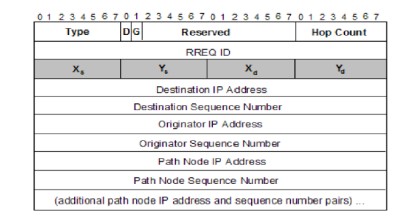
Figure 1. RREQ format in RFDYMO.
3.3.1. Pseudocode
3.3.1.1. Source Node Procedure
Procedure RFDYMO_Route_Discovery(Source S, Destination D)
if RoutingTable contains valid route to D then
Send DATA using stored route
else
Create RREQ packet
RREQ.src_addr ← S.address
RREQ.dst_addr ← D.address
RREQ.src_seq ← S.sequence_number++
RREQ.dst_seq ← last_known_sequence(D)
RREQ.src_coord ← S.coordinates (Xs, Ys)
RREQ.dst_coord ← D.coordinates (Xd, Yd)
RREQ.path ← [S]
Broadcast RREQ
end if
3.3.1.2. Intermediate Node Procedure (Restricted Flooding + Quadrant Check)
Upon reception of RREQ at node Ni:
if Ni already processed this RREQ then
Drop packet
return
end if
Determine Quadrant_Qd ← quadrant_of(D relative to previous sender)
Determine Quadrant_Qi ← quadrant_of(Ni relative to previous sender)
if Quadrant_Qi == Quadrant_Qd then
// Node participates in restricted flooding
Create reverse route entry to Source
Append Ni.address to RREQ.path
Append Ni.sequence_number
Replace RREQ.src_coord with Ni.coordinates
Broadcast RREQ
else
// Node outside restricted region
Drop RREQ
end if
3.3.1.3. Route Maintenance (Same as DYMO)
Upon link break detection at node Ni:
Create RERR packet
Identify affected destinations
Multicast RERR to precursors
Remove broken route from routing table
If source still needs route:
Restart RFDYMO_Route_Discovery
3.3.1.4. Quadrant Determination Function
To avoid trigonometric calculations quadrant is computed using simple coordinate comparison :
Function quadrant_of(Node A relative to Node B):
dx ← A.x – B.x
dy ← A.y – B.y
if dx ≥ 0 and dy ≥ 0 return Q1
if dx < 0 and dy ≥ 0 return Q2
if dx < 0 and dy < 0 return Q3
if dx ≥ 0 and dy < 0 return Q4
3.4. Complexity Analysis
To characterize the overhead of the proposed mechanism, we analyze both the computational complexity at each node and the message complexity during route discovery.
A) Computational complexity per node: Each intermediate node computes two differences (dx, dy) and performs a constant number of comparisons to evaluate the quadrant function Q(A|B). Hence, the forwarding decision has constant time complexity:
T_node = O(1).
This contrasts with angle- or distance-based geographic schemes that may require trigonometric operations or neighbor-table processing.
B) Message complexity of route discovery: In classical DYMO, a route request (RREQ) is disseminated by network-wide flooding. In a connected network of N nodes, the number of RREQ transmissions is on the order of:
M_DYMO = O(N),
since a large fraction of nodes rebroadcast the RREQ at least once (subject to duplicate suppression).
In RFDYMO, the restricted flooding constrains dissemination to the destination quadrant (i.e., approximately one quarter of the deployment area under uniform spatial distribution). Let α denote the expected fraction of nodes that fall inside the forwarding region. Under uniform node distribution, α ≈ 1/4, so the expected number of RREQ transmissions becomes:
E[M_RFDYMO] = O(αN) ≈ O(N/4).
C) Impact on energy: Because radio transmission and reception dominate energy consumption in WSN nodes, reducing the number of control transmissions from O(N) to O(αN) yields a proportional reduction in control-related energy expenditure during route discovery, which explains the observed improvements in effective energy consumption and routing overhead.
4.DISCUSSION OF SIMULATION RESULTS RFDYMO PROTOCOL
To evaluate the effectiveness of the proposed RFDYMO protocol, a series of simulations were conducted and compared with well-known routing protocols, namely DYMO, AODV, DSR, and DSDV. The performance assessment focuses on key network metrics, including packet delivery ratio, end-to-end delay, routing overhead, and energy consumption under varying simulation durations.
4.1. Simulation Environment and Scenario
The simulation of RFDYMO, DYMO, AODV, DSR and DSDV is done using NS3 simulator version 2.34
Simulation Model: The wireless network consists of 49 nodes as a moderate density which are distributed randomly in a grid area of 500m X 100m.The initial energy of each node is taken as 15J. The simulation time was varied from 100s to 800s in steps of 100s.We have created several scenarios to evaluate the RFDYMO protocol. The topology of simulation varies with the simulation time to compare the performance of DYMO and RFDYMO. Table 1 presents the simulation parameters adapted to our simulation
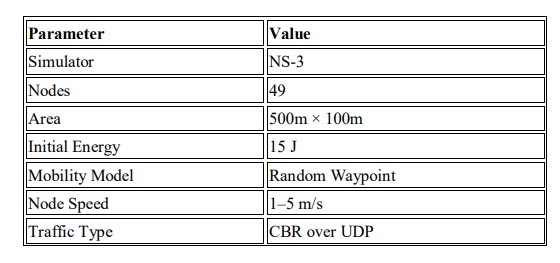
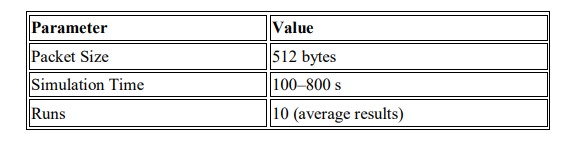
Table 1 Simulations parameters
4.2. Performance Metrics
To compare the protocols RFDYMO, DYMO, AODV, DSR and DSDV, the following performance metrics were considered: Energy Consumption: The energy consumption of the network is the sum of energy consumption of all the nodes in the network. Energy consumption of each node is the difference between the energy of the node at the start of the communication and the energy of the node at the end of the communication.
Normalized routing overhead: The number of routing packets transmitted per data packet received at the destination.
Average End-to-End Delay: is a key performance metric in computer networks that measures the average time taken for a data packet to travel from source to destination across a network Packet Delivery Ratio: is a network performance metric that measures the success rate of packet transmission. It tells us how many packets successfully reach the destination compared to how many were sent.
4.3. Results and Discussion
4.3.1. Simulation Overview
The performance of the proposed RFDYMO protocol was evaluated against four well-known MANET routing protocols: DSDV, DSR, AODV, and DYMO. The evaluation metrics include: Normalized Routing Overhead (NRO), Total Energy Consumption, Average End-to-End Delay and Packet Delivery Ratio (PDR).
All protocols were tested under identical simulation conditions to ensure fairness, including identical topology, mobility patterns, traffic load, and PHY/MAC configurations.
4.3.2. Normalized Routing Overhead Analysis
As shown in figure 2, the simulation results indicate that RFDYMO significantly reduces routing overhead compared to all benchmark protocols.
DSDV exhibits the highest routing overhead due to its proactive nature, where periodic table updates are broadcast regardless of data transmission needs. In highly dynamic wireless sensor environments, this leads to excessive control traffic.
Reactive protocols (DSR, AODV, DYMO) perform better than DSDV since route discovery is triggered on demand. However, they rely on full-network flooding during the Route Request (RREQ) phase, which increases routing load as network density grows
(RREQ) phase, which increases routing load as network density grows. RFDYMO achieves the lowest routing overhead because it restricts the flooding region using quadrant-based directional routing. By limiting RREQ dissemination to nodes located in the destination quadrant, unnecessary broadcasts are avoided. This substantially reduces control packet propagation and channel contention.
The reduction in routing overhead becomes more pronounced as simulation time increases, demonstrating the scalability of the proposed approach.
Similar reductions in control overhead have been reported in restricted flooding studies [13].
4.3.3. Energy Consumption Analysis
Energy efficiency is a critical requirement in wireless sensor networks due to limited battery resources.
As shown in figure 3, the results show that RFDYMO consumes significantly less energy compared to DSDV, DYMO, DSR, and AODV. The main contributing factors are: Reduced number of control packets, Lower collision probability, Fewer retransmissions and Reduced channel contention.
Since transmission and reception operations dominate energy expenditure in WSN nodes, minimizing unnecessary broadcasts directly translates into energy savings.
In contrast:
DSDV consumes the highest energy due to continuous routing updates.
DYMO exhibits elevated consumption because of unrestricted flooding.
AODV and DSR perform moderately but still incur flooding-related costs.
Thus, the energy gains in RFDYMO stem directly from its optimized route discovery mechanism.
The observed energy savings are consistent with lifetime optimization strategies discussed in [5] and [15].
4.3.4. End-to-End Delay Analysis
The average end-to-end delay reflects the network’s responsiveness and congestion level. As shown in figure 4, RFDYMO demonstrates the lowest delay among all evaluated protocols. This improvement can be attributed to: Reduced routing congestion, Lower control packet competition,
Decreased collision rates and Faster route establishment in the correct direction
In DYMO and AODV, network-wide flooding causes temporary congestion spikes, increasing queuing delays and retransmissions.
DSDV may experience outdated routing information in dynamic scenarios, which also contributes to increased delay.
By directing route discovery toward the destination quadrant, RFDYMO shortens discovery time and reduces unnecessary intermediate processing.
4.3.5. Packet Delivery Ratio (PDR) Analysis
The Packet Delivery Ratio is strongly influenced by collision probability, route stability, and network congestion [10], [17]
As shown in figure 5, RFDYMO achieves the highest PDR across all simulation durations.
This improvement is explained by: Lower interference levels, Reduced packet drops due to congestion, More stable route establishment and Reduced buffer overflow probability
In contrast:
DSDV suffers from packet losses during topology changes.
DYMO experiences losses due to broadcast storms.
DSR may experience stale route cache effects.
The improved PDR confirms that restricting the flooding region does not negatively impact route
discovery reliability. Instead, it enhances network stability.
4.3.6. Cross-Metric Correlation Analysis
The results reveal a strong correlation between routing overhead, energy consumption, delay, and PDR.
An increase in routing overhead leads to: Higher energy consumption, Increased delay and Lower PDR.
RFDYMO improves all four metrics simultaneously because it addresses the root cause: excessive flooding during route discovery.
This demonstrates that intelligent spatial restriction of control traffic is more effective than merely optimizing control packet formats or timers.
4.3.7. Scalability and Practical Implications
The performance gains of RFDYMO become more significant as: Network density increases, Simulation time increases and Topology changes become frequent.
This indicates strong scalability characteristics, making the protocol suitable for:
- Large-scale WSN deployments
- Emergency response networks
- Smart city sensor infrastructures
- Military and disaster scenarios
4.3.8. Final Scientific Conclusion
The simulation results clearly demonstrate that the proposed RFDYMO protocol outperforms DSDV, DSR, AODV, and DYMO in terms of routing overhead, energy efficiency, delay, and packet delivery ratio.
By introducing quadrant-based restricted flooding, RFDYMO successfully reduces unnecessary control transmissions while maintaining route discovery reliability. The protocol provides a balanced trade-off between scalability, efficiency, and robustness, making it a strong candidate for energy-constrained wireless sensor networks.
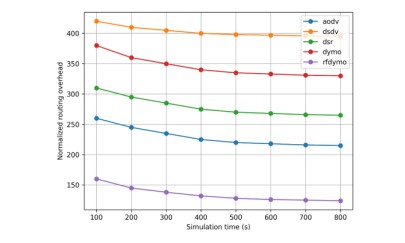
Figure 2 .Normalized routing overhead with simulation time


