
MLPTFDDQN: CARBON AND COST-AWARE ADAPTIVE FUNCTION SCHEDULING FOR SERVERLESS EDGE IOT FRAMEWORK
M. Jayanthi, Ram Mohan Rao Kovvur, Dr. V. Sukanya
Department of Computer Science and Informatics, Mahatma Gandhi University, Nalgonda, Telangana-508254, India
Department of Information Technology, Vasavi College of Engineering (Autonomous), Hyderabad 500031, India
Department of Computer Science and Engineering, Osmania University, Hyderabad, Telangana- 500007, India
ABSTRACT
A specific system architecture designed for Internet of Things (IoT) applications is serverless edge computing. It makes use of edge computing to enable code execution close to the data sources and serverless computing to reduce operational management. However, serverless function scheduling becomes more challenging due to resource-constrained edge infrastructures and highly dynamic, latency sensitive applications. Furthermore, current serverless scheduling systems frequently overlook important aspects like carbon emissions, cost, and SLO violations and prioritize only latency, model accuracy, and throughput. Therefore, in this paper, we introduce a carbon and cost-aware scheduler framework called MLPTFDDQN, which integrates a multi-layer perceptron-threshold filtering (MLP-TF) with a double deep Q network (DDQN) for adaptive function scheduling. In this framework, we first estimated each incoming function’s execution time and resource requirements using an Enhanced iTransformer-based predictor. Next, a Node Compatibility Scoring and Filtering Model based on MLP-TF is used to choose a set of feasible edge nodes. Then, DDQN with a modified epsilon-decreasing strategy is used to select the suitable node-container pair to schedule the function. Experimental results on the Alibaba and Huawei datasets demonstrate that the proposed MLPTFDDQN significantly outperforms state-of-the-art baselines, achieving up to a 39.31% reduction in carbon emissions, a 37.20% reduction in total cost, and a 24.15% reduction in SLO violations.
KEYWORDS
MLP-TF, iTransformer, DDQN, edge nodes, carbon.
1. INTRODUCTION
The versatility and scalability of serverless computing are combined with the proximity and low latency of edge devices in a new technological advancement called serverless edge computing [1 – 3]. The concept of serverless computing, which is executed through Function-as-a-Service (FaaS), was first created for cloud computing to relieve developers of the responsibilities of managing backend components and resources. In a similar vein, serverless at the edge applies this idea to IoT software development, alleviating developers from complicated operational procedures to concentrate on the fundamental business sense of their applications [4-6]. Developers can use high-level programming languages to create independent stateless functions by utilizing serverless at the edge.
However, the limitations of edge devices compared to cloud counterparts complicate the function scheduling process. Due to this environment’s low bandwidth and high communication latency, the cold start issue in particular significantly impairs system quality of service (QOS) and causes SLO violation [7-9]. It lowers function success rates in addition to extending the overall execution time of latency-sensitive services. Therefore, to make this environment high performing, service providers maintain functions alive in servers’ memory so that they are not impacted by a start-up overhead, also known as the cold start of functions [10-12]. But keeping functions alive consumes resources and energy, which leads to more carbon footprint. Moreover, this excessive energy consumption and computing resources keeping alive lead to increased operational costs. Thus, balancing carbon emissions and operational cost continues to be an important problem that requires scheduling techniques to find the optimal solution.
Several studies have already proposed effective scheduling techniques in terms of performance, resource consumption, and lowering computation latency [13–15]. Current heuristic algorithms are appropriate for stable systems with predictable workloads since they are less complicated and computationally efficient. Nevertheless, they are unable to adjust to intricate and extremely dynamic edge situations, where resource availability and request patterns are constantly shifting[16-18]. Reinforcement learning-based algorithms, such as deep Q-networks, PPO, and DDPG, are better at handling complex systems that are continuously evolving because they are based on adaptive decision-making processes. Nevertheless, they have a high cost of exploration and can become unstable in extremely dynamic situations [19, 20]. Furthermore, the majority of the studies ignored cost and carbon emissions in favor of latency and throughput as the primary goals.
Therefore, in this work, we integrated a multi-layer perceptron-threshold filtering (MLP-TF) with a double deep Q network (DDQN) to optimize carbon emissions, cost, and SLO violation. In this hybrid MLPTFDDQN framework, we proactively predict the incoming function’s resource requirements and execution time using the Enhanced iTransformer-based approach. With this approach, we effectively select suitable nodes in the subsequent steps to schedule the function and reduce the SLO violations. Then we utilized an MLP-TF-based node scoring and filtering mechanism to select a set of suitable nodes based on their available resource and energy capacity. By using this method, we remove the set of infeasible node which have low resource and energy availability to run the functions. Finally, DDQN with a modified epsilon-decreasing strategy based scheduler analyzes the selected feasible nodes from the previous step and chooses one node-container pair to schedule the functions. It enhances the consistency and efficiency of the scheduling process and results in a better trade-off between exploration and exploitation.
The major contributions of this paper are,
- We created an Enhanced iTransformer-based function resource and execution time predictor for predicting the resource requirements for serverless functions under dynamic workloads. It helps the scheduler make the right choices by capturing the complex and erratic patterns of function execution.
- To efficiently lessen the overestimation of the action values during the scheduling phase and quicken the network’s convergence, we employ the DDQN-based scheduler. This scheduler is enhanced with a modified epsilon-decreasing approach, whichchooses the optimal rule of the current best solution with a specific probability.
- An efficient MLP-TF method is introduced that may choose a group of candidate nodes according to their energy, resource capacity, and execution capabilities. This reduces the action space and allows for accurate scheduling choices.
Several experiments are carried out to evaluate the efficacy of the proposed algorithm, and the results are compared with those of alternative approaches on workloads from Alibaba and Huawei.The rest of this paper is structured as follows. We review relevant studies in Section II. The problem scenario and the modeling procedure are presented in Section III. The proposed algorithm design is presented in Section IV. Our assessment and simulation tests are detailed in Section V. The article is finally concluded in Section VI.
2.LITERATURE REVIEW
To improve resource allocation and energy-aware function execution in serverless edge contexts, Ghorbian et al. [21] introduced an energy-aware scheduler. It makes use of several schedulers, including SLEP, SAEP, and SSEP, and dynamically chooses the best one according to the energy level of active edge nodes. Through the integration of IBM’s MAPE-K control loop, this framework regularly monitored the energy availability, calculated the execution cost of incoming functions, and assessed the network’s overall capacity to manage workload demand. To assess performance, four load-generating patterns were used in this work.
In another work, Kumar et al. [22] introduced a DRL-based function scheduler for energy-aware function scheduling in a serverless environment. For this, they used a Deep Q-Network that dynamically balances execution success and energy consumption under changing workload conditions. A variety of artificially generated workloads were used for performance measurement, and the outcomes were contrasted with those of current heuristic algorithms.
Tütüncüoğlu and Dán [23] developed a StackelbergGame-based game-theoretic analysis for cost aware function placement and resource allocation in serverless edge computing. For this, they proposed Stackelberg Gradient Play (SGP) and used Differential Stackelberg Equilibrium (DSE) to get around computational problems. The SGP is an efficient implicit gradient-based technique that guarantees convergence to DSE.
To precisely capture the dynamic energy characteristics of PMs, Zhang et al. [24] developed a container-state-aware energy consumption model. To do this, they created an improved Bayesian Optimization-Based Energy Consumption Minimization algorithm that breaks down the high dimensional search space into a number of lower-dimensional sub-problems to discover the best reuse times for various serverless operations. Additionally, a number of customized heuristic approaches for container deployment and request allocation were utilized.
A dynamic method for carrying out serverless workflows at the edge was presented by Zolfaghari et al. [25]. It consists of three essential elements: initial function placement, request scheduling, and dynamic modification. In the first phase, the function instances were distributed among edge nodes using the Non-dominated Sorting Genetic Algorithm II. In the second phase, request scheduling uses a pattern graph matching method to divide requests among these instances. Lastly, the dynamic adjustment component used a local search method called simulated annealing to periodically improve placement and scheduling techniques in response to shifting demands.
In another study, Al-Qadhi et al. [26] introduced the FaaSBid model, which encourages users to perform serverless services close to the edge on unutilized resources. This paper developed the Fitness-Based Swap algorithm that initializes function placement based on pre-defined parameters such as storage cost, maximum processing time, and function size. Then, the Maximum Revenue Bid-based scheduling algorithm was used to prioritize activities to maximize revenue near the edge, while the Dynamic Demand Replacement Algorithm was utilized to periodically place in-demand functions close to the edge nodes.
3. SYSTEM MODEL AND PROBLEM FORMULATION
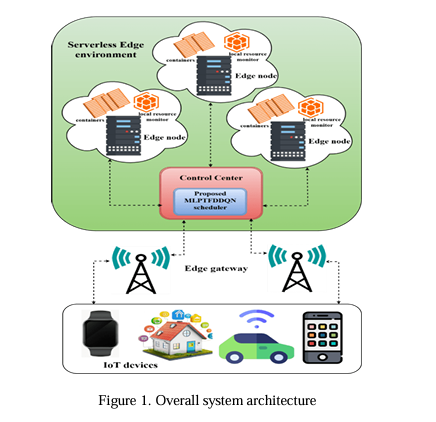
As seen in Figure 1, we consider a system paradigm with two main parts: serverless edge nodes and IoT clients. The apps that run on IoT devices are called IoT clients, and they are represented by

Figure 1. Example of a Petri Net
IoT devices deliver function requests

to the serverless edge environment at unpredictable intervals throughout application
execution due to their limited computing resources. The CPU and memory
requirements vary depending on the function. Several edge nodes, represented by

are present in the edge environment and act as edge servers for the deployment and execution of function requests. The CPU, memory, and energy capacities of each edge node vary.

be the group of containers running on edge or cloud servers. Every node also includes a local resource monitor that keeps track of real-time CPU, memory, bandwidth, and storage availability. The suggested scheduling architecture schedules the function on edge nodes and containers in a hierarchical fashion upon receiving the function request. The main goal of this effort is to reduce costs and carbon emissions during function scheduling. The next subsections provide an explanation of these goals.
3.1. Carbon emission
The carbon emission during the execution of the function 𝐶𝐸𝑐 𝑒𝑥𝑒(𝑓,𝑡) is computed using the following equation,

Here, CI(t) indicates the carbon intensity(gCO₂/kWh) at time t based on the current energy, and 𝑐 𝑒𝑥𝑒(𝑓,𝑡)indicates
Function Execution Energy in container c, which is computed as below.


