
IJCNC 04
HYBRID UPLINK ACCESS IN IEEE 802.11ax UNDER NON-SATURATED TRAFFIC: ANALYTICAL MODELING AND PERFORMANCE EVALUATION
Asma A. Eliwa , Mohamed Yasin I. Afifi , Ibrahim F. Tarrad and Mohammed A. Salem
Faculty of Engineering, City University of Cairo (CUC), New Heliopolis City, Egypt
ABSTRACT
The emergence of wireless systems with numerous terminals, such as Internet of Things (IoT) deployments, Smart Home Systems, and enterprise Wi-Fi networks, requires efficient channel access mechanisms. However, existing methods in IEEE 802.11ax standard (Wi-Fi 6) face performance issues under practical non-saturated traffic conditions as a result of a trade-off between scheduled and contention-based transmissions. In this paper, we study a hybrid channel access scheme which combines scheduled and random-access transmissions into a single Trigger Frame (TF). Some Resource Units (RUs) are used for scheduled access determined by Buffer Status Reports (BSRs), while the remaining RUs are allocated for random access to accommodate new terminal connections. Realistic traffic modeling is considered using Pareto traffic arrival for non-saturated conditions. The analytical model is validated via simulation to evaluate throughput, access latency, ability to provide random access, and energy efficiency. The analysis is performed for the cases of both static and dynamic scheduling mechanisms. Results demonstrate that our proposed hybrid mechanism outperforms the random-only scheme, achieving up to 3× higher throughput than random-only access in areas of dense stations; reduces access delay by over 40% compared to static scheduling; and increases energy efficiency when using dynamic scheduling
KEYWORDS
IEEE 802.11ax (Wi-Fi 6), OFDMA, MU-MIMO, Non-Saturated Traffic, Pareto Traffic, Channel Sounding
1. INTRODUCTION
Wireless Local Area Networks (WLANs) based on IEEE 802.11 protocols have emerged as the main solution for providing high-speed Internet access. Their low deployment cost, ease of installation, and flexibility to support a wide range of applications have been key factors that have led to the widespread adoption of Wi-Fi and a rapid increase in the number of Wi-Fienabled devices [1], [2], [3]. Recent reports indicate that Wi-Fi accounts for more than half of global Internet traffic. The demand for these devices continues to grow rapidly, driven by the need to support emerging applications and higher data rate requirements. Additionally, the growing number of low-latency applications, including video streaming, online gaming, and Internet of Things (IoT) services, further expose performance limitations in Wi-Fi networks, particularly regarding throughput, latency, and reliability when used in crowded environments [4], [5], [6]. The IEEE 802.11ax amendment (Wi-Fi 6) was developed to support High Efficiency (HE) WLANs in dense deployment scenarios. This amendment increases network performance by achieving up to four times higher per-station throughput compared to legacy WLANs. Two primary elements of the new Medium Access Control (MAC) standard that provide the necessary level of throughput are Orthogonal Frequency Division Multiple Access (OFDMA) and Uplink Multi-User Multiple-Input Multiple-Output (UL MU-MIMO). OFDMA divides the operating channels into multiple Resource Units (RUs) ,allowing for simultaneous connections from multiple devices using OFDMA technology whether in the downlink, uplink, or both. UL MUMIMO is for use in the upload direction providing multiple station connections to the AP simultaneously over the same frequency resource using spatial multiplexing. Additional improvements to reduce the impact of interference and improve the overall efficiency of WLANs have also been made through other enhancements such as BSS Coloring and Target Wake Time (TWT). This paper will concentrate on evaluating the performance of the new MU-OFDMA and MU-MIMO multi-user transmission mechanisms in both uplink and downlink [4] – [8].
Despite these improvements, most existing studies on IEEE 802.11ax assume saturated traffic conditions, where all stations always have data ready to transmit. However, in practical scenarios, many applications such as IoT sensing, smart home systems, and event-driven services generate bursty and intermittent traffic, which corresponds to non-saturated conditions. To model this behavior, Pareto Type II (Lomax) arrivals are considered, as they capture the heavy-tailed and self-similar characteristics of modern IoT and multimedia applications [9], [10]. The behavior of systems under such conditions differs significantly from saturated system behavior due to contention, queuing, and throughput, and which necessitates a more realistic performance evaluation [11], [12], [13]
This paper presents an analytical model supported by simulation to evaluate IEEE 802.11ax performance with regard to non-saturated traffic. In addition, we propose and evaluate a hybrid uplink channel access mechanism that integrates both scheduled and random access. In particular, we study a hybrid uplink channel access mechanism that combines scheduled and random transmissions within a unified Trigger Frame (TF). In this scheme, a portion of the Resource Units (RUs) is allocated for scheduled access based on buffer status reports, while the remaining RUs are used for random access to accommodate new or sporadic users. To the best of our knowledge, no prior work has jointly analyzed hybrid access under non-saturated traffic while accounting for MU-MIMO channel sounding overhead. The results show that the proposed approach achieves a better balance between efficiency, fairness, and signaling overhead compared to conventional schemes, especially in dense and dynamic traffic scenarios.
1.1. Literature Review
Studies on IEEE 802.11ax technology have considered MU solutions extensively. For example, in the OFDMA access mode, there have been extensive applications of Markov chain models to analyze RA [14,15], resulting in efficiency improvements in the form of frame size control [16]. Thereafter, SA schemes have been implemented [17,18] and tested via simulation tools such as NS-3 [19]. In order to counter the shortcomings of RA and SA alone, HA methods that integrate RA and SA have been suggested, usually with a combination of random access and scheduling phases [20,21]. However, most research works make the assumption of saturated traffic conditions [22].
Most recent studies on hybrid access have analyzed non-saturated (NS) conditions and how bursty traffic interacts with dynamic transition methods to enhance throughput performance [23] – [25]. International Journal of Computer Networks & Communications (IJCNC) Vol 18, No 5, September 2026 53 MU-MIMO was initially introduced in IEEE 802.11ac only for the downlink channels [26,27] with research concerning TXOP sharing [28] and user selection [29]. MU-MIMO was extended to include both uplink and downlink in IEEE 802.11ax [26]. There are two ways of implementing uplink MU-MIMO: synchronous and asynchronous. The synchronous mode allows synchronized high-rate transmission with high timing synchronization requirements. In asynchronous mode, there is more flexibility but the system requires advanced channel sensing. Studies on scheduling in the synchronous mode [30] and simultaneous use of MU-OFDMA/MU-MIMO [31], channel sensing in asynchronous mode [32] using Markov chain model [33] and renewal process model [34] were conducted. Asynchronous UL MU-MIMO is rarely used in IEEE 802.11ax.
1.2. Motivation and Contributions
To conclude, while prior research has provided valuable insights into MU-OFDMA and MUMIMO in the context of IEEE 802.11ax, there are still several limiting factors present. Most analytical models assume saturated traffic and rely complex analytical formulations. In addition, the majority of research has focused primarily on the metrics of throughput, whereas other important metrics such as delay, power consumption and energy efficiency remain largely unexplored. Furthermore, very limited analysis has been carried out on the use of hybrid access for non-saturation traffic with realistic channels sounding overheads in the context of MUMIMO.
In order to facilitate a proper comparison between the existing works and our proposed research, the important aspects and limitations of the literature that are most pertinent to the study are presented in Table 1. As can be observed from the table below, the majority of existing studies are limited to saturated traffic and throughput only. The study which is most relevant among all the studies examined is [25] which lays down the basics of hybrid access with respect to nonsaturated Poisson traffic. It does not cover Pareto traffic, channel sounding, and important performance parameters including delay, energy consumption, and energy efficiency.
Building upon the framework in [25], this paper makes the following key contributions. First, a comprehensive performance evaluation is conducted on non-saturated traffic conditions using a Pareto method of evaluation to capture the trade-offs among key performance indicators including throughput, access delay, Random Access Capability (RAC), energy consumption, and energy efficiency for the various types of scenarios that represent the system’s operation in unsaturated network conditions. A comprehensive review of the performance evaluation results performed on non-saturated traffic conditions provides a more realistic portrayal of actual network behavior, thus giving greater insight into the various mechanisms that operate within the system under normal operating conditions.
Secondly, a dynamic Resource Unit (RU) allocation scheme is proposed that the Resource Units (RUs) are allocated based on Buffer Status Reports (BSRs) rather than conventional static allocation the Resource Units (RUs) to users before receiving Buffer Status Reports (BSRs). Through the use of real-time traffic demands, the dynamic Resource Unit (RU) allocation method will enable a more effective manner of using or allocating resources based on from both the minimization of underutilization and the minimization of congestion and thus maximize the system response time and overall system performance. The results demonstrate that use of the dynamic Resource Unit (RU) allocation scheme will produce a more efficient means of resource management in comparison to the use of the traditional means of static allocation of Resource Units (RUs).
Finally, a unified MU-MIMO framework is developed that includes overhead resources needed to accurately quantify the cost of Channel State Information (CSI) acquisition in accordance with IEEE 802.11ax. The unified MU-MIMO model also takes into consideration the overhead introduced during the process of channel sounding which is required for an appropriately reliable estimate of CSI and is required for uplink MU-MIMO operation in an MU-MIMO environment. By including both transmission components as well as overhead components together as part of the same unified MU-MIMO system configuration within a single framework, a more realistic and comprehensive evaluation framework is provided to evaluate the costs required to acquire CSI for various MU-MIMO system configurations
1.3. Organization
The remainder of this paper is structured as follows: the system model and analytical framework are defined in Section 2; the transmission and hybrid-access mechanisms are addressed in Section 3; performance measure definitions are discussed in Section 4; and result and discussion sections are provided in Section 5. Finally, the paper’s conclusion is introduced in section 6.
2. SYSTEM MODEL & ANALYTICAL MODELING
2.1. Network Assumptions
Consider a Basic Service Set (BSS) IEEE 802.11ax (Wi-Fi 6) network consisting of one Access Point (AP) and multiple connected Stations (STAs). To focus exclusively on MAC-layer behavior, an ideal physical (PHY) layer is assumed, providing error-free transmission and perfect channel estimation. Across all devices, a subset is scheduled using the Scheduled Access (SA) mechanism, while the remaining STAs rely on Random Access (RA) through uplink triggerbased contention, where
The AP dynamically allocates uplink Resource Units (RUs) over the available channel bandwidth , which is partitioned into equal-sized subchannels. Each RU employs the same Modulation and Coding Scheme (MCS) index to ensure fairness among contending STAs.Let the total number of RUs be divided into scheduled RUs and random-access RUs such that Unlike
Unlike saturated traffic models, the proposed system considers non-saturated traffic conditions, where each STA may or may not have packets available for transmission during agiven Trigger Frame (TF) cycle. Packet arrivals at the STAs are modeled as a stochastic process such that the packet inter-arrival times are distributed according to a Pareto distribution to account for the characteristics of bursty and self-similar traffic.
Each STA is equipped with a finite buffer capable of holding a maximum of packets. A bulk-service aggregation mechanism is assumed, allowing up to packets to be transmitted in a single successful attempt. The AP operates with antennas, and each STA with antennas, enabling MU-MIMO grouping when applicable.
The minimum contention window is denoted as , and exponential backoff is applied for failed RA transmissions up to a retry limit
2.2. Non-Saturated Traffic Condition
Contrary to normal saturated models, where there are packets in all time units in the buffer for STAs to transmit, in a practical WLAN environment, there are random arrivals of packets, making STAs switch between being idle, being in backoff state, and transmitting the packets in accordance with the buffer content. Once the service period expires, the STA enters an idle state in case the buffer is empty or goes into backoff again in case the buffer still has packets.
Let denote the probability that a STA has at least one packet remaining after service, and denote the probability that a packet arrives during the backoff countdown. If the buffer is empty after service, the STA waits for an average ofTF-cycles before a new packet is produced
Hence, the system is renewed after an expected interval of time slots. Both and are derived as functions of the selected traffic model, according to their statistical characteristics.
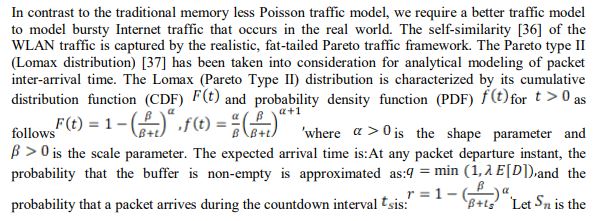
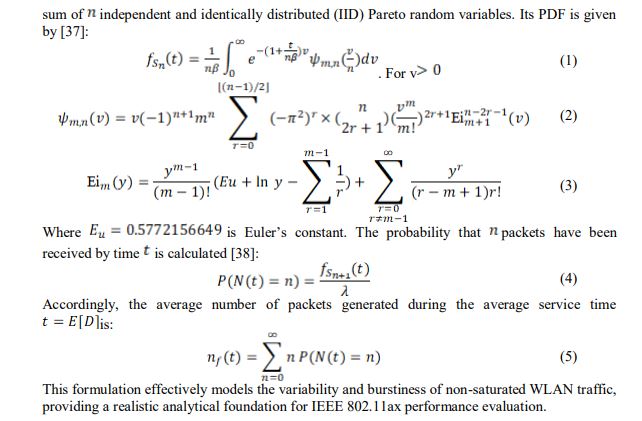
2.3. Pareto Traffic Model
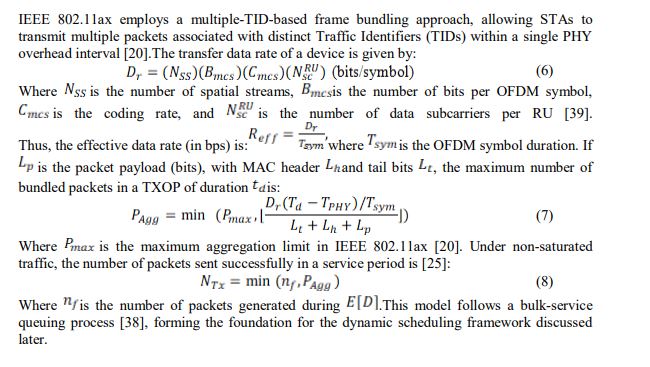
2.4. Actual Packet Transmission and Aggregation
2.5. Transmission Probability Derivation
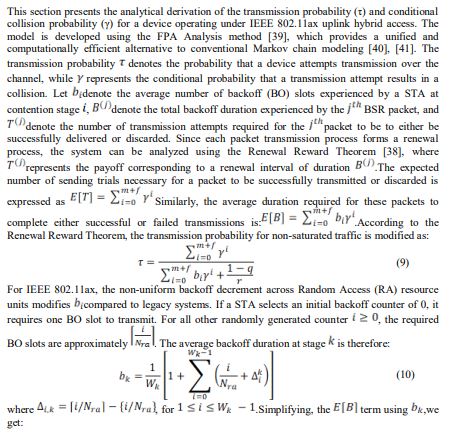
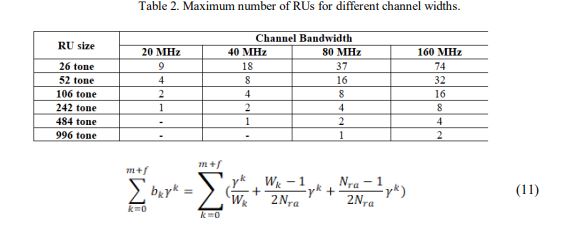
Substituting this expression into the transmission probability equation yields a non-linearmapping .According to Brouwer’s Fixed-Point Theorem [42], such a system admits a unique fixed-point solution for , provided that is a non-decreasing sequence.The steady-state transmission probability is then obtained by substituting the fixed-point value of into the above relation.
3. MU-TRANSMISSION & HA MECHANISM
3.1. Overview of OFDMA
OFDMA has been introduced in IEEE 802.11ax, which revolutionizes the mechanism of channel access in IEEE 802.11ax. In previous versions of the standard, where the channel was divided into only one station, OFDMA breaks the channel into many Resource Units (RUs). RU has a certain number of subcarriers or tones. One important physical layer improvement in IEEE 802.11ax is the decrease in subcarrier spacing by a factor of four along with an increase in the duration of OFDM symbols by four times, leading to more subcarriers in the same bandwidth.
The standard sizes of Resource Units in IEEE 802.11ax are 26, 52, 106, 242, 484, 996, and 2×996 tones. The number of RUs available depends on the bandwidth of the channel as well as the selected RU size (see Table 2). It is also important to note that multiple RUs can be with different sizes utilized in one OFDMA transmission.
3.2. Uplink OFDMA Frame Structure and Access Mechanisms
Figure 1 demonstrates the UL Multi-User hybrid access model employed by the IEEE 802.11ax protocol family, illustrating the sequential exchange of control and data frames between the AP and the connected STAs. The figure illustrates the two-dimensional approach, wherein the x-axis shows the ordering of frame exchange, and the y-axis shows the RU allocation in the frequency domain
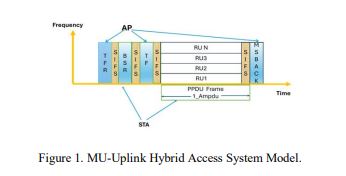
In the initial process, the Access Point transmits the Trigger Frame Request (TFR) control frame and share information on RU allocation with STAs. After sending the TFR, any STA with pending data ready to be transmitted in the UL initiates the Distributed Coordination Function (DCF) process by lowering its backoff (BO) counters. Those STAs whose BO counter values drop to zero will begin sending Buffer Status Reports (BSRs)
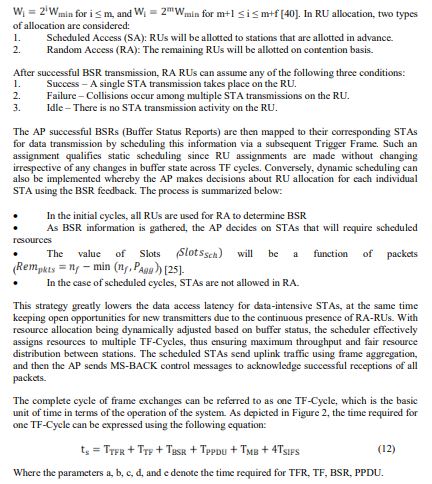
The contention resolution procedure employs the following algorithm: In case of collisions during data transmission, the BO index (i) is incremented by STAs until it reaches the value of , which signifies the maximum number of retransmission attempts allowed. The contention window size is determined using a binary exponential backoff algorithm, where
3.3. MU-MIMO Integration and Channel Sounding
The implementation of MU-MIMO is one of the great developments of IEEE 802.11ax that uses spatial diversity along with frequency and time domain utilized by OFDMA. As compared to the single-user MIMO that provides service for one station for each transmission opportunity, MUMIMO supports simultaneous communication with several stations through spatial streams. For our study, we use a combination approach in which MU-OFDMA operates during SA. Let denote the number of antennas at the AP; to fully utilize the MU-MIMO capability, all antennas are assumed active during scheduled transmissions. Consequently, simultaneously served STAs can be expressed as , where represents the number of resource units (RUs) allocated for scheduled access.
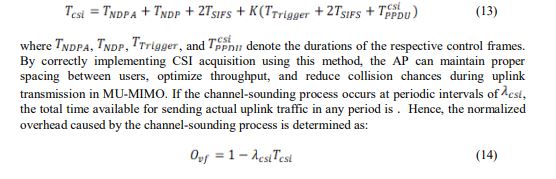
For efficient MU-MIMO operation, the AP requires accurate CSI to separate users spatially and minimize inter-user interference. Hence, a channel sounding procedure is periodically performed, initiated by the AP through a Null Data Packet Announcement (NDPA) frame followed by a Null Data Packet (NDP) frame, which allows STAs to estimate the channel. Subsequently, the AP triggers a subset of STAs to transmit their CSI feedback using the MU-OFDMA capability, enabling up to STAs to report their CSI simultaneously depending on the number of available RUs. When the total number of STAs exceeds , multiple sounding rounds (denoted by ) are required, each consisting of a Trigger frame followed by uplink CSI PPDUs. The total duration of the sounding process is given by [25]:
4. KEY PERFORMANCE METRICS ANALYSIS
4.1. Throughput
The throughput metric is considered to be the most important performance parameter in the IEEE 802.11ax technology. It measures the total amount of payload bits transferred successfully within one unit time for SA and RA stations
The mean number of successful transmissions per TF-cycle is given by
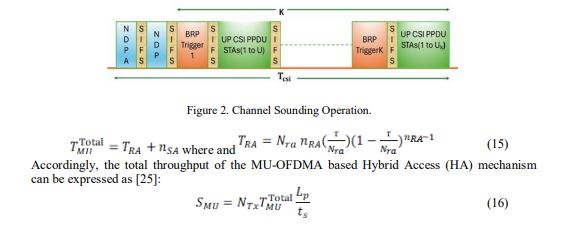
In MU-MIMO operation, .Under channel sounding overhead is considered, the achievable uplink throughput is reduced and can be expressed as:
4.2. RA Capability
RA Capability (RAC) measures how quickly new stations can join the network through random access. It represents the percentage of successful random-access attempts during one transmission TF cycleis calculated as:


