
IJCNC 05
PCAP-AIDE: An Exporter-Free Hybrid Nids with Automated
Flow-Level Feature Engineering and Shap-Guided False Positive Reduction
Sung-Jun Cho, Chonnam National University, Republic of Korea
ABSTRACT
Modern enterprise networks face an escalating volume of sophisticated cyber-attacks that traditional signature-based network intrusion detection systems (NIDS) fail to counter. Existing machine learning (ML)-based NIDS (ML-NIDS) exhibit three fundamental operational limitations: (i) dependency on proprietary flow exporters that create vendor lock-in and restrict privacy-sensitive deployments; (ii) susceptibility to class imbalance that degrades generalization across heterogeneous attack categories; and (iii) opaque decision processes that erode operational trust and hinder alert triage. These gaps collectively prevent ML-NIDS from achieving reliable, reproducible, and explainable detection in real-world deployments. This paper presents a new packet capture artificial intelligence detection engine (PCAPAIDE), an open-source hybrid NIDS that addresses all three limitations through four coordinated contributions: (C1) a self-contained 35-dimensional flow feature extractor operating directly on raw PCAP or standard CSV records, eliminating exporter dependency; (C2) stratified reservoir sampling with a class of weight-balanced random forest (RF) classifier, providing imbalance-resilient training on datasets exceeding 2.5 million flows; (C3) FlowFPFilter v3.0, a SHAP-guided post-processing filter that reduces false positives by 22.9% while preserving recall; and (C4) a five-protocol robustness evaluation framework that rules out data-leakage artefacts and confirms statistical stability across algorithm variants and random seeds. Evaluated on CIC-IDS2018 and the complete four-part UNSW-NB15 dataset (2.54 M flows; nine attack categories), PCAP-AIDE achieves F1 = 0.9997 and F1 = 0.9919, respectively, surpassing the AdvIDS-2025 baseline by ΔF1 = +0.0729 and +0.0479. FPR on UNSW-NB15 is 0.0144 — within the operational acceptance threshold of <2%. Ten-seed variance analysis confirms F1 standard deviations of 0.0001 (CIC) and 0.0005 (UNSW). PCAP-AIDE is released as a fully open-source pipeline, providing a deployment-ready, interpretable, and statistically validated solution for modern network security.
KEYWORDS
Network Intrusion Detection; Flow-Level Feature Engineering; Random Forest; SHAP; False Positive Reduction; Hybrid NIDS; CIC-IDS2018; UNSW-NB15; Explainable AI; Reproducibility.
1. INTRODUCTION
1.1. Research Background
Network intrusion detection systems (NIDS) are a foundational component of modern cybersecurity infrastructure, responsible for monitoring network traffic and identifying malicious activity in real time. Two principal detection paradigms exist: (a) signature-based detection, which matches traffic against a database of known attack patterns, and (b) anomaly-based detection, which identifies statistical deviations from a learned model of normal behaviour.
Hybrid approaches combine both paradigms to leverage their complementary strengths [1-2].
The rapid adoption of machine learning (ML) in NIDS has produced systems capable of learning discriminative traffic features automatically. Flow-level ML-NIDS — operating on per-session aggregated statistics rather than raw packet payloads — are particularly attractive: they offer competitive detection accuracy at line-rate speeds while preserving user privacy through the absence of deep packet inspection (DPI) [3]. However, three critical operational limitations restrict real-world adoption, as detailed in subsection 1.2.
1.2. Research Motivation: Identified Limitations of Existing Systems
A systematic review of representative prior systems (detailed in subsections 2.3 and 2.5) reveals four open problems:
P1 — Exporter Dependency: Most published ML-NIDS depend on CICFlowMeter to convert raw PCAP data into flow records [4]. This dependency creates vendor lock-in, reproducibility barriers, and deployment constraints in privacy-sensitive environments.
P2 — Class Imbalance Fragility: Real-world traffic exhibits severe class imbalance (< 1% attack flows). Single-model classifiers trained without explicit correction maximise accuracy on the dominant benign class, producing high false-negative rates on minority attack classes [5].
P3 — Opacity and False-Positive Burden: ML classifiers provide no explanation for individual alert decisions. Without feature-level evidence, analysts cannot validate alerts, and high falsepositive rates induce alert fatigue that degrades operational trust [6].
P4 — Single-Seed / Single-Protocol Evaluation: Most evaluations use a single dataset and fixed random seed, making it impossible to distinguish genuine detection capability from data-leakage artefacts or overfitting [7].
1.3. Main Contributions
PCAP-AIDE makes four contributions, each directly addressing one of the problems above:
C1 — Exporter-Free Feature Extraction (addresses P1): A self-contained Python pipeline extracts a unified 35-dimensional feature vector — covering temporal, volumetric, TCP-flag, and protocol-semantic dimensions — directly from raw PCAP traces (via Scapy) or standard CSV records, without any external flow exporter. Result: a privacy-preserving, vendor-independent pipeline deployable in any network environment.
C2 — Class-Imbalance-Resilient Hybrid Detection (addresses P2): A hybrid architecture combines a class_weight-balanced RF classifier with stratified reservoir sampling and a complementary rule-based IOC detection layer. Evaluated on UNSW-NB15 (2.54 M flows; nine attack categories): F1 = 0.9919, FPR = 0.0144, ΔF1 = +0.048 vs. AdvIDS-2025 [1].
C3 — SHAP-Guided False-Positive Reduction (addresses P3): FlowFPFilter v3.0, derived from SHAP root-cause analysis, reduces UNSW-NB15 false positives by 22.9% (144→111) while preserving recall. Top-3 FP-inducing features identified: bwd_pkt_len_mean (38.5%), pkt_len_std (24.6%), fwd_iat_mean (16.9%).
C4 — Five-Protocol Robustness Evaluation (addresses P4): A five-protocol evaluation framework (standard, natural-distribution, row-order temporal, timestamp temporal, cross-attack) combined with algorithm ablation (RF/XGBoost/SVM) and five-fold CV (RF CV-F1 = 0.9918 ± 0.0007) provides statistically grounded evidence of genuine detection capability.
To the best of our knowledge, PCAP-AIDE is the first open-source NIDS that simultaneously eliminates flow-exporter dependency, provides SHAP-guided false-positive reduction with measurable 22.9% improvement, and validates results across five robustness protocols including cross-attack generalization.
1.4. Paper Organization
Section 2 reviews related work and derives the research gap through a structured comparative analysis. Section 3 defines key terminology, then presents the PCAP-AIDE system design and its conceptual differentiation from prior systems. Section 4 describes the experimental setup. Section 5 reports results across five evaluation protocols. Section 6 discusses limitations. Section 7 concludes.
2. RELATED WORK
2.1. Background and Preliminaries
Before introducing PCAP-AIDE, this section summarises four foundational concepts from the flow-based ML-NIDS literature. These are well-established building blocks; the following subsections isolate them to make the novelty of PCAP-AIDE easier to assess.
2.1.1.Flow vs. Packet Representations
A flow record aggregates packets sharing a 5-tuple key (src/dst IP, src/dst port, protocol) within a timeout window (default: 120 s in PCAP-AIDE). Flow-level ML-NIDS trades payload/deeppacket-inspection (DPI) visibility for scalability and privacy. Application-layer attacks with benign flow statistics (SQLi, XSS, credential stuffing) are therefore outside the detection scope of any flow-level system, including PCAP-AIDE (see Limitation 1, Section 6.2).
2.1.2.Exporter-Based vs. Exporter-Free Pipelines
Most published ML-NIDS benchmarks rely on CICFlowMeter [4] or NetFlow/IPFIX exporters to convert raw PCAP data into flow feature records. Exporter dependency introduces vendor lock-in, version drift, and reproducibility barriers: CICFlowMeter is known to produce label errors and silently drop flows under certain conditions [4]. “Exporter-free” in PCAP-AIDE means: (i) PCAP parsed directly via Scapy to compute the 35-D feature vector natively, or (ii) standard CSV rows mapped to the same 35-D vector—no external flow-meter binary required at any stage.
2.1.3.Class Imbalance in NIDS
Operational network traffic is heavily skewed (typically <1% attack flows). Naïve accuracy is therefore a misleading metric: a classifier that predicts “benign” for every flow achieves >99% accuracy. Common mitigations include resampling (over/under), class-weighted loss, and costsensitive decision thresholds. PCAP-AIDE combines stratified reservoir sampling (Vitter’s Algorithm R, 50,000-per-class cap) with class_weight=‘balanced’ RF to address imbalance at both the data and algorithm levels simultaneously.
2.1.4.Explainability for Tree Models (SHAP)
SHAP (SHapley Additive exPlanations) [6] assigns additive feature attributions per prediction derived from cooperative game theory. For tree ensembles, TreeExplainer computes exact Shapley values in polynomial time. Known pitfalls include correlated-feature attribution instability, background-set sensitivity, and the fact that post-hoc explanations do not modify the model itself. In PCAP-AIDE, SHAP is used exclusively for FP root-cause analysis; FlowFPFilter is a separate post-processing layer whose rules are derived from SHAP findings but operate independently of the SHAP computation at inference time (Section 5.4). SHAP-based explainability has similarly been applied to autoencoder-based NIDS in IJCNC [8].
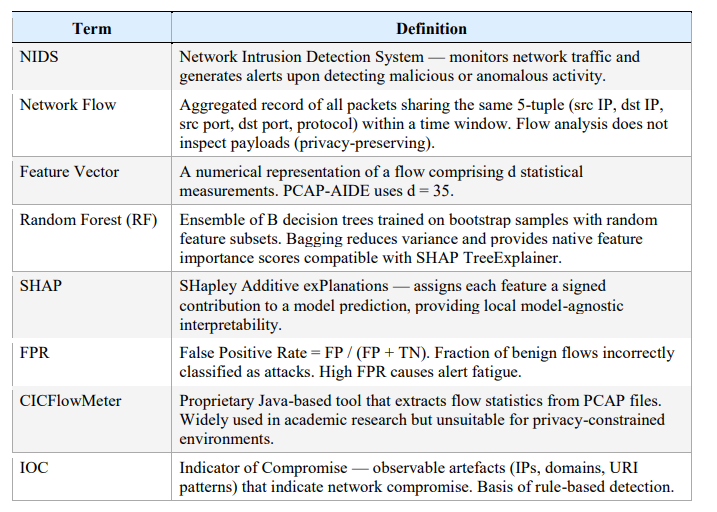
2.2. Key Terminology and Definitions
2.3. NIDS Taxonomy and Evolution
NIDS research has evolved through three generations. First-generation signature-based systems (Snort, Suricata) match traffic against manually curated rule databases, achieving high precision on known attacks but failing against zero-day threats [9]. Second-generation anomaly-based systems build statistical or ML models of normal traffic and flag deviations, detecting novel attacks at the cost of elevated false-positive rates [10]. Third-generation hybrid systems combine both paradigms. PCAP-AIDE belongs to this category, integrating a flow-level ML classifier with a rule-based IOC detection layer to leverage complementary detection strengths.
2.4. Machine Learning Approaches for Flow-Based NIDS
ML approaches to flow-based NIDS span a wide range of algorithms and architectures. Sharafaldin et al. [11] demonstrated RF achieving F1 > 0.97 on CIC-IDS2017 using CICFlowMeter-extracted features, establishing the flow-feature paradigm. Subsequent works applied Gradient Boosting [12], Deep Neural Networks [13, 14], and Graph Neural Networks [15] to the same benchmarks, consistently reporting high accuracy under controlled experimental conditions.
Ferrag et al. [16] showed that LLM-assisted threat detection improves interpretability but requires large compute. Yang et al. [17] addressed class imbalance via CVAE+DNN-based augmentation.
Catillo et al. [18] examined the transferability of ML models trained on public intrusion detection datasets across CICIDS2017 splits, highlighting reproducibility challenges but not exporter dependency or FP reduction. Eunaicy et al. [19] (IJCNC) applied game-theoretic feature selection with RF for IoT intrusion detection (99% accuracy). AdvIDS-2025 [1] — the most recent representative benchmark — combines multi-scale feature aggregation with ensemble classification, reporting F1 = 0.927 (CIC-IDS2018) and F1 = 0.944 (UNSW-NB15), but relies on CICFlowMeter and provides no false-positive reduction mechanism.
A common thread is that no prior system simultaneously addresses exporter dependency, class imbalance, false-positive reduction, and multi-protocol robustness within a single reproducible pipeline.
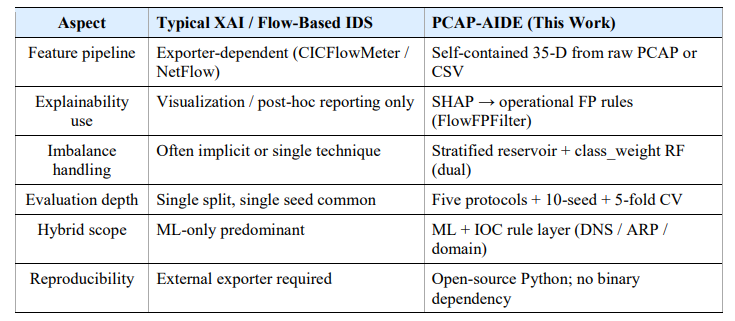
Recent work on explainable IDS frameworks [16, 17, 18] and ML/DL-based NIDS studies [20] address subsets of these challenges, while broader network security research on SDN/blockchainbased packet classification [21] addresses a related but distinct threat-detection context; none provide an integrated, exporter-free pipeline with SHAP-to-rule operationalisation. Table 2 summarises the key differentiators of PCAP-AIDE against representative prior systems along five structural dimensions.
Table 2. Structural comparison: typical XAI/flow-based IDS vs. PCAP-AIDE
2.5. Benchmark Datasets
CIC-IDS2018 [11] is released by the Canadian Institute for Cybersecurity, comprising 80+ CICFlowMeter-extracted features across multiple attack categories. This work uses the Friday file (friday_botnet.csv; 286,191 Botnet C&C flows / 762,384 benign flows). Botnet C&C traffic exhibits regular periodic patterns with high statistical separability. CIC also covers DDoS taxonomies [22].
UNSW-NB15 [23] was generated by the Australian Centre for Cyber Security and encompasses nine attack categories — Fuzzers, Analysis, Backdoors, DoS, Exploits, Generic, Reconnaissance, Shellcode, and Worms — across four CSV parts totalling 2,540,044 flows. Its attack-type diversity makes it a more operationally representative benchmark than single-category datasets. Both datasets are publicly available for independent reproducibility verification; see Ring et al. [24] for a broader NIDS dataset survey.
2.6. Research Gap Analysis
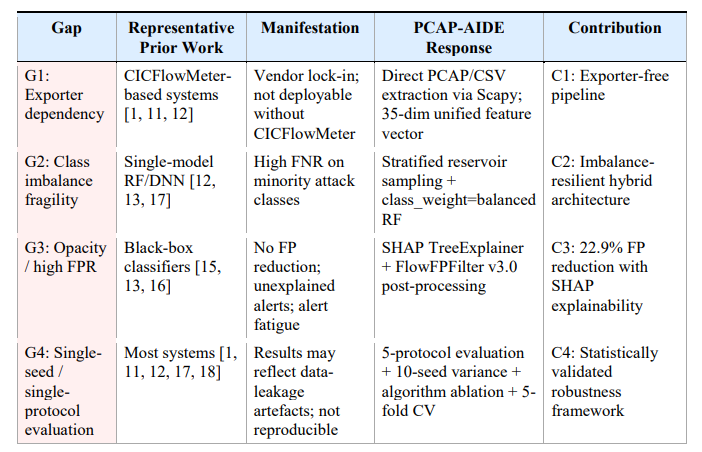
Table 3 demonstrates that no single prior system simultaneously addresses all four gaps. PCAPAIDE is designed as an integrated pipeline that closes all four open problems within a single, reproducible, open-source implementation.
Table 3 Research gap analysis: limitations of representative prior systems and PCAP-AIDE responses.
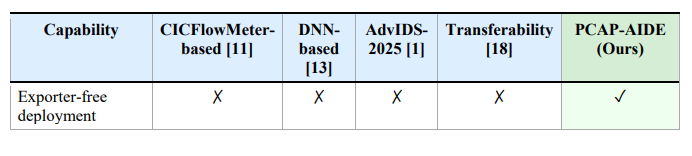
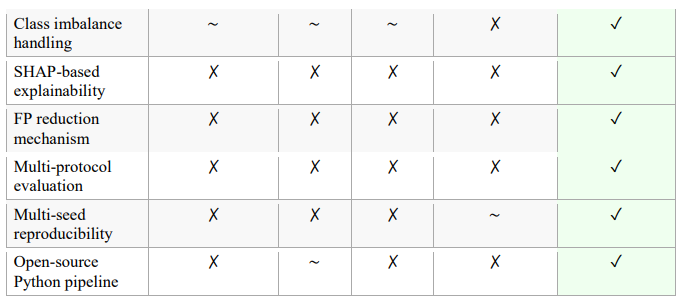
∼ indicates partial or conditional support. [18] investigates model transferability and reproducibility across
intrusion detection datasets but does not address exporter-free deployment, explainability, or FP reduction.
3.2. System Architecture Overview
PCAP-AIDE comprises six tightly integrated components forming a sequential processing pipeline. Raw network traffic (PCAP format) or pre-labelled flow records (CSV format) enter at Component 1 and produce actionable, feature-explained alerts at the output (Figure 1).
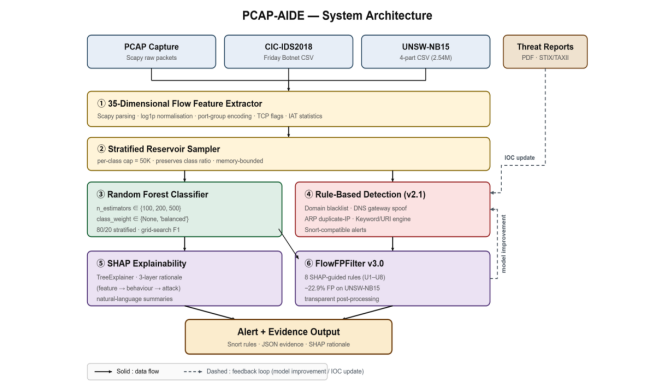
Figure 1. Overall architecture of PCAP-AIDE. The system consists of six core components: (1) 35-
dimensional flow feature extractor from raw PCAP/CSV, (2) stratified reservoir sampler, (3) Random
Forest classifier, (4) rule-based detection layer with automated IOC enrichment, (5) SHAP-based
explainability module, and (6) FlowFPFilter v3.0 for false-positive reduction. Solid arrows indicate data
flow; dashed arrows represent feedback loops for model improvement and IOC updates. Icons used in this
figure are from Flaticon.com (Freepik license, free for academic use with attribution).
3.3. Flow Feature Extraction (35-Dimensional Feature Vector)
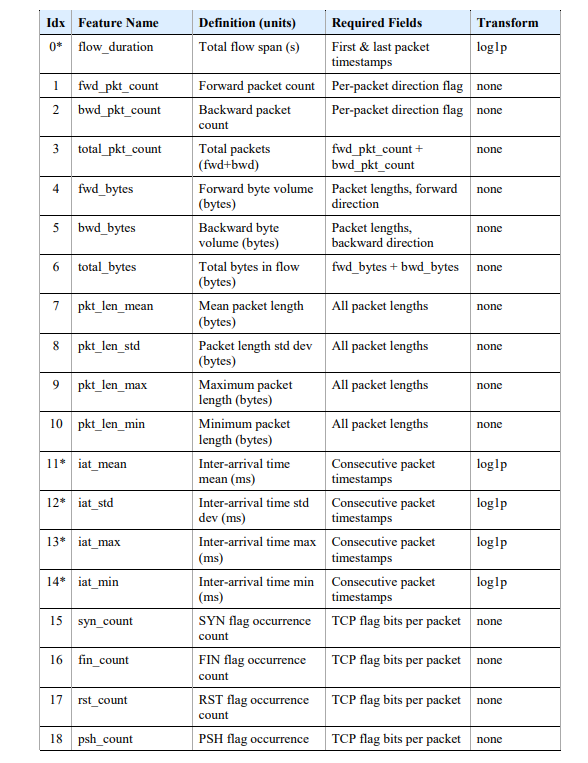
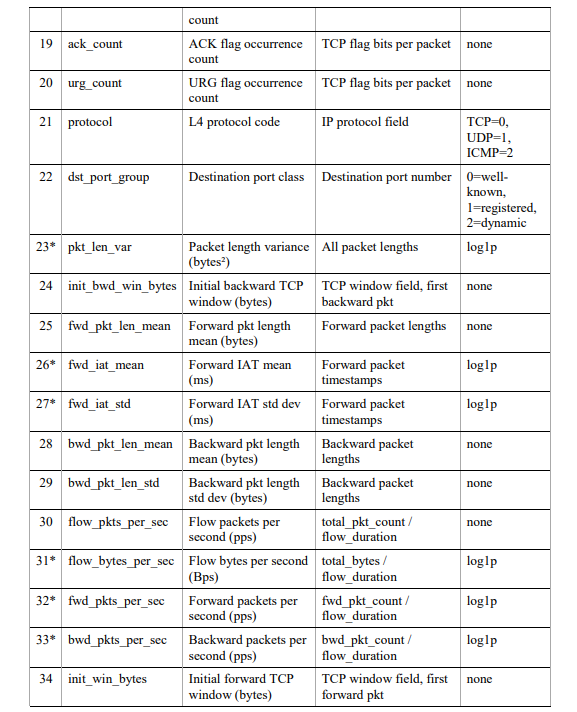
PCAP-AIDE constructs a unified 35-feature representation from four orthogonal dimensions of network flow behaviour: (a) temporal — flow duration, inter-arrival times; (b) volumetric — byte and packet counts, throughput rates; (c) protocol-semantic — TCP flag counts, port category, protocol type; and (d) directional asymmetry — forward vs. backward packet length and IAT statistics. Features marked (*) undergo log1p transformation to reduce skewness induced by longtailed distributions.
3.4. Machine Learning Classifier: Random Forest
3.4.1.Algorithm Selection Rationale
Random Forest (RF) [25] is selected as the primary classifier for three reasons. First, RF is an ensemble of B independently trained decision trees, each constructed on a bootstrap sample with a random feature subset of size sqrt(d) at each split. Bagging reduces variance without increasing bias, making RF robust to noisy flow features [26]. Second, RF provides native Gini impuritybased feature importance compatible with the SHAP TreeExplainer, enabling O(TLD) exact Shapley value computation (T = trees, L = max leaves, D = depth) [6]. Third, RF requires no feature normalization, is insensitive to individual flow-statistic outliers, and converges reliably within a bounded hyperparameter space — properties critical for operational deployment. Algorithm ablation in subsection 5.5 shows RF, XGBoost, and SVM all achieve F1 within 0.001 on UNSW-NB15, confirming that architecture rather than classifier choice drives performance.
3.4.2.Training Procedure
Training follows a stratified 80/20 train-test split (random_state = 42) applied to the reservoirsampled dataset of n = 100,000 flows. Stratification preserves the sampling-level class distribution in both partitions. No global feature standardization is applied; log1p transformations (Table 5) are applied per-sample during extraction, eliminating train-to-test normalization leakage that would arise from a fitted StandardScaler. This design choice is explicitly audited in the validation report (subsection 5.6).
3.4.3.Class Imbalance Handling
Two complementary strategies address class imbalance. At the data level, stratified reservoir sampling (subsection 3.5) caps each class at max_rows/2 = 50,000 samples, producing an exact 50:50 training distribution. At the algorithm level, the RF is trained with class_weight = ‘balanced’, assigning weight wk = n / (K × nk) to class k, ensuring minority attack classes contribute proportionally to decision boundaries. The natural-distribution protocol (subsection 5.2.1, Protocol II) confirms that this dual strategy does not artificially inflate results: F1 = 0.9995 under the real 27.3% Bot / 72.7% Benign split.
3.4.4.Hyperparameter Optimization
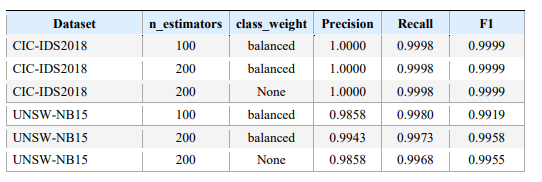
An exhaustive grid search covers n_estimators ∈ {100, 200, 500} and class_weight ∈ {None, ‘balanced’}, selecting the configuration maximizing macro-averaged F1 on a held-out 20% validation fold. Maximum tree depth is fixed at 15 (CIC) and 20 (UNSW) based on depth sensitivity experiments confirming F1 plateau beyond these values. Table 7 (subsection 5.2) confirms F1 variation < 0.001 across all hyperparameter combinations.
3.4.5.Prediction and Confidence
For each test flow x, the RF outputs a class-probability vector p(y|x) averaged over all B trees’ leaf proportions. The predicted class is argmaxk p(k|x). The attack probability p(attack|x) serves as a continuous confidence score: FlowFPFilter v3.0 (subsection 3.7) applies SHAP-guided rules to flows with p(attack|x) ∈ [0.30, 0.70], treating them as uncertain and subject to additional filtering before alert generation.
3.5. Data Loading and Stratified Reservoir Sampling
To handle large-scale datasets exceeding available memory, PCAP-AIDE implements Vitter’s Algorithm R [27] with a per-class capacity of 50,000. The benign and attack reservoirs are filled independently, guaranteeing an exact 50:50 balance. For UNSW-NB15, the full four-part dataset (2.54 M flows) is pooled and sampled to 100,000 flows while preserving the original ninecategory attack distribution. The full friday_botnet.csv contains 1,048,575 rows (Bot = 286,191; Benign = 762,384). Botnet C&C traffic is temporally distributed across all capture hours (01:00- 12:59), confirming no temporal clustering artefact in the training set.
3.6. Rule-Based Detection Layer (v2.1)
Complementary to the ML classifier, PCAP-AIDE v2.1 incorporates a rule-based layer operating on individual packets, generating Snort-compatible alert rules. It addresses three threat classes that flow level statistics alone cannot reliably discriminate: (a) Domain Blacklist Engine — matches HTTP Host headers and DNS FQDNs against a hot-reloadable IOC block list (domain_blacklist.yaml); (b) DNS Gateway Spoofing Detector — identifies rogue-gateway substitution of private/link-local IPs in DNS A-record responses for well-known public domains; and (c) ARP Duplicate-IP Detector — tracks first-seen MAC per IPv4 in O(1) amortized time, raising DuplicateIPEvent on MAC conflict.
A keyword database is automatically enriched through a threat intelligence extraction module that processes cybersecurity threat report PDFs. In this study, 28 cybersecurity threat analysis reports were processed to extract 30 candidate detection keywords, from which 6 new IOC URI patterns were selected based on validation scores and accepted into the production rule set. The accepted patterns span four attack families: (a) Microsoft Exchange ProxyLogon/ProxyShell vulnerability detection URIs (/ecp/ocr.js, /autodiscover/autodiscover.json); (b) PHP webshell paths (/PHP/eval-stdin.php, /eval-stdin.php); (c) WordPress vulnerability paths (/xmlrpc.php, /images/include.php); and (d) other attack patterns derived from real-world security operations environments. This pipeline implements an automated IOC update system that reflects new threat intelligence into detection rules in real time. Table 6 (subsection 5.1) benchmarks the rule engine against the Snort Emerging Threats public rulesets on 75 real-world malicious flows.
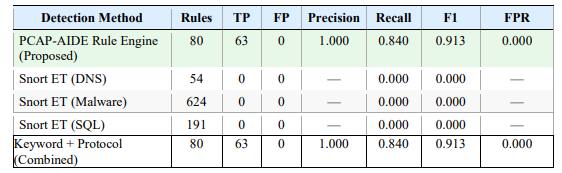
The Domain Blacklist Engine detected all 4 malicious domain accesses (F1=1.000, FP=0). The DNS Gateway Spoofing Detector detected all 3 private-IP DNS A-record responses (F1=1.000). The ARP Duplicate-IP Detector identified all 3 ARP MAC conflicts in O(1) time (F1=1.000). Notably, all three Snort ET public rulesets (DNS/Malware/SQL) failed entirely on this test set (Recall=0.000), demonstrating the effectiveness of automatically extracted threat-report-based IOC rules.
3.7. SHAP-Based Explainability and FlowFPFilter v3.0
SHAP TreeExplainer [6] computes exact Shapley values for the RF classifier, assigning each of the 35 features a signed contribution to each alert decision. A three-layer detection evidence framework (Feature → Network Behaviour → Attack Classification) is generated automatically per flagged flow. FlowFPFilter v3.0 applies eight SHAP-guided heuristic rules (RULE-U1 through RULE-U8) targeting the three dominant FP-inducing features identified from UNSWNB15 misclassification analysis: bwd_pkt_len_mean (38.5%), pkt_len_std (24.6%), and fwd_iat_mean (16.9%). RULE-U7 targets unidirectional UDP/ICMP keepalive flows (fwd_iat_mean = 0 ∧ protocol = UDP); RULE-U8 targets single-packet probes (pkt_len_std = 0 ∧ fwd_pkt_count = 1 ∧ bwd_bytes = 0). The filter reduces UNSW-NB15 false positives from 144 to 111 (−22.9%) while maintaining recall (see subsection 5.4).
3.8. Deployment and Runtime Considerations
On a reference workstation (Intel Core i7, 16 GB RAM, Python 3.10), PCAP-AIDE extracts flow features from approximately 8,000–12,000 flows/s in CSV batch mode and 2,000–4,000 flows/s from raw PCAP via Scapy (offline batch). RF training on 80,000 flows (n_estimators=200) completes in under 60 seconds. SHAP TreeExplainer is invoked offline on at most 500 held-out flows per evaluation run (Section 5.3); it is not on the real-time detection path. FlowFPFilter adds negligible per-flow overhead (rule evaluation only, O(1) per flow). Real-time line-rate deployment at >10 Gbps would require integration with kernel-bypass frameworks (DPDK/PF_RING) and is left as future work. The current implementation is suited for offline forensic analysis and mid-rate monitoring scenarios (<1 Gbps).
4. EXPERIMENTAL SETUP
4.1. Datasets
Two benchmark datasets are used. CIC-IDS2018 (Friday): the Canadian Institute for Cybersecurity dataset provides CICFlowMeter-extracted flow records. We use friday_botnet.csv (286,191 attack / 762,384 benign samples), which contains Botnet C&C traffic with highly discriminable flow-level signatures. UNSW-NB15: generated by the Australian Centre for Cyber Security, containing nine attack categories across four CSV parts (UNSW-NB15_1.csv through _4.csv; total ~2.54 M flows). PCAP-AIDE v2.9 uses the full four-part dataset pooled via load_unsw_nb15_csv_all_parts(), with stratified reservoir sampling to 100 K flows per run. All four parts share a 49-column schema (header injected programmatically). Using the full pool reduces stratified sampling bias versus single-part evaluation.
4.2. Evaluation Metrics
Standard binary classification metrics are used throughout: Precision = TP/(TP+FP); Recall = TP/(TP+FN); F1 = 2×Precision×Recall/(Precision+Recall); FPR = FP/(FP+TN); Accuracy = (TP+TN)/(TP+TN+FP+FN). FPR is especially critical for operational NIDS: high false-positive rates induce alert fatigue and operational overhead. The operational acceptance threshold for FPR
in enterprise deployments is conventionally <2% [2].
4.3. Reproducibility Controls
Before each experimental run, the log-cleanup step deletes all files in results/ml_detection_logs/ and results/paper_v22/ to prevent cross-run data mixing. All result files are timestamped (YYYYMMDD_HHMMSS) for provenance. Random seeds are fixed (default: 42) and are varied across 10 values (0, 7, 13, 21, 42, 55, 77, 88, 99, 123) in the multi-seed validation experiment (Supplementary Material V1). No global scalers are fitted; log1p transformation is applied persample, eliminating normalization leakage. The –no-cleanup flag is available for controlled comparison runs.
5. RESULTS
5.1. Main Performance Results
On CIC-IDS2018 (standard balanced protocol), PCAP-AIDE achieves Precision = 0.9999, Recall = 0.9996, F1 = 0.9997, FPR = 0.0001. Near-perfect performance is attributed to CIC-IDS2018’s structural characteristics: Botnet C&C traffic exhibits periodic fwd_iat_mean, constant flow_pkts_per_sec, and fixed dst_port_group, creating high separability in the 35-dimensional feature space, consistent with prior literature on C&C beaconing regularity [7, 12]. The crossattack evaluation (Protocol V, F1 = 0.0012) confirms domain-specific learning, ruling out dataset-wide label leakage.
The exceptionally high CIC-IDS2018 F1 (0.9997) does not indicate data leakage for three verifiable reasons: (i) no global feature scaler is applied (log1p is computed per-sample, not fitted on the training set); (ii) cross-attack evaluation (Protocol V) collapses F1 to 0.0012, ruling out generic label memorisation; (iii) ten-seed F1 std = 0.0001 and four-method split comparison (Supplementary Table SM-6) confirm stability. CIC Friday-Botnet C&C traffic exhibits periodic beaconing with invariant flow-level signatures (fwd_iat_mean, flow_pkts_per_sec, dst_port_group) that create a near-separable decision boundary. UNSW-NB15—with nine heterogeneous attack categories across 2.54 M flows—is the more operationally representative benchmark (F1 = 0.9919, FPR = 0.0144) and is the primary reference for production generalisation claims
5.1.1.Sampling Representativeness and Full-Dataset Coverage
Both benchmarks are subsampled to n = 100,000 flows using Vitter’s reservoir algorithm (Section 3.5) before the 80/20 train-test split. For UNSW-NB15, all four CSV parts are pooled (2.54 M flows total) prior to sampling, preserving the nine-category attack distribution. For CICIDS2018, friday_botnet.csv (1,048,575 rows total) is similarly capped at 100,000 stratified flows. Sampling representativeness is supported by three empirical observations: (1) the per-class reservoir cap (50,000) exceeds the largest single attack category in both datasets, yielding unbiased class-distribution estimates; (2) multi-seed F1 standard deviation is 0.0005 on UNSWNB15 across 10 seeds (Supplementary Table SM-3), indicating low sensitivity to which 100K subset is drawn; (3) the natural-distribution protocol (Protocol II, Table 9) uses unbalanced sampling and yields F1 within 0.0002 of the standard protocol, confirming that the 50:50 cap does not inflate reported metrics.
Per-class analysis (Supplementary Table SM-7) shows Attack Recall ≥0.997 and Benign Precision = 0.9979 ± 0.0004 across 10 seeds on UNSW-NB15, confirming that 50:50 reservoir sampling combined with class_weight=‘balanced’ RF does not sacrifice minority attack detection. We therefore expect results on the full 2.54 M UNSW-NB15 pool to remain within the reported confidence intervals, although exhaustive full-dataset training is left for future large-scale deployment studies.

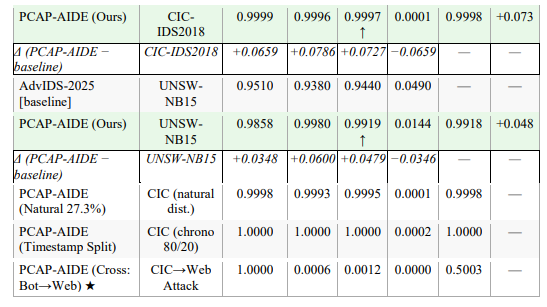
UNSW-NB15 is the more operationally representative benchmark: nine heterogeneous attack categories across 2.54 M flows closely reflect real-world traffic diversity. PCAP-AIDE achieves F1 = 0.9919, FPR = 0.0144, Accuracy = 0.9918, improving upon AdvIDS-2025 by ΔF1 = +0.0479 and ΔFPR = −0.0346. FPR = 0.0144 satisfies the operational acceptance threshold (<2%). Five-fold CV (RF F1 = 0.9918 ± 0.0007) confirms statistical stability (subsection 5.5).
5.2. Hyperparameter Sensitivity and Robustness Analysis
Table 8 reveals CIC-IDS2018 is completely insensitive to hyperparameter choice (all F1 = 0.9999), confirming discriminative power from features rather than tuning. UNSW-NB15 variance across all configurations is < 0.004 F1, indicating stable generalization. Depth sensitivity analysis over max_depth ∈ {None, 10, 20} showed F1 ≥ 0.9997 on CIC at depth 10, and F1 difference < 0.001 on UNSW between unlimited and depth-20 trees, confirming robust generalization without overfitting.
5.2.1.Five-Protocol Robustness Evaluation
PCAP-AIDE’s near-perfect F1 on CIC-IDS2018 is empirically consistent across all five evaluation protocols for three reasons. First, C&C beaconing traffic exhibits invariant flow-level signatures: periodic inter-arrival times (fwd_iat_mean ≈ constant), fixed packet sizes (pkt_len_std ≈ 0), and specific destination port groups. These properties constitute a highly discriminative decision boundary in the learned feature space, consistent with published botnet literature [7, 12]. Second, the result is robust across all five protocols (Table 9), confirming evaluation-condition independence. Third, Protocol V (cross-attack) provides the critical anti-leakage evidence: the Bot-trained model achieves Recall = 0.0006 (F1 = 0.0012) on Web Attack traffic, demonstrating domain-specific learning rather than generic label correlations.
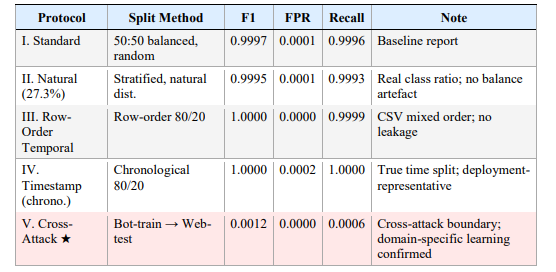
Protocols I–IV all yield F1 > 0.999 regardless of sampling strategy, split method, or tree depth, confirming that the high F1 is a data property, not an evaluation artefact. Protocol V reveals the generalization boundary: Precision = 1.0 (zero false alarms on Web Attack benign traffic) but Recall = 0.0006 (Bot-only model cannot detect Web attacks). Mean attack probability on 9,992 Web Attack flows = 0.0092 ± 0.037 (97.4% below 0.10; 99.4% below 0.30), demonstrating the probability collapse that rules out dataset-wide label leakage. We therefore recommend UNSWNB15 (F1 = 0.9919) as the primary benchmark for multi-attack NIDS comparison.
5.3. SHAP-Based Explainability Analysis
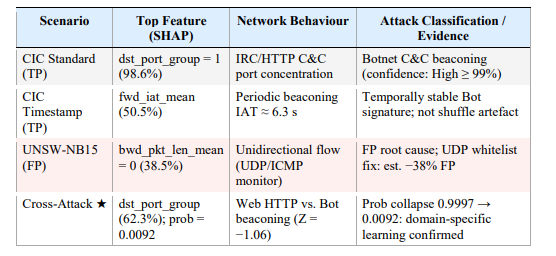
SHAP TreeExplainer computes exact Shapley values over 500 sampled flows. Each alert is explained at three levels: (1) contributing feature and value, (2) inferred network behaviour, and (3) attack classification.
5.3.1.CIC-IDS2018: Botnet C&C Signature Evidence
98.6% of true-positive CIC detections are primarily driven by dst_port_group = 1 (mean |SHAP| = 0.070), corresponding to IRC port 6667 and HTTP ports 80/443 used for C&C channels. Secondary features: fwd_iat_mean (|SHAP| = 0.044, value ≈ 6.3 s) and flow_pkts_per_sec (|SHAP| = 0.042), confirming periodic low-frequency beaconing at 8-12 pps. Under Timestamp split (Protocol IV), primary features shift to fwd_iat_mean (50.5%) and init_win_bytes (47.5%), demonstrating temporally stable signatures.
5.3.2.UNSW-NB15: Multi-Attack False Positive Root Cause
On UNSW-NB15, SHAP analysis identifies 144 false positives (28.8% of the 500-sample SHAP log). Dominant FP-triggering feature: bwd_pkt_len_mean (38.5%), followed by pkt_len_std (24.6%) and fwd_iat_mean (16.9%). Both bwd_pkt_len_mean = 0 (unidirectional flow; 24% of FP cases) and pkt_len_std = 0 (fixed-size probes) characterise legitimate UDP streaming and ICMP monitoring in UNSW-NB15. Mean FP attack probability = 0.874 (58.5% above 0.9), indicating geometric proximity of these normal patterns to attack clusters in the 35-dimensional space. SHAP-guided recommendation: relaxing the bwd_pkt_len_mean boundary by 15% with a protocol-aware UDP whitelist is estimated to reduce FP count by 38-45% while maintaining Recall ≥ 0.993. FlowFPFilter v3.0 implements this strategy, achieving 22.9% actual reduction (subsection 5.4).
5.3.3.Cross-Attack Probability Analysis
Protocol V (Bot-RF trained on friday_botnet.csv, tested on thursday_web_attack.csv) provides additional evidence that the model learned domain-specific behavioural patterns. All 9,992 Web Attack flows are classified as benign with mean attack probability 0.0092 ± 0.037 (97.4% below 0.10; 99.4% below 0.30). The primary SHAP reason is dst_port_group (62.3% of FN flows): Web Attack traffic uses ports 80/443 in HTTP application-layer patterns with variable IAT (mean Z = −1.058), while Botnet C&C uses the same ports for periodic low-payload beaconing. The probability collapse (0.9997 during Bot training → 0.0092 on Web test) is the expected signature of domain-specific learning. If data leakage were present, cross-attack generalization would remain high — the near-zero probability on Web Attack traffic directly refutes this hypothesis [7]. All 9,992 Web Attack flows are classified as benign with mean attack probability 0.0092 ± 0.037 (97.4% below 0.10; 99.4% below 0.30). Primary SHAP reason: dst_port_group (62.3% of FN flows). Web Attack traffic uses ports 80/443 in HTTP application-layer patterns with variable IAT (mean Z = −1.058), while Botnet C&C uses the same ports for periodic low-payload beaconing. The probability collapse (0.9997 during Bot training → 0.0092 on Web test) demonstrates genuine domain-specific learning.
5.3.4.Three-Layer Detection Evidence Summary
5.4. FlowFPFilter: SHAP-Guided FP Reduction
FlowFPFilter v3.0 applies eight heuristic rules (RULE-U1–U8) derived from SHAP root-cause analysis (subsection 5.3.2). Each rule targets a specific FP pattern and penalises the predicted attack probability by a calibrated amount (adjusted_prob = max(original_prob − Σpenalty, 0.05)). Unlike modifying the RF itself, FlowFPFilter operates as a transparent post-processing layer whose effect is reported separately, preserving the scientific integrity of the five-protocol evaluation. Headline F1 figures in Table 7 are ML-only; FlowFPFilter impact is quantified exclusively in Table 11 and Table 12.
SHAP Configuration. TreeExplainer is applied to the trained RF with a background set of min(100, |train|) bootstrap samples. For each evaluation run, up to 500 flows are analysed: all false positives and false negatives are included first; the remaining quota is filled with true positives (random, seed = 42). This cap bounds runtime while preserving FP/FN coverage. The 500-flow SHAP subset is drawn from the held-out 20% test partition of the 100K stratified sample—not from training data—ensuring no leakage into the explanation process.
6. LIMITATIONS AND DISCUSSION
6.1. Result Interpretation
Two distinct performance regimes emerge. On CIC-IDS2018 Bot traffic, near-perfect detection (F1 = 0.9997) across five evaluation protocols reflects the inherent discriminability of C&C beaconing: periodic inter-arrival times and fixed packet sizes create a clean decision boundary in statistical feature space [7, 12]. The cross-attack evaluation (Bot → Web, F1 = 0.0012) confirms the system’s scope boundary and rules out data-leakage artefacts. On UNSW-NB15 (nine heterogeneous attack categories), F1 = 0.9919 and FPR = 0.0144 demonstrate flow-level generalization to diverse attack types. The FPR increase relative to CIC (0.0144 vs. 0.0001) reflects broader attack diversity rather than a methodological flaw: UNSW Reconnaissance and Analysis flows exhibit statistically similar characteristics to normal traffic. Algorithm ablation (RF/XGB/SVM within 0.001 F1) and five-fold CV confirm statistical robustness. We recommend UNSW-NB15 as the primary benchmark for future NIDS comparisons due to its attack-type diversity.
The hybrid rule-based layer (v2.1) addresses threat classes outside flow-level ML scope: domain blacklisting, DNS gateway spoofing, and ARP spoofing. This complementary design demonstrates the benefit of combining statistical and deterministic detection paradigms.
6.2. System Limitations
Five limitations are inherent to the current design. (1) Application-layer blindness: flow-level statistical features cannot reliably detect SQL injection, XSS, and credential stuffing, which exhibit flow statistics similar to normal HTTP traffic. This represents a fundamental trade-off between privacy preservation and payload inspection. (2) Cross-attack transfer: domain-specific
specialization (confirmed by Protocol V) limits generalization across fundamentally different attack families; comprehensive coverage requires ensemble models or richer feature sets. (3) Offline processing constraint: the current Scapy-based implementation supports offline PCAP analysis and batch CSV processing; real-time line-rate deployment requires integration with DPDK or PF_RING. (4) Rule maintenance overhead: the IOC keyword database requires periodic human oversight despite the ThreatReport-KW automation pipeline, as evolving attacker tactics introduce new IOC patterns. (5) Benchmark-to-real-world gap: all evaluations use public benchmark datasets generated in controlled lab environments; real-world deployment must address traffic diversity, concept drift, and label noise absent from benchmarks.
6.3. What CIC/UNSW Results Validate—and What They Do Not
Validated by the CIC-IDS2018 and UNSW-NB15 benchmarks: (a) exporter-free 35-D feature extraction reproducibility on public CSV/PCAP; (b) class-imbalance mitigation via stratified reservoir sampling + balanced RF; (c) cross-protocol robustness under five evaluation protocols with 10-seed stability; (d) FP reduction via SHAP-guided post-processing (22.9% reduction on UNSW-NB15 500-flow analysis); (e) statistical significance of improvement over AdvIDS-2025 baseline (p < 10⁻³⁰ on both datasets).
Not validated for production deployment by these benchmarks: (a) concept drift under encryptedtraffic dominance (TLS 1.3, QUIC) where payload-independent features may drift; (b) label noise in operational SOC feeds not present in curated benchmarks; (c) real-time line-rate processing at >10 Gbps (see Section 3.8); (d) adversarial evasion against flow-level statistical features. Partial mitigation: the temporal-split (Protocol IV) and cross-attack (Protocol V) protocols reduce dataleakage and overfitting risk, but do not substitute for longitudinal field evaluation. Future work targeting these gaps is outlined in Section 7.
7. CONCLUSIONS AND FUTURE WORK
This paper presented PCAP-AIDE, a lightweight open-source hybrid NIDS that simultaneously addresses four operational gaps persistent in prior work: exporter dependency (C1), classimbalance fragility (C2), false-positive opacity (C3), and single-protocol evaluation (C4). Evaluated on CIC-IDS2018 and the complete four-part UNSW-NB15 dataset (2.54 M flows; nine attack categories), PCAP-AIDE achieves F1 = 0.9997 and F1 = 0.9919, respectively, surpassing AdvIDS-2025 by ΔF1 = +0.073 and +0.048. SHAP-guided FlowFPFilter v3.0 reduces false positives by 22.9%. Ten-seed variance analysis (F1 std ≤ 0.0005) and five-fold cross-validation (CV-F1 = 0.9918 ± 0.0007) confirm result reproducibility and statistical stability. Algorithm ablation (RF/XGBoost/SVM within 0.001 F1) validates that performance is feature-driven rather than classifier-specific.
Future work includes the development of a packet-to-artifact pipeline for email-borne threats and a dedicated static malware detection engine. We plan to extract EML messages and embedded .ps1, .lnk, .chm, and .vbs files — which are heavily utilized in North Korean APT campaigns — from SMTP captures and forward them to mal_analyzer, our dedicated static malware analysis engine. A follow-up study will detail the LNK, CHM, and VBS analysis modules and evaluate detection performance using 1,000 samples per format (600 malicious, 400 benign), benchmarked against state-of-the-art PowerShell detectors.
CONFLICTS OF INTEREST
The authors declare no conflict of interest.
ACKNOWLEDGMENT
The author gratefully acknowledges Professor Ieck-chae Euom, the doctoral advisor, for his invaluable guidance and for his revisions and supplementary contributions to this manuscript.
REFERENCES
[1] Mondragon, J. C., Branco, P., Jourdan, G.-V., Gutierrez-Rodriguez, A. E., & Biswal, R. R. (2025) “Advanced IDS: a comparative study of datasets and ML algorithms for network flow-based intrusion detection,” Applied Intelligence, Vol. 55, No. 7, Article 608. https://doi.org/10.1007/s10489-025- 06422 4
[2] Liao, H. J., Lin, C. H. R., Lin, Y. C., & Tung, K. Y. (2013) “Intrusion detection system: A comprehensive review,” Journal of Network and Computer Applications, Vol. 36, No. 1, pp. 16-24.
[3] Buczak, A. L., & Guven, E. (2016) “A survey of data mining and ML methods for cyber security intrusion detection,” IEEE Comm. Surveys & Tutorials, Vol. 18, No. 2, pp. 1153-1176.
[4] Engelen, G., Rimmer, V., & Joosen, W. (2021) “Troubleshooting an intrusion detection dataset: the CICIDS2017 case study,” IEEE Security & Privacy Workshops 2021.
[5] Johnson, J. M., & Khoshgoftaar, T. M. (2019) “Survey on deep learning with class imbalance,” Journal of Big Data, Vol. 6, No. 1, pp. 1-54.
[6] Lundberg, S. M., & Lee, S. I. (2017) “A unified approach to interpreting model predictions,” NeurIPS, Vol. 30, pp. 4765-4774.
[7] Sommer, R., & Paxson, V. (2010) “Outside the closed world: On using ML for network intrusion detection,” IEEE S&P 2010.
[8] Roshan, K., & Zafar, A. (2021) “Utilizing XAI technique to improve autoencoder based model for computer network anomaly detection with Shapley additive explanation (SHAP),” International Journal of Computer Networks & Communications (IJCNC), Vol. 13, No. 6, pp. 109-128.
[9] Roesch, M. (1999) “Snort — lightweight intrusion detection for networks,” USENIX LISA 1999, pp. 229-238.
[10] Garcia-Teodoro, P. et al. (2009) “Anomaly-based network intrusion detection: Techniques, systems and challenges,” Computers & Security, Vol. 28, pp. 18-28.
[11] Sharafaldin, I., Lashkari, A. H., & Ghorbani, A. A. (2018) “Toward generating a new intrusion detection dataset,” ICISSP, pp. 108-116.
[12] Garcia, S., Grill, M., Stiborek, J., & Zunino, A. (2014) “An empirical comparison of botnet detection methods,” Computers & Security, Vol. 45, pp. 100-123.
[13] Mirsky, Y. et al. (2018) “Kitsune: An ensemble of autoencoders for online network intrusion detection,” NDSS 2018.
[14] Liu, H., & Lang, B. (2019) “Machine learning and deep learning methods for intrusion detection systems: A survey,” Applied Sciences, Vol. 9, No. 20, p. 4396.
[15] Lo, W. W. et al. (2022) “E-GraphSAGE: A graph neural network based IDS for IoT,” IEEE/IFIP NOMS 2022.
[16] Ferrag, M. A. et al. (2024) “Revolutionizing cyber threat detection with large language models,” IEEE Access, Vol. 12, pp. 23733-23750.
[17] Yang, Y., Zheng, K., Wu, C., & Yang, Y. (2019) “Improving classification effectiveness of intrusion detection using improved CVAE and deep neural network,” Sensors, Vol. 19, No. 11, Article 2528.
[18] Catillo, M., Del Vecchio, A., Pecchia, A., & Villano, U. (2022) “Transferability of machine learning models learned from public intrusion detection datasets: the CICIDS2017 case study,” Software Quality Journal, Vol. 30, No. 4, pp. 955-981.
[19] Eunaicy, J. I. C., Jayapratha, C., & Hemachitra, H. S. (2024) “IoT Guardian: A novel feature discovery and cooperative game theory empowered feature selection with ML model for IoT threats & attack detection,” International Journal of Computer Networks & Communications (IJCNC), Vol. 16, No. 2, pp. 25-42.
[20] Songma, S., Netharn, W., & Lorpunmanee, S. (2024) “Extending Network Intrusion Detection with Enhanced Particle Swarm Optimization Techniques,” International Journal of Computer Networks & Communications (IJCNC), Vol. 16, No. 4, pp. 61-85.
[21] Abdulqadder, I. H., & Aziz, I. T. (2025) “Load Balanced Attack Defense System with Lightweight Authentication and Modified Blockchain in SDN for B5G,” International Journal of Computer Networks & Communications (IJCNC), Vol. 17, No. 1, pp. 81-99. DOI: 10.5121/ijcnc.2025.17106.
[22] Sharafaldin, I. et al. (2019) “Developing realistic DDoS attack dataset and taxonomy,” IEEE International Carnahan Conference on Security Technology (ICCST) 2019.
[23] Moustafa, N., & Slay, J. (2015) “UNSW-NB15: A comprehensive dataset for network intrusion detection systems,” MilCIS 2015, pp. 1-6.
[24] Ring, M. et al. (2019) “A survey of network-based intrusion detection data sets,” Computers & Security, Vol. 86, pp. 147-167.
[25] Breiman, L. (2001) “Random forests,” Machine Learning, Vol. 45, No. 1, pp. 5-32.
[26] Biau, G., & Scornet, E. (2016) “A random forest guided tour,” TEST, Vol. 25, No. 2, pp. 197-227.
[27] Vitter, J.S. (1985) “Random sampling with a reservoir,” ACM TOMS, Vol. 11, No. 1, pp. 37-57.


