
IJCNC 04
Two-Agent Reinforcement Learning for Task Offloading in IoT-MEC Networks
Oussama Lagnfdi, Marouane Myyara and Anouar Darif
LIMATI Laboratory, Department of Mathematics and Computer Science,
Polydisciplinary Faculty, Sultan Moulay Slimane University, PO Box 592, Beni Mellal, 23000, Morocco.
ABSTRACT
The rapid proliferation of Internet of Things (IoT) devices has placed unprecedented pressure on the network edge, where applications such as augmented reality, real-time analytics, and autonomous navigation demand low latency and tight energy budgets that traditional cloud-centric architectures cannot meet. Multi-access Edge Computing (MEC) addresses this gap by relocating computation closer to end users, but the core question of where and how each task should be executed remains open: rule based and single-objective offloading strategies fail to simultaneously balance service latency, energy efficiency, and user experience under dynamic, large-scale conditions. In this paper we propose TAROT (Two-Agent Reinforcement Learning Offloading Tasks), a cooperative framework for three tier IoT–MEC–Cloud environments. TAROT decouples the offloading decision from the resource allocation problem and assigns each to a dedicated Q-learning agent, so that the two sub problems are specialised independently while still being optimised jointly. The framework is evaluated on Pure Edge Sim under heterogeneous IoT workloads, device densities ranging from 200 to 2,400, and diverse application profiles, and is compared against five widely-used baselines (Random, Round-Robin, Trade-Off, Pure-Edge, and Pure-Cloud). At 2,400 devices, TARLOT delivers an average service time of 1.1 s (against 4.3 s for Pure-Cloud), a Quality of Experience of 0.77 (against 0.22 for Pure-Cloud), a task-failure rate below 2 % (against nearly 14 % for Pure-Cloud), and a per-device energy consumption of only 3.6 W (against 11.2 W for Pure-Cloud) — roughly a 68 % reduction. Balanced CPU utilisation across the local, edge, and cloud tiers further confirms that TARLOT prevents resource bottlenecks, establishing it as a practical solution for next-generation large-scale IoT deployments.
KEYWORDS
Machine Learning, Task Offloading, Multi-access Edge Computing Network, Quality of Experience, Quality of Service, Service Time.
1. INTRODUCTION
The rapid growth of smart mobiles and IoT devices is changing smart homes, healthcare, intelligent transportation, and industrial automation. This is a significant step toward a fully digital society [1]. Augmented reality, real-time video analytics, and autonomous navigation are just a few examples of modern applications that require a large amount of data and are highly sensitive to delays. This puts a lot of pressure on the Quality of Service (QoS) and Quality of Experience (QoE) [2], [3]. Despite advances in mobile computing, the limited storage, energy, and processing capacities of devices often lead to unsatisfactory user experiences [4]. Furthermore, the exponential growth of IoT devices, combined with the widespread adoption of AI, VR, and AR technologies, generates massive amounts of data that must be processed efficiently near end users [5]. Centralized cloud computing suffers from latency, bandwidth constraints, and network congestion, making it inadequate for time-sensitive applications such as autonomous driving. Edge computing addresses this issue by providing distributed processing near users, thereby enabling latency critical applications. To efficiently utilize this architecture, a computational offloading framework is needed to solve the Task Assignment Problem (TAP), a combinatoric optimisation problem formulated as a Generalised Assignment Problem (GAP) that is NP-hard. To overcome these limitations, Multi-access Edge Computing (MEC) brings computation closer to devices, reducing delay, balancing energy consumption, and enhancing both QoS and QoE. Such edge-enabled architectures provide a foundation for scalable, lowlatency, and reliable IoT services.
To address these requirements, MEC brings computation closer to IoT devices, reducing network congestion and service delay. However, the heterogeneity of IoT devices—combined with limited energy capacities and fluctuating workloads—makes efficient task offloading challenging. Recent research highlights the benefits of moving from simple device–edge architectures to multi-tier systems that integrate local, edge, fog, and cloud layers, offering more flexible resource allocation and better scalability [6], [7]. Such architectures enable fine-grained optimization but also introduce more complex offloading decisions, as devices must dynamically balance delay, energy consumption, and resource availability.
Traditional static or heuristic-based algorithms, like greedy approaches, frequently fall short of capturing the variability of network conditions and device constraints in highly dynamic environments [8]. Recently, sequential decision-making in computation offloading has been successfully addressed by reinforcement learning (RL). Without the need for explicit system modelling, RL-based models learn optimal policies on their own and adjust to changing environments. The efficiency of Q-learning and deep RL for resource management, task scheduling, and offloading strategies in edge and cloud systems has been shown in a number of recent studies [9], [10], [11].
In this paper, we propose a reinforcement-learning based offloading framework designed for a three-tier IoT architecture, consisting of local devices, mist devices, edge servers, and cloud data centres. Our objective is to jointly optimize QoS and QoE by minimizing latency and energy consumption while reducing task-failure rates. Each IoT device is modelled as an autonomous
RL agent that determines where to execute its tasks based on real-time network conditions, device energy levels, task complexity, and available computing resources [12]. Furthermore, we propose a novel multi-layer RL approach where edge agents can delegate offloading decisions to a higher fog-layer agent in situations of uncertainty, mitigating biased actions from limited local
knowledge.
We use Two-Agent Reinforcement Learning to determine the best offloading actions and resource allocation over time, modelling the problem as a Markov Decision Process (MDP) [13] to formalize the learning process. According to simulation results, the proposed two agent RLbased offloading and allocation strategy significantly outperforms baseline methods such as the Greedy heuristic, TRADE OFF, ROUND ROBIN, RANDOM, Pure Cloud, and Pure EDGE algorithms. Multiple QoS metrics, including execution time, failed tasks, and energy efficiency, as well as QoE indicators relevant to user-centric applications, demonstrate noticeable improvements.
The remainder of this paper is organized as follows. Section 2 reviews the related work. Section 3 presents the system model and problem formulation. Section 4 describes the International Journal of Computer Networks & Communications (IJCNC) Vol 18, No 4, July 2026 59 reinforcementlearning-based offloading framework. Section 5 provides the simulation results. Section 6 concludes the paper and discusses future research directions
2. RELATED WORK
Task offloading and resource management have been extensively studied in heterogeneous IoT– MEC ecosystems, as they play a central role in reducing latency, improving energy efficiency, and preserving overall Quality of Service (QoS). Existing approaches can broadly be categorized into optimization-based models, heuristic and metaheuristic strategies, and learningdriven techniques.
Optimization-based task offloading. Recent studies have adopted mathematical formulations to model offloading as multi-objective optimization problems. For instance, Li et al. [14] formulated joint offloading and resource allocation as a convex optimization problem to minimize delay and energy consumption in dense MEC networks. Similarly, Similarly, Jadad and Touzene [15] proposed a QoS-based cost-effective offloading middleware for mobile cloud applications that dynamically adjusts virtual machine provisioning and resource selection according to workload demands and user QoS requirements. Their results demonstrated significant improvements in response time and VM leasing costs while maintaining efficient cloud resource utilization. Although effective in structured environments, these methods struggle to adapt to dynamic wireless conditions and heterogeneous device capabilities typical of real-world IoT deployments
Heuristic and metaheuristic approaches. Heuristic strategies have been proposed to reduce computational complexity by deriving near-optimal decisions. Zhang et al. [16] introduced a dependency-aware heuristic offloading scheme for multi-task IoT applications, achieving improvements in completion time under moderate load. Metaheuristic algorithms, such as particle swarm optimization (PSO) and grey wolf optimization (GWO), have also demonstrated promising results. AlSalman [17] proposed a multi-model regression framework for predicting resource allocation efficiency in IoT-driven 6G environments. The study demonstrated how machine learning models can improve adaptive resource management and prediction accuracy under heterogeneous network conditions. Also, metaheuristic algorithms are widely used for optimization problems, with genetic algorithms being among the most prominent due to their biological inspiration. In [18], Zhenyue Jia et al. address a cooperative multi-task assignment problem for UAVs using a modified genetic algorithm. Simulation results show that the proposed method achieves efficient and computationally feasible solutions.
Hybrid intelligent frameworks. Combining fuzzy logic with classical optimization or swarm intelligence has gained attention for handling uncertainty in MEC–IoT environments. Kavitha and Gobi [19] introduced a federated learning-based framework for resource allocation in Network Function Virtualization environments. Their approach combines lightweight machine learning models with distributed learning techniques to improve scalability, reduce latency, and enhance energy efficiency while preserving local data privacy. While hybrid models enhance flexibility, many still rely on pre-defined rules or fixed weights, limiting their adaptability when device density or application demands shift over time.
Summary and research gap. Although considerable progress has been made, existing research often overlooks three key aspects: (i) multi-tier hierarchical offloading across local, mist, edge, and cloud layers; (ii) joint optimization that simultaneously enhances QoS and Quality of Experience (QoE); and (iii) adaptive frameworks capable of reallocating tasks when a nearby edge server is congested or unavailable. To address International Journal of Computer Networks & Communications (IJCNC) Vol 18, No 4, July 2026 60 these gaps, our work proposes a more comprehensive reinforcement learning–driven framework that unifies multi-layer offloading, resource utilization, task success rate, and service time optimization into a holistic decisionmaking model.
3. SYSTEM MODEL AND PROBLEM FORMULATION
3.1. ystem Model
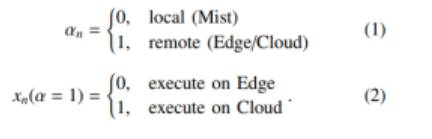
The overall three-tier architecture is illustrated in Figure 1, where IoT devices interact with nearby edge servers and may further forward computation-intensive tasks to the cloud whenever local and edge resources are insufficient. Each task is defined by its data size, required CPU cycles, and delay constraint. Edge and Cloud servers provide virtualized computing resources, where offloaded tasks are scheduled using time-sharing and space-sharing policies to optimize execution time and resource utilization. Let S = {S1, S2, . . ., Sp} denote the set of servers, where p includes Edge and Cloud servers. Each server S k hosts a set of virtual machines VMk = {vm1, vm2, . . ., vmn}, with dedicated computing capacities. Tasks are executed either locally on IoT devices or remotely on Edge/Cloud servers, depending on the offloading decision variables xn and yn. Here, xn = 0 indicates local execution, and xn = 1 indicates offloading; if xn = 1, then yn = 0 denotes execution at the Edge, and yn = 1 denotes execution in the Cloud
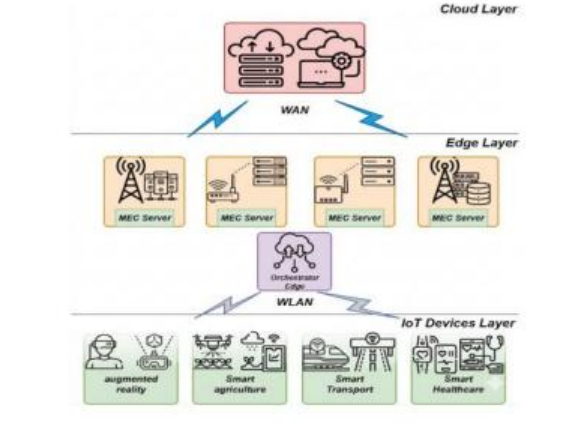
Figure 1. Three-tier architecture: IoT Devices – Edge – Cloud
3.2. Task Model
Each task Tn generated by an IoT device is defined by three parameters: 1) Task size Bn, representing the amount of data to be processed or transmitted; 2) Required CPU cycles Cn for processing; 3) Maximum tolerable delay τn, representing the task’s delay sensitivity
3.3. Decision Variables
The decision variables determine the execution layer of each task:
3.4. Computation Model
The total service time of a task depends on its execution location:
Local Execution (Mist):
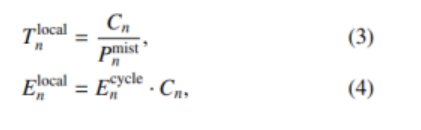
where Pn mist is the Mist node processing speed and En cycle is the energy per CPU cycle
Edge Execution:
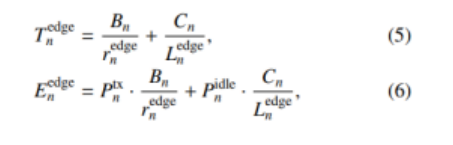
where rn edge is the uplink transmission rate to the edge server, Ln edge is the allocated computing resource at the edge server, Pn tx is the transmission power, and Pn idle is the idle power during edge computation.
Cloud Execution:
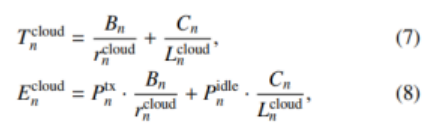
where rn cloud is the uplink transmission rate to the cloud server, Ln cloud is the allocated computing resource at the cloud server, Pn tx is the transmission power, and Pn idle is the idle power during cloud computation.
3.5. Quality of Experience (QoE)
Model The QoE metric captures user satisfaction by considering both service time and task loss. For each task, the QoE is defined as:
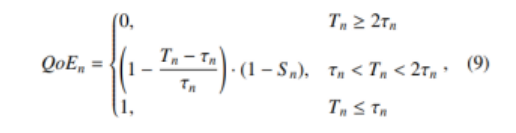
where Sn ∈ {0, 1} indicates whether the task failed (Sn = 1) or was successfully completed (Sn = 0). The overall average QoE across all tasks is:
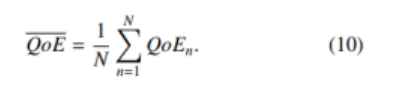
Figure 2 illustrates task computation and resource allocation models for local Computation, Edge Servers, Cloud Servers, indicating task offloading in MEC architecture. It’s important to note that the transmission delay in the Cloud server case is typically longer due to distance and potential network congestion.
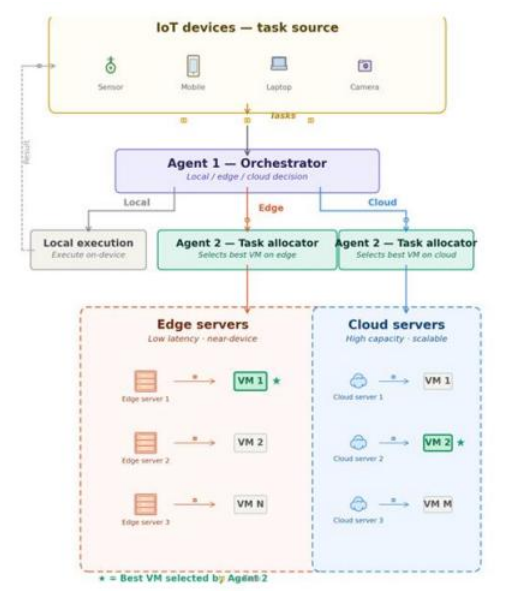
Figure 2. Proposed two-agent HRL architecture for task offloading and VM allocation in a three-tier MEC environment
This section formalises the architecture and the task model used throughout the paper. We first describe the three-tier IoT(Mist)–Edge–Cloud system (Section 3.1), then characterise individual tasks (Section 3.2) and the offloading decision variables (Section 3.3). The computation and energy models for each execution tier are presented in Section 3.4, and the section concludes with the Quality-of-Experience metric and the overall optimisation objective (Section 3.5). Each IoT device n ∈ N generates a task Tn characterized by its data size Bn, required CPU cycles Cn, and maximum tolerable delay τn. Tasks can be executed locally on a Mist node, or offloaded to a remote edge or cloud server. The execution cost of task Tn is defined as a weighted sum of service time and energy consumption. For local execution (Mist), the cost is given by:

For remote execution (edge or cloud), the cost is expressed as:

The optimization problem is formulated as:
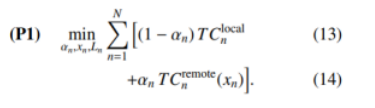
Subject to:
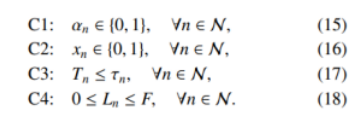
Constraint (C1) ensures that each task is either executed locally on a Mist node or offloaded remotely. Constraint (C2) determines whether remote execution occurs at the edge or cloud. Constraint (C3) guarantees that the service time does not exceed the task deadline, and Constraint (C4) limits the allocated computing resources at the remote servers.
4. PROPOSED TWO-AGENT Q-LEARNING OFFLOADING STRATEGY
Reinforcement learning (RL) is a machine learning technique in which an agent learns by interacting with its environment instead of relying on labelled datasets. The agent observes the system state, selects an action, and receives a reward based on the quality of that action. In our framework, a two-agent Q-learning approach is adopted for task execution and offloading decisions. The first agent decides whether a task should be executed locally on the Mist layer or offloaded, while the second agent selects between Edge and Cloud resources. To reduce the complexity and memory cost of the Q-table, continuous variables such as task size, deadline, International Journal of Computer Networks & Communications (IJCNC) Vol 18, No 4, July 2026 64 transmission rate, and resource load are discretized into low, medium, and high levels, making the learning process more suitable for IoT environments.
4.1. Agent 1: Offloading Decision (Mist vs. Remote)
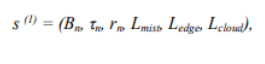
The first agent models the offloading decision as a discrete-time Markov Decision Process (MDP) and learns an optimal policy using Q-learning. Each component of s⁽¹⁾ is mapped to its corresponding low/medium/high level as defined at the beginning of Section 4.
State:
where Bn is the task size, τn the maximum tolerable delay, rn the network transmission rate, and Lmist, Ledge, Lcloud the current loads (e.g., CPU usage) of the Mist, Edge, and Cloud layers, respectively.

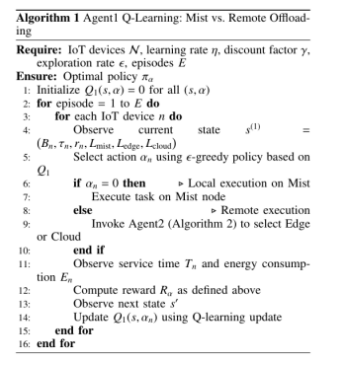
The agent receives a reward that penalises high service time, high energy consumption, and task failures or deadline misses:

where w1 and w2 are weighting factors, ⊮fail is 1 if the task execution fails (e.g., resource unavailability), ⊮miss is 1 if the service time exceeds τn, and β is a penalty coefficient. Algorithm 1 details the Q-learning process for Agent1.
The Q-table is updated using the standard rule: Q1(s, α) ← (1 − η) Q1(s, α) + η [ Rα + γ max α′ Q1(s ′, α′)], with learning rate η and discount factor γ.
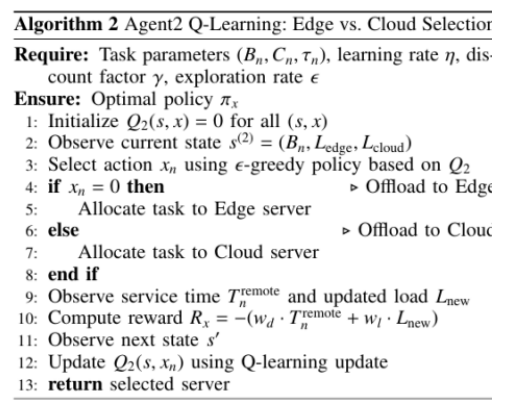
4.2. Agent 2: Remote Server Selection (Edge vs. Cloud)
When Agent1 decides to offload (αn = 1), Agent2 chooses the remote server that will execute the task. This agent also learns via Q-learning. As in Agent 1, each component of s⁽²⁾ is encoded using the same three-level scheme
State:
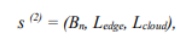
with xn = 0 for Edge and xn = 1 for Cloud.
Reward:
The reward encourages low service delay and balanced resource utilisation:

where Tn remote is the service time on the chosen server, Lnew is the load of that server after the task is allocated, and wd, wl are weights. Algorithm 2 shows the Q-learning procedure for Agent2.
The Q-table is updated with:
Q2(s, x) ← (1 − η) Q2(s, x) + η [Rx + γ max x ′ Q2(s ′, x ′)].
4.3. Complexity Analysis
The two-agent decomposition reduces learning complexity compared to a monolithic agent that must reason over all three execution layers simultaneously. Let |A₁| = 2 and |A₂| = 2 denote the action spaces of the offloading and allocation agents respectively. For each task, the per-step cost is O(|A₁| + |A₂|), so the overall complexity over N tasks and E episodes is

scaling linearly with both quantities. The memory footprint is likewise tightly bounded: with three linguistic levels per state variable, the Q-tables of Agent 1 and Agent 2 contain at most 3⁶ × |A₁| = 1,458 and 3³ × |A₂| = 54 entries respectively, a combined cost of roughly 6 KB in singleprecision floating-point — well within the budget of even the most constrained IoT devices
5. PERFORMANCE EVALUATION
To evaluate the proposed hierarchical Q-learning offloading strategy, simulations were conducted using PureEdgeSim [22]. The environment models IoT, mist, edge, and cloud layers. The learning process relies on state–action–reward interactions, where Q-values reflect execution cost based on service time and energy consumption. An ϵ-greedy policy with decaying exploration, learning rate η = 0.1, and discount factor γ = 0.9 ensures stable convergence. The framework operates in two stages: first deciding between local execution and offloading, then selecting the execution layer. System states include VM utilization, task workload, and delay constraints for adaptive offloading decisions in realistic MEC environments. Table 1 summarizes the main configuration parameters of the IoT, MEC, and Cloud layers used in the simulation. The IoT layer includes a large number of resource-constrained devices, while International Journal of Computer Networks & Communications (IJCNC) Vol 18, No 4, July 2026 67 the MEC and Cloud layers provide progressively higher computational capabilities. This heterogeneous architecture reflects realistic MEC environments and highlights the necessity of intelligent offloading strategies to efficiently handle computation-intensive and delay-sensitive tasks.
Table 1 .. Values of Parameters for Each Device in the Architecture.
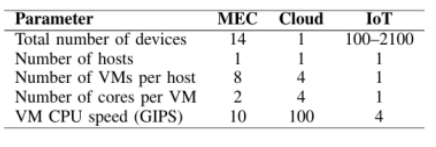
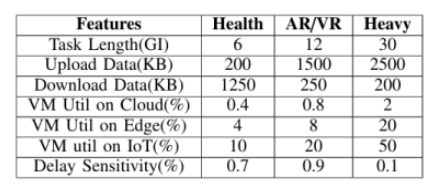
Table 2 presents the main characteristics of the applications considered in the simulation. The selected applications exhibit diverse computational demands, data transmission requirements, and delay sensitivities, ranging from highly delay-sensitive augmented reality tasks to computation intensive workloads. This diversity enables a realistic evaluation of the proposed offloading strategy under varying application requirements and network conditions.
Table 2 .. Application Features.
5.1. Simulation Results
To evaluate TARLOT, extensive simulations were conducted under heterogeneous workloads, varying device densities, and diverse application profiles. The simulator settings and application characteristics are summarized in Tables 1 and 2. The proposed framework was compared with five baseline approaches across several performance metrics.
Random:
assigns tasks without considering resource conditions, representing a lowerbound baseline.
Round-Robin:
distributes tasks cyclically to balance workload without adapting to system dynamics
Trade-Off:
uses predefined rules based on latency and resource utilization
Pure-Edge:
executes all tasks at the MEC layer, reducing transmission delay but increasing congestion under heavy workloads.
Pure-Cloud:
fully offloads tasks to the cloud, providing high computational capacity at the expense of higher network delay.
Tarlot:
Tasks are adaptively offloaded using a hierarchical reinforcement learning strategy, where decisions are made dynamically based on system state, enabling efficient load balancing and improved performance under varying network and resource conditions.
5.1.1. Simulation of Execution
Delay The average service time reflects the combined effect of transmission and processing delays across all offloading tiers. As shown in Fig. 4, TARLOT consistently achieves the lowest service time across all device counts, starting at approximately 0.45 s for 200 devices and rising only to 1.1 s at 2400 devices. This stability is attributed to its dual-agent architecture, where one agent handles offloading decisions and a second manages resource allocation, enabling finegrained scheduling that minimizes end-to-end delay. Pure Cloud performs the worst, reaching over 4.3 s at high load due to inherent transmission latency. RANDOM and Round Robin show moderate and steadily increasing trends, while Pure Edge benefits from proximity but remains constrained by edge capacity. Trade Off demonstrates intermediate behaviour. Overall, TARLOT proves most suitable for latency-sensitive IoT applications.
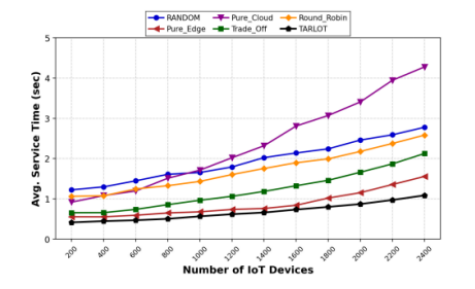
Figure 3.. Comparison of average service time across all offloading strategies as a function of the number of IoT devices.
5.1.2. Simulation of Quality of Experience QoE
captures how well each algorithm satisfies user perceived performance requirements under increasing load. As illustrated in Fig. 5, TARLOT maintains the highest QoE throughout all scenarios, starting near 0.94 and degrading only slightly to 0.77 at 2400 devices, demonstrating International Journal of Computer Networks & Communications (IJCNC) Vol 18, No 4, July 2026 69 strong resilience under heavy load. Pure Edge ranks second but declines more noticeably at high device counts. Trade Off exhibits moderate degradation, while RANDOM, Round Robin, and Pure Cloud suffer significant QoE losses, with Pure Cloud dropping as low as 0.22. The superior performance of TARLOT is due to the coordinated operation of its two agents, which jointly optimize offloading and allocation to preserve user experience even as system load scales.
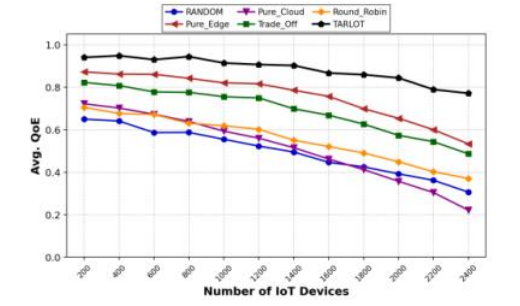
Figure 4.. Evolution of average quality of experience for all approaches as a function of the number of IoT devices.
5.1.3. Simulation of Task
Failure Rate The failure rate measures the proportion of tasks that fail due to resource saturation or network congestion. Fig. 6 shows that under light loads, all algorithms perform comparably. However, as the number of devices grows, Pure Cloud experiences the sharpest rise, reaching nearly 14% at 2400 devices, followed by RANDOM at 9.5%. Round Robin and Pure Edge show intermediate failure rates, while Trade Off remains moderate. TARLOT achieves the lowest failure rate across all scenarios, staying below 2% even at peak load. This robustness stems from the dualagent coordination, where the offloading agent avoids overloaded tiers and the allocation agent distributes tasks efficiently, preventing resource exhaustion.
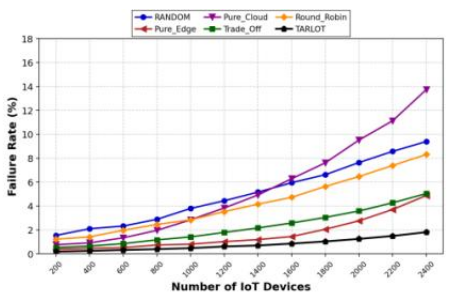
Figure 5.. Impact of system load on the task failure rate of all evaluated offloading approaches.
5.1.4. Simulation of Avg VM utilization
the average CPU utilization at the local device level. TARLOT achieves the highest local utilization among all algorithms, increasing steadily from approximately 12% at 200 devices to 38% at 2400 devices. This reflects its strategy of executing tasks locally when edge and cloud resources are under pressure, making effective use of on-device computational capacity. Round Robin and RANDOM show moderate local utilization, reaching around 23% and 21% respectively at peak load. Trade Off maintains a lower local usage of approximately 16%, while Pure Cloud and Pure Edge exhibit near-zero local utilization, as they exclusively offload tasks to remote tiers without considering local execution.
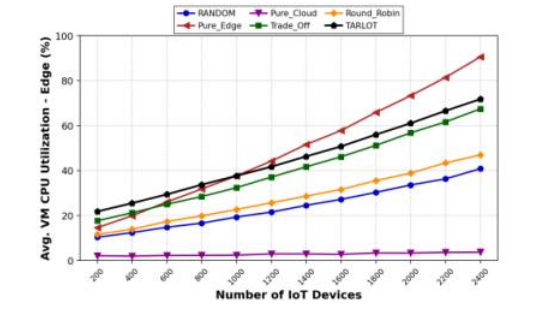
Figure 6.. Average VM CPU utilization at the edge server tier for all approaches as a function of the number of IoT devices.
5.1.5.Simulation of Avg VM utilization
the average CPU utilization at the cloud server level. Pure Cloud saturates cloud resources most aggressively, reaching approximately 89% at 2400 devices. TARLOT maintains a balanced cloud utilization of around 50% at peak load, indicating that its allocation agent selectively routes tasks to the cloud only when edge and local resources are insufficient. Trade Off and Round Robin exhibit moderate cloud usage at approximately 46% and 40% respectively. RANDOM reaches around 34%, while Pure Edge maintains near-zero cloud utilization, confirming its exclusive reliance on edge resources. Overall, TARLOT achieves the most balanced cloud usage, avoiding saturation while ensuring tasks are handled efficiently.
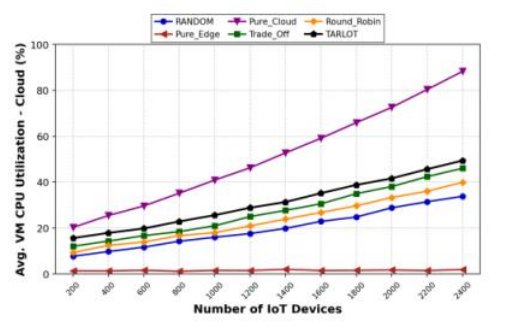
Figure 7.. Average VM CPU utilization at the cloud server tier for all approaches as a function of the number of IoT devices.
5.1.6.Simulation of Avg Energy Consumption
Energy efficiency is a fundamental concern in IoT-MEC environments, where devices are often battery-constrained and operate under strict power budgets. As the number of IoT devices grows, the energy overhead introduced by task transmission and remote processing becomes increasingly significant, directly impacting device lifetime.
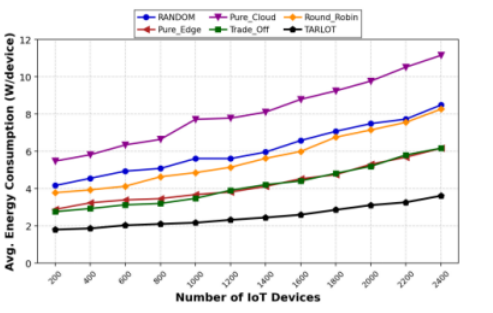
Figure 8.. Per-device energy consumption of all approaches as a function of the number of IoT devices.
Fig. 10 reveals that Pure Cloud incurs the highest energy cost per device, reaching 11.2 W/device at 2400 devices due to constant high-bandwidth transmissions to distant cloud servers. RANDOM and Round Robin follow with similar intermediate profiles around 8.5 W/device, reflecting their inability to avoid costly long-range offloading decisions. Pure Edge and Trade Off achieve better efficiency near 6.2 W/device by leveraging edge proximity. TARLOT attains the lowest energy consumption, rising from only 1.9 W/device at 200 devices to 3.6 W/device at International Journal of Computer Networks & Communications (IJCNC) Vol 18, No 4, July 2026 72 2400 devices. By minimizing unnecessary long-range transmissions through intelligent offloading and reducing idle resource usage via adaptive allocation, TARLOT significantly outperforms all baselines in energy efficiency.
DISCUSSION
In this study, we evaluated several task offloading algorithms in IoT-MEC environments, primarily focusing on average service time and QoE as key metrics. Our findings highlight TARLOT as maintaining the most consistent and lowest service times, particularly in scenarios with increasing IoT device counts. Furthermore, our assessment of QoE and task failure rates demonstrated that TARLOT delivers the highest QoE levels and minimizes task failures even under heavy system loads, while Pure Cloud and RANDOM exhibit the worst degradation across both metrics. The examination of energy consumption further underscored the advantages of TARLOT, consuming less than a third of the energy of Pure Cloud at peak load. Overall, our study underscores the promising potential of TARLOT for task offloading in IoTMEC environments, given its exceptional performance and adaptability. Notably, TARLOT consistently minimizes average service time and energy consumption, crucial for ensuring stability even under system overload. Its simultaneous optimization of offloading decisions and resource
allocation, through its dual-agent architecture, is paramount for meeting the demands of IoT applications and guaranteeing a superior user experience. The balanced CPU utilization across local, edge, and cloud tiers further speaks to its robustness in preventing bottlenecks. Considering the broader context of IoT-MEC, scalability challenges and the impact of network dynamics on algorithm performance must be carefully addressed during development. Ensuring scalability is vital for managing the growing number of IoT devices and computational demands effectively, while algorithms must also rapidly adapt to network fluctuations. Looking ahead, the integration of intelligent offloading frameworks into industrial applications across sectors such as healthcare, smart manufacturing, and autonomous vehicles would provide invaluable real-world testing environments, fostering the development of tailored and efficient solutions.
6. CONCLUSIONS AND FUTURE WORK
Multi-access Edge Computing has emerged as a powerful paradigm for IoT systems, moving computation closer to end devices and significantly reducing the latency and energy costs associated with traditional cloud-based solutions. In this work, we explored intelligent task offloading in a three-tier IoT–Edge–Cloud architecture, focusing on how reinforcement learning can improve the allocation of computing resources between local devices, edge servers, and the cloud. By highlighting the importance of a cooperative dual-agent strategy, our results show that separating the offloading decision from the resource-allocation decision yields noticeably better performance across every metric we considered. The proposed TARLOT framework demonstrates strong adaptability, achieving lower service delays, higher quality of experience, and reduced energy consumption even when the number of devices reaches 2,400. Simulation findings consistently confirm that the two-agent approach prevents resource congestion while preserving user satisfaction under heavy workloads.
A direct numerical benchmark of TARLOT against recent learning-based offloading frameworks would further strengthen the analysis. However, differences in simulators, workload models, and evaluation settings across the literature currently prevent a fully fair comparison, and reproducing International Journal of Computer Networks & Communications (IJCNC) Vol 18, No 4, July 2026 73 each method under our PureEdgeSim environment is beyond the scope of this study. Building on these findings, future work will proceed along three complementary directions. First, we plan to conduct a controlled re-implementation of relevant learning-based baselines under a unified PureEdgeSim configuration to enable fair benchmarking across identical workloads, mobility patterns, and network conditions. Second, we intend to expand the experimental evaluation by considering additional operating conditions, including varying wireless-link quality, heterogeneous task-arrival rates, and node mobility, to further validate the robustness of the dualagent framework.
Third, we aim to enhance TARLOT by replacing the current linguistic discretization and tabular Q-learning structure with a Deep Q-Network architecture, enabling direct learning from continuous state variables and capturing more complex interactions between task size, deadlines, link quality, and system load. In addition, federated learning will be integrated to support collaborative and privacy-aware policy training for large-scale and dynamic MEC environments
CONFLICTS OF INTEREST
THE AUTHORS DECLARE NO CONFLICT OF INTEREST
REFERENCES
[1] C. Paniagua And J. Delsing, “Industrial Frameworks For Internet Of Things: A Survey,” Ieee Systems Journal, Vol. 15, No. 1, Pp. 1149– 1159, 2020.
[2] K. Dev, Y.-B. Kim, And S. Singh, “Energy-Efficient Computation Offloading For Iot Applications In Multi-Access Edge Computing: A Survey,” Ieee Access, Vol. 10, Pp. 78 512–78 535, 2022.
[3] W. Zhang And M. Zhou, “Qoe Assessment And Optimization For Delay-Sensitive Iot Applications In Edge Computing Environments,” Ieee Internet Of Things Journal, Vol. 11, No. 2, Pp. 1245–1260, 2024.
[4] L. Chettri And R. Bera, “A Comprehensive Survey On Internet Of Things (Iot) Toward 5g Wireless Systems,” Ieee Internet Of Things Journal, Vol. 7, No. 1, Pp. 16–32, 2020.
[5] M. Patel, B. Naughton, C. Chan, N. Sprecher, S. Abeta, And A. E. A. Neal, “Mobile-Edge Computing Introductory Technical White Paper,” White Paper, Mobile-Edge Computing (Mec) Industry Initiative, Pp. 854–864, 2014.
[6] F. Yang, Q. Guo, And H. Li, “A Survey On Multi-Tier Computing Architectures For Iot: Edge, Fog, And Cloud Synergy,” Acm Computing Surveys, Vol. 55, No. 9, Pp. 1–38, 2023.
[7] A. Bebortta, S. Rout, And M. Sahoo, “Fog–Cloud Collaborative Frameworks For Large-Scale Iot: Architecture, Challenges, And Future Directions,” Future Generation Computer Systems, Vol. 145, Pp. 124–142, 2023.
[8] M. Myyara, O. Lagnfdi, A. Darif, And A. Farchane, “Enhancing Qos For Iot Devices Through Heuristicsbased Computation Offloading In Multi-Access Edge Computing.” Infocommunications Journal, Vol. 16, No. 4, 2024.
[9] X. Xiong, X. Liu, And J. Wang, “Multi-Agent Reinforcement Learning For Cooperative Task Offloading In Edge-Enabled Iot Systems,” Ieee Transactions On Mobile Computing, Vol. 22, No. 7, Pp. 4470– 4487, 2023.
[10] D. Sharma And P. Singh, “Deep Meta-Reinforcement Learning For Adaptive Resource Management In Edge Computing,” Journal Of Network And Computer Applications, Vol. 228, P. 103750, 2024.
[11] M. Zia, F. Hussain, And B. Ahmad, “Qos-Aware Computation Offloading Using Q-Learning In Mobile Edge Computing-Enabled Iot,” Ieee Systems Journal, Vol. 17, No. 3, Pp. 3451–3461, 2023
[12] M. Abdi And Y. Idrissi, “Edge–Cloud Distributed Reinforcement Learning For Iot Computation Offloading,” Ieee Transactions On Parallel And Distributed Systems, Vol. 35, No. 5, Pp. 1231– 1245, 2024.
[13] O. Chala, V. Yevsieiev, S. Maksymova, And A. Abu-Jassar, “Mathematical Model Based On Multiagent Reinforcement Learning (Marl) And Partially Observable Markov Decision Process International Journal of Computer Networks & Communications (IJCNC) Vol 18, No 4, July 2026 74 (Pomdp) For Modeling Cargo Movement For A Mobile Robots Group,” Multidisciplinary Journal Of Science And Technology, Vol. 5, No. 4, Pp. 480–489, 2025.
[14] P. Li And W. Chen, “Joint Computation Offloading And Resource Allocation In Mec-Enabled Iot Networks,” Ieee Transactions On Mobile Computing, Vol. 22, No. 5, Pp. 2601–2615, 2023.
[15] H. Jadad And A. Touzene, “Qos-Based Cost-Effective Offloading As A Service Middleware For Mobile Cloud Applications,” International Journal Of Computer Networks & Communications (Ijcnc).
[16] H. Zhang And P. Zhao, “Heuristic Task Offloading For Multi-Task Iot Applications In Edge Computing Environments,” Ieee Access, Vol. 11, Pp. 45 000–45 012, 2023.
[17] H. Alsalman, “A Multi-Model Regression Approach For Predicting Resource Allocation Efficiency In Iot-Driven 6g Networks,” International Journal Of Computer Networks & Communications (Ijcnc).
[18] Z. Jia, J. Yu, X. Ai, X. Xu, And D. Yang, “Cooperative Multiple Task Assignment Problem With Stochastic Velocities And Time Windows For Heterogeneous Unmanned Aerial Vehicles Using A Genetic Algorithm,” Aerospace Science And Technology, Vol. 76, Pp. 112–125, 2018.
[19] K. A. And M. Gobi, “An Efficient Federated Forcart Algorithm For Predicting And Allocating Resources In Network Function Virtualization,” International Journal Of Computer Networks & Communications (Ijcnc).
[20] Q. Bukhsh And S. Khan, “Deep Reinforcement Learning For Intelligent Resource Allocation In Mecassisted Iot,” Computer Networks, Vol. 240, P. 110046, 2024
[21] H. Wu And Y. Zhang, “Qoe-Aware Computation Offloading For Edge Intelligence,” Ieee Transactions On Mobile Computing, Vol. 23, No. 4, Pp. 3456–3469, 2024.
[22] C. Mechalikh, Z. Safavifar, F. Golpayegani Et Al., “Quality Matters: A Comprehensive Comparative Study Of Edge Computing Simulators,” Simulation Modelling Practice And Theory, Vol. 138, P. 103042, 2025.


