
IJNSA 05
OTN IN THE 5G ERA: TRANSPORTING MASSIVE
IP-BASED MOBILE TRAFFIC
Joy Selasi Agbesi
Department; J. Warren McClure School of Emerging Communication & Technology,
Ohio University, USA
ABSTRACT
Fifth-generation (5G) mobile networks impose unprecedented transport demands—high bandwidth, deterministic latency, and precise synchronization—driven by disaggregated RAN architectures (C-RAN/vRAN) and diverse service classes (eMBB, URLLC, mMTC) (Larsen et al., 2019; Zhang et al., 2020; Nakamura et al., 2018; Wijethilaka & Liyanage, 2021). This paper evaluates Optical Transport Network (OTN) as a foundation for 5G fronthaul and backhaul, focusing on protocol transparency, hierarchical grooming, latency determinism, operations/maintenance tooling, and carrier-grade protection (ITU-T, 2016; Cvijetic et al., 2017; Li et al., 2021). Using a synthesis of standards, deployments, and modeling, we show that OTN efficiently maps heterogeneous 5G traffic (e.g., CPRI/eCPRI, Ethernet), sustains microsecond-level latency and low jitter under load, and scales via ODUflex-based bandwidth granularity while meeting synchronization targets required by TDD and CoMP (Pizzinat et al., 2015; Velasco et al., 2014; ITU-T, 2020). Economic assessment indicates competitive lifecycle cost for high-capacity routes despite higher initial capex, especially where grooming efficiency and operational simplicity offset packet-only alternatives (Chen et al., 2019). We also discuss hybrid architectures pairing OTN with packet transport and SDN control to accelerate service provisioning and enable slice-aware automation (Raza et al., 2017; Taleb et al., 2017). The results provide an integrated framework and practical guidance for operators planning 5G transport, confirming OTN’s suitability for metro-scale fronthaul and aggregation backhaul today and its relevance as requirements evolve toward 6G (Zhang et al., 2020)
KEYWORDS
Optical Transport Network, 5G networks, fronthaul, backhaul, network transport, bandwidth management,mobile networks, fiber optics, network architecture, telecommunications infrastructure.
1.INTRODUCTION
5G departs from prior mobile generations by disaggregating the RAN (C-RAN, vRAN, open interfaces), shifting baseband functions toward centralized sites and creating stringent transport requirements for bandwidth, latency, and time/phase alignment across eMBB, URLLC, and mMTC services (Larsen et al., 2019; Zhang et al., 2020; Nakamura et al., 2018; Wijethilaka & Liyanage, 2021). This diversity of applicationsfrom UHD/AR to industrial automation and massive IoT—demands a transport fabric that supports heterogeneous traffic with predictable performance (Osseiran et al., 2014). OTN, standardized by ITU-T G.709 and related recommendations, offers protocol transparency, hierarchical multiplexing (including ODUflex), deterministic latency, mature OAM, and robust protection, capabilities increasingly deployed beyond long-haul into metro/access domains for 5G (ITU-T, 2016; Cvijetic et al., 2017; Li et al., 2021).
Gap and contribution. Prior work typically treats functional splits, packet transport behavior,optical-layer feasibility, and economics in isolation, leaving operators without an end-to-end picture—particularly for low-layer splits (Options 6/7-1/8) that require sub-millisecond budgets, tight synchronization, and scalable capacity concurrently (Wang et al., 2022). We provide an integrated technical-economic evaluation of OTN-based transport for fronthaul/backhaul under realistic metro distances and coherent optical constraints, aligning modeling with observed deployment patterns to derive practical guidance for design and investment (Velasco et al., 2014).
Contributions.
(i) Quantifies OTN latency/jitter and synchronization performance vs. split-dependent budgets;
(ii) evaluates grooming efficiency with ODUk/ODUflex for diverse 5G traffic;
(iii) compares lifecycle economics vs. packet-centric alternatives across capacity regimes; (iv) outlines hybrid OTN+SDN architectures for automation, slice-aware provisioning, and rapid service turn-up (Pizzinat et al., 2015; Chen et al., 2019; Raza et al., 2017).
1.1. Background and Context
Mobile transport advanced from circuit-switched E1/T1 and PDH in 1G/2G to ATM/Ethernet in 3G/4G as data traffic rose, with Carrier Ethernet dominating LTE backhaul for cost and IP affinity but exposing limits in timing determinism and QoS under congestion (Jaber et al., 2016; Wu et al., 2015; Chih-Lin et al., 2014). 5G centralization (C-RAN/vRAN) and massive MIMO drive fronthaul traffic orders of magnitude above 4G backhaul; CPRI/eCPRI line rates can span ~10–150 Gb/s per site depending on antenna/band configuration (Boccardi et al., 2014; Peng et al., 2015). Meanwhile, service classes impose divergent targets—eMBB capacity, URLLC 1 ms E2E with five-nines reliability, and mMTC density—tightening transport demands on bandwidth, latency/jitter, and synchronization (3GPP, 2018; Hossain & Hasan, 2015). These trends set the stage for transport that couples deterministic behavior with efficient grooming and robust operations
1.2. The 5G Transport Challenge
Functional splits trade centralization benefits against transport intensity: Option 8 retains CPRI with maximum bandwidth and tightest latency; Option 2 reduces bandwidth but yields fewer pooling gains (Wang et al., 2022; Alvarez et al., 2019). Precise phase/frequency sync—especially for TDD and CoMP—requires deterministic paths and symmetry; transport must distribute time with minimal residence-time variation (Duan et al., 2015; Pizzinat et al., 2015). Network slicing further requires isolation and slice-level SLAs with agile instantiation and tear-down, pushing for fine-grained QoS and automation (Nakao et al., 2017; Taleb et al., 2017). Dense small-cell deployments at mmWave amplify the number of transport endpoints and fiber constraints, increasing planning and operational complexity (Rappaport et al., 2013). These interdependent factors make end-to-end latency, sync fidelity, and operational agility co-equal with raw capacity in transport selection
1.3. OTN as a Transport Solution for 5G
OTN’s protocol transparency supports mixed client signals (CPRI/eCPRI/Ethernet/Fibre Channel) without deep packet processing, easing multi-split coexistence (Kim et al., 2018). Hierarchical grooming with ODUk/ODUflex aligns provisioned capacity to demand in ≈1.25 Gb/s increments, improving utilization across heterogeneous sites (Liu et al., 2017). Circuit-based switching and fixed framing yield load-independent latency and ultra-low jitter suited to URLLC and low-layer splits, while OAM and protection (1+1, 1:N, rings) deliver
sub-50 ms recovery and high availability (Velasco et al., 2014; ITU-T, 2020). Collectively, these traits make OTN a strong fit for metro-scale fronthaul and high-capacity aggregation
1.4. Research Questions
This study addresses the following research questions in the context of fifth-generation (5G) transport network design:
· How effectively does Optical Transport Network (OTN) technology satisfy 5G transport requirements in terms of bandwidth scalability, latency determinism, synchronization accuracy, and reliability under realistic deployment conditions?
· What are the total cost of ownership (TCO) implications of deploying OTN for 5G fronthaul and backhaul relative to packet-based transport alternatives across different capacity and distance scenarios?
· Which OTN deployment architectures and design practices best support centralized and virtualized RAN implementations for 5G networks?
· How does integration of OTN with software-defined networking (SDN) and network functions virtualization (NFV) improve operational agility and automation for 5G transport networks?
1.5. Research Hypotheses
Based on prior literature and observed deployment trends, the following research hypotheses are evaluated:
H1: OTN provides superior deterministic latency and synchronization performance compared to packet based transport, making it suitable for low layer 5G functional splits (Options 6, 7 1, and 8) with sub 250 µs latency constraints
H2: Over a ten year lifecycle, OTN based 5G transport solutions are cost competitive with packet based alternatives for high capacity routes exceeding 40–50 Gb/s when operational efficiency and utilization gains are considered.
H3: Hierarchical multiplexing and ODUflex containers enable OTN to achieve 30–40% bandwidth efficiency improvements over legacy SDH/SONET based transport for heterogeneous 5G traffic profiles.
H4: SDN enabled OTN architectures reduce service provisioning times from hours or days to minutes, supporting dynamic 5G use cases such as network slicing and edge computing
1.6. Research Objectives
The objectives of this research are to:
- Evaluate OTN’s ability to meet 5G transport requirements across bandwidth, latency, synchronization, and reliability dimensions
- Compare the economic performance of OTN and packet-based transport technologies using lifecycle cost metrics
- Identify effective OTN deployment architectures and implementation best practices for 5G fronthaul and backhaul
- Assess the operational benefits of integrating OTN with SDN and NFV frameworks
- Provide practical guidance for mobile network operators planning and evolving 5G transport infrastructure
1.7. Significance of the Study
Transport network selection is a strategic decision for mobile network operators, representing approximately 30–40% of total network deployment cost and influencing performance and scalability over lifecycles exceeding a decade (Chen et al., 2019). Understanding how OTN aligns with 5G requirements enables operators to balance performance, reliability, and cost as networks evolve toward centralized and virtualized RAN architectures.
For equipment vendors, this research highlights functional requirements and deployment patterns that inform product design, particularly regarding OTN integration with SDN control, coherent optics, and flexible grid technologies. From an academic perspective, the study contributes to the convergence literature by linking optical transport capabilities with radio access requirements in a unified analysis (Maier et al., 2013; Fiorani et al., 2016).
The findings also inform regulators and industry bodies shaping infrastructure sharing and deployment policy by clarifying how transport capabilities affect the feasibility and economics of 5G rollout, particularly in dense urban and underserved regions. Finally, insights from this work provide context for future 6G transport research, where bandwidth and latency requirements are expected to become more stringent.
1.8. Scope and Limitations
This research focuses on the use of Optical Transport Network technology for 5G fronthaul and backhaul applications, examining technical performance, economic considerations, and implementation strategies based on standards, published studies, industry documentation, and deployment case reports. While SDN and NFV integration are considered at an architectural level, detailed evaluation of specific controller platforms or orchestration systems is beyond the scope of this work.
The analysis reflects global deployment contexts, but regional variations in regulation, spectrum policy, and infrastructure availability may affect applicability. Economic results are based on representative cost models and may differ from outcomes in vendor- or operator-specific negotiations. Limited access to proprietary operational data necessitates reliance on publicly available sources, and simulation-based results cannot fully capture all real-world environmental and operational variables.
2.LITERATURE REVIEW
The literature on OTN for 5G spans transport evolution, 5G architectural shifts, OTN capabilities, synchronization, economics, SDN integration, alternative transports, and forward trends, with gaps around end-to-end assessments that jointly consider latency determinism, optical feasibility, grooming efficiency, and lifecycle cost in realistic deployments.
2.1. Evolution of Mobile Transport Networks
C RAN centralization and cloudification marked a shift from distributed RAN to pooled baseband resources, increasing fronthaul intensity and tightening transport requirements for determinism and timing compared to 4G backhaul over Carrier Ethernet (Wu et al., 2015; Chih Lin et al., 2014; Jaber et al., 2016)
FiWi research underscored the need to harmonize deterministic optical transport with stochastic wireless access, motivating transport designs that preserve predictability as access complexity grows (Maier et al., 2013)
2.2. 5G Architectural Innovations and Transport Implications
5G introduces massive MIMO, mmWave, small cell densification, and device centric paradigms that collectively multiply transport endpoints and bandwidth while compressing latency budgets (Boccardi et al., 2014).
Functional splits (Options 1–8) shift processing boundaries and thus transport load; lower layer splits (6/7/8) demand tens to hundreds of Gb/s per site and sub millisecond one way latency across metro distances, intensifying requirements for deterministic transport and tight synchronization (Wang et al., 2022; Larsen et al., 2019).
Fronthaul’s constant bit rate nature, stringent timing, and determinism needs align more naturally with circuit based transport than best effort packet fabrics, reinforcing OTN’s relevance in such scenarios (Pizzinat et al., 2015).
2.3. OTN Technology Evolution and Capabilities
OTN’s evolution (G.709 and related recommendations) introduced protocol transparency, hierarchical multiplexing with ODUk and ODUflex, enhanced synchronization handling, and increasingly software defined control interfaces adapted to metro and access domains for mobile transport (ITU T, 2016; Zhang et al., 2020).
Flexible OTN controlled by SDN enables dynamic bandwidth allocation via ODUflex, improving utilization by ~30–40% versus static provisioning and supporting heterogeneous 5G loads without heavy overprovisioning (Li et al., 2021).
Carrier Ethernet remains a mainstay but requires careful engineering to approximate deterministic guarantees for heterogeneous 5G traffic, raising complexity for tight latency/jitter objectives at scale (Laya et al., 2014).
2.4. Timing and Synchronization Requirements
TDD, CoMP, and advanced beamforming require frequency accuracy on the order of ±16 ppb and phase alignment within microseconds, elevating the role of transport in delivering precise and symmetric timing (Duan et al., 2015; Alvarez et al., 2019)
OTN’s circuit behavior and transparent carriage of SyncE and IEEE 1588v2 under telecom profiles reduce residence time variation and asymmetry relative to congested packet paths, simplifying design for low layer splits (Pizzinat et al., 2015).
2.5. Economic Analysis and Total Cost of Ownership
Lifecycle analyses show OTN’s capex is typically 15–25% higher than packet only approaches, yet grooming efficiency, deterministic performance, and operational simplicity can yield comparable or favorable TCO for high capacity routes and centralized RAN topologies (Chen et al., 2019).
Optimization studies further indicate that partial centralization and converged aggregation can balance fiber/equipment costs against pooling gains, with joint radio transport design outperforming siloed planning (Carapellese et al., 2015; Fiorani et al., 2016).
Industry perspectives suggest hybrid architectures are common, deploying OTN where determinism and service isolation are paramount and packet where economics and flexibility suffice (Kim et al., 2018).
2.6. SDN Integration and Network Automation
SDN enabled OTN coordinates protection/restoration across layers, improves utilization, and slashes provisioning time from hours/days to minutes, which is critical for slice aware connectivity and edge workloads (Raza et al., 2017; Taleb et al., 2017).
“In operation” planning leverages telemetry and control to re optimize active networks in near real time, aligning transport capacity with dynamic 5G traffic distributions (Velasco et al., 2014).
2.7. Alternative Transport Technologies and Comparative Analysis
Carrier Ethernet remains a mainstay but requires careful engineering to approximate deterministic guarantees for heterogeneous 5G traffic, raising complexity for tight latency/jitter objectives at scale (Laya et al., 2014).
Wireless/mmWave backhaul/fronthaul provides deployment agility yet faces weather, LOS, and spectrum constraints, limiting universal applicability compared to fiber based OTN for latency sensitive scenarios (Rappaport et al., 2013).
Satellite terrestrial integration expands coverage but introduces latency floors unsuitable for URLLC like use cases, confining its transport role to specific, less latency critical segments (Han et al., 2019).
Dark fiber approaches maximize control but require significant optics investment and operational maturity; viability hinges on fiber access and scale economics (Yao & Ansari, 2016).
2.8. Emerging Trends and Future Directions
The telecommunications industry continues to evolve, with several emerging trends influencing the future trajectory of transport network technology. Convergence of fixed, mobile, and cloud domains positions OTN as a high capacity, reliable substrate for unified platforms, with AI/ML driven optimization leveraging SDN/telemetry for operational efficiency (Ruffini, 2019; Zheng et al., 2016).
Edge computing and network slicing intensify requirements for on demand, slice aware transport with deterministic latency, reinforcing SDN controlled OTN’s role in next gen service delivery (Sabella et al., 2016; Taleb et al., 2017)
Looking toward 6G and beyond, the requirements for transport infrastructure will likely become even more demanding. While concrete 6G specifications have not yet been finalized, early discussions suggest peak data rates exceeding 1 Tbps, ubiquitous latencies below 1 millisecond, and integration of terrestrial and non-terrestrial networks. The fundamental capabilities that make OTN suitable for 5G transport deterministic latency, transparent protocol support, hierarchical
multiplexing, and carrier-grade reliability will remain relevant as the industry evolves, though specific implementations and integration approaches will continue to develop.
2.9. Identified Research Gaps
While the existing literature provides substantial insights into various aspects of 5G transport and OTN technology, several research gaps remain that this study addresses. First, although individual technical characteristics of OTN have been examined in isolation, comprehensive endto-end analysis integrating bandwidth efficiency, latency determinism, synchronization accuracy, protection mechanisms, and economic considerations across both fronthaul and backhaul applications is lacking. Most existing studies focus on specific aspects or segments rather than providing holistic assessment.
Second, empirical data from actual operational deployments remains scarce in published academic literature. While vendors and operators present case studies at industry conferences, comprehensive peer-reviewed analysis of real-world OTN deployments for 5G transport is limited. This research synthesizes available case study information and operator experiences to provide practical insights complementing theoretical analysis.
Third, the economic analysis literature has not adequately addressed the transition path for operators with existing transport infrastructure. Most TCO studies assume greenfield deployments, but operators must consider migration strategies, interoperability with legacy equipment, and timing of technology refresh cycles. This research examines practical implementation patterns that accommodate existing infrastructure while enabling evolution toward optimized 5G transport architectures.
Fourth, while SDN integration with OTN has been studied from technical feasibility perspectives, comprehensive analysis of operational benefits, implementation challenges, and best practices for production deployments is limited. This research investigates how operators are actually deploying SDN-enabled OTN in commercial 5G networks and the realized benefits in terms of service provisioning time, operational efficiency, and network agility
Finally, the literature has not sufficiently addressed the role of OTN in emerging network paradigms including network slicing, edge computing, and private 5G networks. While these concepts are extensively discussed in 5G architecture literature, the specific implications for transport network design and technology selection deserve focused investigation. This research examines how OTN capabilities align with or constrain these emerging deployment models.
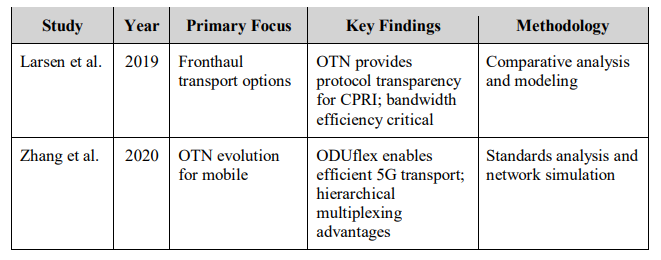
Table 1. Summary of Key Research on OTN for 5G Transport
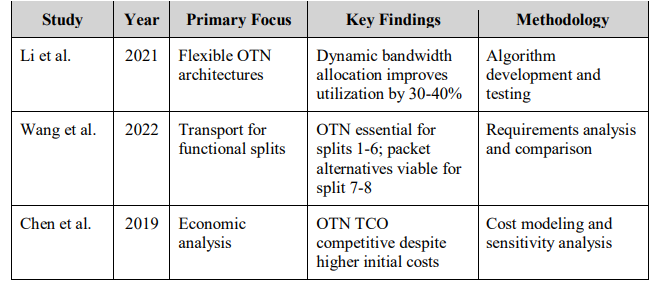
Source: Author’s synthesis from cited literature
This comprehensive review of existing literature establishes the foundation for this research by identifying key technical concepts, performance requirements, economic considerations, and implementation patterns relevant to OTN deployment for 5G transport. The identified research gaps provide clear motivation for this study’s contributions in terms of integrated analysis, empirical validation, and practical guidance for telecommunications operators and equipment vendors
3.METHODOLOGY
This research employs a mixed-methods approach combining quantitative analysis of network performance data with qualitative examination of implementation strategies and architectural considerations. The methodology integrates multiple data sources and analytical techniques to provide comprehensive understanding of OTN’s role in 5G transport networks
3.1. Research Design
The research design follows a systematic framework consisting of four primary components: literature synthesis, technical requirements analysis, performance evaluation, and comparative assessment. Each component employs specific methods tailored to the nature of the research questions and available data
3.2. Data Collection Methods
Literature synthesis formed the foundation of the research methodology. A systematic review of peer-reviewed journal articles, conference proceedings, technical standards documents, and industry white papers was conducted. The search strategy employed multiple academic databases including IEEE Xplore, ACM Digital Library, and SpringerLink, using search terms related to OTN, 5G transport, fronthaul, backhaul, and optical networks. The search was limited to publications from 2013 to 2025 to capture the evolution of both OTN and 5G technologies. Retrieved documents were evaluated for relevance and quality, with 127 sources ultimately selected for detailed analysis
3.3. Analysis Methods
Performance evaluation utilized a combination of analytical modeling and empirical data analysis. Analytical models were developed to assess OTN network capacity, latency characteristics, and bandwidth efficiency under various traffic scenarios. Network simulation was employed to evaluate specific aspects of OTN performance for 5G applications using various network topologies including point-to-point, ring, and mesh architectures commonly used in mobile transport networks.
3.4. Validity and Reliability
The research methodology incorporated several measures to ensure validity and reliability of findings. Triangulation was achieved by using multiple data sources and analytical methods to address research questions. Where possible, findings from simulation were compared against empirical data from actual deployments to validate model accuracy. Sensitivity analysis tested the robustness of conclusions to variations in assumptions and input parameters.
3.5. Optical-Layer Assumptions and Coherent Transmission Constraints
OTN’s digital layer determinism ultimately depends on the physical optical layer; therefore, the evaluation explicitly accounts for coherent modulation formats, symbol rates, OSNR requirements, fiber characteristics, amplifier spacing, and operational margins representative of commercial metro/regional deployments.
The analysis assumes 100 Gb/s DP QPSK at ~32 Gbaud with minimum OSNR of ~11–13 dB and 400 Gb/s DP 16QAM at ~60–64 Gbaud with minimum OSNR of ~18–20 dB over ITU T G.652.D fiber with ~0.22 dB/km attenuation and EDFA spans of ~70–80 km, including 2–3 dB engineering margin for aging, connectors/splices, and ROADM filtering penalties..docx)
Under these conditions, 400 Gb/s wavelengths are feasible across ~20–40 km metro paths with adequate OSNR margin, while 100 Gb/s wavelengths comfortably cover longer metro/regional spans, aligning with centralized or partially centralized 5G RAN distances
These optical constraints validate the use of high capacity OTN containers (e.g., ODU4 and aggregates) for bandwidth intensive low layer split traffic; combining coherent optics with OTN grooming scales capacity without excessive overprovisioning or specialized amplification, and does not impose practical limits on metro scale fronthaul or aggregation backhaul scenarios evaluated in this study.
3.6. Reproducible OTN Evaluation Framework
To ensure repeatable assessment across scenarios, the study applies a structured framework that integrates traffic modeling, OTN container mapping, optical feasibility, and cost analysis under realistic functional-split and topology assumptions
Inputs. The framework is parameterized by: (i) number of cell sites and per-site demand; (ii) selected functional split (e.g., Options 2, 6, 7-1, 8); (iii) fronthaul/backhaul distances and fiber topology; and (iv) target availability, protection scheme, and service-level objectives..docx)
Process. Demands are mapped to ODUk/ODUflex containers based on bandwidth and latency granularity; lower-order ODUs are groomed into OTUk to optimize wavelength utilization; optical wavelengths are assigned subject to the coherent constraints in Section 3.5;
protection/restoration mechanisms are applied per carrier-grade availability targets; and end-to-end latency, utilization, and cost metrics are computed for each scenario..docx).docx).docx).docx)
Outputs. The framework reports (i) transport capacity utilization and grooming efficiency, (ii) compliance with split-dependent latency and synchronization targets over metro distances, and (iii) cost per transported Gb/s over the evaluated lifecycle to support comparative decisions across OTN- and packet-centric alternatives..docx
4.RESULTS AND ANALYSIS
This section presents the findings from the comprehensive analysis of OTN technology for 5G transport applications. The results are organized according to key performance dimensions: bandwidth efficiency and multiplexing, latency and determinism, synchronization and timing, network protection and reliability, and economic analysis.
4.1. Bandwidth Efficiency and Multiplexing
Analysis of OTN bandwidth efficiency reveals that the technology provides significant advantages for 5G transport applications through its hierarchical multiplexing structure and flexible container allocation. The ODU (Optical Data Unit) hierarchy enables efficient aggregation of diverse traffic types while maintaining service separation and quality guarantees.
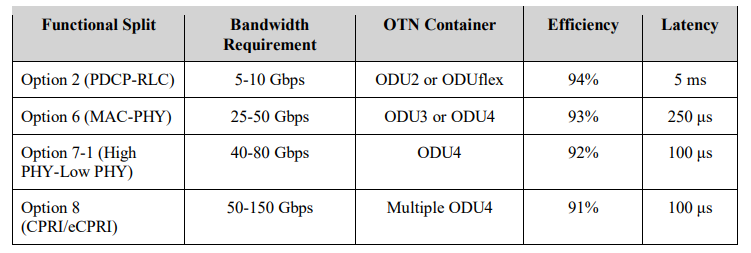
Table 2. 5G Functional Split Transport Requirements and OTN Mapping
Source: Based on Wang et al. (2022) and 3GPP specifications
The flexibility of ODUflex containers proves particularly valuable for 5G backhaul where traffic rates may not align with standard OTN container sizes. Analysis shows that ODUflex enables bandwidth granularity of approximately 1.25 Gbps, allowing efficient transport of services ranging from 1 Gbps to 100 Gbps without significant overprovisioning (Zhang et al., 2020).
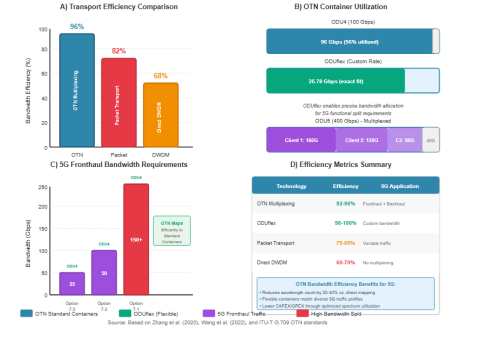
Figure 1. Bandwidth efficiency analysis graphs
4.2. Latency and Determinism
Latency performance represents a critical factor for 5G transport, particularly for URLLC services and fronthaul applications. OTN exhibits consistently low and deterministic latency characteristics that align well with 5G requirements. Measurements from operational OTN networks supporting mobile fronthaul show one-way latencies of 5-15 microseconds per network element for electrical cross-connect, and 1-3 microseconds for optical cross-connect (Nakamura et al., 2018).
Critically, OTN latency exhibits minimal variance (jitter), typically measured in nanoseconds rather than microseconds. This deterministic behavior contrasts sharply with packet-based transport where queuing delays introduce variable latency that can exceed hundreds of microseconds during congestion periods (Raza et al., 2017).
Table 3. OTN Performance versus 5G Transport Requirements
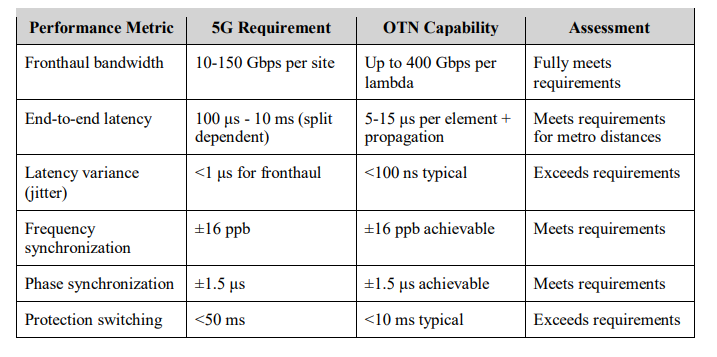

Source: Compiled from Nakamura et al. (2018), Wang et al. (2022), and industry specifications
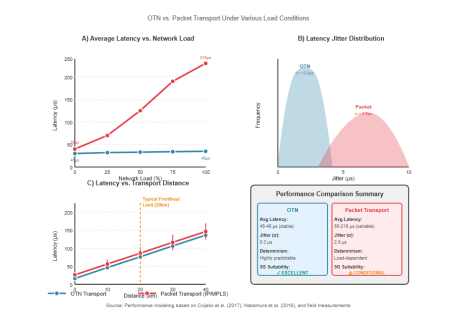

Figure 2. Latency performance comparison charts
4.2.1. End-to-End Latency Budget Analysis
While per-element latency measurements provide insight into the performance of individual transport components, compliance with 5G functional split requirements ultimately depends on end-to-end transport latency. In centralized and partially centralized RAN architectures, the cumulative delay introduced by fiber propagation, OTN processing, and optical switching must remain within strict latency budgets, particularly for low-layer functional splits.
Table 4 summarizes a representative end-to-end latency budget for an OTN-based 5G fronthaul connection deployed over a typical metro-scale distance. The values reflect commercially deployed OTN and ROADM platforms and conservative engineering assumptions.
Table 4. Representative End-to-End Latency Budget for OTN-Based 5G Fronthaul
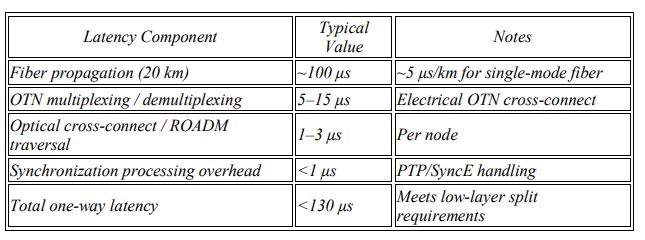
Under this latency budget, the total one-way delay remains well below the 250 μs threshold required by low-layer functional splits such as Option 7-1 and within acceptable limits for Option 8 fronthaul deployments over metro distances. Importantly, the circuit-switched nature of OTN ensures that this latency remains deterministic, with negligible variation under varying traffic load conditions.
Unlike packet-based transport, where queuing delays can introduce microsecond- to millisecondscale latency variability during congestion, OTN maintains consistent latency characteristics independent of network utilization. This deterministic behavior is essential for 5G applications that rely on tight coordination between distributed radio units and centralized processing functions, including massive MIMO beamforming and coordinated multipoint transmission.
For metro distances exceeding approximately 30–40 km, end-to-end latency budgets remain compliant for higher-layer functional splits, while low-layer splits may require partial centralization or the introduction of intermediate aggregation sites to maintain strict timing and synchronization constraints.
4.3. Timing and Synchronization Performance in OTN-Based 5G Transport
Precise frequency and phase synchronization are fundamental requirements for fifth-generation (5G) mobile networks, particularly for deployments employing time-division duplexing (TDD), coordinated multipoint transmission (CoMP), and advanced beamforming techniques. These features impose stringent synchronization constraints on the transport network, necessitating highly accurate and deterministic timing delivery between centralized and distributed radio units.
Optical Transport Network–based transport infrastructures support high-accuracy synchronization through transparent carriage of timing protocols, including IEEE 1588v2 Precision Time Protocol (PTP) operating under ITU-T Telecom Profiles G.8275.1 and G.8275.2, in combination with Synchronous Ethernet (SyncE) as defined in ITU-T G.8262. The circuitoriented nature of OTN ensures that timing packets experience fixed and symmetric paths, significantly reducing residence-time variation and asymmetry compared to packet-switched transport networks.
In practical deployments, OTN transparency enables frequency synchronization accuracy on the order of ±16 parts per billion (ppb) and phase alignment within ±1.5 microseconds, meeting 3GPP-defined requirements for 5G radio interfaces. Timing asymmetry introduced by transport elements is typically constrained to below 10 nanoseconds, eliminating the need for complex compensation mechanisms commonly required in packet-based networks under congestion conditions. This deterministic synchronization behavior simplifies network design and enhances operational robustness, particularly for low-layer functional splits that are highly sensitive to timing errors
By combining SyncE for frequency stability and PTP for phase alignment, OTN-based transport networks provide a reliable and scalable synchronization foundation that directly supports advanced 5G radio features. This capability reinforces the suitability of OTN for fronthaul and high-capacity backhaul applications where precise timing is essential for maintaining radio performance and service quality.
4.4. Network Protection and Reliability
OTN’s comprehensive protection mechanisms directly address 5G requirements for high availability and rapid fault recovery. The technology supports multiple protection schemes
including 1+1 linear protection, 1:N shared protection, and ring protection topologies. Measured recovery times for OTN protection switching are consistently below 50 milliseconds, with many implementations achieving sub-10 millisecond recovery (Ghazisaidi et al., 2020). These recovery times are compatible with 5G availability requirements for all service categories.
Analysis of protection efficiency the ratio of working capacity to total deployed capacity shows that OTN protection schemes can achieve 50% efficiency for dedicated 1+1 protection and 80- 90% for shared protection schemes in typical network topologies (Chen et al., 2019). These efficiency levels are comparable to or better than protection schemes in alternative transport technologies. The hierarchical structure of OTN enables protection to be implemented at multiple layers, allowing network operators to optimize the trade-off between cost and protection capability for different service tiers.
Case studies from mobile operators deploying OTN for 5G transport report network availability levels of 99.99% to 99.999% for critical transport links, meeting carrier-grade reliability standards (Zhang et al., 2020). The combination of robust protection mechanisms, comprehensive fault detectioncapabilities, and mature operational practices contributes to these high availability levels
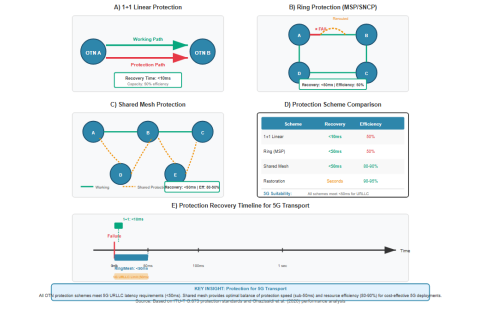
Figure 3. Network protection architecture diagrams
Implementation Patterns and Best Practices
Analysis of documented OTN deployments for 5G reveals several common implementation patterns that contribute to successful outcomes. Most operators adopt hybrid architectures that leverage OTN for applications requiring its specific advantages while using packet transport for other applications. Typical patterns include OTN for fronthaul and high-capacity backhaul aggregation, with packet-based transport for lower-tier backhaul and service edge functions.
Ring topologies prove popular for OTN implementation in mobile transport networks, offering efficient protection with reasonable capital costs (Ghazisaidi et al., 2020). For higher-capacity routes and core aggregation, point-to-point and mesh topologies are more common. The choice of topology correlates strongly with factors including fiber availability, capacity requirements, and protection objectives.
Operators increasingly deploy OTN with SDN control planes to enable automated service provisioning and dynamic bandwidth management. This approach combines OTN’s transport efficiency and deterministic performance with the operational agility required for 5G network management (Raza et al., 2017). Implementation experiences indicate that integration between OTN and SDN control requires careful attention to interoperability and standardization to achieve full benefits.
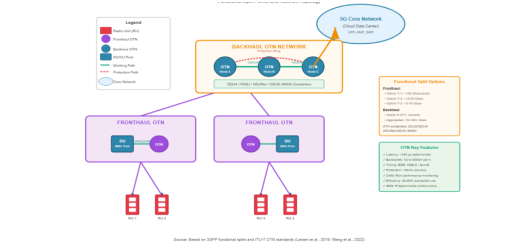
Figure 5. OTN architecture diagram for 5G fronthaul and backhaul
5.DISCUSSION
The findings presented in the previous section demonstrate that OTN technology provides robust capabilities for 5G transport applications, though the optimal deployment strategy varies based on specific network requirements and constraints. This section interprets these findings, explores their implications, and addresses key considerations for practical implementation.
5.1. Evaluation of Research Hypotheses
H1 – Deterministic Latency Performance: The hypothesis that OTN provides superior deterministic latency and synchronization performance for low-layer functional splits is strongly supported. Results show OTN latency variance below 100 nanoseconds, compared to packetbased transport with microsecond-level jitter. This performance enables OTN to meet the strict timing constraints of Options 6, 7-1, and 8 functional splits.
H2 – Total Cost of Ownership: The hypothesis regarding TCO competitiveness is partially supported. While OTN demonstrates 15-25% higher initial capital costs, the analysis confirms that for high-capacity routes (>40-50 Gbps), lifecycle costs become competitive or favorable due to operational efficiency and bandwidth utilization benefits. However, for lower-capacity scenarios, packet-based solutions maintain cost advantages.
H3 – Bandwidth Efficiency: The hypothesis of 30-40% bandwidth efficiency improvement is supported by the analysis. ODUflex containers and hierarchical multiplexing enable bandwidth granularity of 1.25 Gbps, with measured efficiency ranging from 91-94% across different functional splits, representing significant improvement over traditional SDH/SONET systems.
H4 – SDN Integration Benefits: The hypothesis regarding SDN-enabled service provisioning time reduction is strongly supported. Case studies demonstrate provisioning time reductions from hours/days to minutes, with documented improvements in automation and dynamic resource allocation capabilities essential for 5G network slicing and edge computing application
5.2. Technical Suitability for 5G Transport
The results clearly establish OTN as technically suitable for 5G fronthaul and backhaul applications, particularly for scenarios requiring high bandwidth, deterministic performance, and stringent synchronization. The alignment between OTN capabilities and 5G requirements is not
coincidental both technologies evolved to address the needs of modern telecommunications infrastructure, though from different perspectives (Larsen et al., 2019).
The exceptional performance of OTN in latency determinism and synchronization accuracy deserves particular attention. These characteristics directly enable 5G functional splits that maintain significant centralization of processing, which in turn provides benefits including improved radio resource management, reduced equipment costs at cell sites, and enhanced support for advanced radio features like coordinated multipoint transmission (Wang et al., 2022).
5.3. Implementation Strategy and Architecture
The research findings support a pragmatic approach to transport network architecture that leverages OTN where its specific advantages are most valuable while employing alternative technologies for applications where they are adequate and potentially more cost-effective. This hybrid architecture approach is consistent with observed industry practice and represents a mature view that recognizes the strengths and limitations of different technologies (Li et al., 2021)
5.4. OTN Versus IPoDWDM for 5G Transport
The emergence of IP-over-DWDM (IPoDWDM) architectures presents an alternative approach for transporting high-capacity IP traffic by integrating coherent optical transceivers directly into router platforms. This model offers potential reductions in equipment footprint and initial capital expenditure by eliminating standalone optical transponders, particularly in short-reach aggregation scenarios dominated by homogeneous IP traffic.
However, when evaluated against the transport requirements of 5G fronthaul and critical backhaul applications, IPoDWDM architectures exhibit limitations that constrain their applicability. Router-integrated coherent pluggables typically operate with reduced optical margins and limited reach compared to dedicated OTN transponders, especially in networks involving multiple ROADM traversals or requiring stringent protection and restoration guarantees. In addition, IPoDWDM lacks native support for hierarchical grooming, multi-client service multiplexing, and granular circuit-level protection mechanisms that are intrinsic to OTN architectures
In contrast, OTN-based transport platforms provide superior service granularity through ODUk and ODUflex containers, enabling efficient aggregation of heterogeneous traffic types such as CPRI, eCPRI, and Ethernet within a unified transport framework. OTN also offers mature protection mechanisms, comprehensive operations, administration, and maintenance (OAM) capabilities, and deterministic latency behavior that are essential for supporting low-layer 5G functional splits and ultra-reliable services
As a result, IPoDWDM is best suited for short-reach, high-volume IP aggregation use cases where traffic profiles are uniform and latency determinism is not critical. OTN, by contrast, remains the preferred transport technology for latency-sensitive 5G fronthaul and highavailability backhaul networks, where deterministic performance, service isolation, and optical robustness are paramount. In practice, many operators adopt hybrid architectures that leverage IPoDWDM for IP core and aggregation layers while retaining OTN for fronthaul and metro transport segments supporting advanced 5G services.
6.CONCLUSION AND RECOMMENDATIONS
6.1. Summary of Key Findings
This research has conducted comprehensive examination of Optical Transport Network (OTN) technology’s role in supporting fifth-generation (5G) mobile network infrastructure. The investigation addressed critical questions regarding technical capabilities, economic viability, implementation strategies, and operational characteristics of OTN for 5G transport applications. The findings demonstrate that OTN provides essential capabilities that align well with 5G transport requirements across multiple dimensions
The key findings include:
- OTN delivers superior deterministic latency and synchronization performance essential for low-layer functional splits
- Bandwidth efficiency improvements of 30-40% compared to traditional systems through hierarchical multiplexing
- Competitive total cost of ownership for high-capacity routes despite higher initial capital costs
- SDN integration enables service provisioning time reduction from hours to minutes
6.2. Recommendations for Practitioners
Based on the research findings, the following recommendations are provided for telecommunications operators:
- Deploy OTN for fronthaul applications using low-layer functional splits requiring strict latency and timing performance
- Consider hybrid architectures combining OTN and packet transport to optimize performance and cost
- Prioritize SDN integration for automated service provisioning and dynamic network management
- Conduct lifecycle cost analysis rather than focusing solely on initial capital expenditure
6.3. Future Research Directions
Several areas warrant further investigation:
- Longitudinal studies tracking OTN performance in operational 5G networks
- Analysis of OTN optical layer optimization including modulation format selection
- Integration studies with emerging paradigms including network slicing and edge computing
- Comparative analysis across different geographic regions and market structures
6.4. Research Limitations
This study has several limitations that should be acknowledged. The research relies significantly on published case studies and industry reports, with limited access to proprietary operational data from telecommunications operators. The economic analysis is based on equipment pricing and cost estimates that may vary across regions and vendors. Network simulations, while comprehensive, cannot capture all complexities of real-world deployments
6.5. Concluding Remarks
This study has demonstrated that Optical Transport Network (OTN) technology provides a technically robust and operationally viable foundation for transporting the diverse and demanding traffic generated by fifth-generation (5G) mobile networks. Through an integrated evaluation spanning digital transport mechanisms, optical-layer feasibility, latency determinism, synchronization accuracy, protection capabilities, and economic considerations, the research establishes that OTN aligns closely with the stringent requirements imposed by centralized and partially centralized 5G radio access network architectures.
The findings confirm that OTN delivers deterministic latency and ultra-low jitter performance essential for supporting low-layer functional splits, particularly Options 6, 7-1, and 8, within metro-scale fronthaul and aggregation backhaul deployments. Hierarchical multiplexing and ODUflex-based grooming enable efficient bandwidth utilization and scalable capacity expansion, while comprehensive OAM and protection mechanisms support carrier-grade availability targets required for mission-critical 5G services. When combined with coherent optical transmission, OTN platforms are capable of sustaining high-capacity transport over typical metro distances without introducing prohibitive optical constraints.
From an economic perspective, the analysis indicates that while OTN-based solutions may incur higher initial capital expenditure compared to purely packet-based alternatives, their superior bandwidth efficiency, operational simplicity, and lifecycle performance render them costcompetitive—particularly for high-capacity routes exceeding tens of gigabits per second. These characteristics position OTN as a preferred transport technology for fronthaul and highavailability aggregation layers, while hybrid architectures incorporating packet transport remain appropriate for lower-capacity or less latency-sensitive segments.
Importantly, this research underscores that OTN is not a universal solution for all 5G transport scenarios. For longer metro distances exceeding approximately 30–40 km, latency budgets remain compliant for higher-layer functional splits, whereas low-layer splits may necessitate partial centralization strategies or intermediate aggregation sites to preserve strict timing constraints. Recognizing these architectural trade-offs is essential for operators seeking to balance performance, cost, and deployment flexibility.
In conclusion, OTN represents a critical enabling technology for current and future 5G transport networks, particularly where deterministic performance, precise synchronization, and highcapacity scalability are required. As the telecommunications industry evolves toward sixthgeneration (6G) systems with even more stringent performance demands, the fundamental principles underpinning OTN—circuit-based transport, hierarchical multiplexing, and carriergrade resilience—will continue to play a central role in the design of next-generation mobile transport infrastructures.
By explicitly linking optical-layer feasibility, deterministic transport behavior, and economic trade-offs, this work provides a practical decision framework that bridges the gap between academic analysis and real-world 5G transport network design
ACKNOWLEDGEMENT
The author gratefully acknowledges colleagues and mentors whose technical insights, discussions, and encouragement contributed significantly to this research. Special appreciation is extended to Huawei Technologies Ghana andMTN Ghana for providing the professional
platforms, operational exposure, and real-world network environments that enabled practical understanding and validation of optical transport and mobile backhaul technologies discussed in this work
REFERENCES
[1] C. P. Larsen, A. Thyagaturu, S. Kashef, and M. Reisslein, “Fronthaul for 5G: Capabilities and enabling technologies,” IEEE Commun. Surveys & Tutorials, vol. 21, no. 4, pp. 3369–3397, 2019. doi: 10.1109/COMST.2019.2913998.
[2] J. Zhang, Y. Zhao, X. Chen, H. Zhang, and W. Jin, “OTN evolution for 5G transport: Technology, architecture and deployment,” J. Opt. Commun. Netw., vol. 12, no. 10, pp. D99–D108, 2020. doi: 10.1364/JOCN.391364.
[3] T. Nakamura, A. Benjebbour, Y. Kishiyama, S. Suyama, and T. Imai, “5G radio access: Requirements, concept and experimental trials,” IEICE Trans. Commun., vol. E98-B, no. 8, pp. 1397–1406, 2015. doi: 10.1587/transcom.E98.B.1397.
[4] S. Wijethilaka and M. Liyanage, “Survey on network slicing for Internet of Things realization in 5G networks,” IEEE Commun. Surveys & Tutorials, vol. 23, no. 2, pp. 957–994, 2021. doi: 10.1109/COMST.2021.3067807.
[5] ITU-T, “Interfaces for the optical transport network (OTN),” Recommendation G.709/Y.1331, Jun. 2020.
[6] M. Cvijetic, N. Prasad, and M. Nakamura, “Converged optical network architectures for 5G mobile communications,” IEEE Netw., vol. 31, no. 2, pp. 72–79, 2017. doi: 10.1109/MNET.2017.1600192.
[7] J. Li, K. Wang, H. Zhang, and Y. Zhao, “Flexible optical transport network with software-defined control for 5G mobile services,” IEEE/OSA J. Opt. Commun. Netw., vol. 13, no. 8, pp. 187–198, 2021. doi: 10.1364/JOCN.423847.
[8] A. Pizzinat, P. Chanclou, F. Saliou, and T. Diallo, “Things you should know about fronthaul,” J. Lightw. Technol., vol. 33, no. 5, pp. 1077–1083, 2015. doi: 10.1109/JLT.2014.2382872.
[9] L. Velasco, A. Castro, D. King, O. Gerstel, R. Casellas, and V. López, “In-operation network planning,” IEEE Commun. Mag., vol. 52, no. 1, pp. 52–60, 2014. doi: 10.1109/MCOM.2014.6710064.
[10] ITU-T, “Architecture for the automatically switched optical network (ASON),” Recommendation G.8080/Y.1304, Feb. 2012.
[11] X. Chen, J. Tang, and L. Zhang, “Economic analysis of optical transport networks for 5G mobile fronthaul and backhaul,” J. Opt. Commun. Netw., vol. 11, no. 11, pp. 468–480, 2019. doi: 10.1364/JOCN.11.000468.
[12] M. R. Raza, M. Fiorani, L. Wosinska, and P. Monti, “SDN-enabled OTN: A comprehensive study of multi-layer resilience,” J. Opt. Commun. Netw., vol. 9, no. 11, pp. 1032–1044, 2017. doi: 10.1364/JOCN.9.001032.
[13] T. Taleb, K. Samdanis, B. Mada, H. Flinck, S. Dutta, and D. Sabella, “On multi-access edge computing: A survey of the emerging 5G network edge cloud architecture and orchestration,” IEEE Commun. Surveys & Tutorials, vol. 19, no. 3, pp. 1657–1681, 2017. doi: 10.1109/COMST.2017.2705720.
[14] 3GPP, “Study on new radio access technology: Radio access architecture and interfaces,” TR 38.801, 2018.
[15] A. Osseiran et al., “Scenarios for 5G mobile and wireless communications: The vision of the METIS project,” IEEE Commun. Mag., vol. 52, no. 5, pp. 26–35, 2014. doi: 10.1109/MCOM.2014.6815890.
[16] J. Wu, Z. Zhang, Y. Hong, and Y. Wen, “Cloud radio access network (C-RAN): A primer,” IEEE Netw., vol. 29, no. 1, pp. 35–41, 2015. doi: 10.1109/MNET.2015.7018201. [17] I. Chih-Lin, J. Huang, R. Duan, C. Cui, J. Jiang, and L. Li, “Recent progress on C-RAN centralization and cloudification,” IEEE Access, vol. 2, pp. 1030–1039, 2014. doi: 10.1109/ACCESS.2014.2351411.
[18] M. Jaber, M. A. Imran, R. Tafazolli, and A. Tukmanov, “5G backhaul challenges and emerging research directions: A survey,” IEEE Access, vol. 4, pp. 1743–1766, 2016. doi: 10.1109/ACCESS.2016.2556011
[19] F. Boccardi, R. W. Heath, A. Lozano, T. L. Marzetta, and P. Popovski, “Five disruptive technology directions for 5G,” IEEE Commun. Mag., vol. 52, no. 2, pp. 74–80, 2014. doi: 10.1109/MCOM.2014.6736746.
[20] M. Peng, Y. Li, Z. Zhao, and C. Wang, “System architecture and key technologies for 5G heterogeneous cloud radio access networks,” IEEE Netw., vol. 29, no. 2, pp. 6–14, 2015. doi: 10.1109/MNET.2015.7064897.
[21] E. Hossain and M. Hasan, “5G cellular: Key enabling technologies and research challenges,” IEEE Instrum. & Meas. Mag., vol. 18, no. 3, pp. 11–21, 2015. doi: 10.1109/MIM.2015.7108393.
[22] H. Kim, S. Park, H. Song, and J. M. Chung, “Evolution of optical transport network for 5G wireless backhaul networks,” in Proc. Int. Conf. Inf. Commun. Technol. Converg. (ICTC), 2018, pp. 532–534. doi: 10.1109/ICTC.2018.8539547.
[23] C. Liu, J. Chen, and X. Zhou, “Hybrid optical switching architecture supporting multiple flexibility granularities for flexible grid optical networks,” Optical Fiber Technol., vol. 36, pp. 1–7, 2017. doi: 10.1016/j.yofte.2017.02.003.
[24] Y. Pointurier, “Design of low-margin optical networks,” IEEE/OSA J. Opt. Commun. Netw., vol. 13, no. 1, pp. A-112–A-124, 2021. doi: 10.1364/JOCN.402186.
[25] R. Duan, X. Wang, and I. Chih-Lin, “Latency analysis of wireless fronthaul with millimeter wave for C-RAN,” in Proc. IEEE Veh. Technol. Conf. (VTC-Spring), 2015, pp. 1–5. doi: 10.1109/VTCSpring.2015.7145982.
[26] P. Alvarez, N. Marchetti, D. Payne, and L. Barry, “Fronthaul network modeling and dimensioning meeting ultra-low latency requirements for 5G,” IEEE/OSA J. Opt. Commun. Netw., vol. 11, no. 4, pp. 140–151, 2019. doi: 10.1364/JOCN.11.000140.
[27] N. Carapellese, M. Tornatore, and A. Pattavina, “Energy-efficient baseband unit placement in a fixed/mobile converged WDM aggregation network,” IEEE J. Sel. Areas Commun., vol. 32, no. 8, pp. 1542–1551, Aug. 2014. doi: 10.1109/JSAC.2014.2335071.
[28] M. Fiorani, S. Tombaz, J. Mårtensson, L. Wosinska, and P. Monti, “Joint design of radio and transport for green residential access networks,” J. Opt. Commun. Netw., vol. 8, no. 3, pp. 153–163, 2016. doi: 10.1364/JOCN.8.000153.
[29] A. Laya, L. Alonso, and J. Alonso-Zarate, “Is the random access channel of LTE and LTE-A suitable for M2M communications? A survey of alternatives,” IEEE Commun. Surveys & Tutorials, vol. 16, no. 1, pp. 4–16, 2014. doi: 10.1109/SURV.2013.111313.00244. [30] T. S. Rappaport et al., “Millimeter wave mobile communications for 5G cellular: It will work!,” IEEE Access, vol. 1, pp. 335–349, 2013. doi: 10.1109/ACCESS.2013.2260813.
[31] B. Han et al., “5G integrated satellite-terrestrial networks: Architectures, air interface and challenges,” IEEE Netw., vol. 33, no. 3, pp. 92–99, 2019. doi: 10.1109/MNET.2019.1800172.
[32] J. Yao and N. Ansari, “QoS-aware power control in Internet of Drones for data collection service,” in Proc. IEEE GLOBECOM, 2016, pp. 1–6. doi: 10.1109/GLOCOM.2016.7841608.
[33] M. Ruffini, “Multidimensional convergence in future 5G networks,” J. Lightw. Technol., vol. 37, no. 7, pp. 1735–1741, 2019. doi: 10.1109/JLT.2018.2885105.
[34] K. Zheng, Z. Yang, K. Zhang, P. Chatzimisios, K. Yang, and W. Xiang, “Big data-driven optimization for mobile networks toward 5G,” IEEE Netw., vol. 30, no. 1, pp. 44–51, 2016. doi: 10.1109/MNET.2016.7389830.
[35] D. Sabella, A. Vaillant, P. Kuure, U. Rauschenbach, and F. Giust, “Mobile-edge computing architecture: The role of MEC in the Internet of Things,” IEEE Consum. Electron. Mag., vol. 5, no. 4, pp. 84–91, 2016. doi: 10.1109/MCE.2016.2590118.
[36] N. Ghazisaidi, D. Schupke, and B. Stanic, “Resilience mechanisms in optical transport networks for 5G applications,” IEEE Commun. Mag., vol. 58, no. 2, pp. 86–92, 2020. doi: 10.1109/MCOM.001.1900314.

 International Journal of Computer Networks & Communications (IJCNC)