
IJCNC 06
HLEVRA: AN EFFICIENT RESOURCE ALLOCATION STRATEGY FOR UPLINK AND DOWNLINK IN 6G NETWORKS
ABSTRACT
During the last decade, there has been a massive development of wireless networks, and nowadays 4G and 5G technologies are a usual thing. The next generation 6G standard is even more promiscuous, such as improved artificial intelligence (AI). In order to maximize resource allocation on 6G networks, the study suggests Horned Lizard Ensemble Voting Resource Allocation (HLEVRA) model. HLEVRA uses AI methods to compute user needs on resources and distribute them to them. In simulating an environment of a 6G network using NS3, the HLEVRA performance is measured according to the most important parameters, including throughput, data transfer rate, energy consumption, communication delay and packet drop. The findings reveal that HLEVRA is effective in the management of resources in a 6G network. HLEVRA recorded a spectacular throughput of 14.7 Gbps, data rate of 840 Kbps, 0.33 mW of energy usage, 20 ms of communication delay and packet drop rate of 12.5 with 100 users connected. These results indicate that HLEVRA is an effective strategy to optimize the 6G network performance.
KEYWORDS
6G Cellular Systems · Horned Lizard Optimization · Data transfer rate· Power consumption · Packet
drop
1. INTRODUCTION
Voice and data services are the primary goals of 2G, 3G, and 4G networks [1], whereas industrial environments are the focus of 5G [2]. The revolutionary services that are supported with emerging 6G technology include mixed reality and high-resolution sensing and demand extreme throughput and reliability [3]. It is anticipated that the wireless networks will substitute the traditional industrial wired networks because of the higher rate of data transmission, reduced latency, and enhanced reliability [4]. The 6G visions are recent, and they have X-subnetworks as the means of achieving extreme connectivity [5, 6]. These subnetworks appear in various contexts including in-vehicles, aeroplanes, in-robots, and bodies [7], handling scenarios from static devices to quick drones linked to cellular networks [8]. Wireless connections use the same frequency ranges as cellular phones among controllers, actuators, and sensors [9]. Subnetworks provide highly reliable performance even with weak or nonexistent links to broader networks [10]. However, quick mobility can cause highly dynamic interference and high transmission failure rates [11]. Resource allocation algorithms maximize multidimensional resources under interference and delay constraints [12], though these problems are non-convex with NPhardness [13]. Various strategies address these computationally intractable problems [14].
Current algorithms rely on information challenging to obtain in real networks, like channels between sub-networks [15, 16, 18]. While 5G shows good potential for IoE services, it cannot satisfy all the requirements of new smart programs [17]. Deep reinforcement learning (DRL) has solved radio resource allocation problems well recently [19], though existing strategies have unsolvable issues [20].Despite their effectiveness, most existing techniques do not explicitly consider the uncertainty inherent in server resource allocation and utilization[40].
The Existing system often lacks effectiveness due to poor prediction of desired resources. Considering these drawbacks, the present work has aimed to incorporate the optimization with the ensemble mode as the prediction mechanism. Key contributions to the proposed HLEVRA are listed below
• Introduced HLEVRA, a novel hybrid framework combining the Horned Lizard Optimization algorithm with ensemble-based predictive modeling for real-time resource allocation in 6G networks.
• Implemented and tested the HLEVRA framework in a multi-cellular user 6G environment using the NS3 programming environment, evaluating its performance based on critical metrics like throughput, delay, and energy consumption.
• Showed that HLEVRA provides superior efficiency over recent 6G algorithms, achieving high throughput and a high predictive model accuracy of 99.25% while significantly reducing delay and packet drop.
The latter part of the investigation was explained as follows; the latest study papers are described in the 2nd section. The 3rd section includes a brief description of the proposed methodology. The 4th section contains the outcomes of the resource-sharing framework and its correlation with the recent models. In the end, the 5th section concludes the study.
2. RELATED WORK
Some of the recent works related to this research study area are described as follows, Recent works deal with the issues of 6G resource management. Xia et al. [21] proposed an Attentionbased Graph Neural structure (A-GNS) based on power received and signal strength, which attained a better convergence, but low scalability. A dynamic resource model suggesting the modification of KuhnMunkres algorithm and Lagrangian decomposition to achieve energy efficiency in 6G-IoT networks was proposed by James et al. [22], but has been applied to multiobjective problems. Quingtian et al. [23] applied a double deep Q network (DDQN) with the highest complexity but with ultra-low latency [23] through optimal resource allocation. The Markovian decision process and dynamic nested neural structure designed by Kai et al. [24] minimized the delay time but had resource conflicts during the simultaneous execution of these tasks. Ramoni et al. [25] proposed the concept of multi-agent Q learning, Q-heuristics channel and power selection that enhanced convergences but had low percentiles. Khan et al. [32] came up with high-gain metamaterial-based antennas with an additional gain of over 34 dBi in SubTHz frequencies. Chandel et al. [33] proposed small-scale triple-band orthogonal MIMO antennas to operate in the C band, Wi-Fi 6E and X bands. Ouaissa and Ouaissa et al. [34] considered the radio resource management of M2M communications revealing the congestion in radio resources and computational complexities of scheduling algorithms in dense environments. Yan et al. [38] proposes a dynamic resource allocation framework for 5G network slicing using DRL. By integrating an Advantage Actor-Critic (A2C) algorithm with Massive MIMO technology, the system autonomously manages bandwidth and power across different network slices. Arefin and Azad [39] introduce a Prioritized Scheduling Routing Protocol for Wireless Body Area Networks (WBANs) to enhance medical data reliability. The protocol categorizes sensor data based on urgency, ensuring that critical health alerts are prioritized during transmission to prevent packet drops and reduce latency. Table 1 provides the difficulties of the available literature.
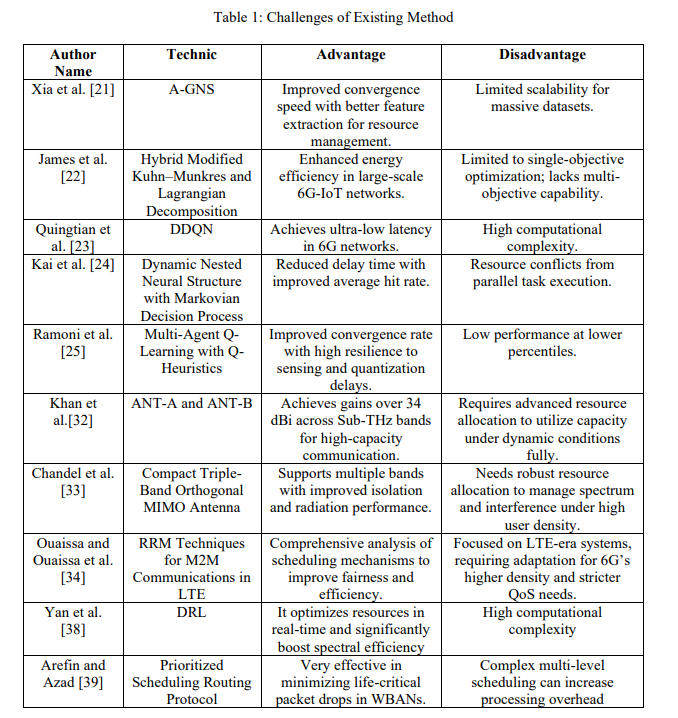
The literature indicates that the current research has made vital advancements in 6G resources management but there are major shortcomings that include a high level of computational complexity, low scalability, single-objective optimization, and a lack of adaptability in dense networks. Most methods achieve energy optimization, latency optimization, or neither both, without considering a combination of measures of multiple performance. In white of these gaps, the proposed HLEVRA framework combines Horned Lizard Optimization with ensemble learning in order to meet the goals of multi-objective resources allocation, adaptive and energyefficient resources allocation. This method increases the scalability and reduces throughput delay, along with high throughput, even in ultra-dense 6G conditions.
3. PROPOSED METHODOLOGY
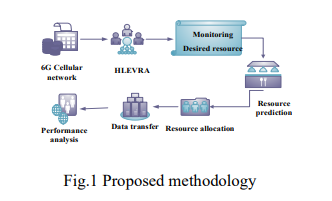
The HLEVRA strategy deals with essential constraints of current approaches to resource allocation of 6G. The traditional approaches to optimization, Q-learning and deep reinforcement learning have the disadvantage of being unable to change the schedule dynamically or even in dense environments, and reliant on full channel state information. The proposed method of HLEVRA is a hybrid one that incorporates bio-inspired Horned Lizard Optimization with ensemble-based predictive modeling. The dual-layer design will allow real time search adaptation of resources and anticipate user specific demand trends to utilize in uplink and downlink scheduling. As far as we know, this is the first publication to bring these methodologies together in 6G resource allocation in a realistic framework of NS3 simulation. The innovation offers predictive foresight and optimization agility, and facilitates highperformance in terms of throughput, latency, energy savings and packet management in ultradense environments with low latency requirements. Fig 1 is a summary of the overall methodology.
3.1. 6G Cellular Systems
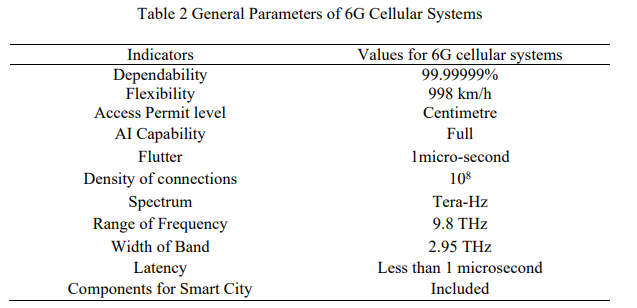
6G cellular systems function in the frequency range of 101 GHz to 3 THz, enabling ultra-highspeed data transmission and extremely low latency for next-generation communication networks. However, managing massive data remains challenging. As 6G focuses on highquality service and terabit wireless performance, standardization efforts for terahertz communication are still in their early stages. The formally accepted 300 GHz band supports numerous encoding modules. General Parameters of 6G Cellular Systems Shown in Table 2.
3.2. Horned Lizard Ensemble Voting Resource Allocation
HLEVRA combines Horned Lizard Optimization and the Ensemble Voting Resource Allocation Technique to create an advanced resource allocation method for 6G systems. It tackles network challenges using adaptive patterns and improves allocation and prediction through an enhanced fitness function. The initiation of the connection of devices (E) in the proposed optimization is expressed in Eqn (1) [23].This equation lists all devices in the network, where each En device is denoted by a single letter. In HLEVRA, these devices serve as the starting point for resource allocation and prediction, with all subsequent calculations based on this set of devices.

The data is processed from the transmitting point i to the receiving point j. For computing the task of each connected device, the defining function of the optimization generated from the parameters processing cycle ( Di ), task computing size ( Vi ), and the necessary storage for computing the task ( Wi ).Equation (2) [23] represents task allocation for each linked device, combining all task parameters into one set to enable optimal resource allocation.

Afterwards, the optimization’s fitness function is triggered to determine the duration of data processing in each connection with their tasks ( Ft ). And is denoed in Eqn (3) [23].This is used to calculate processing time, helping HLEVRA allocate resources efficiently and reduce latency.
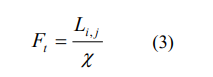
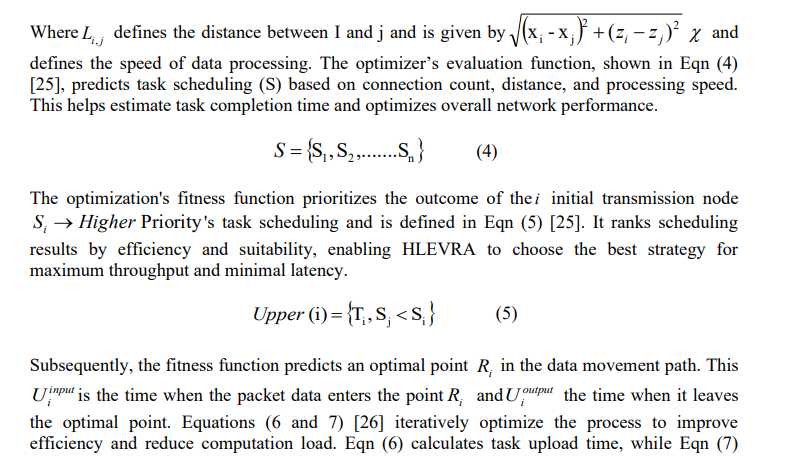
computes task execution time based on device location, enhancing resource allocation and
minimizing delays.
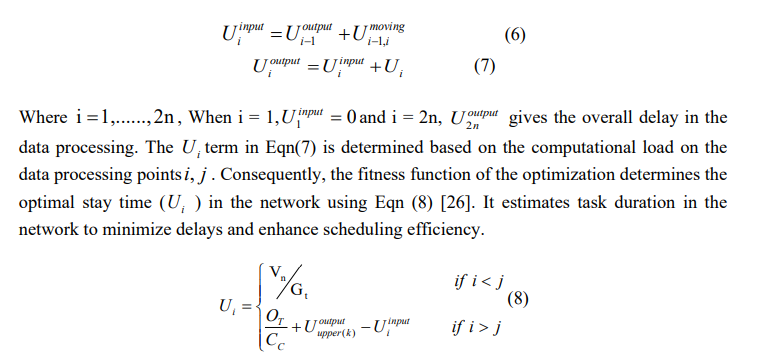
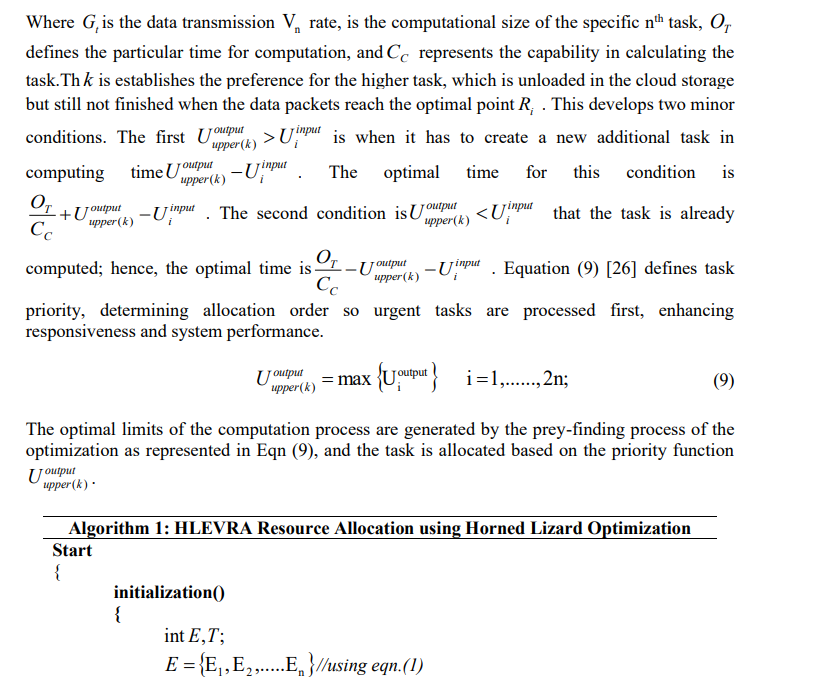
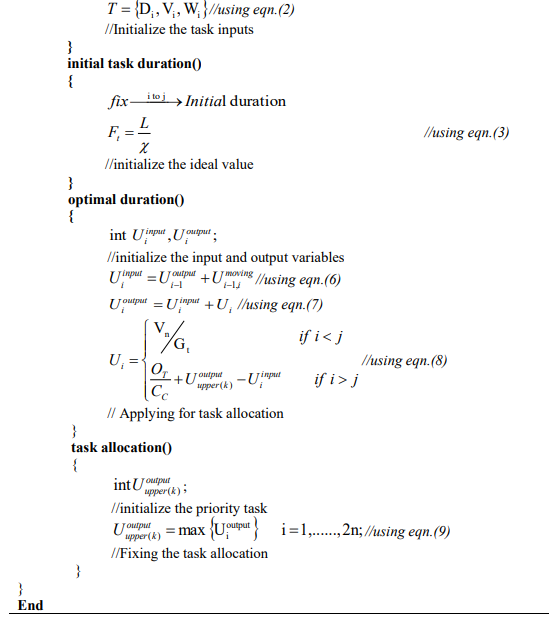
The HLEVRA framework is described in algorithm 1. The algorithm sets up candidate solutions that are resource allocation among users and base stations. The multi-objective function that is used to assess fitness takes into account the communication delay, energy consumption, and throughput (Eqns 3-5). The optimal solution is determined and the mechanism of finding prey of the Horned Lizard (Eqn 9) leads to population evolution to reach optimal allocations. This is repeated until convergence or set limit of iteration. The algorithm returns optimal resource allocation minimizing delay and energy while maximizing efficiency.
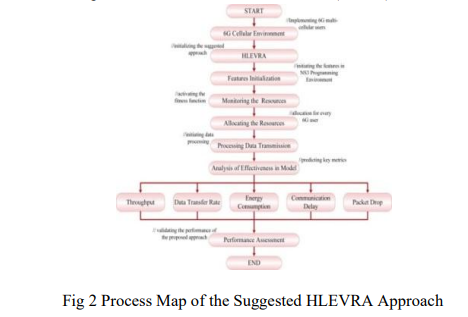
Fig 2 illustrates the HLEVRA process. The 6G cellular environment is implemented in NS3 simulator, and HLEVRA is activated to optimize data transmission. Optimization identifies network resource requirements, allocates resource tasks to specific functions, and processes data transmission. Performance is evaluated through energy consumption, communication delay, packet drop, data transfer rate, and throughput. Results are compared with recent techniques for validation.
4. RESULTS AND DISCUSSION
The 6G resource-sharing framework was simulated on Ubuntu 22.04.4 LTS using NS3 with Python bindings. HLEVRA managed resource allocation and evaluated performance through throughput, data rate, energy use, delay, and packet drop. A Horned Lizard Optimizer was used to simulate 20100 users in 88 urban grid (population = 10, iterations = 50). Latency and energy were determined using path length and Euclidean distance whereby the aim was to maximize throughput and minimize delay and energy. Prediction was improved with the help of a soft voting ensemble (Decision Tree, KNN, SVM), which models realistic dense 6G network dynamics.
4.1. Case Study
To ascertain the effectiveness of the suggested methodology, a valid functional analysis is carried out with a linear distribution of results. The study includes throughput, transfer rate of data, energy usage, drop in data packets, and delay in data communication. The optimization allocates the resources, and the data is processed. The acquired findings are matched and related to the latest model to interpret the advancement percentage in the model’s effectiveness. This suggested technique attained superior outcomes in all correlated experiments.
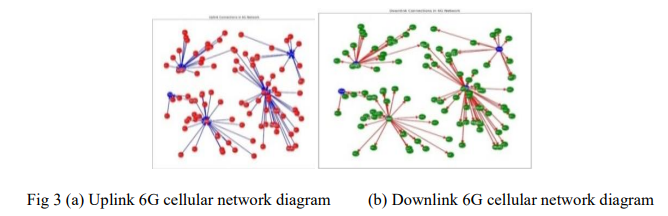
The 6G cellular environment developed in the NS3 stimulator in uplink and downlink is shown in Fig 3. In the uplink Fig 3 (a), data flows from the red circles (users) to the blue circle (station). This represents the transmission of data from user devices to the network infrastructure. The performance metrics measured (throughput, transfer rate, energy usage, packet loss, and delay) would directly impact the uplink performance. For example, a high uplink throughput would indicate efficient transmission of data from users to the network. In the downlink Fig 3 (b), data flows from the blue circle (station) to the red circles (users). This refers to data transmission from the network to user devices. Key metrics like low packet loss indicate reliable and efficient downlink performance.
4.1.1. Resource Allocation
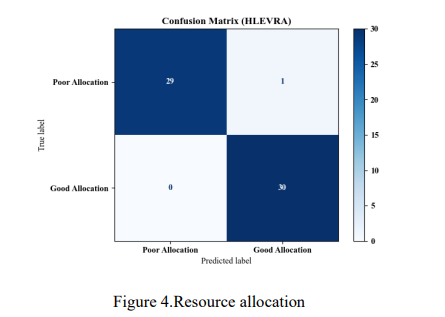
This confusion matrix illustrates the classification performance of the proposed HLEVRA model for resource allocation decisions. The matrix shows that the model correctly classified 29 instances of Poor Allocation and 30 instances of Good Allocation, demonstrating strong prediction reliability. Only one case of Poor Allocation was misclassified as Good Allocation, and there were no misclassifications in the Good Allocation category. The high number of correct predictions and minimal error indicate that the model effectively distinguishes between poor and good allocation decisions with high accuracy and strong generalization capability. Resource allocation Shown in Figure 4
4.1.2. HLEVRA Convergence Behavior
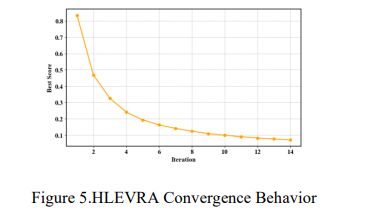
The convergence behavior of the proposed HLEVRA algorithm is illustrated over 14 iterations. The graph shows the gradual decrease in the best fitness score, indicating the optimizer’s ability to progressively find better resource allocation solutions. Initially, the score is higher due to suboptimal allocations, but as iterations proceed, the adaptive prey-finding and escape strategies enable efficient exploration and exploitation of the solution space. The convergence trend demonstrates that HLEVRA quickly stabilizes within a few iterations, validating its computational efficiency and suitability for dynamic 6G network environments. HLEVRA Convergence Behavior shown in Figure 5.
4.1.3. Throughput
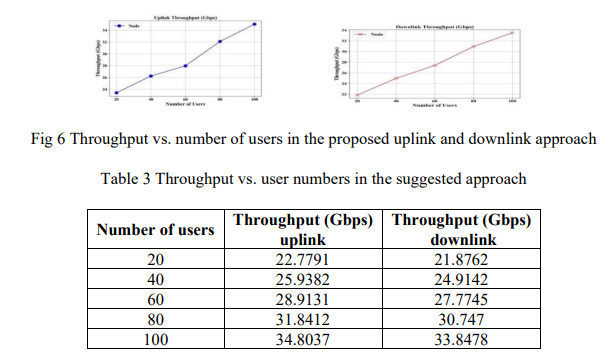
Throughput expressed in Gbps indicates the rate of data processing by the 6G network and represents its overall processing capacity, as Figure 6 and Table 3 indicate that throughput rises gradually as the number of users rises between 20 and 100 uplink to 34.8037 Gbps and downlink to 33.8478 Gbps. This steady enhancement ensures the capacity of the system to handle increased user loads such that the data flow is balanced and the performance is reliable within the system when it comes to 6G technology.
4.1.4. Data Transfer Rate
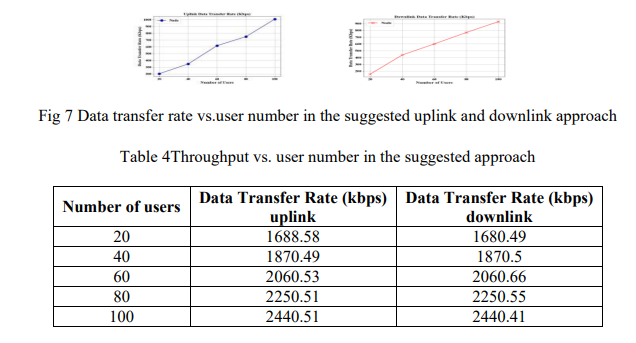
Multi-input, multi-output approach ensures that there is stability of the data transfer rate in the 6G system. Fig 7 indicates the rate at which a user is able to transfer data when there is an increasing number of users in the proposed uplink and downlink system. Table 4 indicates that uplink and downlink rates increase (1688.58kbs to 2440.51kbs and 1680.49 to 2440.41 kbps respectively) with the number of users rising between 20 and 100. This proves effective scaling and balanced performance during management of increased traffic.
4.1.5. Energy Consumption
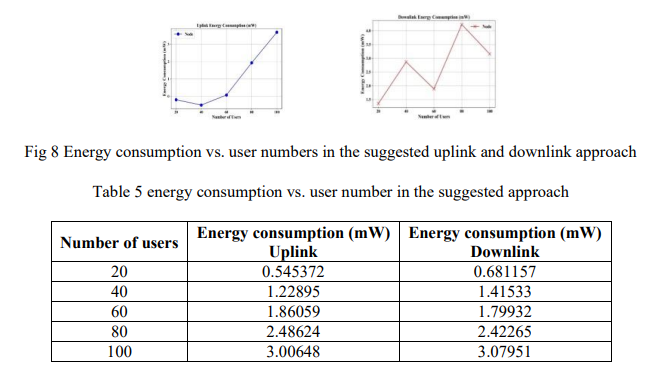
With the growth in the capacity of the data, the energy consumption also rises. Energy efficiency is an important issue in 6G networks due to the fact that the increased speed and transmissions will be accompanied by high power consumption since the high-speed performance will require too much power. Fig 8 and Table 5 indicate that with increase in the number of users, uplink energy consumption also increases, as compared to 0.545mW at 20 users, 3.006mW at 100 users and downlink energy consumption also increases, compared to 0.681mW at 20 users and 3.079mW at 100users. It means that as the data traffic increases, the energy consumption increases at the same proportion.
4.1.6. Communication Delay
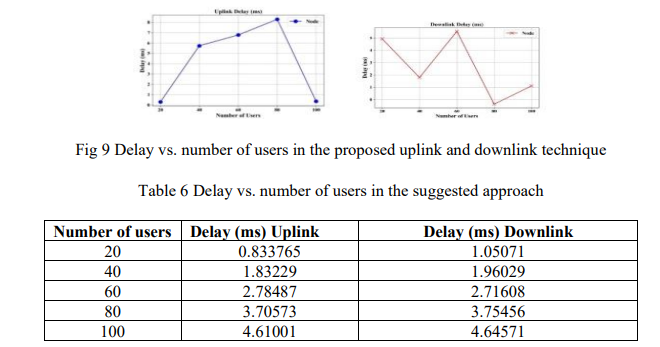
The delay in communication between the processing of data packets in the protocol stack and their delivery at the receiving layer of the target layer affects quality of service and the user experience. As seen in Fig 9 and Table 6, uplink delay increases to 4.610 and downlink to 1.050 ms as the number of users (20 to 100) increase respectively. The increasing trend of latency at the higher user loads underscores that it is difficult to sustain low delay at high traffic.
4.1.7. Packet Drop
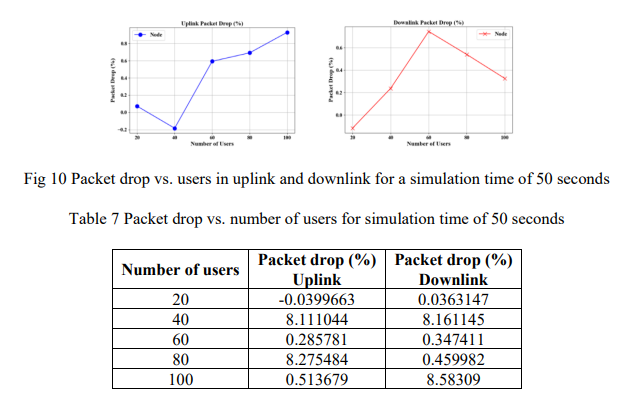
Packet Drop is a term that can be used to define data packets that do not make it to the receiver because of the poor signal strength or network congestion. Fig 10 and Table 7 indicate that the number of packets dropped in the proposed uplink scheme and downlink scheme varies proportional to the number of users instead of having a constant trend. Uplink and downlink drop of packets range between -0.039 to 8.275 and 0.036 to 8.583 respectively among 20 to 100 users. Such fluctuations represent the different performance of the network when there are different loads
4.2. Comparison
The performance of the proposed model was tested on the comparison with the recently published works such as 6G-DeFLI, IOO-VRF and V-GGRP. The metrics such as Throughput, Data Rate, Energy Consumption, Communication Delay, Accuracy and Packet Drop were used in comparison. The whole simulation was performed in an NS3 simulator with the standardized parameters of the 6G cellular system to enable a fair, rigorous, and transparent comparison.
4.2.1. Throughput
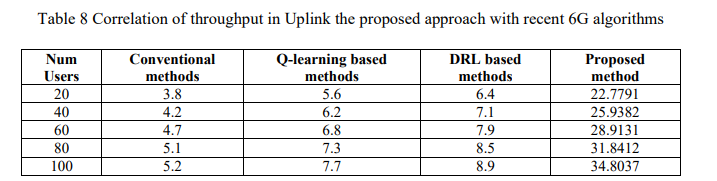
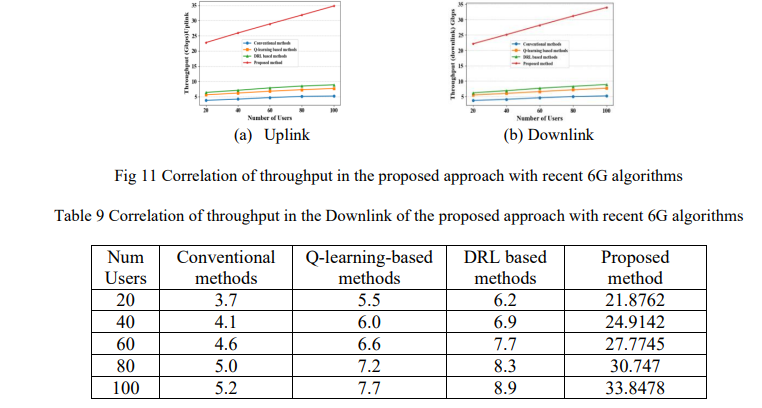
Figure 11 and Tables 8-9 provide the throughput performance comparisons. The proposed method is much more effective than the existing 6G approaches, such as Conventional (3.852 users), Q-learning (5.67 users) and DRL (6.48 users), whose throughput was 22.779134.8037users, respectively. This shows the outstanding scalability and efficiency of the proposed model in comparison to existing methods.
4.2.2. Data Transfer Rate
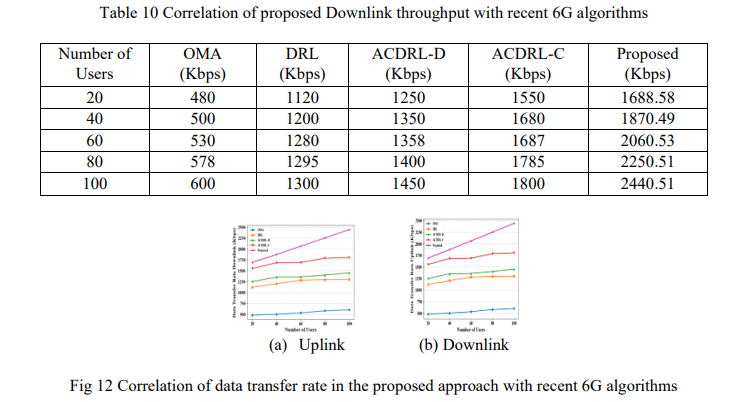
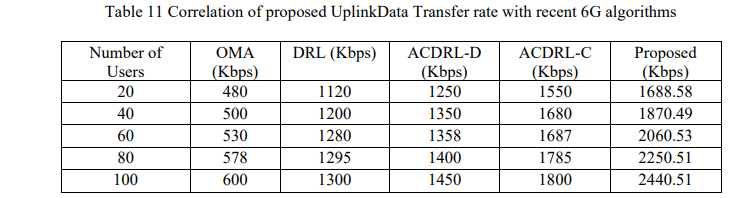
Data Transfer Rate is used to quantify the rate of information transfers within the network elements. As Figure 12 (a) and Table 10 reveal, the proposed downlink method is more efficient in maximizing the rate of downlink, with the rate of 2440.52 being significantly higher than the existing approaches to 6G, including OMA (600), DRL (1300), actor-critic deep reinforcement learning- discrete action (ACDRL-D) [27] (1450), and actor-critic deep reinforcement learningcontinuous action (ACDRL-C) [27] (1800), and demonstrates a better ability to maximize the efficiency of the downlink. Table 11 in the comparison of uplink data transfer rates shows that there are considerable improvements. OMA reaches 600, DRL reaches 1300, ACDRL-D reaches 1450 and ACDRL-C reaches 1800. The presented approach provides the highest value of 2440.47 as it is depicted in Figure 12 (b) and is mostly superior to all the other methods in maximizing the uplink data transfer rates.
4.2.3. Energy Consumption
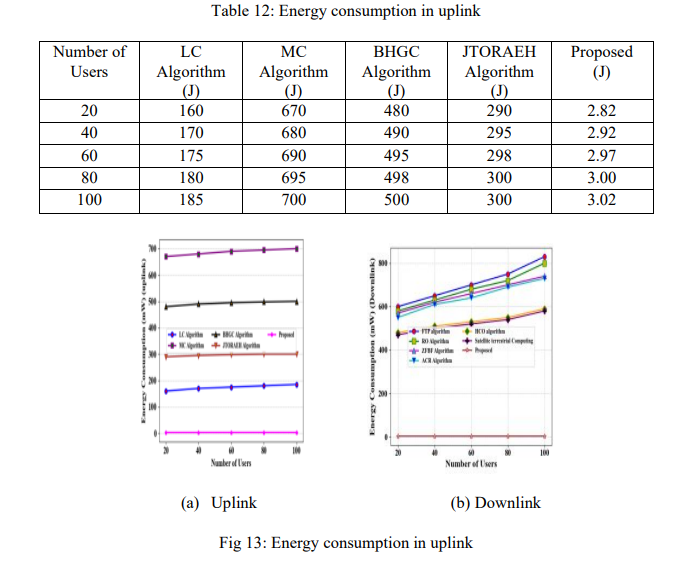
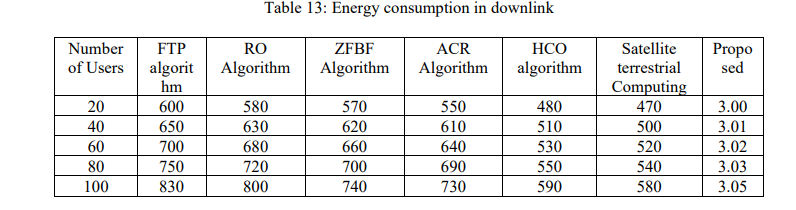
Energy Efficiency Analysis gives a comparison between the proposed approach and recent 6G models in Table 12, Table 13, and Figure 13. The uplink proposed is compared with Local computing (LC), MEC server computing (MC) algorithm, based on Hungarian and graph colouring (BHGC), and Joint task offloading and resource allocation in mobile edge computing with energy harvesting [28]. In the uplink, the suggested approach uses 3.02 mW, which is way less than LC (185 mW), MC (700 mW), BHGC (500 mW), and JTORAEH (300 mW), and it represents an unprecedented power optimization. In the case of the downlink, compared with Fixed Transmit Power (FTP) Algorithm, Zero-Forcing Beamforming (ZFBF) Algorithm, Random Offloading (RO) Algorithm, Average Computing Resources (ACR) Algorithm, and Heuristic Computing Offloading (HCO) Algorithm [29]. It has a 3.07 mW, which is better than FTP (830 mW), RO (800 mW), ZFBF (740 mW), ACR (730 mW), HCO (590 mW), and Satellite Terrestrial Computing (580 mW). The resulting extreme change underscores the high energy efficiency by the proposed model in the uplink and downlink communication
4.2.4. Communication Delay
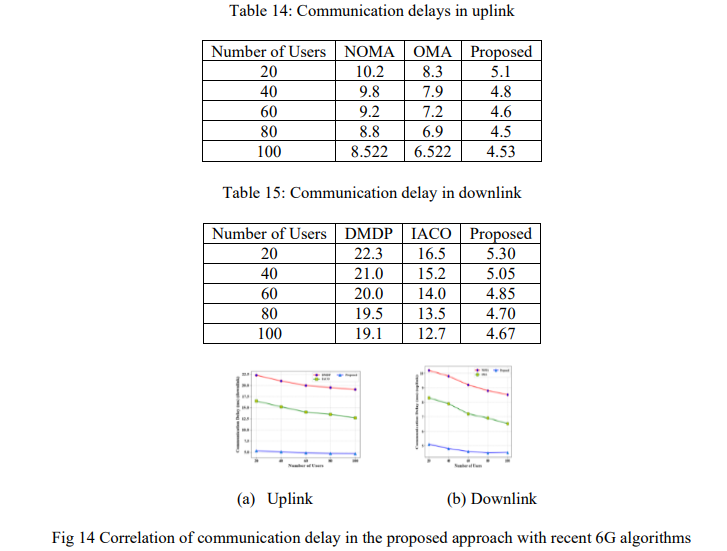
The suggested downlink is contrasted with Deep Markov Decision Process (DMDP) and the Improved Ant Colony Optimization (IACO) [30]. Table 14 of Non-Orthogonal Multiple Access and Orthogonal Multiple Access Finite Block length theorem (FBT) [31] compares the proposed approach in uplink with the existing approaches. Table 15 records these readings. Figure 14 (a) demonstrates the correlation of communication delay in the suggested approach with the recent 6G algorithms. Table 14 gives the values of values of communication delay in the downlink. The comparison of the results reveals that the given approach decreases the downlink communication delay to 4.67 milliseconds (ms) (Figure 14, b), which is significantly lower than the delay to 19.1 milliseconds (Delays Minimization Dynamic Programming, DMDP) and 12.7 milliseconds (Iterative Ant Colony Optimization, IACO). This shows that it is more efficient in reducing delay.
4.2.5. Packet drop
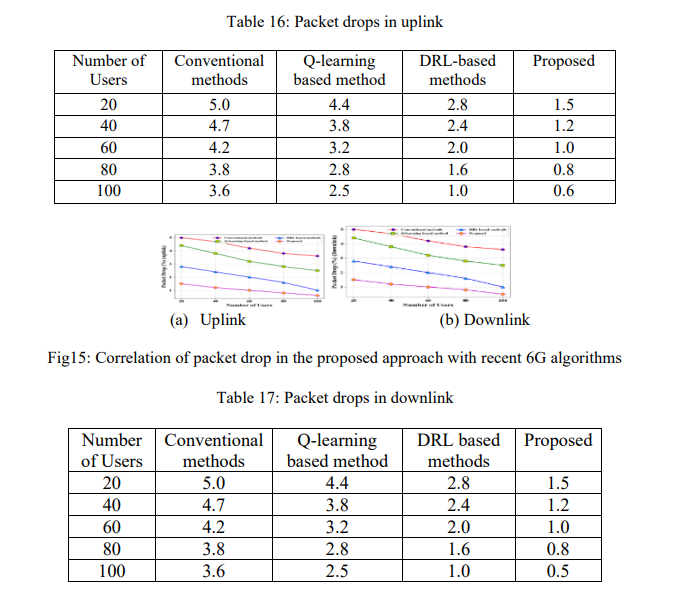
Table 16, Table 17, and Figures 15 show Packet Drop Analysis of uplink and downlink. Compared to Conventional (3.6%), Q-learning (2.5%), and DRL (1%), the proposed method has the lowest percentage (0.6) in the uplink and downlink, which is minimized to minimum loss. This is a huge decrease made possible by the effectiveness of the proposed model in reducing the number of packets lost and increase the reliability of transmissions.
4.2.6. Accuracy
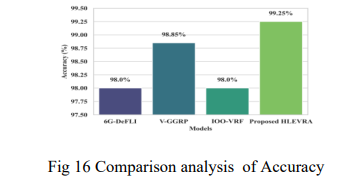
Traditional approaches such as the 6G Distributed Hash Table and Blockchain-enabled Federated Learning for IoT (6G-DeFLI) [35], Enhanced Congestion Avoidance Model with V Gradient Geocast Routing Protocol (V-GGRP) [36] and the Intelligent Osprey Optimized Versatile Random Forest (IOO-VRF) model [37] are used for comparison. In 6G-enabled IoT networks, HLEVRA performs better with 99. 25 per cent accuracy compared to 6G-DeFLI (98), V- GGRP (98. 85), and IOO-VRF (98) (as indicated in Figure 16). It was also found to be robust, scalable, and efficient in 6G resource allocation using NS3 simulations of up to 20100 users, with up to 45x higher throughput, and one hundred ninety percent lower energy consumption and delay and packet drop than Conventional, Q-learning, DRL, and Actor-Critic models.
4.3. Overall Performance
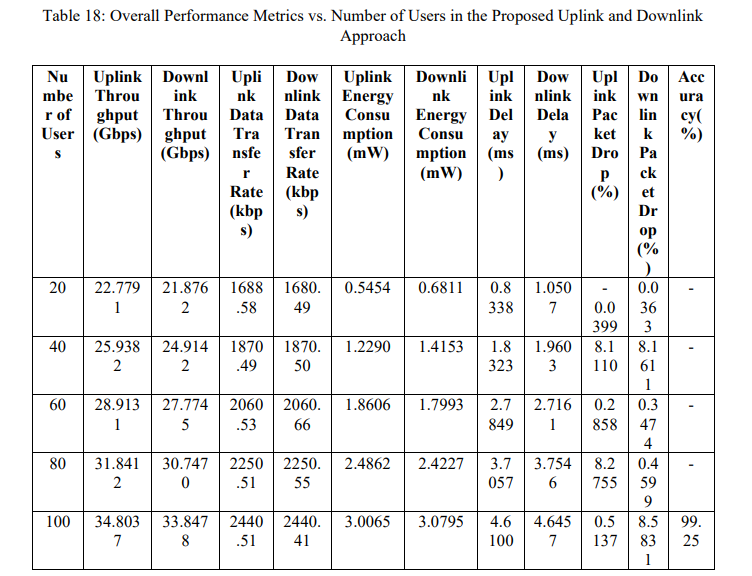
The summary of Comprehensive Performance Evaluation can be seen in Table 18 which provides a detailed overview of the uplink and downlink performance of the proposed system, in 20-100 users, through throughput, data rate, energy consumed, delay, packet drop, and accuracy. The findings indicate scalable throughput and data rates, and energy consumption and delay increase with heavier loads, and there is also varied packet drop with conditions of the network. The suggested HLEVRA framework has a high accuracy of 99.25 which proves its high efficiency in 6G conditions.
4.4. Strengths and Weaknesses
The suggested approach has high throughput and low latency in uplink and downlink, effective energy consumption with capacity in high user density, and strong resource distribution by bioinspired optimization with ensemble prediction. Nonetheless, its analysis is only done in simulated conditions, it can add computational load to low-power devices, and it makes ideal conditions of channels that might not accurately represent the real-life conditions.
4.5. Statistical Analysis
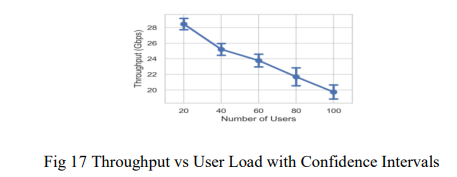
To assess the statistical soundness of HLEVRA under different network loads, we performed a one-way ANOVA test on the throughput measurements inductive on the results in five different user situations (20, 40, 60, 80 and 100 users), and 10 randomized experiments. The ANOVA showed a large F-value of 143.31 and p-value of 5.44 × 10 -5, which is statistically significant difference in throughput performance of the load conditions. Figure 17 provides a correlation between throughput and user load by the 95 percent confidence interval. On increasing the number of users, the average throughput tends to reduce slowly as the number of users rises to 100 since there is increased network contention. The error bars ensure that there is stable and reliable performance, and the robustness of HLEVRA and its stability in different load conditions can be determined.
5. CONCLUSION
This paper suggests the HLEVRA an intelligent resource allocation system that employs an ensemble voting-based approach, along with Horned Lizard Optimization, to offer substantial throughput, delay, energy consumption, and packet drop rates enhancements to next-generation 6G wireless networks. The HLEVRA model was modeled using NS3 platform of multi-cellular users. With the increase in the number of users by 20 to 100, the uplink throughput improved further by 22.7791 to 34.8037 Gbps and the rate of data transfer rose by 1688.58 to 2440.51 Kbps with the energy consumption and delay also lying within acceptable ranges. There were improvements in downlink performance that were consistent. A comparative analysis revealed HLEVRA to be much more efficient, able to scale and be robust enough to be used in ultradense and latency-sensitive applications like autonomous car and industrial IoT.
Mobility-conscious allocation of resources, heterogeneous network adaptation (multi-RAT and edge computing), energy efficient resource-scheduling modules (adaptive sleep scheduling and dynamic power management), multi-objective optimization, and federated learning-based distributed control are some of the improvements to be incorporated in the future. The in-theloop testing will be used to verify the feasibility of 6G deployments.
COMPLIANCE WITH ETHICAL STANDARDS
Funding: No funding is provided for the preparation of the manuscript.
Conflict of Interest: The Authors declare that they have no conflict of interest. Ethical Approval: This article does not contain any studies with human participants or animals performed by any of the authors.
Consent to participate: All the authors involved have agreed to participate in this submitted article.
Consent to Publish: All the authors involved in this manuscript give full permission for the publication of this submitted article.
Authors’ Contributions: All authors have equal contributions in this work
Data Availability Statement: Data sharing not applicable to this article.
REFERENCES
[1] Haq, I., Soomro, J.A., Mazhar, T., Ullah, I., Shloul, T.A., Ghadi, Y.Y., Ullah, I., Saad, A., & Tolba, A. (2023) “Impact of 3G and 4G technology performance on customer satisfaction in the telecommunication industry,” Electronics12.7: 1697.
[2] Attaran, M (2023) “The impact of 5G on the evolution of intelligent automation and industry digitization,” Journal of ambient intelligence and humanized computing 14.5: 5977-5993.
[3] Alsabah, M., Naser, M.A., Mahmmod, B.M., Abdulhussain, S.H., Eissa, M.R., Al-Baidhani, A., Noordin, N.K., Sait, S.M., Al-Utaibi, K.A., & Hashim, F. (2021) “6G wireless communications networks: A comprehensive survey,” Ieee Access 9: 148191-148243.
[4] Anumbe, N., Saidy, C., & Harik, R. (2022) “A Primer on the Factories of the Future,” Sensors22.15: 5834.
[5] Karam, G.M., Gruber, M., Adam, I., Boutigny, F., Miche, Y., & Mukherjee, S. (2022) “The evolution of networks and management in a 6G world: An inventor’s view,” IEEE Transactions on Network and Service Management19.4): 5395-5407.
[6] Adeogun, R., Berardinelli, G., & Mogensen, P.E. (2022) “Enhanced interference management for 6G in-X subnetworks,” IEEE Access10, 45784-45798.
[7] Kuchár, P., Pirník, R., Janota, A., Malobický, B., Kubík, J., & Šišmišová, D. (2023) “Passenger occupancy estimation in vehicles: A review of current methods and research challenges,” Sustainability15.2: 1332.
[8] Al-Absi, M.A., Al-Absi, A.A., Sain, M., & Lee, H. (2021) “Moving ad hoc networks—A comparative study,” Sustainability 13. 11, 6187.
[9] Du, X., Wang, T., Feng, Q., Ye, C., Tao, T., Wang, L., Shi, Y., & Chen, M. (2022) “Multi-agent reinforcement learning for dynamic resource management in 6G in-X subnetworks,” IEEE transactions on wireless communications22.3: 1900-1914.
[10] Berardinelli, G., Baracca, P., Adeogun, R.O., Khosravirad, S.R., Schaich, F., Upadhya, K., Li, D., Tao, T., Viswanathan, H., & Mogensen, P. (2021) “Extreme communication in 6G: Vision and challenges for ‘in-X’subnetworks,” IEEE Open Journal of the Communications Society,2, 2516- 2535.
[11] Puspitasari, A.A., An, T.T., Alsharif, M.H., & Lee, B.M. (2023) “Emerging technologies for 6G communication networks: Machine learning approaches,” Sensors23.18, 7709.
[12] Mei, J., Han, W., Wang, X., & Poor, H.V. (2022) “Multi-dimensional multiple access with resource utilization cost awareness for individualized service provisioning in 6G,” IEEE Journal on Selected Areas in Communications40.4, 1237-1252.
[13] Shi, Y., Lian, L., Shi, Y., Wang, Z., Zhou, Y., Fu, L., Bai, L., Zhang, J., Zhang, W. (2023). “Machine learning for large-scale optimization in 6g wireless networks,” IEEE Communications Surveys & Tutorials.
[14] Khatib, O., Ren, S., Malof, J., & Padilla, W.J. (2021) “Deep learning the electromagnetic properties of metamaterials—a comprehensive review,” Advanced Functional Materials31.31, 2101748.
[15] Trabelsi, N., & ChaariFourati, L. (2024, April) “A Brief Review of Machine Learning-Based Approaches for Advanced Interference Management in 6G In-X Sub-networks,” In International Conference on Advanced Information Networking and Applications,475-487. Cham: Springer Nature Switzerland.
[16] Wei, W., Yang, R., GuH,Zhao, W., Chen, C., & Wan, S. (2021) “Multi-objective optimization for resource allocation in vehicular cloud computing networks,” IEEE Transactions on Intelligent Transportation Systems,23. 12: 25536-25545.
[17] Miya, J., Raj, S., Ansari, M.A., Kumar, S., & Kumar, R. (2023) “Artificial intelligence advancement for 6G communication: a visionary approach,” In 6G Enabled Fog Computing in IoT: Applications and Opportunities, 355-394. Cham: Springer Nature Switzerland.
[18] Xu, Y., Gui, G., Gacanin, H., & Adachi, F. (2021) “A survey on resource allocation for 5G heterogeneous networks: Current research, future trends, and challenges,” IEEE Communications Surveys & Tutorials, 23.2, 668-695.
[19] Sande, M.M., Hlophe, M.C., & Maharaj, B.T. (2021) “Access and radio resource management for IAB networks using deep reinforcement learning,” IEEE Access,9, 114218-114234.
[20] Tinh, B.T., Nguyen, L.D., Kha, H.H., & Duong, T.Q. (2022) “Practical optimization and game theory for 6G ultra-dense networks: Overview and research challenges,” IEEE Access10, 13311- 13328.
[21] Du, X., Wang, T., Feng, Q., Ye, C., Tao, T., Wang, L., Shi, Y., & Chen, M. (2022) “Multi-agent reinforcement learning for dynamic resource management in 6G in-X subnetworks,” IEEE transactions on wireless communications22.3, 1900-1914.
[22] Ansere, J.A., Kamal, M., Khan, I.A., & Aman, M.N. (2023) “Dynamic resource optimization for energy-efficient 6G-IoT ecosystems,” Sensors23.10, 4711.
[23] Wang, Q., Liu, Y., Wang, Y., Xiong, X., Zong, J., Wang, J., & Chen, P. (2023) “Resource allocation based on Radio Intelligence Controller for Open RAN towards 6G,” IEEE Access.
[24] Du, X., Wang, T., Feng, Q., Ye, C., Tao, T., Wang, L., Shi, Y., & Chen, M. (2022) “Multi-agent reinforcement learning for dynamic resource management in 6G in-X subnetworks,” IEEE transactions on wireless communications22.3, 1900-1914.
[25] Adeogun, R., & Berardinelli, G. (2022) “Multi-agent dynamic resource allocation in 6G in-X subnetworks with limited sensing information,” Sensors22.13, 5062.
[26] Tang, F., Zhou, Y., & Kato, N. (2020) “Deep reinforcement learning for dynamic uplink/downlink resource allocation in high mobility 5G HetNet,” IEEE Journal on selected areas in communications38.12, 2773-2782.
[27] Alajmi, A. (2023) “Machine Learning Empowered Resource Allocation for NOMA Enabled IoT Networks.”
[28] Li, S., Zhang, N., Jiang, R., Zhou, Z., Zheng, F., & Yang, G. (2022) “Joint task offloading and resource allocation in mobile edge computing with energy harvesting,” Journal of Cloud Computing 11.1: 17.
[29] Wang, Q., Chen, X., & Qi, Q. (2023) “Energy-Efficient Design of Satellite-Terrestrial Computing in 6G Wireless Networks,” IEEE Transactions on Communications
[30] [30] Ramamoorthy, P., Sanober, S., Di Nunzio, L., & Cardarilli, G.C. (2023) “Sustainable Power Consumption for Variance-Based Integration Model in Cellular 6G-IoT System,” Sustainability 15.17: 12696.
[31] Sabuj, S.R., Rubaiat, M., Iqbal, M., Mobashera, M., Malik, A., Ahmed, I., & Matin, M.A. (2022) “Machine-type communications in noma-based terahertz wireless networks,” International Journal of Intelligent Networks 3, 31-47.
[32] Khan, A., Ahmad, A., & Alam, M. (2024) “High Gain Metamaterial Implemented Antenna Design with Circular Polarization for mm-Wave 5G and 6G Sub-THz Communication,” Journal of Electronics and Informatics5.4: 423-441.
[33] Chandel, R., Kaundal, S., Singh, A., Kumar, A., & Kumar, S. (2024) “Compact Triple-Band Orthogonal MIMO Antenna,” Journal of Ubiquitous Computing and Communication Technologies6.3: 256-270.
[34] Ouaissa, M., & Ouaissa, M. (2020) “Radio resource management for M2M communications in cellular networks,” In Machine Learning for Radio Resource Management and Optimization in 5G and Beyond 40-53. CRC Press.
[35] Priya, J.C., Nanthakumar, G., Choudhury, T., & Karthika, K. (2025) “6G-DeFLI: enhanced qualityof-services using distributed hash table and blockchain-enabled federated learning approach in 6G IoT networks,” Wireless Networks31.1: 361-375.
[36] Sahoo, A., & Tripathy, A.K. (2025) “Congestion avoidance in 6G networks with V Gradient Geocast Routing Protocol,” Scientific Reports15.1: 595.
[37] Zhou, Y. (2025) “Network Security Threats and Defense Mechanisms for 6G Multi‐Virtual Network Scenarios,” International Journal of Network Management 35.2: e70003.
[38] Yan, D., Ng, B.K., Ke, W., & Lam, C.T.(2023). Deep reinforcement learning based resource allocation for network slicing with massive MIMO. IEEE Access 11: 75899-75911.
[39] Arefin, M.T., & Azad, A.K.(2024). Prioritized Scheduling Routing Protocol for Minimizing Packet Drop in Wireless Body Area Network. International journal of Computer Networks & Communications 16(6): 10-5121.
[40] Boudi, R., Gherbi, C., & Aliouat, Z. Delay and Throughput Aware Cross Layer Tdma Approach in Wsn Based Iot Networks.

 International Journal of Computer Networks & Communications (IJCNC)