
OPTIMIZING QOS AND CONGESTION IN MANETSUSING XGBOOST WITH HYBRID PSO AND BELUGAWHALE STRATEGIES
Diksha Shukla and Raghuraj Singh
Department of Computer Science and Engineering, Harcourt Butler Technical
University, Kanpur, India
ABSTRACT
In mobile ad hoc networks (MANETs), optimizing quality-of-service (QoS) routing is a NP-hard problem that requires effective solutions to improve crucial QoS metrics. Congestion is another major issue that has a significant impact on performance, especially at the node level. This study proposes a novel QoSaware routing framework that integrates machine learning (ml) with bio-inspired optimization to detect and mitigate node congestion in MANETs by assessing node reliability with key metrics such as queue buffer, received signal strength (RSS), residual energy (RE), bandwidth, and latency. To address the data sparsity and improve the model training, Synthetic Minority Oversampling Technique (SMOTE) has been used to expand the dataset, assuring a fair representation of the classes. Furthermore, K-means clustering has been used to generate labelled data in instances when labels were not easily available, allowing for more precise predictions. The prediction engine is based on an optimized XGBoost model, which is augmented by a synergistic mix of Particle Swarm Optimization (PSO) and the Beluga Whale Optimization Algorithm (BWOA). The results demonstrate that the suggested technique produces a higher PDR, outperforming AODV by 22% and IIWGSO-DRestNet-AODV by 2%. The throughput is increased by 60% over the AODV and 10% over the IIWGSO-DRestNet-AODV by varying pause time. Results are also proved better in terms of number of flows and number of nodes. Effectiveness of the proposed protocol has been established by comparing the results with ACO, PSO, CSO-AODV, IIWGSO-DResNetAODV, and normal AODV protocols.
KEYWORDS
MANET, Quality-of-service, Routing, Optimization, AODV Protocol, XGBoost
1. INTRODUCTION
MANETs are the foundation for flexible and decentralized communication, particularly in dynamic contexts like disaster recovery, military operations, and remote sensing. To establish connectivity in MANETs, nodes must engage indirect and multi-hop communication due to their lack of infrastructure [2,3,5,25]. However, the reliance on finite energy resources, along with frequent changes in network structure, frequently results in congestion, particularly at the node level. While channel optimization can help with link congestion, node congestion must be addressed by effectively managing critical metrics such as queue buffer, delay, and bandwidth [26].
Ensuring QoS is crucial in MANETs since it has a direct impact on data transmission efficiency and dependability. However, establishing ideal QoS is difficult due to unpredictable node mobility and fluctuating network quality, which causes increased packet loss, jitter, and end-toend (E2E) delays. This involves the creation of adaptive routing protocols that can dynamically manage these QoS limits, ensuring consistent network performance [5].
Optimisation techniques and ml have become critical for improving MANET efficiency. Among these, Extreme Gradient Boosting (XGBoost) excels in processing complex datasets and making precise network decisions. When combined with optimization methods, XGBoost enhances QoS significantly by optimizing routing and lowering congestion. This research presents a hybrid optimization framework that combines PSO with the BWO to improve XGBoost’s performance for QoS and congestion control in MANETs. PSO provides efficient multidimensional optimization, whereas the BWO accelerates convergence and increases solution quality via cooperative foraging behaviour [27,28,29,30].
The paper’s structure is as follows: Section 2 examines previous research on the creation of routing protocols in MANETs, with a focus on QoS considerations. Section 3 provides a full description of the proposed BWOA-PSO-XGBoostNet framework. Section 4 describes the simulation environment for the MANET system model, as well as the evaluation criteria. Section 5 provides the results of training, testing, and verifying the BWPSO-XGBoostNet protocol, as well as a comparative comparison of the model’s performance against state-of-theart methodologies. Section 6 contains the final remarks.
2. LITERATURE SURVEY
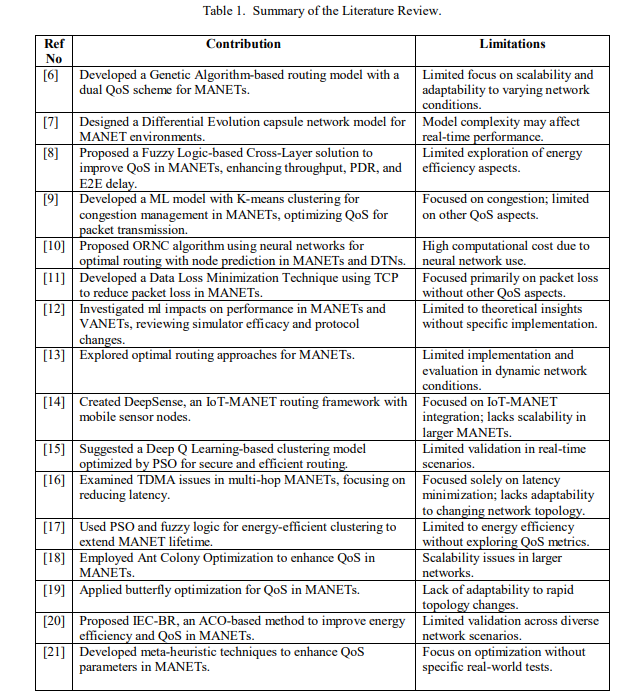
Using a dual QoS system, Bapu et al. [6] created a routing model for MANETs based on a genetic algorithm. In MANET contexts, Chandrasekaran and Selvaraj [7] designed and tested a Differential Evolution (DE) capsule network model. Hasan et al. [8] came up with a Fuzzy Logic-based Cross-Layer (FLS-CL) solution to make QoS measurements like throughput, PDR, and E2E delay better for MANET. In addition, Sucharitha and Latha built a ML model that uses K-means clustering to handle network congestion by adjusting QoS settings to make packet transmission as smooth as possible [9, 31].
Tripathia et al. devised and optimized the Optimal Routing with Node Prediction (ORNC) method for MANETs and Delay Tolerant Networks (DTNs) [10]. Vivekananda et al. introduced a Data Loss Minimization Technique (DLMT) that uses TCP to reduce packet loss in MANETs [11]. Kaushik et al. investigated the impact of ml on performance indicators in a variety of adhoc networks, including MANET and VANET, by reviewing simulator efficacy and protocol alterations [12]. Ben Chigra et al. investigated approaches for optimal MANET routing paths [13]. Chandrasekaran et al. created DeepSense, an IoT-MANET routing framework that uses mobile sensor nodes to route packets from IoT nodes [14].
Haridas and Prasath suggested a clustering model with Deep Q Learning (RoDQL) optimized by PSO for secure and efficient routing [15]. Danilchenko et al. investigated time-division multiple access (TDMA) issues in multi-hop MANETs, focusing on latency minimization [16]. Devi et al. [17] used PSO and fuzzy logic in energy-efficient clustering to increase MANET lifetime. Sarkar et al. [18] employed Ant Colony Optimization (ACO) for QoS in MANETs, while Arivarasan et al. [19] used the butterfly optimization approach for comparable aims. Singaravelan and Mariappan [20] proposed IEC-BR, an ACO-based method for improving energy efficiency and QoS in MANETs. Kumari and Sahana developed meta-heuristic techniques to improve MANET’s quality-of-service (QoS) parameters [21].
Alameri and Komarkova investigated the integration of ACO with various MANET routing protocols to adapt to network topology changes while maintaining performance [22]. Subbaiah and Govinda proposed a performance model for Volunteered Computing MANET and tactile internet, with a focus on efficient buffer management and fractional data handling to optimize node performance [23]. Shafi presented the AOERP protocol, which selects Adaptive Relay
Nodes (ARNs) based on Energy Factor and Neighbor Node Ratio (NNR) to improve routing efficiency [24]. Maros et al [25] introduced a resilient routing strategy for MANETs using decentralized blockchain technology and Deep Neural Networks (DNN). Alameri [26] suggested architecture that incorporated a memory channel into the fuzzy control system, which stores state variables such as the latest broadcast information. Tamizharasu proposed [27] to optimize cluster head (CH) selection. They considered node weights based on stability, neighborhood, energy use, distance, density, and residual energy. Muhannad Tahboush proposed [28] PEO-AODV protocol which improves AODV by using node geographic coordinates and hop count estimates to optimize routing. Tamizharasi [29] suggested a bioinspired deep residual neural network (DResNet) architecture for an effective QoS routing mechanism in MANETs. Table 1 presents a comprehensive Summary of the literature review.

From the rigorous literature review, it is clear that key difficulty of MANETs is to maintain good QoS under dynamic conditions. Existing routing methods frequently struggle with congestion detection, dependability evaluation, and effective routing in these dynamic settings. Furthermore, many systems fail to address data sparsity and imbalance in node behaviour, which might impair the efficacy of ml models used for prediction. Some of the major challenges are given below.
- Congestion Detection and Mitigation
- Data Sparsity and Imbalanced Datasets
- Model Performance Optimization
- Adaptability and Efficiency in Dynamic Environments
- End-to-End QoS Optimization
This study presents a novel BWPSO-XGBoost-AODV framework for dynamic congestion detection and mitigation. The proposed solution tackles significant constraints in existing protocols, resulting in strong network performance across all QoS parameters. The key objectives of this research are to build a unique QoS routing protocol for MANETs by integrating a bio-inspired optimization technique with a deep residual neural network. Specifically, the objectives include:
1) Designing a bio-inspired hybrid BWOA and PSO algorithm tailored to boost QoS factorssuch as delay, packet loss, throughput, and energy efficiency in MANETs.
2) Developing a ML model capable of generating optimal routing paths that satisfy QoScriteria, even with insufficient training data.
3) Combining the BWOA and PSO algorithm with the XGBoost model to develop aneffective hybrid framework that can reliably anticipate and pick optimal routes.
4) Incorporating the hybrid model into the AODV routing protocol to increase routingefficiency, decrease overhead, and extend network lifetime.
5) Analysing the computational complexity of the suggested model to demonstrate itsefficiency and efficacy compared to existing routing strategies.
3. WORK METHODOLOGY
This research focuses on developing a congestion-aware mechanism to enhance the AODV routing protocol and ensure efficient data transmission in dynamic networks. Figure 1 depicts the overall architecture of the proposed protocol. The process begins with the application of AODV protocol, which initiates route discovery and calculates node reliability using the Analytic Hierarchy Process (AHP) to assign weights to reliability metrics. A node reliability formula is then used to generate reliability values, which are used to update the routing table. KMeans clustering is used to detect congested and non-congested nodes, which is then balanced using SMOTE to rectify any data imbalance. The reliability properties are then fine-tuned using a hybrid optimization technique that combines BWOA and PSO.
The optimized attributes are then utilized to build an XGBoost classifier that predicts congestion. Based on the forecast, non-congested nodes are used for dependable data transmission, whereas congested nodes are identified and their paths are abandoned. This method ensures efficient, congestion-aware routing in dynamic network situations.

3.1. AODV Routing Protocol
The routing problem in MANET is inherently complex and often modelled as an NP-hard problem. Traditional AODV protocols operate by broadcasting route request packets during the route discovery phase, which can lead to congestion and inefficiencies, especially in dynamic environments characterized by frequent node mobility and limited energy resources. AODV protocol operates by establishing routes on demand, allowing nodes to dynamically discover
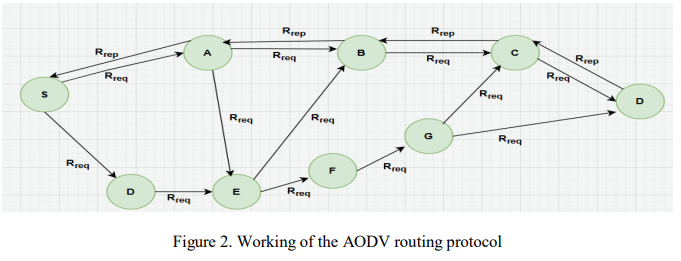
paths as needed. When a source node wishes to communicate with a destination node, it transmits an RREQ packet across the network. Intermediate nodes that get the RREQ will note the address of the node that issued the request and continue forwarding the packet until it reaches the destination node [2, 3, 5]. After receiving the RREQ, the destination node sends back an RREP packet with information about the reverse path to the source. Figure 2 depicts the route discovery process from source node S to destination node D.
The AODV routing protocol is described through the following algorithm 1
Algorithm 1: Working of the AODV routing protocol
Inputs: Source node (Sn), Destination node (Dn)
Output: final destination route
- Initialize an empty route list, set Sn as the first route node
- Set Hop Count (Hc) to 0
- Create an RREQ message including Sn, Hc, and Dn
- While Dn is not reached
5.Broadcast RREQ from the current route node to neighboring nodes
6.Record Hc
7.For each neighbor node receiving the RREQ:
8.If the neighbour node matches Dn:
9.Update route to include Dn - Send RREP back to Sn with Hc set to 1
- Exit loop
- If no match:
- Update route to include the neighbor node
- Send RREP to Sn with Hc set to 1
- Continue to next node
- Collect all discovered routes (R1, R2, R3, …, Rn)
- For each route Ri:
- Calculate distance from Sn to Dn
- Select the route with the minimum distance as the final destination route (Dr)
- Return DR as the most efficient route from Sn to Dn
- End
The algorithm (1) illustrates how the AODV routing protocol works by dynamically identifying the most effective path between a source node (Src) and a destination node (Des). The process begins with the establishment of an empty route list, with the source node as the first node on the route. Simultaneously, the hop count, which measures the number of hops between nodes during route discovery, is reset to zero. A RREQ message is then generated, which includes the source node, destination node, and current hop count. This RREQ acts as the starting point for
broadcasting the route discovery request. During each stage, the protocol updates and tracks the hop count while broadcasting the RREQ from the current node to all adjacent nodes. Each node in the surrounding network processes the RREQ using two criteria. When a nearby node (Des). matches the destination node, it is added to the path. This step indicates a successful route discovery by returning a RREP message to the source node with a hop count of one. The loop then breaks. However, if the neighbor node does not match the destination node, the route is adjusted to incorporate it. Following that, a RREP is sent back to the source node with a hop count of one, and the procedure is repeated for the next surrounding node. After identifying all routes from the source to the destination, the total distance between each route is calculated, and the shortest route is chosen as the final destination path [24]. This ideal path provides effective data transmission by reducing delay and increasing reliability. The AODV protocol allows for efficient route discovery and consistent performance in dynamic, resource-constrained networks by dynamically updating the route database.
3.2. Modified AODV
The AODV protocol was modified to compute the parameters listed in the Table 2 for detecting
and reducing congestion in the proposed BWPSO-AODV routing protocol.
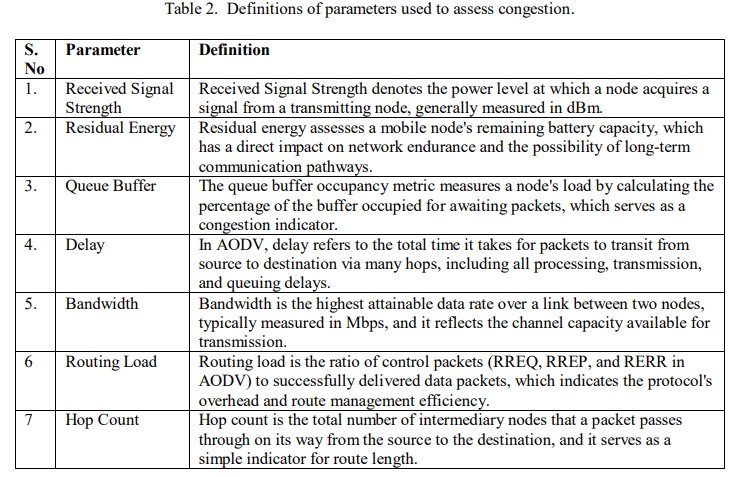
During the route discovery process, the model assesses each of the multiple paths for a reliability score using these parameters and ensures that the protocol adaptively selects the most reliable path and significantly improves the data packet delivery while minimizing delays. Once the source node receives the RREP, it initiates the assessment of various parameters needed to assess the reliability of the established route. These parameters include Source (src) and Destination (dest) to identify the communicating nodes, Queue Buffer (queue_buffer) to represent the current number of packets in the node’s queue for congestion assessment, Delay (delay) to measure the time taken for packets to traverse the network, Bandwidth (bandwidth) to indicate the available capacity for data transmission, Routing Load (routing_load) reflecting the current load on the routing protocol, Residual Energy (residual_energy) for maintaining
network longevity, Received Signal Strength (received_signal_strength) to indicate connection quality, and Hop Count (hop_count) representing the number of nodes the data packet must traverse. The reliability (rel) is calculated using the following equation 1:

where,
Qcal = 1-queue_length/max_queue_length
RSScal = 1- received_signal_strength/max_received_signal_strength
REcal = residual_energy/max_residual_energy
Bwcal = bandwidth/max_bandwidth
Dwcal = 1- delay/max_delay
And w1, w2, w3, w4, w5 are the weights assigned to various parameters.
The formula emphasizes minimizing negative impacts on reliability by incorporating factors such as queue length and routing load, while simultaneously maximizing the benefits derived from residual energy, bandwidth, and delay. Weight values are calculated through the AHP technique that adjusts the influence of its corresponding parameter on the overall reliability score, allowing for tailored optimization based on specific network conditions and objectives
3.2.1. Analytic Hierarchy Process
AHP is a Multi-Criteria Decision Making (MCDM) technique for structuring and analysing complicated decision issues. It organizes the problem in three levels: goal, criteria, and alternatives. AHP uses pairwise comparisons to assign numerical weights to criteria and alternatives based on their relative importance.
3.2.2. K- Means Clustering
K-Means clustering is unsupervised ml method used to group nodes in MANET routing protocols based on similarities metrics such as queue buffer, signal intensity, residual energy, delay, and bandwidth. Creating clusters makes it easier to select dependable nodes and routes, improving QoS and maintaining stability, particularly in dense network situations.
3.2.3. SMOTE
SMOTE is an oversampling method for balancing datasets that generates synthetic samples for minority classes. This is especially useful when training ml models to predict node reliability in MANETs, where data can be skewed, resulting in incorrect predictions for less common but essential cases of poor reliability or high vulnerability nodes. Using SMOTE, can increase the model’s sensitivity to under -represented reliability circumstances, allowing for more robust categorization in security-focused applications like detecting potential Black Hole and Gray Hole assaults in MANETs.
3.3. Hybrid Beluga Whale and Particle Swarm optimization (BWOA-PSO)
The Hybrid BWOA-PSO Algorithm combines the benefits of two optimization techniques namely BWOA and PSO to identify the best route in a network that minimizes time while increasing dependability. This hybrid strategy uses BWOA’s global exploration capabilities and PSO’s local refining power to efficiently search the solution space. The method begins by creating a population of particles with random locations and velocities. These particles show
various possible pathways from source to destination. Each particle’s position correlates to a unique route configuration that may be assessed in terms of network performance. The hybrid BWOA-PSO is described in algorithm 2.
Algorithm 2: Pseudo-code of hybrid BWOA-PSO Algorithm
Inputs: Number of nodes, population size, α, β, γ, queue_buffer, delay, bandwidth,
routing_load, residual_energy, received_signal_strength, hop_count, reliability
Output: optimized properties in terms of delay and reliability
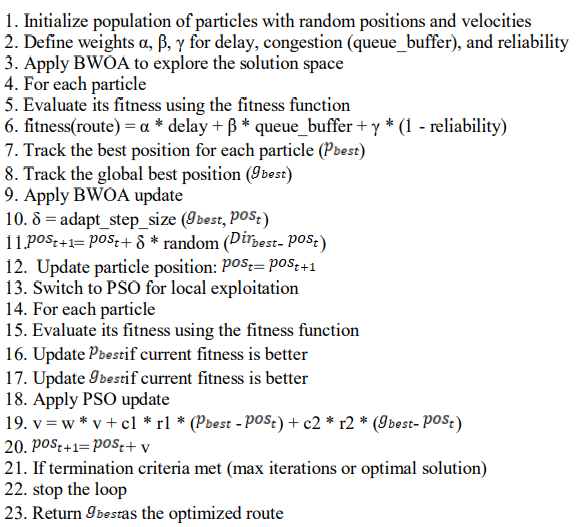
In the initial step of optimization, the BWOA is used for global exploration. BWOA simulates beluga whale behaviour in nature to explore the search space by transporting particles to promising places. Each particle’s fitness is assessed, and the best position discovered by each particle is saved as its personal best, but the global best position is tracked throughout the entire population. The particles are then updated with an adjustable step size, allowing them to explore areas with minimal congestion and great reliability. BWOA’s updating method ensures that particles move in a way that stimulates the finding of new solutions while avoiding local minima. Here, each solution (particle) represents a potential route across nodes in the MANET. Congestion-related metrics for each node are encoded as attributes such as Delay (Deli) and Available bandwidth (Bani) for evaluating fitness. Fitness function used for congestion minimization evaluates the congestion level (Conr) for each route (r), combining node metrics using equation (2).

Where Normalised delay ( ) and Normalized bandwidth ( ) bring them to a comparable scale and α, β such that α + β = 1, are the weights for normalized delay, and normalized bandwidth respectively. BWOA update takes place by emulating the movement of beluga whales, particles adapt based on their distance from low-congestion paths. Adaptive step size δ directs the position update towards the most promising congestion-efficient path using equation (3).

Here, Dir best represents the route with the least congestion, promoting adaptive exploration when far from optimal solutions
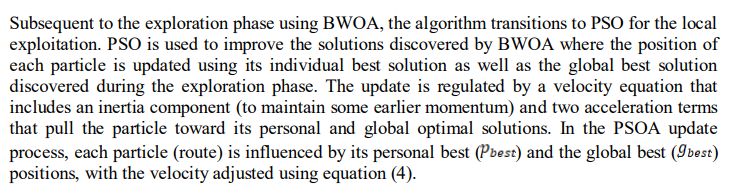

This enables PSO to better leverage the interesting areas identified by BWOA and converge on the best route. The algorithm continues to go through the PSO update process, evaluating each particle’s fitness, updating its personal and global best positions, and refining the particle positions until the termination criteria are reached. The algorithm continues until it reaches a specified threshold for congestion minimization or a maximum number of iterations, identifying an optimal route that minimizes congestion across the MANET.
These objectives could include accomplishing a set maximum number of repeats or finding an ideal solution that minimizes time while increasing reliability. Once the termination requirements are met, the algorithm delivers the global best position as the optimized route, which is the most reliable and efficient path given the network parameters. In summary, the Hybrid BWOA-PSO Algorithm combines the advantages of global exploration (by BWOA) and local exploitation (via PSO), resulting in an efficient and resilient search for the optimal route. This hybrid methodology gives a balanced and comprehensive solution to the complex multiobjective optimization problem of decreasing delay while optimizing dependability in network routing.
3.4. Proposed Hybrid Bwpso-Xgboost-Aodv Routing Algorithm
This solution mixes the bio-inspired optimization BWOA and PSO algorithm with the XGBoost model, enabling both components to work collaboratively towards the objective of improving routing pathways and enhancing QoS measures. The optimization process trains and fine-tunes the ML model, while the neural network leverages the optimized weights to predict the optimum routing patterns, exhibiting a cooperative interaction between bio-inspired optimization and ML components.
3.4.1. The XGBoost Model
The extreme Gradient Boosting (XGBoost) model is designed with gradient boosting tree blocks, tree regularization functions, and a linear booster that optimizes for minimized error and enhanced interpretability. The objective function is designed to evaluate the routing performance based on characteristics such as PDR, delay, residual energy, and bandwidth. The goal is to maximize network dependability and throughput while minimizing delay and energy usage. At each iteration, the algorithm adjusts the hyperparameters and the quality of each solution is determined based on its objective function.
3.4.2. The Proposed Hybrid Approach
This hybrid combines BWO and PSO with the high-performance XGBoost classifier, resulting in a system capable of managing complicated data structures and boosting prediction accuracy under dynamic network settings. BWPSO-XGBoost-AODV, which is built into the AODV protocol, solves key QoS metrics including dependability, latency, and bandwidth efficiency while responding to the needs of MANET environments with high node mobility. The approach uses K-means clustering to classify sparse data points as congested or non-congested based on important network parameters like Queue Buffer and Signal Strength with an aim to improve prediction precision and allowing for more precise routing decisions.
To address the class imbalance problem, particularly the minority of “congested” nodes, SMOTE technique, which generates synthetic samples to balance the data set is used. This preprocessing step ensures that the XGBoost classifier remains impartial and works accurately in both congested and uncongested conditions. Furthermore, the combination of BWO and PSO enhances the XGBoost hyper-parameters like learning rate, estimators, and maximum depth by using BWO’s exploration through simulated hunting behaviour and PSO’s swarm intelligence principles. This layered optimization increases the model’s adaptability to shifting network dynamics. Finally, the suggested model is simulated in NS2, with parameters including residual energy, hop count, and routing information given into the BWPSO-XGBoost-AODV algorithm. This system provides an accurate, balanced, and QoS-driven approach to MANET congestion prediction and routing optimization. Algorithm 3 is the complete pseudo code of proposed BWPSO-XGBoost-AODV Algorithm.
Algorithm 3: Pseudo-code of proposed BWPSO-XGBoost-AODV Algorithm
Input: Node metrics: queue buffer (Qcal), received signal strength (RSScal), residual energy
(REcal), delay (Dwcal), bandwidth (Bwcal)
Output: Optimized congestion-free routes
1. Initialize AODV Routing Protocol
2. Calculate routing tables for node communication
3.Calculate Reliability Weights Using AHP
4. Define criteria for AHP (e.g., Queue_Buffer, RSS, Residual_Energy, Delay, Bandwidth)
5. Compute weights for each criterion
6. Update node reliability using the computed formula:
7. Reliability = (w1 * Queue_Buffer) + (w2 * RSS) + … (wn * Bandwidth)
8.Compute Node Reliability
9. For each node:
10. Calculate reliability score using the formula
11. Update routing table with reliability values
12. Apply KMeans Clustering
13. Perform KMeans clustering on reliability scores
14. Cluster 0: Non-congested
15. Cluster 1: Congested
16. If cluster_centers [0][0] > cluster_centers [1][0]
17. Swap cluster labels to correctly assign congested and non-congested routes
18. Handle Data Imbalance with SMOTE
19. Check class distribution in congested and non-congested routes
20. If imbalance exists:
21. Apply SMOTE to oversample minority class
22. Hybrid Optimization with WOA and PSO
23. Define objective_function to optimize:
24. Learning rate, max depth, number of estimators
25. Initialize WOA and PSO with:
26. Number of agents/particles = 10
27. Max iterations = 10
28. Optimize hyperparameters using WOA and PSO
29. Store best parameters from both optimization methods
30. Train XGBoost Model
31. Train XGBoost model with optimized parameters on reliability data
32. Predict Congestion
33. Predict congestion for routes- Non-congested (Reliable) and Congested (Unreliable)
34. Transmit Data Through Reliable Routes
35. For each route:
36. If route is predicted as non-congested:
37.Transmit data through the route
38. Else
39. Mark route as congested and discard it
40. End
4. EXPERIMENTAL SETUP AND ENVIRONMENT
In this study, the basic AODV routing protocol is supplemented with a novel BWPSOXGBoost-AODV routing algorithm intended to improve QoS in MANETs. The suggested approach is created, trained, analysed, and validated with Python 2024 and the NS2 simulator within the MANET environment [1]. The NS2 simulator simulates the MANET environment by creating datasets containing parameters such as residual energy, received signal strength, queue buffer, bandwidth, delay, and hop count. These measurements are used to calculate reliability, which is fed as input into the BWPSO-XGBoost algorithm implemented in Python 2024.
The protocol’s scalability and mobility are tested within a 250-m communication radius and two-ray ground propagation model for large distances with simulation time of 50 seconds and 10, 20, 30, 40, 50, 60, 70, 80, 90 and 100 nodes. The interface’s queue may hold up to 512 packets and uses the IEEE 802.11 MAC layer protocol. A random waypoint mobility model randomly assigns nodes from source to destination [4]. CBR flow rates are used for traffic with packet sizes 512, 1000, or 1500 bytes. Packet queue length is taken as 50. Table 3 gives various simulation parameters considered during network simulation.

4.1. Evaluation Criteria
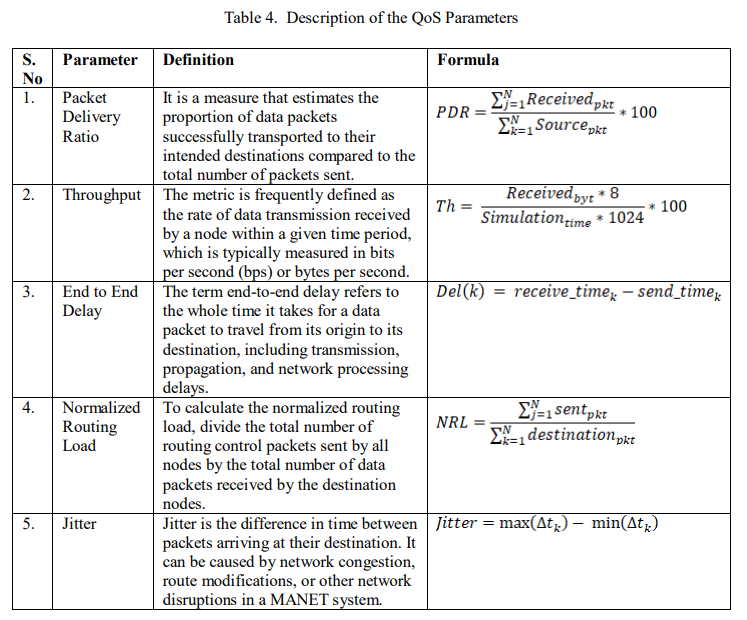
QoS parameters are a set of measurements and qualities that define and measure a network’s performance features, such as throughput, end-to-end delay, jitter, packet delivery ratio, and network overhead. Table 4 describes the various QoS parameters addressed in this study.
5. RESULTS AND DISCUSSIONS
The NS2 simulator and Python 2024 have been used for the implementation of the proposed BWPSO-XGBoost-AODV technique of routing in MANET environment. AODV protocol has been used for routing and other protocols namely AODV, ACO, PSO, PSO-AODV, IIWGSODResNet-AODV [29] have been used for comparison with the proposed BWPSO-XGBoostAODV protocol. Comparison has been done under three different scenarios by varying pause time, number of nodes and number of flows. Results of comparison are shown in the subsections 6.1, 6.2 and 6.3.
5.1. Impact of Varying Pause Time
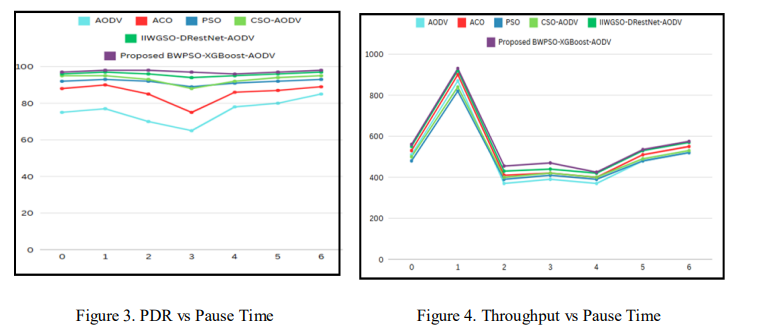
Here, a random waypoint mobility model is used, with the pause time ranging from 0 to 6 ns while keeping other parameters constant. Table 1 describes the simulation environment with a fixed number of data flows set to as 5. Given the network’s dynamic nature, the proposed technique has a significant impact on node mobility across multiple QoS metrics. Figure 3, Figure 4, Figure 5, and Figure 6 show results of comparison on PDR, throughput, overhead and delay respectively on varying pause time. The results demonstrate that the proposed technique produces a much higher PDR, outperforming AODV by 22% and IIWGSO-DRestNet-AODV by 2%, indicating robust performance even under high mobility situations. The rise in PDR is due to routing RREP packets through nodes with appropriate fitness values, which are defined by critical factors such as queue buffer (to avoid congestion), RSS (to ensure strong connectivity), residual energy (to prevent route breaks), bandwidth (to minimize congestion), and latency (to reduce delays). Prioritizing such nodes enables efficient routing, lowers packet loss, and increases delivery success. Similarly, throughput is considerably increased by 60% over AODV and 10% above IIWGSO-DRestNet-AODV. However, it varies with mobility due to the network’s dynamic nature. Figure 5 depicts reduced routing overhead, with a 12% decrease from AODV and a 4% decrease from IIWGSO-DRestNet-AODV. This increase is attributed to the path selection based on computed fitness values rather than the shortest path, which normally risks congestion and packet loss. Finally, Figure 6 shows reduced latency as the congestion-free paths are picked by RRPLY packets. Thus, the overall findings show that the proposed protocol can effectively accommodate high-mobility scenarios in MANETs

5.2. Impact of Varying Number of Nodes
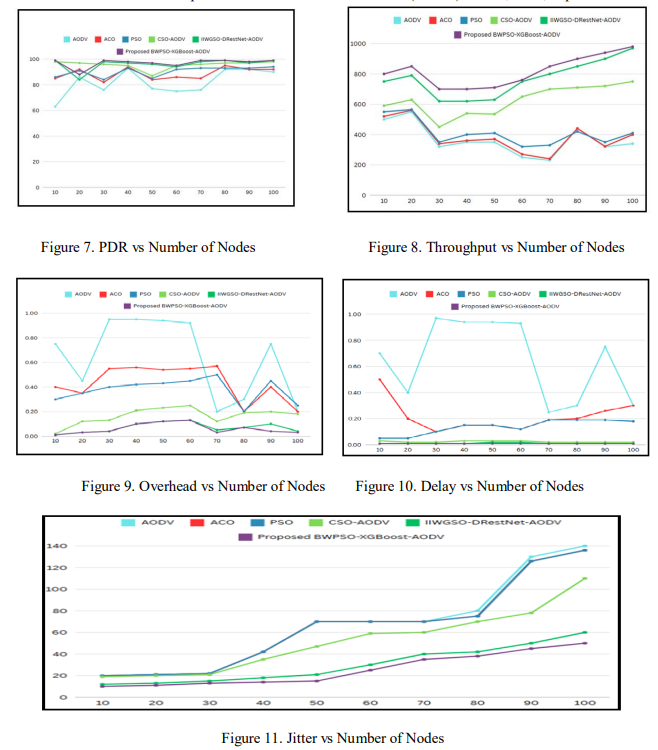
Scalability testing of the BWPSO-XGBoost-AODV algorithm is conducted by varying node count from 10 to 100and keeping pause time and number of flows as constant. Figure 7 shows that the PDR of the proposed protocol is 15% and 1% higher than the traditional AODV and IIWGSO-DRestNet-AODV respectively, indicating increased reliability of data delivery as the network capacity expands. Similarly, Figure 8 shows that the proposed protocol achieves 60% and 10% higher throughput and IIWGSO-DRestNet-AODV respectively, implying that it can accommodate increased data traffic in scalable networks.
Figure 9 shows a significant reduction of 60% in routing overhead for the proposed protocol as compared to normal AODV and a 1% compared to IIWGSO-DRestNet-AODV. This reduction is related to the updated RREPLY mechanism, which finds optimized pathways more effectively. Other protocols such as ACO, PSO, and CSO-AODV have higher overhead than BWPSOXGBoost-AODV proving its advantage in lowering routing complexity. Figure 11 demonstrates that BWPSO-XGBoost-AODV has the lowest jitter value than the other protocols including ACO, PSO, CSO-AODV, IIWGSO-DRestNet-AODV, and conventional AODV, indicating its consistent packet transmission rates. However, Figure 10 shows that CSO-AODV has the shortest end-to-end time among all protocols.
The combined investigation of high-mobility and scalability reveal that the BWPSO-XGBoostAODV protocol outperforms competing protocols like AODV, ACO, PSO, CSO-AODV, and IIWGSO-DRestNet-AODV, in almost important metrics such as PDR, throughput, routing overhead, and jitter. These improvements demonstrate that BWPSO-XGBoost-AODV is wellsuited to dynamic and large-scale MANET systems, providing consistent QoS and dependability under changing network conditions.
5.3. Impact of Varying Number of Flows
To assess the effect of congestion on the performance of the proposed BWPSO-XGBoostAODV protocol, simulations were run by varying traffic flows from from 4 to 8, while keeping the number of nodes and mobility level constant. As illustrated in Figure 12, the proposed protocol’s PDR remains higher, with a 30% increase over traditional AODV and a 15% increase over IIWGSO-DRestNet-AODV. Improved PDR demonstrates the protocol’s capacity to successfully handle congestion, which may cause packet drops and delays when utilizing standard shortest-path routing approaches. This increase is attributed to the BWPSO-XGBoostAODV protocol’s fitness-based route selection that dynamically examines characteristics such as queue buffer, RSS, residual energy, bandwidth, and latency, allowing it to identify paths with lower congestion risk. On the other hand, competing methods, such as ACO, PSO, CSO-AODV, and IIWGSO-DRestNet-AODV, exhibit decreased performance during congestion due to their reliance on less adaptive path selection algorithms.
The proposed protocol also increases throughput, as seen in Figures 13. Furthermore, Figures 14 and 15 show considerable reduction in the delay and routing overhead, demonstrating the protocol’s ability to maintain QoS under congestion conditions. Thus, overall, the results demonstrate that BWPSO-XGBoost-AODV outperforms ACO, PSO, CSO-AODV, IIWGSODRestNet-AODV, and the original AODV protocol, giving better performance in MANET environments with high congestion, including military and emergency response scenarios

1) Quantitative Comparison: A thorough performance evaluation has been incorporated inDiscussion section-6, wherein we compare our model with the standard AODV and otherestablished improved methods. Metrics including PDR, latency, throughput, jitter, and overheadare illustrated in graphical representations.
2) QoS Enhancement: The findings indicate that the suggested model markedly enhances QoSby sustaining elevated PDR and reduced latency, especially in high-mobility and high-densitycontexts.
3) Congestion Control: Our model integrates buffer occupancy, residual energy, andbandwidth awareness to circumvent congested pathways. This adaptive decision-makingdemonstrates a reduction in packet loss and latency, signifying efficient congestionmanagement.
4) Routing Efficiency: The suggested hybrid method includes fuzzy logic and optimization techniques, enabling it to find more dependable and stable routes. The model exhibits a significant decrease in routing overhead relative to traditional protocols.
6. CONCLUSIONS AND FUTURE SCOPE
This study describes BWPSO-XGBoost-AODV routing algorithm, which combines BWPSO and Particle PSO with the conventional AODV protocol to improve QoS MANETs. The algorithm improves routing decisions based on dynamic network conditions by combining the exploration capabilities of BWPSO and the optimization powers of PSO. Findings show that BWPSO-XGBoost-AODV outperforms other protocols, including ACO, PSO, CSO-AODV, IIWGSO-DRestNet-AODV, and simple AODV. It significantly improves the key QoS parameters such as mobility adaptability, scalability, and congestion control, resulting in greater data delivery rates and more consistent network performance even in highly mobile and unpredictable contexts.
Future efforts will focus on improving the security of BWPSO-XGBoost-AODV protocol by addressing vulnerabilities such as black hole and gray hole attacks, which can disrupt data transfer and jeopardize network resilience. By incorporating robust security mechanisms such as trust-based evaluations or anomaly detection, the protocol can improve its stability and resilience, allowing for secure and efficient communication under variety of scenarios. These upgrades will make BWPSO-XGBoost-AODV a dependable alternative for MANETs in applications that demand both high QoS and secure, robust connections, in critical scenarios such as military and emergency response applications.
CONFLICT OF INTEREST
The authors declare no conflict of interest.
REFERENCES
[1] Ssariyakul T, Hossain E (2009) Introduction to network simulator 2 (NS2). In: Introduction to network simulator NS2. Springer, Boston, MA, pp 1–18
[2] Loo J, Lloret Mauri J, Hamilton Ortiz J (2011) Mobile ad hoc networks: current status and future trends.Taylor & Francis, p 538
[3] Perkins C, Belding-Royer E, Das S (2003) RFC3561: ad hoc on-demand distance vector (AODV) routing
[4] Bettstetter C, Resta G, Santi P (2003) The node distribution of the random waypoint mobility model for wireless ad hoc networks. IEEE Trans Mobile Comput 2(3):257–269
[5] Basagni, Stefano. Mobile ad hoc networking. 2004
[6] Bapu, T., Anitha, R., Soundararajan, S., Nagaraju, V., Nagappan, P., & Daniel, A. (2022). GAMAN–genetic algorithm in mobile adhoc networks for creating systematic QoS. ECS Transactions,107(1), 3599.Chandrasekaran, K., & Selvaraj, T. (2022).
[7] Differential evolution CapsNet model for QoS routing enhancement in wireless networks. International Journal of Communication Systems, 35(2),e4146.
[8] Hasan, N., Mishra, A., & Ray, A. K. (2022). Fuzzy logic based cross-layer design to improve quality of service in mobile ad-hoc networks for next-gen cyber physical system. Engineering Science and Technology, an International Journal, 35, 101099.
[9] Sucharitha, K., & Latha, R. (2022). Designing an ML-based congestion detection algorithm for routing data in MANETs.In International conference on computing, communication, electrical and biomedical systems (pp. 3–13). Springer. International Journal of Computer Networks & Communications (IJCNC) Vol.17, No.5, September 2025 97
[10] Tripathia, A., Mekathotia, V. K., Waghuldea, I., Patela, K., &Balasubramaniana, N. (2021). Neural network aided optimal routing with node classification for adhoc wireless network.In CEUR Workshop Proc (vol. 2889, pp. 43–54).
[11] Vivekananda, G. N., Lavanya, B., & Reddy, P. (2021). DLM technique for QoS improvement in MANETS. Wireless Networks, 27(4), 2867–2877.
[12] Kaushik, S., Tripathi, K., Gupta, R., & Mahajan, P. (2021). Futuristic analysis of machine learning based routing protocols in wireless ad hoc networks. In 2021 Fourth international conference on computational intelligence and communication technologies (CCICT) (pp. 324–329). IEEE.
[13] Ben Chigra, Y., Ghadi, A., &Bouhorma, M. (2021). A survey of optimization techniques for routing protocols in mobile ad hoc networks. In Emerging trends in ICT for sustainable development (pp. 129–139). Springer.
[14] Chandrasekaran, S., Kannan, S., &Subburathinam, K. (2021). DeepSense—Deep neural network framework to improve the network lifetime of IoT-MANETs. International Journal of Communication Systems, 34(3), e4650.
Zz
[15] Haridas, Prasath, A. R. (2021). Bi-fitness swarm optimizer: Blockchain assisted secure swarm intelligence routing protocol for MANET. 12(5), 1442–1458.
[16] Danilchenko, K., Azoulay, R., Reches, S., & Haddad, Y. (2022). Deep learning method for delay minimization in MANET. ICT Express, 8(1), 7–10.
[17] Devi, V. S., Hegde, N. P., & Kumar, C. N. (2021). Energy efficient clustering using PSO and fuzzy logic for hybrid MANETs. ARPN Journal of Engineering and Applied Sciences., 16(22), 2354–2362.
[18] Sarkar, D., Choudhury, S., & Majumder, A. (2021). Enhanced-Ant-AODV for optimal route selection in mobile ad-hoc network. Journal of King Saud University-Computer and Information Sciences, 33(10), 1186–1201.
[19] Arivarasan, S., Prakash, S., & Surendran, S. (2022). An efficient QOS aware routing using improved sensor modality-based butterfly optimization with packet scheduling for MANET. In Intelligent data communication technologies and internet of things (pp. 463–476). Springer.
[20] Singaravelan, M., & Mariappan, B. (2022). Reinforcement energy efficient ant colony optimization of mobile ad hoc multipath routing performance enhancement. The International Arab Journal of Information Technology, 19(2), 195–202.
[21] Kumari, P., & Sahana, S. K. (2022). Swarm based hybrid ACO-PSO meta-heuristic (HAPM) for QoS multicast routing optimization in MANETs. Wireless Personal Communications,123(2), 1145–1167.
[22] Alameri, I. A., &Komarkova, J. (2022). Performance and statistical analysis of ant colony route in mobile ad-hoc networks. International Journal of Electrical & Computer Engineering, 12(3), 2088–8708.
[23] Subbaiah, C. V., & Govinda, K. (2022). A bio inspired optimization with reliable QoS routing through efficient packet transmission in mobile ad-hoc network. Renewable Energy Focus, 41, 188–197.
[24] Sharma, Dhirendra Kumar, and Nitika Goenka. “An Effective Control of Hello Process for Routing Protocol in MANETs.” International Journal of Computer Networks & Communications (IJCNC) Vol 13 (2021).
[25] Abdellaoui, Ayoub, Jamal Elmhamdi, and Halim Berradi. “Spatial relation for multipoint relays selection algorithm in mobile ad hoc networks.” 2018 6th International Conference on Multimedia Computing and Systems (ICMCS). IEEE, 2018.
[26] Elsayed, Alzahraa, Khalil Mohamed, and Hany Harb. “Enhanced Traffic Congestion Management with Fog Computing: A Simulation-based Investigation using iFog-Simulator.” arXiv preprint arXiv:2311.01181 (2023).
[27] Ghodichor, Nitesh, et al. “Secure Routing Protocol to Mitigate Attacks by Using Blockchain Technology in Manet.” arXiv preprint arXiv:2304.04254 (2023).
[28] Sultan, Mohamad T., Hesham El Sayed, and Manzoor Ahmed Khan. “An intrusion detection mechanism for MANETs based on deep learning artificial neural networks (ANNs).” arXiv preprint arXiv:2303.08248 (2023).
[29] Tamizharasi, S., B. Arunadevi, and S. N. Deepa. “Bio-inspired deep residual neural network learning model for QoS routing enhancement in mobile ad-hoc networks.” Wireless Networks 29.8 (2023): 3541-3565.
[30] S. M. Hassan, M. M. Mohamad, and F. B. Muchtar, ‘‘Advanced intrusion detection in MANETs: A survey of machine learning and optimization techniques for mitigating black/gray hole attacks,’’ IEEE Access, vol. 12, pp. 150046–150090, 2024, doi: 10.1109/ACCESS.2024.3457682.
[31] J. Gandhi and Z. Narmawala, ‘‘A comprehensive survey on machine learning techniques in opportunistic networks: Advances, challenges and future directions,’’ Pervas. Mobile Comput., vol. 100, May 2024, Art. no. 101917, doi: 10.1016/j.pmcj.2024.101917.
AUTHORS
Diksha Shukla received her MCA degree from National institute of Technology, Raipur. She is currently pursuing her Ph.D. in the Computer Science and Engineering Department of Harcourt Butler Technical University, Kanpur, India. Her research area is Mobile Ad hoc Networks.
Dr. Raghuraj Singh is currently working as a Professor of Computer Science & Engineering and Dean, Research and Development at Harcourt Butler Technical University, Kanpur (India). He has more than 34 years of experience in teaching & research. He has successfully discharged various administrative responsibilities like Director, KNIT Sultanpur, Nodal Officer, IIIT Lucknow, Director (Mentor) of Rajkiya Engineering College, Ambedkar Nagar and Sonbhadra, Nodal Officer of Rajkiya Engineering College, Bijnor, and Dean, Planning & Resource Generation, Dean, Continuing Education & Internal Quality Assurance, Head of Department, Registrar, Controller of Examination, Chief Proctor, Asstt. Dean etc. at HBTU, Kanpur. Prof. Singh has handled 08 research and consultancy projects funded by the AICTE/UGC New Delhi and various other funding agencies. He is a member of professional bodies like IETE, IE (India), CSI, ACM, ISTE, IACSIT, Singapore etc. and reviewer & member of editorial board of many National/International journals/conferences and books. He has published more than 180 research papers in National and International journals/conferences, 06 Books/Book Chapters, supervised 19 Ph.D. theses, 29 M. Tech. dissertations, and more than 90 B. Tech./MCA projects

 International Journal of Computer Networks & Communications (IJCNC)