
IJCNC 02
QOS BASED RELIABLE ROUTE IN MANET FOR MILITARY APPLICATIONS
Diksha Shukla and Raghuraj Singh
Department of Computer Science and Engineering,
Harcourt Butler Technical University, Kanpur, India
ABSTRACT
Mobile Ad hoc Networks (MANETs) are crucial for situations like military operations and disaster relief where traditional networks are impractical. However, they face challenges such as dynamic topology, limited resources, and scalability. The widely used AODV protocol lacks the necessary Quality of Service (QoS) for real-time applications due to high route discovery overhead, congestion and frequent maintenance. To overcome these constraints, this study presents a reliable routing protocol (RRP-AODV) that improves QoS by considering factors from the first three levels in the OSI model such as received signal strength, distance, queue congestion, node degree, and node longevity. During the route discovery process, the RREQ phase compares node distance and degree against threshold values to determine further hops. During the RREP phase, queue congestion and node lifetime (the ratio of residual energy to utilization rate) are assessed. When the source node receives an RREP packet, it updates its Cost Metric (CM) with the minimal nod lifespan and compares buffer occupancy from a preset threshold for acceptability. Using a weighted moving average approach, the neighbor table is updated in response to the received signal strength. RRP-AODV addresses the key limitations of the conventional AODV protocol. Simulation results demonstrate that the suggested protocol RRP-AODV outperforms than AODV and QoSRP in context of Packet delivery ratio, throughput, end to end delay, packet loss ratio and normalized routing load in two scenarios that modify the nodes number and simulation time.
KEYWORDS
AODV, MANET, Queue Congestion, Quality of Service, Signal Strength, military areas, Cross-layer n
- INTRODUCTION
Military applications on ad-hoc networks demand strict QoS parameters including low latency, high dependability, and secure data transfer to ensure operational effectiveness in dynamic and dangerous circumstances [27,28]. However, due to uncertain topologies, limited resources, interference, and security risks, obtaining these QoS metrics in military MANETs is problematic [1]. The AODV protocol, while vital for dynamic routing, requires modifications in route discovery, maintenance, and data delivery to fulfil military standards. Routing in MANETs refers to the act of building the route for data transmission between mobile nodes in a dynamic and infrastructure-less environment. It facilitates communication by allowing nodes to discover neighboring nodes, exchange routing information, and respond to frequent alterations to network topology induced by node mobility [25]. Routes in MANETs may be formed either reactively (on demand) or proactively (periodically updated), depending on the protocol employed and the network circumstances [1]. In the Reactive Routing Protocol, routes are built on-demand as required, commencing a route discovery process. The most popular protocol under this category, AODV gives better results in battlefield scenarios. AODV protocol start with route establishment, where a sender node broadcasts a RREQ packet to its neighbors in an attempt to find a way to the destination. It establishes routes only when necessary Intermediate nodes will either.
pass along the request or, if they possess a valid route, respond with a RREP packet. [2]. Route maintenance is carried out through frequent updates to routes via hello messages and RERR packets are used to remove broken links.
Routing in tactical self-organizing networks is critical for sending multimedia data such as video and audio in warfare circumstances and requires strong QoS support. Improving QoS in MANETs routing has emerged as a challenging field of study for military applications, providing reliable and effective data transmission despite the obstacles of changing topology and constrained capacity. Further, sufficient resources must be maintained to meet the QoS requirements of a certain application. The Application needs to determine which QoS factors are taken into account. The five main QoS metrics are delay, throughput, packet loss ratio, normalized routing load and packet delivery ratio. Figure 1 shows a military network that links military hardware and soldiers on the ground to a tactical center, headquarters, and UAV relay connection.

Figure 1. Scenario of MANET in Military areas
It has been established that, the route selection is influenced by node signal strength, congestion levels, hop count, and the leftover energy of battery-operated nodes [26]. Optimal pathways must prioritize nodes with high signal strength in order to resist rapid topology changes and reduce connection failures. Because of the battery-powered nodes, energy efficiency is crucial and pathways with nodes having little residual energy are prone to route failure [23]. Additionally, reducing congestion along pathways is critical to avoiding delays in real-time data transmission.
Existing protocols fail to include all five critical aspects including distance, signal strength, energy, node degree and congestion for optimal path selection. Therefore, the proposed RRPAODV protocol tracks the received signal power at the physical layer, residual energy and queue congestion at the MAC layer and node degree from the network layer to improve the considered QoS performance metrics; packet delivery ratio, throughput, network overhead and delay during communication in military applications over MANETs.
In MANETs, this technique alters specifically the route discovery (contains route request, route reply) and route maintenance (contains local data update) stages of the popular AODV routing protocol. The outline of this paper is as follows: A review of pertinent literature is presented in Section 2, Section 3 explains the proposed RRP-AODV routing algorithm, Section 4 discusses the simulation parameters and results are presented in Section 5, and conclusions and recommendations for further research are given in Section 6.
2.LITERATURE SURVEY
In the last few years, delivering QoS-enabled route has become the primary issue for military operations as they have specific service needs. QoS denotes the degree of customer satisfaction which may be described by metrics like throughput, latency and packet delivery ratio etc. Although, most of the researchers have worked on these issues but, most of them have not concentrated on the components like distance, degree of node, node remaining energy, node congestion and received signal strength collectively. Therefore, their results do not demonstrate considerable improvement. A detailed survey of the recent works done in this area is presented below.
Pandey et al [5] proposed ALQ-AODV which determines the next hops for routing requests by considering factors such as the degree of the node, the remaining energy of the node, and the quality of the network. Pandey et al [6] suggested MO-AODV that picks the path selection is dependent on the gain factor, which is determined by the received signal strength and energy level. In addition, the hop score is evaluated against a threshold to determine the optimum method for forwarding RREQ packets. But this approach uses a fixed hop score as the threshold. Dipika et al [7] proposed Ant-AODV in that the pheromone value of a path is assessed based on factors such as network end-to-end reliability, congestion levels, hop count, and the remaining energy of the nodes. The path with the greatest pheromone value is chosen for data packet transmission. In this research [8], AGEN-AODV is an innovative MANET routing protocol that stands out by evaluating paths based on multiple criteria: energy efficiency, stability, traffic load, and hop count. What sets it apart is its integration of a Genetic Algorithm (GA) alongside Learning Automata (LA) to intelligently select the most optimal path. This approach ensures not only efficient route selection but also adaptive decision-making. However, metrics used in other studies like distance, latency, PDR, SINR, and Link quality are not considered.
In AODV [9], fuzzy logic is used to evaluate factors like hop count, residual energy, speed, connection expiry time, and bandwidth for optimal route selection. It minimizes the likelihood of connection failure during packet transmission. In this study [10], STAB-AODV compares the node’s residual energy and link effectiveness, as measured by received signal strength, to dynamic threshold values for selecting following hops during route establishment. This work [11] presented a new routing method ENH-AODV that concentrates on choosing of an effective path on a basis of the quality of links and nodes in route construction phase. In this Work [12] suggested in the study addresses both stages of the route selection method i.e. RREQ and RREP together with the maintenance of local information. Parameters such as distance, degree of node, energy and signal power were all taken into consideration throughout the hello process. On the other hand, there was considerable control overhead owing to the interchange of neighbourhood update. In [13], the authors presented a novel technique for AODV that controlled broadcasting of RREQ packets to enhance route efficiency by limiting inefficient nodes and connections during route construction. The technique calculates energy level, route request processing capabilities, neighbours’ traffic level and received signal quality for packet forwarding. If the predicted stability factor is over a threshold value, an intermediate node passes the RREQ to its adjacent ones, otherwise, it simply rejects. Hassan et al [14] coupled AODV protocol with Buffalo Optimization. The approach selected a route depends on delay, energy, and hop count. Simulation results demonstrate the better performance.
Yi Jiang et. al [15] presented a novel routing system combines the Analytic Hierarchy Process, the Entropy Weight Method, and AODV, with energy, congestion, and hop count as metrics. Nodes choose the best route using a score calculated from the weighted sum of these metrics. They planned to apply dynamic thresholds and perform validation of the scheme on the practical applications in future. PEO-AODV [16] proposed to change the conventional AODV to optimize energy efficiency by minimizing hop count and leveraging the geographical location information in the hello packet. These changes improve routing accuracy, network longevity, route failures, mobile node connection breakage, and energy consumption. Abdullah et. al [13] proposed Enhanced AODV calculated route Stability Factor using remaining link lifetime and hop count, which can be used as a cost metric to determine the best route. Nallayam et. al [17] proposed an enhanced priority-aware technique in which forwarding nodes have limited participation in routing if their velocity exceeds the threshold.
The approach detailed in reference [18] applies reinforcement learning to routing in 5G MANETs, incorporating node-specific traffic load and signal-to-noise ratio (SNR) data. In EABAODV [19], the acceptance control system only accepts packets that match the QoS standards, with bandwidth being a critical factor dictated by data rate. In the Table 1, an analysis of the literature review on the QoS parameters has been summarized.
Table 1. Analysis of the related work on QoS parameters
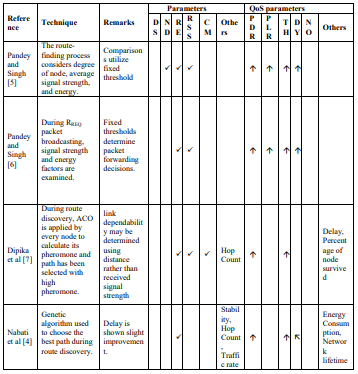


(Notations: Packet delivery ratio: PDR, Packet loss ratio: PLR, Throughput: TH, Delay: DY, Network Overhead: NO, Distance: DS, Node Degree: ND, Residual Energy: RE, received signal strength: RSS, Congestion metric: CM, improved: á, Slightly improved: ã)
The primary research gap identified in the reviewed studies lies in the limited adaptability and scalability of the proposed routing techniques in dynamic, large-scale networks. Many approaches rely on fixed thresholds and focus on isolated metrics such as signal strength, hop count, or packet delivery ratio, which limits their effectiveness in environments with frequent topology changes or varying traffic conditions. Additionally, there is a lack of comprehensive consideration for multiple QoS parameters simultaneously, particularly in real-time adaptation scenarios. It is clearly visible that none of the above-mentioned works has taken all the QoS parameters together in route discovery and local information update. Therefore, there is not much improvement in the result in terms of quality metrics. Also, some of the techniques do not work well for a large network. Therefore, here we propose a comprehensive approach to route discovery, including route request and reply, as well as local information update. The route establishment process considers major factors including distance, degree of node, residual energy, queue congestion and received signal power for the route establishment. Moreover, Average Queue Congestion is also considered using a popular weighted moving average.
3.PROPOSED WORK
One of the most important aspects of military applications using ad hoc network is the construction of an optimal route. To provide QoS support for reliable communication, in the proposed system, improvements are made to the process of route finding and local information updating. During route discovery, the approach alters both the path request and path reply processes. Additionally, the link between nodes is regularly verified.
The route discovery process comprises two steps: the request and reply phases. RREQ packet broadcasting estimates the distance and degree of the node. Distance is used fostering robust inter-node connection status between sender and receiver. Additionally, factoring in the node degree increases the likelihood of successfully finding an effective route. Node degree threshold depends on terrain node density. In addition, routers utilize buffers, which are memory blocks used to temporarily store packets before transmission over wireless media. These buffers, often referred to as queues, determine the amount of traffic a mobile node can manage. However, queues have a limited capacity. Congestion occurs when incoming traffic exceeds the rate at which packets can be sent out, causing the queue to reach its maximum capacity. Based on a predetermined policy, packets are discarded when there is congestion. Dropping the packets reduces quality of service and performance of the network. Therefore, the amount of queue occupancy may be utilized as a measure of quality.
During route reply, to choose the best route, the sender node compares the leftover energy of multiple routes. Local connection information is kept by assessing the received signal power. If nodes regularly receive hello messages with lower signal power over a set period of time, they do not update the neighbor table’s expiry time. As a result, data regarding neighbors with poor connections is quickly erased. This procedure ensures that each node maintains high-quality connections to its neighbors. Figure 2 depicts this proposed approach in the block diagram.

Figure 2. Schematic diagram of the proposed algorithm
3.1. Parameters
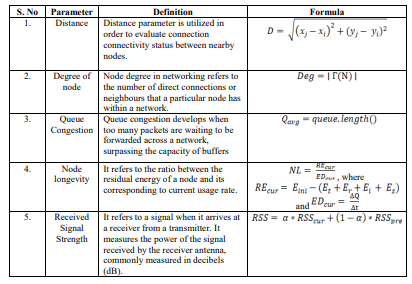
The essential characteristics that have been used in the suggested strategy to boost the AODV routing protocol performance are described in table 2.
Table 2. . Performance parameter definition
3.2. Route Discovery Process
3.2.1. Route Request (RREQ)
When a sender node needs to transmit data packets via a wireless medium, it initially checks its routing table for a route to the destination. If no route information is found, the sender node broadcasts a RREQ packet to neighboring nodes. Only neighbour nodes with a distance neither too short nor too large may forward RREQ packets. We have taken Thmin = T r ∗1/5 and Thmax = T r ∗.98 as limits for the short and long distances respectively. This distance is a crucial factor in determining the next hop. The neighbour count is another factor to consider while broadcasting an RREQ packet. The process during the path request phase is stated as follows.
The starting node willing to deliver a packet to the destination uses the recommended routing strategy. When it sends a packet to the Destination, it calculates its current location at time t (Xpost, Ypost) and appends it to the RREQ packet. When an intermediate node receives a packet P, it calculates its distance based on the sender and the total number of neighbours i.e. directly connected. The receiving node’s neighbour count should be greater than the threshold value. Estimating this measure enhances the likelihood of a successful route-finding operation. The whole path request phase process is given below. Let Ime, Nsr and Nre be the intermediate, sender and receiver nodes respectively, DGn be the count of neighbour nodes and DGndg be the threshold and D be the current distance from the sender to receiver node. The detailed method is described through the data flow chart in Figure 3. Append two new fields in RREQ packet format as shown in Figure 4.

Figure 3. . Flow chart of route request process

Figure 4 . Modified RREQ packet format
Following steps achieve this operation.
Step 1: Ime received RREQ.
Step 2: Calculate DGn, DGndg and D from Nsr to Nre
Step 3: Modify the RP→RP_Xpost, RP→RP_Ypost field in RREQ packet.
RP→RP_Xpost = Xpost, RP→RP_Ypost = Ypost
Step 4: if (D > Thmin&& D < Thmax) && (DGn ≥ DGndg): forward packet
Else: Free
3.2.2. Route Reply (RREP)
During the route reply phase, the destination node sends an RREP packet to the source node, including critical route information like the destination sequence number, IP address, and hop count. This study uses the node lifespan metric, calculated as the ratio of current remaining energy to usage rate, to evaluate node quality for forwarding RREP packets.
The destination node may receive multiple RREQ packets. Upon receiving the first RREP packet, the source node increments its counter sets an expiration time, and records the minimal node lifespan in its Cost Metric (CMt). If the current RREP packet’s cost metric exceeds the recorded CM, the sender node modified its CM field; else, the packet should be discarded. Concurrently, it estimates the current buffer occupancy (Bufcur) and embeds this data in the RREP packet. The buffer occupancy of the receiving node must meet a predefined threshold for acceptance. Let Nsr be the starting node, CMt be the cost field and RP→ CMt field in RREP packet in Figure 5.

Figure 5 . Modified RREP packet format
Following steps are used to implement this operation.
C0 counter variable initialized to 0.
Let Tcur and Tex be the current and expire time and Nt be the node lifespan.
Step 1: if (Nre == Ime)
Estimate Nt and Bufcur
Step 2: if Nre is first receiving node
Rp → CMt = Nt
Else
Compare current Nt with the existing Nt and store Transfer minimum in RP→ CMt cost field in RREP packet.
Step 3: if (Nre == No)
If No is received RREP first time, increment counter and set expiration time
CMt = RP → CMt
Else
If (Tex > Tcur) && (CMt < RP → CMt) && (Bufcur ≥ Bufth)
Forward packet
Else
Discard
The complete process is also depicted through flowchart shown in figure 6.


Figure 6 . Flow chart of route reply method
3.2.3. Route Maintenance Process
In AODV, this interaction is enabled via a hello mechanism [24], in which each node in the network sends hello messages to its neighboring nodes at intervals of one second. When a node gets a hello message from a different node, it modifies its neighbour table by increasing the expiry time for that neighbour. In our network, each node shares critical information with its near neighbour via periodic beacon messages. This information normally consists of the node’s identification and a sequence number. In addition to fundamental information sharing our approach makes use of received signal strength as a criterion for determining connection quality. When it receives a hello message, the receiver node records the signal strength in its neighbour table. To continuously check the health of these linkages, nodes use a statistical number known as the neighbour’s cost factor. This includes utilizing an Exponential Weighted Moving Average Model [22] to calculate the real signal intensity from the received signal power. Equation [1] describes how this model determines the current signal strength using earlier values (S2 and S1) recorded at times s(t) and S(t-1).
SScur = ѱ*S2 + (1- ѱ) *S1 (1)
here ѱ is weight parameter and SScur is current signal power
The neighbour table stores the value. Figure 7 shows neighbour table structure. Node ID, expiry time, ACS, and SSpre (previous signal strength) are in the database, initialized to 0. In the equation (2), the method estimates difference of SScur and SSpre to calculate Signal efficiency (SE).
SE = SScur– SSpre (2)
A SE positive value indicates improving signal quality between two nodes, resulting in a onepoint increase in the reward parameter. Conversely, a negative SE value indicates that the nodes are moving apart, causing a one-point decrease in the reward parameter. Each receiving node evaluates the Neighbor Reward Parameter (NRP) value before updating the neighbor expiry time. If NRP exceeds a specific level, only neighbour expiry times are updated. Otherwise, the package will not be evaluated. SScur is calculated using the Exponential Weighted Moving Average model using current and past signal intensity as inputs. Signal quality is assessed using current and historical SScur, and NRP is then awarded. If the NRP exceeds the threshold, the receiving node changes the expiry time of the node in the neighbour database. Otherwise, the package is rejected. The whole process of route maintenance is explained below in Figure 8.
Let S1 and S2 are signal power at time S(t-1) and S(t).
Let neighbour reward parameter (NRP) value and assign to 0 and SSthr is signal threshold.
Let SScur and SSpre are calculated Current and Previous Signal Strength using weighted moving average.
Step 1: Calculate S1 and S2
Step 2: Calculate SScur and SSpre using weighted moving average using eq (1).
Step 3: Calculate SE by taking SScur and SSpre
Step 4: Assign NRP
if (SE ≥ 0)
NRP++
Step 5: if (NRP ≥ SSthr)
Modify node’s expiry time
Else: Discard packet
4. SIMULATION SCENARIO AND QOS PARAMETERS
For the simulation of network scenarios and their analysis, we used NS2 which is a popular network simulation and analysis tool due to its flexibility and strong community support [21]. To simulate the protocols, we used the default transmission range of 250m, and a two-ray ground propagation model for large distances with simulation time of 100 seconds and 10, 30, 50, 80 and 100 nodes. The interface’s queue may hold up to 512 packets and uses the IEEE 802.11 MAC layer protocol. A random waypoint mobility model randomly assigns nodes from source to destination. CBR flow rates are used for traffic with packet sizes 512, 1000, or 1500 bytes. AODV protocol has been used for routing and three protocols namely AODV. QoSRP and proposed RRP-AODV have been used for the comparison. Table 3 gives various simulation parameters and Figure 9 depicts the simulation scenario of 100 nodes in NS2 by using these parameters.
Table 3 . Simulation parameters


Figure 9 . Simulation scenario
4.2. QoS Parameters
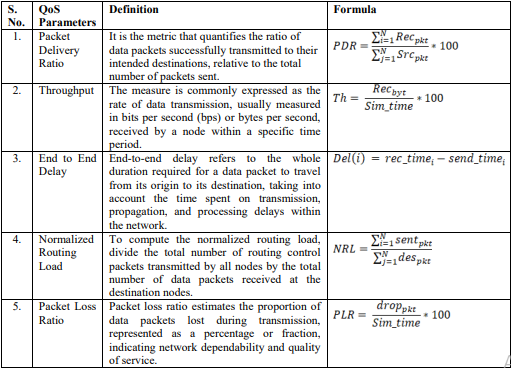
QoS parameters consist of a range of measurements and qualities that determine and measure the performance features of a network, including Throughput, End-to-End Delay, Packet Loss Ratio (PLR), Packet Delivery Ratio, and Network Overhead. Table 4 gives the description of various QoS parameters considered in this study.
Table 4 . Simulation scenario
5 RESULT AND DISCUSSIONS
Firstly, we enhanced the AODV protocol to the proposed RRP-AODV protocol by making modifications in the route request, route reply and route maintenance process and produced the RRP-AODV.tcl file. The simulation used NS2 to generate animation (RRP-AODV.nam) and trace (RRP-AODV.tr) files. NS2 framework files including those in the AODV, MAC, and common directories, were changed to implement the necessary protocol changes. Node mobility was based on the Random Waypoint model [3], which was built with the setdest tool, and traffic patterns (CBR or TCP) were formed with the cbrgen.tcl script, which allowed for customization of traffic type, node count, seed, connections, and data rate.
For performance evaluation, AWK scripts were created for each measure, which processed trace files to retrieve pertinent data. The analysed data was then visualized with Xgraph. The xgraph command is then applied to the xgraph data for each metric. Performance of the proposed protocol RRP-AODV, conventional AODV, and QoSRP was compared across two situations. In the first case 10, 30, 50, 80, and 100 numbers of nodes were considered and in the second situation simulation duration is considered as 100, 200, 300, 400, 500s. Network performance is analysed using QoS parameters/metrics PDR, throughput, end-to-end delay, PLR and normalized routing overhead. proceedings.
5.1. Simulation Results by Varying No of Nodes
Performance of the standard AODV, QoSRP and RRP_AODV protocols on various performance parameters is shown in Figure 10 to Figure 13. Figure 10 shows that the proposed RRP-AODV protocol improves PDR by 5% and 2% as compared to the standard AODV and QoSRP protocols respectively. Figure 11 depicts that the RRP-AODV protocol improves throughput by 22% and 7% as compared to AODV and QoSRP protocols respectively. Since it focuses on node lifespan, degree, and distance during route development, it gives more reliable routes for data transmission. Figure 12 shows 15% and 3% improvement in packet transfer time over AODV and QoSRP respectively. This is because the method makes successful use of energy measurements during route finding to avoid weak nodes which leads to finding stable routes with nodes capable of providing consistent service and thereby reducing the requirement for route rediscovery. Figure 13 shows a relatively high value of normalized routing overhead by 21% and 30% compared to AODV and QoSRP respectively. Likewise, Figure 14 shows significant improvement of 45% and 2% in PLR of RRP-AODV as compared to AODV and QoSRP respectively. Thus, it is clear that the proposed RRP_AODV protocol has considerable improvement in terms of all QoS based performance parameters over the standard AODV and QoSRP protocols for MANET.
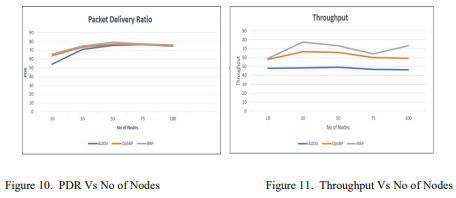


Figure 14 . PLR Vs No of Nodes
5.2. Simulation Results by Varying Simulation Time
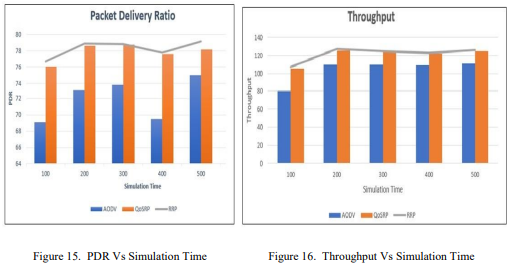
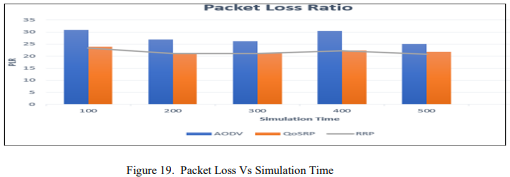
Performance of the proposed RRP-AODV protocol on various QoS based performance parameters has been compared here with the standard AODV and QoSRP protocols on varying the simulation time from Figure 15-19. By building long-lasting routes, RRP-AODV reduces time by 0.1% compared to AODV and 0.01% compared to QoSRP, thus reducing the frequency of route rediscovery. PDR is also improved as RRP-AODV effectively delivers 6% and 1% more data than the AODV and QoSRP respectively. This is due to improved route-finding mechanism that takes into account aspects such as distance, degree, queue length, energy and signal strength. PLR is reduced by 4% and 2% as compared to AODV and QoSRP respectively. This reduction in PLR is attributed to the picking of trustworthy routes with stable links and nodes having appropriate energy. Throughput of RRP-AODV is also improved as it delivers 18% and 2% more numbers of packets than AODV and QoSRP respectively. Normalized routing overhead of RRPAODV is 43% higher than AODV and 17% higher than QoSRP.

Statistical significance is a mathematical approach to determine if the difference observed between two or more datasets is likely due to the protocol modification rather than by random variations. A result is considered statistically significant if the calculated p-value is below a certain threshold (commonly 0.05), indicating a high level of confidence in the reported difference. In MANET reporting only average improvements may mislead readers without proper statistical validation. Statistical tests like t-test are essential to ensure that performance improvements are reliable. The student’s t-test is a well-established statistical test used to compare the means of two independent samples. It is particularly suitable for network performance studies where sample sizes are relatively small, and the data follows a normal or near-normal distribution. It validates whether improvements in protocols (e.g., Modified AODV) significantly outperform baseline protocols (e.g., AODV). The independent two-sample t-test formula.
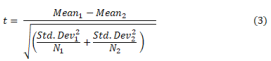
Table 5 . Statistical Significance analysis using T-test on PDR between protocols.

All comparisons produced p-values less than 0.05, confirming that the reported improvements in PDR are statistically significant and not due to chance.
6. CONCLUSIONS
The study introduces the RRP-AODV protocol is ideal for military contexts over standard AODV and QoSRP protocols where nodes may have high-speed mobility and encounter potential jamming. Specifically, the protocol’s use of localized route updates and better route request/reply mechanisms improves route stability and tolerance to rapid topology changes. Furthermore, we examine potential integration with anti-jamming approaches and spectrum-aware routing to improve reliability in hostile environments. Results showed improvements in packet delivery ratio (PDR), throughput, end-to-end delay and packet loss ratio (PLR). By modifying the route request and reply phases to factor in node distance, energy usage, and node lifespan, the protocol ensures more reliable and stable routing. The inclusion of node lifespan and queue congestion metrics enhances the decision-making process during route discovery and maintenance, leading to better route stability and network performance. However, these improvements come with the trade-off of increased routing overhead, as frequent updates of local node information are required, which can be simulated in two network scenarios varying simulation time and number of nodes. We contend that in mission-critical military activities, the benefits of increased reliability and reduced end-to-end delay can justify the higher costs.
In future, the study proposes incorporating fuzzy logic and machine learning techniques to further enhance the protocol’s efficiency by enabling more adaptive and intelligent route discovery processes.
CONFLICT OF INTEREST
The authors declare no conflict of interest.
REFERENCES
[1] Loo J, Lloret Mauri J, Hamilton Ortiz J (2011) Mobile ad hoc networks: current status and future trends. Taylor & Francis, p 538
[2] Perkins C, Belding-Royer E, Das S (2003) RFC3561: ad hoc on-demand distance vector (AODV) routing
[3] Bettstetter C, Resta G, Santi P (2003) The node distribution of the random waypoint mobility model for wireless ad hoc networks. IEEE Trans Mobile Comput 2(3):257–269
[4] Basagni, Stefano. Mobile ad hoc networking. 2004
[5] Pandey P, Singh R (2021) Efficient Routing in Mobile Ad Hoc Networks based on Awareness of Link Quality. In: 2021 International Conference on Computing, Communication, and Intelligent Systems (ICCCIS), pp 245–249. https://doi.org/10.1109/ICCCIS51004.2021.9397236
[6] Pandey P, Singh R (2021) Decision factor based modified AODV for improvement of routing performance in MANET. In: International conference on advanced network technologies and intelligent computing. Springer, Cham, pp 63–72.
[7] Sarkar, Dipika, Swagata Choudhury, and Abhishek Majumder. “Enhanced-Ant-AODV for optimal route selection in mobile ad-hoc network.” Journal of King Saud University-Computer and Information Sciences 33.10 (2021): 1186-1201.
[8] Nabati, Mohammad, Mohsen Maadani, and Mohammad Ali Pourmina. “AGEN-AODV: an intelligent energy-aware routing protocol for heterogeneous mobile ad-hoc networks.” Mobile Networks and Applications (2022): 1-12.
[9] Choudhary, Shubham, et al. “Fuzzy approach-based stable energy-efficient AODV routing protocol in mobile ad hoc networks.” Software Defined Networking for Ad Hoc Networks. Cham: Springer International Publishing, 2022. 125-139.
[10] Pandey, Priyanka, and Raghuraj Singh. “Efficient ad hoc on demand distance vector routing protocol based on route stability in MANETs.” International Journal of Wireless Information Networks 29.3 (2022): 393-404.
[11] Pandey, Priyanka, and Raghuraj Singh. “Efficient route selection scheme in MANET using enhanced AODV protocol.” Wireless Personal Communications 123.1 (2022): 959-974.
[12] Pandey, Priyanka, and Raghuraj Singh. “QoS based modified route discovery in MANET for multimedia applications.” Multimedia Tools and Applications 82.19 (2023): 29671-29688.
[13] Pandey, Priyanka, and Raghuraj Singh. “Advanced AODV routing based on restricted broadcasting of route request packets in MANET.” International Journal of Information Technology 13.6 (2021): 2471-2482.
[14] Hassan MH, Mostafa SA, Mohammed MA, Ibrahim DA, Khalaf BA, Al-Khaleefa AS (2019) Integrating African Buffalo optimization algorithm in AODV routing protocol for improving the QoS of MANET. J. Southwest Jiaotong University, vol 54(3).
[15] Jiang, Yi, Hui Sun, and Muyan Yang. “AODV-EOCW: An Energy-Optimized Combined Weighting AODV Protocol for Mobile Ad Hoc Networks.” Sensors 23.15 (2023): 6759.
[16] Tahboush, Muhannad, Mohammad Adawy, and Osama Aloqaily. “PEO-AODV: Preserving Energy Optimization Based on Modified AODV Routing Protocol for MANET.” International Journal of Advances in Soft Computing & Its Applications 15.2 (2023).
[17] Abdullah, Ako Muhammad, Emre Ozen, and Husnu Bayramoglu. “Enhanced-AODV Routing Protocol to Improve Route Stability of MANETs.” Int. Arab J. Inf. Technol. 19.5 (2022): 736-746.
[18] Nallayam Perumal, Mohan Prabhu, and CS Kanimozhi Selvi. “Improved priority aware mechanism for enhancing QoS in MANET.” Wireless Personal Communications 122.1 (2022): 277-292.
[19] Duong, Thuy-Van T. “An improved method of AODV routing protocol using reinforcement learning for ensuring QoS in 5G-based mobile ad-hoc networks.” ICT Express 10.1 (2024): 97- 103.
[20] Kumar R, Jagadeesh P (2019) QoS routing based on available bandwidth for mobile ad hoc network. Int J Eng Adv Technol (IJEAT) ISSN 8(5S):2249–8958. [21] Ssariyakul T, Hossain E (2009) Introduction to network simulator 2 (NS2). In: Introduction to network simulator NS2. Springer, Boston, MA, pp 1–18 [22] Kar, Pritam, and Mrinal Kanti Deb Barma. “Forecast weighted clustering in MANET.” Procedia Computer Science 89 (2016): 253-260.
AUTHORS

Diksha Shukla received her MCA degree from National institute of Technology, Raipur. She is currently pursuing her Ph.D. in the Computer Science and Engineering Department of Harcourt Butler Technical University, Kanpur, India. Her research area is Mobile Ad hoc Networks.

Dr. Raghuraj Singh is currently working as a Professor of Computer Science & Engineering and Dean, Research and Development at Harcourt Butler Technical University, Kanpur (India). He has more than 34 years of experience in teaching & research. He has successfully discharged various administrative responsibilities like Director, KNIT Sultanpur, Nodal Officer, IIIT Lucknow, Director (Mentor) of Rajkiya Engineering College, Ambedkar Nagar and Sonbhadra, Nodal Officer of Rajkiya Engineering College, Bijnor, and Dean, Planning & Resource Generation, Dean, Continuing Education & Internal Quality Assurance, Head of Department, Registrar, Controller of Examination, Chief Proctor, Asstt. Dean etc. at HBTU, Kanpur. Prof. Singh has handle 08 research and consultancy projects funded by the AICTE/UGC New Delhi and various other funding agencies. He is a member of professional bodies like IETE, IE (India), CSI, ACM, ISTE, IACSIT, Singapore etc. and reviewer & member of editorial board of many National/International journals/conferences and books. He has published more than 180 research papers in National and International journals/conferences, 06 Books/Book Chapters, supervised 19 Ph.D. theses, 29 M. Tech. dissertations, and more than 90 B. Tech./MCA projects.

 International Journal of Computer Networks & Communications (IJCNC)