
IJCNC 08
A NOVEL CLUSTER HEAD SELECTION ALGORITHM TO MAXIMIZE WIRELESS SENSOR NETWORK LIFESPAN
Almamoon Alauthman 1 , Wan NorShuhadah Wan Nik 2
1 Electrical Engineering Department, Al-Balqa Applied University, As Salt 19117, Jordan
2 Faculty of Informatics and Computing, University Sultan Zainal Abidin,
Terengganu, Malaysia
ABSTRACT
Wireless Sensor Networks (WSNs) are crucial for various applications such as environmental monitoring, industrial automation, and healthcare. However, the constrained energy resources of sensor nodes have a substantial effect on the longevity and performance of these networks. To address this issue, this paper introduces the Optimized Energy Efficient algorithm in Wireless Sensor Networks through Cluster Head Selection Using Residual Energy and Distance Metrics together. The study offers a new approach to selecting cluster heads by combining residual energy and distance metrics. The proposed algorithm called modified intelligent energy efficiency cluster algorithm (MIEEC-A), that enhances WSN energy efficiency by choosing nodes with high residual energy and close proximity to their neighbours as cluster heads.Extensive simulations and evaluations show that this approach effectively extends network lifetime, improves data aggregation, and boosts energy efficiency, thus making a valuable contribution to WSN lifetime.
KEYWORDS
WSN, Cluster Head, Cluster Distance, Residual Energy, Sensor Node, BCE-LEACH, IEEC-A, OEE-WCRD
INTRODUCTION
WSNs are widely used in today’s world, spanning various fields such as healthcare, industry, and military applications. The WSNs consists of a large number of sensors that are powered by batteries. The sensor nodes gather, process, aggregate, compress, and send data to the base station, all requiring efficient energy usage. The overall lifespan of the WSN can be impacted by how well energy efficiency is managed [1]. Several studies have been published about ways to reduce the power consumption of wireless sensors to maximize their lifetime. Insufficient power supply is a critical issue for WSNs, often leading to network failures due to node malfunctions [2]. As a result, WSNs are highly energy-sensitive, unlike other wireless networks that are not as dependent on power. Since each sensor node transmits data directly to the base station, its battery is rapidly drained, leading to power depletion. To maximize the network’s lifespan and enhance its performance, efficient energy use is crucial. Consequently, the clustering approach has been implemented to lower energy consumption, extend the network’s lifetime, and boost throughput. Since direct data transfer from the cluster to the base station consumes more energy, each cluster is assigned a Cluster Head (CH) [3]. Routing is a critical element in WSNs to prolong the network’s lifespan. A routing protocol that utilizes the clustering technique is the most efficient way to maximize network longevity by reducing the power consumption of sensor nodes [4]. A LEACH clustering routing protocol is one of the more power-efficient clustering protocols, which divides a WSN’s sensors into multiple clusters. The LEACH protocol operates on a clustering mechanism, where sensors transmit their collected data to Cluster Heads (CHs) at the start of each round. Each CH is then responsible for forwarding the aggregated data to the Base Station (BS). It does not take into account the remaining energy of the sensor when selecting CHs at random. Additionally, a sensor’s power consumption increases directly dueto communication between the Cluster Head (CH) and the Base Station (BS). In turn, this will reduce the lifespan of the wireless sensor network. Due to these reasons, we developed an improved energy efficient clustering technique based on the LEACH protocol in order to maximize network lifetime by reducing energy consumption. Many metrics that can be used to compare different routing protocols in WSNs. The performance of a protocol is primarily influenced by factors such as residual energy, communication distances, multi-hop processes, and network lifespan. [5].
The widespread deployment of WSNs in fields such as environmental monitoring, healthcare, and industrial automation has introduced significant challenges related to energy efficiency and network longevity. Due to the resource constraints of sensor nodes, often powered by limitedcapacity batteries, innovative solutions are needed to prolong network lifetime while maintaining efficient data communication. One promising approach to address this issue is the use of clusterbased algorithms within WSNs [6]. These algorithms have attracted significant interest due to their effectiveness in reducing energy consumption and enhancing network scalability. They achieve this by organizing sensor nodes into clusters and selecting a cluster head to aggregate and transmit data from the member nodes to a central sink or gateway. By minimizing the number of nodes actively transmitting data, these algorithms decrease energy overhead and extend the network’s operational lifespan [7].
The paper is organized as follows: Section 2 outlines the motivation for the research. Section 3 reviews related work. Section 4 provides a detailed explanation of the proposed algorithm. Section 5 presents the results and analysis. Finally, Section 6 offers a conclusion, summarizing the findings and exploring future research opportunities.
MOTIVATION AND CONTRIBUTION
This research is driven by the critical need to enhance the energy efficiency and overall performance of Wireless Sensor Networks (WSNs), which are essential in sectors like environmental monitoring, healthcare, and industrial automation. While current cluster-based methods have demonstrated promise in reducing energy consumption, there is a growing need for novel approaches to further optimize these networks [8].
Our research responds to this need by proposing an innovative cluster-based algorithm designed to greatly improve energy efficiency in WSNs. By strategically grouping sensor nodes into clusters and employing dynamic cluster reconfiguration techniques, our algorithm not only prolongs the network’s operational lifespan but also maintains data integrity and enhances coverage quality. This positions it as a noteworthy advancement in the field of cluster-based WSNs.
The manuscript is structured as follows: The introduction provides an overview of the importance of cluster-based WSNs and outlines the research objectives. The subsequent section offers a comprehensive review of existing cluster-based techniques and their limitations. Next, we provide an in depth description of our proposed cluster-based algorithm, covering its design, functionality, and adaptability to changing network conditions. The experimental methodology section outlines the setup and metrics employed to assess the algorithm’s performance. Finally, the results and discussion section presents the empirical findings and their significance. Finally, we conclude with a summary of our contributions, emphasizing the practical significance of our novel cluster-based approach in enhancing energy efficiency and network longevity in WSNs, and suggest avenues for future research
- RELATED WORK
In Wireless Sensor Networks (WSNs), challenges include limited sensor battery life, harsh environmental conditions, node heterogeneity, Quality of Service (QoS) requirements, node security, and ensuring fully functional deployments [9]. To keep the network operational and extend the lifespan of WSNs, various multi-constrained routing mechanisms have been developed in the literature. Among these, cluster based routing is the most commonly used approach for achieving efficient communication by optimizing resource usage. This method also enhances node management, load balancing, and scalability [10].Given the various challenges in WSNs, the primary goal of researchers is to minimize energy consumption and ensure efficient data transmission. Various hierarchical cluster-based routing protocols have been developed to improve energy efficiency and prolong the network’s lifespan by considering factors such as energy consumption, distance, coverage, mobility, and node density. Numerous algorithms have been proposed in the literature to address energy efficiency issues in specific areas [11].Ongoing research is focused on integrating various approaches and creating hybrid models that further improve energy efficiency and extend the network’s lifespan. MODLEACH [12] It is a variation of the LEACH protocol that uses an energy threshold for efficient cluster head formation. If the current cluster head’s energy exceeds the threshold, it remains in its role for the next round. However, if its energy falls below the threshold, it is replaced following the original LEACH algorithm. CRPD [13] is a cluster-based routing protocol designed for dynamic wireless sensor networks to reduce energy consumption and enhance energy efficiency by updating the network topology.
The results of the proposed mechanism are compared with existing models that effectively address similar challenges. Several of these protocols are discussed in this paper, including BCELEACH [14], which is an improved version of the Low Energy Adaptive Hierarchy (LEACH) protocol, known as Balanced Current Energy-LEACH (BCE-LEACH). This improved algorithm is designed to extend the lifespan of network sensor nodes by balancing their power usage. It selects Cluster Heads (CHs) based on the remaining power of the sensor nodes, allowing only those with adequate remaining energy to qualify as CHs. MO-LEACH [15], this protocol suggests that CHs can forward data to help reduce energy consumption if one is positioned centrally along the path. In this protocol, data transmission from CH to BS is optimized to conserve energy, but as the distance from the base station increases, adjacent sensor nodes experience higher energy consumption. IEEC-A[16] is a redesigned clustering protocol techniquefor WSNs to maximize their lifetime and throughput. The proposed clustering technique minimizes power consumption by selecting the optimal Cluster Head (CH) with the highest remaining power. It also emphasizes the importance of choosing the most suitable route for transmitting data between the CH and the base station. This technique considers the energy remaining in the nodes when selecting the CH and determines the distance between the sensor and the centerof the cluster. OEE-WCRD [17] is an algorithm designed to enhance energy efficiency in Wireless Sensor Networks by selecting Cluster Heads based on residual energy and distance metrics.We proposed a modified Intelligent Energy Efficient Clustering Approach algorithm, named MIEEC-A, aimed at enhancing energy-efficient cluster head selection to prolong the lifespan of wireless sensor networks. This algorithm is designed to optimize energy usage and enhance network longevity by employing an improved cluster head selection strategy. It effectively addresses the dynamic nature of nodes and resolves the issue of fixed round times for changing cluster heads. In this approach, the cluster head selection process considers the residual energy of sensor nodes, their mobility, the number of nodes associated with them, and the distance of the nodes from the base station. The cluster formation is structured so that when a node moves within the network, it can easily join a new cluster based on its new position while leaving its previous cluster without disrupting it. If the moving node is a cluster head, it selects a new cluster head from within its cluster before departing. This approach helps preserve the integrity of the cluster when the cluster head changes. Table 1 presents a summary of this literature review
Table 1Features and Challenges of Existing Work

- PROPOSED METHODOLOGY
The proposed OEE-WCRD protocol selects the cluster head (CH) based on two parameters: the
residual energy of the node and the average distance from the node to the base station.
4.1. Residual Energy Evaluation
Evaluate the residual energy of each sensor node in the network using available energy estimation methods, such as monitoring battery voltage or current consumption [28]. Assign a weight to each node based on its remaining energy, with nodes having higher energy levels being regarded as more suitable candidates for cluster head selection.
4.2. Distance Metric
Once a cluster head (CH) is selected, data must be transmitted to the base station (BS) via a root path. The direct transmission between CHs and the BS involves a relatively long distance, which results in significant energy consumption. To address this, the proposed clustering method uses a4.3. Combining Residual Energy and Distance Develop a selection criterion that integrates residual energy and distance metrics to prioritize potential cluster head nodes. For instance, a weighted scoring system could rank nodes according to their remaining energy and their distance from other nodes. Set a threshold or ranking limit to determine the candidates for cluster head selection.
4.3. Combining Residual Energy and Distance
Develop a selection criterion that integrates residual energy and distance metrics to prioritize potential cluster head nodes. For instance, a weighted scoring system could rank nodes according to their remaining energy and their distance from other nodes. Set a threshold or ranking limit to determine the candidates for cluster head selection.
4.4. Cluster Head Election
Elect cluster heads from the eligible nodes based on the selection criteria and ranking. Ideally, cluster heads should have sufficient residual energy and be near cluster members for efficient data aggregation. A weight function is defined as follows in the point function [30]:

In this equation, E represents the remaining energy of the sensor node within the cluster, X denotes the weight, and D is the distance between the sensor node and the cluster center. The cluster CH is determined by choosing the node with the highest point (P) in each cluster. The value of X ranges between 0 and 1, with a typical value around 0.85, as over 50% of total energy consumption occurs during data transmission between sensors.
4.5. Clustering
4.5.1. Cluster Creation
After selecting the cluster heads, create clusters by assigning nearby sensor nodes to their respective cluster heads. The distance metric is used to determine which sensor nodes should be assigned to each cluster.
4.5.2. Cluster Size Management
Introduce a mechanism to regulate the size of each cluster, ensuring balanced energy
consumption. Use dynamic resizing or merging of clusters to enhance network performance.
4.5.3. Data Aggregation
Set up communication links between cluster members and their cluster heads. Utilize the cluster
head nodes for aggregating data and transmitting it to the base station or sink.
4.5.4. Cluster Head Rotation
Periodically rotate cluster heads to evenly distribute energy consumption across the network and
prevent the early depletion of specific nodes.
4.5.5. Network Dynamics Adaptation
Create algorithms or guidelines to adjust the clustering structure based on changing network
conditions, such as node failures or mobility.
Pseudo-code for the proposed algorithm (MIEEC-A)
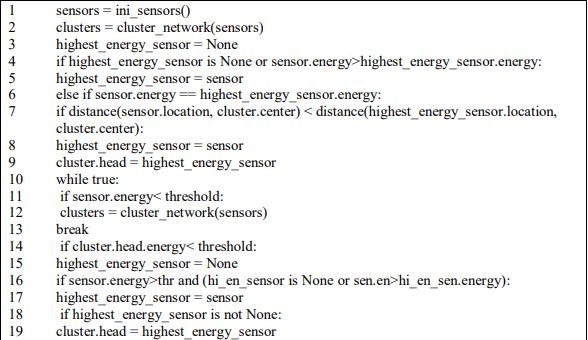
Figure 1. Example of a Petri Net
RESULT
This section presents the simulation results that assess the performance of the proposed clustering algorithm using the NS3 simulation tool. The proposed algorithm is compared with LEACH, BCE LEACH, and MO-LEACH protocols to demonstrate its effectiveness in maximizing network lifetime and throughput. Table 2 provides the detailed simulation parameters used in the
experiments.

Table 2Simulation Parameter
As stated in [30], network lifetime refers to the period during which the deployed sensors can monitor the target phenomenon. One way to measure this is by tracking the time when the first sensor depletes its power and ceases to function. This is an important metric for assessing how well a network can prolong its sensing period [31]. In Figure 1, the number of dead nodes within the network is compared. LEACH sees all sensors die by round 6000, BCE-LEACH by round 6300, IEEC-A by round 6800, andOEE WCRD by round 6900, whereas the proposed clustering algorithm MIEEC-A extends sensor life until round 7000. These results indicate that the proposed technique effectively maximizes network lifetime, as intended by the study
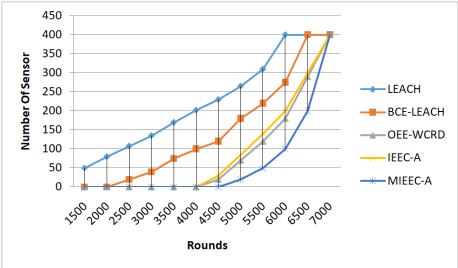
Figure 1The total number of dead nodes in the network.
In the following simulation, the time is measured from when the network starts collecting data
until the first sensor fails. As indicated in Table 3, the number of sensors ranges from 100 to
1000.
Table 3: Time until the sensor Fails
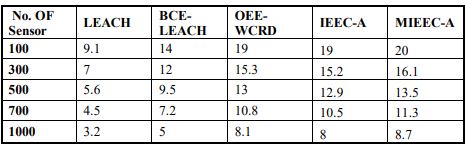
Figure 1Time until the sensor Fails
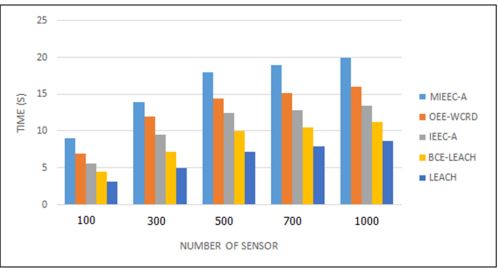
Figure 2Time until the first sensor fails in a network environment with 100 sensors
In the third simulation, the number of messages sent from the cluster heads (CHs) to the base station is calculated as a function of throughput. Table 4 presents the throughput for four existing protocols—LEACH, BCE-LEACH, IEEC-A,and OEE-WCRD, and compares them with the proposed clustering algorithm MIEEC-A.
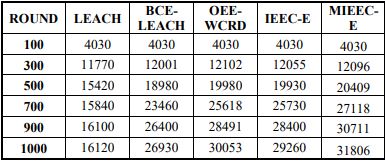
Table 4Throughput Comparison

Figure 3Throughput for a network running for 400 Sensor with varying numbers of Rounds
illustrates the objective of the fourth simulation, which provides an overview of energy consumption among network nodes using the LEACH, BCE-LEACH, IEEC-A, OEE-WCRD, and proposed clustering techniques MIEEC-A. The energy consumption rates differ among these protocols. The LEACH curve shows linearity for 950 rounds, BCE-LEACH for 1600 rounds, IEEC-A for 4710, OEE-WCRD for 4820 rounds, and the proposed technique for 4900 rounds. The results indicate that LEACH’s total node energy drops to nearly zero after 3500 iterations, BCE-LEACH maintains energy up to 5000 iterations, while IEEC-A and OEE-WCRD sustain energy until 5100 iterations, and the proposed technique until 5500 iteration. These findings support the claim that the proposed approach delivers better performance compared to conventional methods.
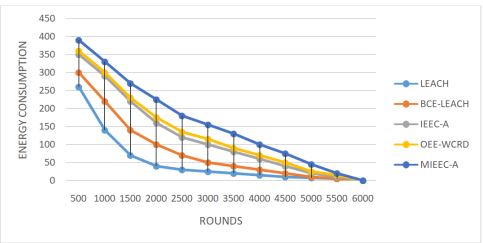
Figure 4Energy consumption among network nodes
Furthermore, it can improve the longevity, throughput, and overall lifespan of the wireless sensor
network (WSN) compared to existing protocols. As a result, the proposed clustering technique
extends the WSN’s lifetime more effectively than other mentioned protocols.
The final simulation, conducted over 1000 rounds with varying numbers of sensors as shown in
Figure 5, demonstrates that the proposed clustering technique achieves the highest throughput
compared to the LEACH, BCE-LEACH, IEEC-A, and OEE-WCRD protocols.
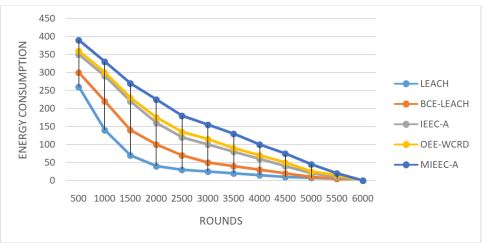
Figure 5Throughput for a network running for 1000 rounds with varying numbers of sensors.
- CONCLUSION
This paper introduces a redesigned clustering head selection for wireless sensor networks (WSNs), that isaimed at maximizing both their lifetime and throughput. The proposed technique reduces power consumption by selecting the optimal cluster head (CH) with the highest available power and determining the most efficient route for data transfer between the CH and the base station. In contrast to LEACH, which selects Cluster Heads (CHs) randomly, the proposed method takes into account the energy levels of the nodes and the distance between the sensor and the cluster center when selecting the CH. It also optimizes the routing path for data transmission using a multi-hop approach to minimize power consumption. The study compares the performance of the proposed clustering technique with three recent protocols—LEACH, BCELEACH, IEEC-A, and OEE-WCRD protocols. Simulation results show that the proposed technique lowers power consumption in CH selection and data transmission, which in turn enhances the WSN’s lifespan and boosts throughput. Additionally, it selects the most appropriate node as the CH, resulting in fewer dead nodes compared to existing protocols. The proposed technique also demonstrates superior throughput compared to LEACH, BCE-LEACH, IEEC-A, and OEE-WCRD. Future research will aim to incorporate advanced machine learning and artificial intelligence techniques to improve cluster head selection and routing decisions, further boosting energy efficiency and adaptability.
CONFLICT OF INTEREST
The authors declare no conflict of interest.
ACKNOWLEDGMENTS
The authors would like to thank everyone, just everyone!
REFERENCE
[1] J. Roselin, P. Latha, S. Benitta, (2017). Maximizing the wireless sensor networks lifetime through
energy efficient connected coverage, Ad Hoc Networks, Volume 62, Pages 1-10.
[2] Adday, G.H.; Subramaniam, S.K.; Zukarnain, Z.A.; Samian, N. (2022). Fault Tolerance Structures
in Wireless Sensor Networks (WSNs): Survey, Classification, and Future Directions. Sensors, 22,
6041
[3] Panimalar Kathiroli, Kanmani Selvadurai, (2022). Energy efficient cluster head selection using
improved Sparrow Search Algorithm in Wireless Sensor Networks, Journal of King Saud UniversityComputer and Information Sciences, Volume 34, Issue 10, Part A, Pages 8564-8575,
[4] Peter M., John N., and Geoffrey M., (2022). Cluster Head Selection Algorithm for Enhanced
Energy Efficiency in Wireless Sensor Network: A Systematic Literature Review. International
journal of computer science and engineering survey (IJCSES) vol 13, no.3,
[5] S. Umbreen, D. Shehzad, N. Shafi, B. Khan and U. Habib, (2020). “An Energy-Efficient MobilityBased Cluster Head Selection for Lifetime Enhancement of Wireless Sensor Networks,” in IEEE
Access, vol. 8, pp. 207779-207793
[6] Bilal S., Ibraheem S., Marwan A., & Ayman A., (2023). New scheme of WSN routing to ensure
data communication between sensor nodes based on energy warning, Alexandria Engineering
Journal, Volume 80, Pages 397-407,
[7] Sharmin, S.; Ahmedy, I.; Md Noor, R. (2023) An Energy-Efficient Data Aggregation Clustering
Algorithm for Wireless Sensor Networks Using Hybrid PSO. Energies 2023, vol 16, page 2487
[8] Amrita Ghosal, Subir Halder, Sajal K. Das, (2020). Distributed on-demand clustering algorithm for
lifetime optimization in wireless sensor networks, Journal of Parallel and Distributed Computing,
Volume 141, Pages 129-142.
[9] H. Mostafaei and M. S. Obaidat, (2018) ‘‘Learning automaton-based self protection algorithm for
wireless sensor networks,’’ IET Netw., vol. 7, no. 5, pp. 353–361.
[10] Y. H. Robinson, E. G. Julie, R. Kumar, and L. H. Son, (2019) ‘‘Probability based cluster head
selection and fuzzy multipath routing for prolonging lifetime of wireless sensor networks,’’ Peer
Netw. Appl., vol. 12, no. 5, pp. 1061–1075.
AUTHORS
Almamoon Alauthman earned his Bachelor’s degree in Computer Engineering from Al-Balqa Applied University (BAU) in Amman, Jordan, and his Master’s degree in Computer Engineering from Jordan University of Science and Technology (JUST) in Irbid, Jordan. He completed his Ph.D. at Sultan Zainal Abidin University (UniSA), Malaysia. Currently, he serves as an assistant professor at the Faculty of Engineering (Electrical Engineering Department) at Al-Balqa Applied University. His research interests include VLSI design, parallel processing, neural networks, computer architecture and organization, and wireless networks.
Wan Nor Shuhadah Wan Nik is currently a senior lecturer at the Faculty of Informatics and Computing, University Sultan Zainal Abidin (UniSA), Malaysia. She earned her Ph.D. in Computer Science (Distributed Systems) from the University of Sydney, Australia, in 2012. From 2014 to 2017, she served as the Deputy Director (Infrastructure & Services) at the Information Technology Centre, UniSA. Dr. Wan Nik has been involved in over ten research grants and has led four national grants in the fiel of Distributed Systems. Her primary research interests include Computer Networks, Distributed Systems, Scheduling in Grid/Cloud and Utility Computing, Wireless Sensor Networks, IoT, Heuristics and Optimization, and Blockchain.

 International Journal of Computer Networks & Communications (IJCNC)