
IJCNC 03
Prioritized Scheduling Routing Protocol for Minimizing Packet Drop in Wireless Body Area Network
Md. Taslim Arefin1, 2 and Md Abul Kalam Azad1, 1Jahangirnagar University, Bangladesh, 2Daffodil International University, Bangladesh
ABSTRACT
The development of wireless body area networks, or WBANs, has altered people’s lives through their utilization in the fields of athletics, cultural activities, fitness, including healthcare, among others. Energy conservation and ensuring the quality of offerings, however, are two of the main design difficulties for WBAN. In a WBAN, the load balancing of various packet buffers is crucial to the construction of a dependable and environmentally friendly technology. This paper proposes a prioritized scheduling-based protocol for minimizing packet drops in wireless body area networks on IEEE 802.15.6. This paper’s primary goal is to reduce packet drops in the queues to increase WBAN throughput. In this instance, we take into account the data packet’s importance as well as its source location to ensure that no packet is held in the designated buffer for an extended period before being sent to the connection point. PyCrypto is used to replicate the suggested approach in order to research and contrast its results with those of its competitors. According to the findings from the simulation, the suggested protocol performs more efficiently in delay, throughput, and energy consumption than the current approaches.
KEYWORDS
Routing Protocol, Wireless Body Area Network, Data Packet, Energy Consumption, Priority Scheduling
1. INTRODUCTION
Three main factors contribute to the extraordinary rise in global population: the growing baby boomer generation, a growing elderly population, as well as the high cost of treatment. Consequently, to promote preemptive healthy living and disease prevention, an advanced healthcare system is needed [1]. Wireless body area networks, or WBANs, are made up of an organization of intelligent, inexpensive sensors and actuators that are embedded or attached to patients’ bodies to measure their physiological parameters. Employing a network of peripheral and injectable gauges, Wireless Body Area Networks (WBANs) provide an ongoing record of physiological data, marking a significant development in both personal exercise and treatment. These networks offer real-time data on characteristics like blood pressure, blood sugar levels, and sports participation, which is helpful in managing chronic diseases, post-operative care, and Overall well-being [2]. The information is then transmitted to a sink node, and the hub makes sure that the received data is forwarded to a remote professional via the world wide web for a medical assessment [2]. WBANs have a number of advantages, such as superior outcomes for patients via early medical problem diagnosis, more patient simplicity, and lower healthcare expenses from remote surveillance illustrated in Figure 1. WBANs are becoming more frequently combined with artificial intelligence and sophisticated data analytics as technology advances to deliver more precise diagnoses and individualized health recommendations [3]. WBANs are intended to be compatible with a number of wireless communications protocols, including IEEE 802.15.4 and IEEE 802.15.6 [20]. WBANs’ methods of communication are essential for both effective power control and dependable data transfer. Protocols including Bluetooth Low Energy, or BLE, ZigBee, and custom wireless standards are frequently utilized; these are chosen according to particular needs like battery consumption, data percentage, and distance [14]. For instance, BLE is preferred because of its low consumption of electricity and broad compatibility with equipment, which makes it perfect for wearable sensors [4]. Conversely, ZigBee is frequently selected due to its resilience and mesh networking capability, which improves communication dependability in crowded spaces [15]. These protocols guarantee the safe and effective transfer of data from gauges to centralized hubs, which can be smartphones or specialized monitoring devices. From there, information can be analyzed, examined, and sent to cloud databases for additional assessment [5].
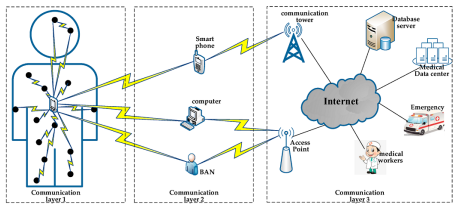
Figure 1 : A general overview of WBAN and its Communication Layers
In contrast to its cousin, IEEE 802.15.6 is highly favoured because of its adaptable features [16], which include high data speeds, short assortment, low consumption of electricity, several frequency bands, access forms of transportation, etc [21]. Any of the three access modes— beacon mode with a superframe, beacon option without superframe and non-beacon method without superframe can be implemented using this standard [3]. However, because it has synchronization capabilities [29], a beacon mechanism with superframe is a very effective access strategy [30]. Recently, there has been an improvement in the dependability and throughput along with mitigation of delay and energy usage in data transmission across WBAN [4]. Additionally, this has been enhanced by the use of Bluetooth, Wi-Fi and ZigBee devices. However, delay constrained transportation of essential and vital data cannot be guaranteed by short-distance transmission, low data rates, effective buffers, or scheduling of priority data [28]. Regarding significance, the data produced by sensors are divided into four categories: emergency, vital whenever needed and routine [5].
Additionally, a number of WBANs cohabit in a specific location to offer population-quality healthcare services. Inadequate packet forwarding and buffering can have an impact on each WBAN’s excellence of service at the points of connection. The personalized devices receive data packets from biosensors in WBAN, and forward the information. For the effectiveness of services-aware data to be transmitted at the assistants with increased energy efficiency, it is crucial to provide effective buffering along with the scheduling of data streams at various customized endpoints. This paper proposes a prioritized scheduling-based protocol for minimizing packet drops in wireless body area networks on IEEE 802.15.6. This paper’s primary goal is to reduce packet drops in the queues in order to increase WBAN throughput. The prominent contributions are as follows.
● In order to ensure that the burden on the terminals is proportional, the transmission gateway is effectively chosen by calculating the computational and transmission load of biological sensors and terminals in WBANs.
● During QoS-aware packet shipment, the data frames produced by each WBAN are effectively queued in four distinct queues based on their significance.
● Using IEEE802.15.6, an effective scheduling method is developed to arrange the packets according to the importance and transit duration.
The paper’s subsequent section is arranged as follows. Section 2 provides a brief overview of the work carried out regarding QoS-aware data transmission via WBAN. The system framework, queuing and arranging mechanism, and suggested algorithm for distributing the load across nodes are presented in Section 3. Section 4 presents its effectiveness evaluation and its juxtaposition with other current state-of-the-art technologies. Section 5 presents the work’s potential future direction and the contents of the conclusion.
2. LITERATURE REVIEW
In a network with several WBANs, arranging schedules in the WBANs is a crucial component that ensures dependable, environmentally friendly data transmission in immediate time. The following subsection presents some of these researchers’ concepts for effective scheduling-based communication of packets in WBAN. Simultaneous WBAN interference reduces each WBAN’s throughput and power consumption [6]. Saba and Tanzila [7] suggested inter-WBAN rescheduling according to graph coloring to lessen inter-WBAN disturbance. Spatial-reuse coloration was used to create a dense sensing construction, and the body sensors were placed at various times. Xie et al. created an additional Clique-Based WBAN Sequencing (CBWS) technique to reduce the impact of disturbance [19].
The WBANs were split up into multiple groups for the CBWS technique, and every single group was given a distinct time window. Pramanik et al. [8] also suggested a QoS-driven arranging strategy that maintains an acceptable threshold to the modify WBAN broadcast sequence and allocate optimal intervals based on WBAN QoS specifications. Ahmad et al. [9] suggested placing relay stations to raise the packet waiting time ratio as part of an affordable dynamic routing scheme for WBANs. They also suggested a link-quality sensitive distribution strategy to distribute resources equitably among several WBANs. Additionally, the effectiveness of the WBANs was examined in crucial scenarios with various levels of traffic [22].
Habib et al. [10] suggest analyzing how the duration of execution affects adaptable media sequencing. A priority-aware price-based bandwidth pooling plan for WBANs was created by them. Additionally, Singh et al. [11] suggest a priority-aware honest technique for delay-sensitive packet exchange in WBANs as well as an incentive system for transmission routing [23]. These methods assign equal priority and a uniform data rate to traffic from multiple sources scheduling. However, due to the diverse QoS needs of WBANs, these approaches are not appropriate for scheduling data in WBANs [11]. There are disparities in user preferences among the medical data produced by a WBAN. Fourati et al. [12] offered a review of several traffic-responsive MAC protocol families. Such protocols, nevertheless, offer just a handful of confirmed spaces for crucial nodes for sensing and no method for prioritizing information [24]. The main disadvantage of these procedures is that the information produced by important nodes might experience a lengthy waiting period, which could prevent important information from arriving at the intended location before the time limit is reached [25]. Synchronous load recycling was the foundation for the development of the recipient-triggered continuous (C-MAC) MAC protocol [27], which was created by Pramanik et al. [8] The proposed protocol eliminates incompatibilities that arise with the CSMA/CA approach by using an ordering-based messaging mechanism. On the other hand, the total quantity of collisions during the access phase rises when many nodes are prioritized. As a result, it successfully decreased access latencies. The main disadvantage of this protocol, though, is that performance will deteriorate because there are only so many scheduled intervals (GTS), particularly when there is a lot of congestion [13]. An environmentally friendly and load-balanced queue with a priority method for WBAN has been suggested by Samanta et al. [13]. The contributors of this paper examine four distinct queue types for the purpose of prioritizing and delaying data streams. Although vital data is efficiently transmitted using this method with the least amount of delay, the burden is not evenly distributed among the four queues [26]. This results in higher energy usage and an interruption in the transmission of important information.
3. TRAFFIC PRIOTIZED SCHEDULING ALGORITHM
This section describes an environmentally friendly traffic prioritized load balancing routing method that uses the IEEE802.15.6 interface to transmit essential traffic on schedule. The paper’s primary goal is to plan traffic using a probabilistic precedence system. Every WBAN’s biosensors transmit information about sensations to the customized device either immediately or via relay nodes. After examining its load table, the data is then sent to the connection point or another customized device. Additionally, every individualized device maintains two distinct queues to hold packets obtained from different individualized devices (remote thread) and the external biosensors of the corresponding WBAN (local queue). Employing probabilistic precedence scheduling, the packets are sent from each of those queues to the closest access point or tailored equipment. The computational architecture and traffic classification created for the analysis of our suggested procedure are initially described in this section. Next, the operation of our suggested algorithm is demonstrated, followed by the load computation at each customized device.
3.1. Overview of IEEE802.15.6
Considering the IEEE802.15.6 standard is used in the construction of our procedure; it is covered in the following paragraphs. Our paper’s primary goal is to arrange transmissions in customized mechanisms for effective load distribution and important transmission of packets. Over the past several years, IEEE 802.15.6 has become increasingly common in WBANs due to its inexpensive cost, low spectrum, dependability, and ability to operate at frequencies that are low. The WBAN is made up of a hub, also known as the PD, and several biosensors [17]. The personalized device functions in either non-beacon transmission with superframes or beacon transmission with superframes depending on the time basis. The superframe has an x number of divisions that should be x < 255 [20]. Every beacon interval might or might not observe the transmission of a beacon packet [18]. However, the PD might function without superframes in non-beacon configuration. Every beacon interval might or might not observe the transmission of a beacon packet [22]. However, the PD might function without superframes in non-beacon configuration. Beacon 1, Particular Access Stage 1, Unplanned Access Stage 1, Controlled Access Stage, Particular Access Stage 2, Unplanned Access Stage 2, another Controlled Access Stage, Beacon 2 along with the Argument Access Stage make up the superframe when it is in signal technique with superframe [19]. Whenever a biosensor contains vital information pertaining to an individual’s life, it competes for distribution [17].
3.2. System Architecture and Traffic Prioritization Mechanism
Our suggested model makes the assumption that multiple-state wireless body networks are linked to the Internet by means of personalized devices. Multiple biosensors on each WBAN transfer sensory information to the customized device based on the subsequent presumptions.
● Data is sent immediately to the tailored device or via a relay station that is farther from it if the biosensor’s information differs from previously obtained information and is not significant.
● The biosensor sends the data straight to the customized gadget if the information is vital.
Consider the N number of WBAN networks such as W = {W1, W2, W3 ,………, Wn}. Each WBAN has M number of sensors such as S = {S1, S2, S3 ,………, Sn}. In addition, there are N number of personalized devices such as PD = {PD1, PD2, PD3, ……… PDn} and K number of access points such as AP = {AP1, AP2, AP3 ,……., APn}. Once the customized gadget receives the information that comes from the biosensors, it sends it via internet connection to a medical database.
Different kinds of traffic are produced in WBAN, and these must be planned according to their importance. Applications for both medical and other purposes are supported by WBAN. The health applications include the monitoring of different signals, such as the heart’s ECG, brain’s EEG, and the brain’s EMG, to provide therapeutic help. Commercial electronics-related signals are among the non-medical possibilities. Four distinct groups are used to classify the traffic that a WBAN generates. Occasionally, crucial data that may have a direct bearing on the health of an individual is generated by applications for medicine. Urgent transportation is the name given to this kind of traffic, and it has the highest level of priority. In order for information to be properly transmitted by the time frame, it must be routed via a dependable path and given the greatest possible chance in buffering and sequencing. Additionally, a number of continuous indications, like EEG and EMG, that must be routinely checked are classified as frequent transportation and given an extremely high priority. Arguably these transports are not urgent, it is crucial that these kinds of data are delivered reliably. Medical indications that are not continuous, such as blood pressure, temperature, etc., are classified as intermittent communication and given a medium order of importance, whereas non-medical communication is given low consideration. Our goal in this work is to develop an effective buffering and time management algorithm that will allow emergency traffic to be provided ahead of schedule without compromising the dependability of other communication deliveries.
3.3. Forwarding Node Selection Mechanism
Three separate tables are maintained by each PD: an activity table, an occupancy table, and an information table. The occupancy history is stored in the activity table. There are three possible occupancy states for PD: underloaded, moderately laden, and overloaded. Each PD has upstream and downstream nodes such as Nu and Nd. Upstream is for informing the activity states and downstream is for forwarding packets. All are stored in an information table. Only when a node in the companion set changes from underloaded to moderately laden, from moderately loaded to overloaded, or vice versa, do they notify the PD of their condition. No additional status is reported, the current load status is still accurate. The Forwarding Node selection algorithm is as follows Algorithm 1.
Algorithm – 1: Forwarding Node Selection Approach
Input: N number of WBANs – W = {W1, W2, W3 ,………, Wn}, M number of sensors – S = {S1, S2, S3 ,………, Sn}, N number of personalized devices – PD = {PD1, PD2, PD3, ……… PDn}, N number of Access points – AP = {AP1, AP2, AP3 ,……., APn}
Output: Forwarding Node from ith PD.
a. Initialize the neighbors of upstreams (Nu)
b. Initialize the neighbors of downstreams (Nd)
c. Load or occupancy computation ( ) on PD at AP time
d. Occupancy information forwarded.
e. Update the occupancy information for PDs.
f. PSj belongs to Nd
g. PSj = PD, forward the node.
h. Recalculate the occupancy of PSj.
i. Check all with Nu, if status is changed.
3.4. Traffic Buffering and Sequencing
The section introduces the IEEE 802.15.6 specification and an effective stochastic priority-based sequencing technique for dependable immediate information transfer over WBAN. The IEEE 802.15.6 CSMA/CA method has a major impact on delay along with throughput. Our suggested technique’s primary goal is to transmit QoS-aware, environmentally friendly data via WBAN. Various types of sensors are positioned at various body parts in a WBAN. Everybody is aware of where they are, what they have sensed, and how important something is. Following receipt of the information from the sensors, the customized device establishes the priority and adds it to the local buffer. Naturally, there are four sub-queues for each of the four traffic categories that make up the local buffer. There could be a number of disadvantages to establishing a sub-queue specifically for every category, though. Low manageability for increasing traffic strain is the first downside. If there is not enough capacity in the associated sub-queue to hold the traffic of that order of importance, there will be a packet failure and an increase in latency. The second issue is the inefficient use of buffer memory. In an emergency, when the sensors produce massive amounts of traffic, the likelihood of a loss climbs dramatically.
Every PD has one distant buffer to hold packets obtained from different PDs and one localized buffer to hold packets received from WBAN instruments. Only one queue is available for each AP to hold the packets that come in via additional PDs through APs. Four subqueues are conceptually created from each queue, as well as the dimensions of every single subqueue changed dynamically based on the volume of communication in each importance classification. The reasonable division of a queue kept at individual AP, or customized device, is depicted in the Figure 2. For the most important urgent traffic statistics, the first sub-queue is employed as a specialized queue, and the remaining three subqueues are employed as common lines. The most important periodic communication has its own dedicated queue, which is the subsequent subqueue. The periodical traffic is buffered by sharing both the third through fourth subqueues. For aperiodic traffic, the third as well as fourth subqueues are utilized as shared and exclusive subqueues. Only the 4th subqueue is used by non-medical traffic as its specialized cache. However, low-importance non-medical subjects’ traffic does not have a shared delay
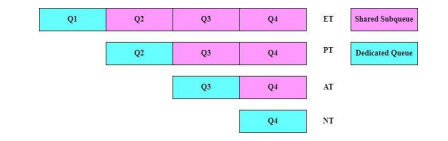
Figure 2: Queue Position of PDs
Upon receiving a packet through its individual biosensor via WBAN, the PD ascertains the quantity of capacity at its regional backlog. Transmission is first given shared delay by the PD. room is allotted in the associated specialized sub-queue if there is no room in the communal subqueue for that type of traffic. In the event that no space remains, the message is discarded. Similar to this, the distant queue’s storage capacity is examined when traffic coming from different PDs becomes available. The general subqueue is where the packets are safeguarded, while the exclusive sub-queue is where the messages remain buffered if there is no room in the general subqueue. Whenever the messages are buffered, they are organized employing a stochastic scheduling of priority technique. In a probabilistic approach, the messages are serviced from both immediate and distant queues. Nonetheless, individual queue’s messages are scheduled according to importance. The load parameters (R) assigned to the local and distant queues determine when packets are scheduled to arrive from the respective queues. This research considers the distant queue to be more important than the local queue. The following formulas numbered (1), (2), (3), (4), and (5) are used to calculate the load parameters for the local and distant queues.
defines local load of communication, defines left number of pockets in local position, defines the received number of pockets at the local zone. are packets at local areas that are received from sensors and supplied to APs. are the received packets of the APs from the sensors. are the power for transmission and receiving respectively. Finally the total load cost is defined by . Considering that the distant queue might include certain information that comes from different WBANs, the above scheduling algorithm assigns the distant queue a higher probability precedence than the regional buffer. Serving both the local buffer and the distant queue comes with stochastic priority. On the other hand, individual queue transmissions are served according to priority. Algorithm 2 presents the buffering alongside the scheduling mechanism.
Algorithm – 2: Buffering Procedure (QUEUE Q, Data)
Input: Set of traffic categories = {ET, PT, AT, NT)} Set of conceptual channels = {Q1, Q2, Q3, Q4, Ql, Qr}Information obtained at the PD. BC stands for buffer occupancy.
Output: Remote/Local queue at PD, Packet Dropped, Buffered, or Scheduled.
a. Traffic categories of Data are determined by PDs
b. IF (((Data = ET) && (BC + size(Data))) <= size(4 conceptual channels))
i. INSERT (Q1, Data)
c. ELSE IF (((Data = PT) && (BC + size(Data))) <= size(Q2+Q3+Q4))
i. INSERT (Q2, Data)
d. ELSE IF (((Data = NT) && (BC + size(Data))) <= size(Q3+Q4))
i. INSERT (Q3, Data)
e. ELSE
i. INSERT (Q4, Data)
f. IF (Data at PD)
i. BUFFERING (Ql, Data)
g. ELSE
i. BUFFERING (Qr, Data)
h. Calculate load or occupancy parameters Rl, Rr
i. Calculate probability Pr
j. Generate Rn in the interval [0, 1]
k. IF (Rn <= Pr)
i. Qr is responsible for packets
l. ELSE
i. Ql is responsible for packets
4. RESULTS AND ANALYSIS
This section presents the performance study of our recommended approach with respect to transmission proportion, average interruption, productivity, and energy consumption compared to the current IEEE 802.15.6, C-MAC (Zhang et al., 2017), and ELBPQ-MAC (Ambigavathi and Sridharan, 2018) standards. PyCrypto is used to implement the suggested method and its equivalents so that their performance may be examined.
The IEEE802.15.6 MAC protocol is a system that uses fixed slots for time in its superframe architecture. As a result, as the total number of connections grows so does the collision likelihood of the connections. High congestion intricacy and higher latency are the outcomes of this. In order to examine the IEEE802.15.6’s performance, we take into consideration a basic priority queue that is put into place at every PD in the WBAN along with the internet interface. Each PD that uses ELBPQ-MAC has two priority queues implemented: one for packets coming from the PD’s internal WBAN and another for packets coming from additional PDs.
Regarding the transmission of information, we take into consideration the biosensors linked to the PD via a single-hop star configuration. In addition, an assortment of access points (APs) are set up to catch the information from PD and then send it via the internet to the distant healthcare facility. We take into account 50 WBANs spread throughout a 100 x 100 area, each with six biosensors. The suggested method of communication is implemented over the IEEE802.15.6 procedure, along with its equivalents. Every WBAN has a leftover energy of 0.5 J. We ran the tests for fifty rounds, and the graphs displayed the 95% intervals of assurance. All the experimental simulation parameters are – simulation time in seconds (200), 50 WBANs, 5-10 number of APs, 16.7 nj Tx circuits, 36.1 nj Rx circuits, 1.97 nj amplifier circuits, 50 number of customized devices, 300 number of body sensors, 4 pacs per second packet rate, each packet 512 bytes size, CBR traffic category, 2.4 band frequency. The experimental setup is as follows according to the simulation parameters depicted in the Figure 3.
This research models a Wireless Body Area Network (WBAN) ecosystem in this experimental setting in order to assess its energy consumption, packet transportation, and routing effectiveness. There are fifty WBANs in the scenario, and it takes 200 seconds to complete. There are six body sensors and fifty customized devices per WBAN, for an aggregate of 300 sensors throughout the network. The 2.4 GHz frequency group, which is typical for WBAN interactions, is where the network functions. To evaluate the effect on the efficiency of networks, we examine two scenarios, namely 5 and 10 APs, with varying amounts of Access Points (APs). The receiving circuit (Rx-circuit) uses 36.1 nJ of energy per operation, compared to 16.7 nJ for the transmitting circuit (Tx-circuit). Furthermore, 1.97 nJ of energy is used by the amplifier circuit for each operation. A packet of information of 512 bytes in size and an exchange rate of four transmissions per second are the characteristics of data transfer. Constant Bit Rate (CBR) communication ensures a consistent data flow. Protocol for routing, which dynamically determines routes between APs and WBANs while maximizing dependability and efficiency.

Figure 3: Experimental Setup of WBAN
Through careful analysis of the energy consumption, data transmission achievement, and durability of the WBAN under various configurations, made possible by this experimental setup, we are able to provide significant information for the planning and creation of potential WBAN technologies.
4.1. Performance Metrics
Delay: A difference between obtaining time of the packet and transmitting time of the packet among APs, and sensors. Delay is the sum of delay of transmission , delay of queuing , and delay of propagation as the following equation. Throughput: It is a computation of the rate of packets with the difference between the number of available packets and the number of available transmitted packets among APs, and sensors. The measurement can be defined as the following. Here, defines the number of available obtained packets, and defines the number of available transmitted packets among APs and sensors.
Rate of Delivered Packets (RDP): It is a percentage of the obtained packets and transmitted packets overtime. The ratio based measurement is as follows. Here, defines the number of available obtained packets, and defines the number of available transmitted packets among APs and sensors. Energy Consumption: Amount of consumed power over time , considering 3 distinct circuits such as circuit of transmission, amplifier, and circuits of receiver. An existing model [1] has been applied for this measurement.
4.2. Performance Analysis
Analysis of Delay
The average distribution delay vs simulation time is displayed in Figures 4 and 5. The data shows that delivery delays reduce with a boost in the total amount of APs. In addition, it is noted that our model has less latency than the current models that different packets encounter. This is important because, in contrast to the current models, ours allows the crucial packets to be sent with greater clarity. The essential packets in the PD that get delivered from the local WBAN alongside other faraway WBANs are prioritized by the stochastic prioritization model that our model proposes to ensure the timely transmission of essential packages. This algorithm’s buffering technique also guarantees that important packets are successfully buffered, which lowers the likelihood of packet skipping. As a result, transmission and reception times also get shorter. In contrast, the data packets are scheduled according to the permitted latency delay by the ranking queue programmers used by the current methods. As a result, the messages are transmitted according to the permitted latency delay, and the packets that are queued up are ignored. As a result, packet delivery delays average higher than 3. However, an increase in AP also enhances the likelihood of locating the road to AP, which unquestionably shortens the delay. Figures 3 and 4 show the delay caused by the packet as the number of APs increases.

Figure 4: Average transmission latency versus duration of simulation (with 100 WBANs and 5 APs).

Figure 5: Average transmission latency versus duration of simulation (100 WBANs and 10 APs).
Analysis of Rate of Delivered Packets
Figures 6 and 7 show the amount of packet delivery percentage against simulation duration for 50 distinct WBANs with varying numbers of APs. It is clear that as the amount of APs rises, so does the RDP. The prevalence possibility of PDs rises with the quantity of APs, increasing the likelihood of an association between PDs and APs. The juxtaposition of the suggested model with other current models in terms of RDP is depicted in the images. The suggested approach outperforms ELBPQ-MAC and C-MAC, it is discovered. This is because our paper uses an effective buffering method that lowers the likelihood of packet drops.

Figure 6: Percentage of transmission of packets versus duration of simulation (50 WBANs and 5 APs)

Figure 7: Percentage of transmission of packets versus duration of simulation (100 WBANs and 10 APs)
Analysis of Throughput
Figures 8 and 9 illustrate how throughput changes with the duration of simulation for both the same amount of WBANs and a variable number of APs. While the simulation duration grows, the throughput rises, but at a progressively slower rate. The message distribution ratio rises as a result of the higher throughput of about 2000 for 200 seconds. The figures demonstrate how our suggested approach outperforms its equivalents with regard to throughput.
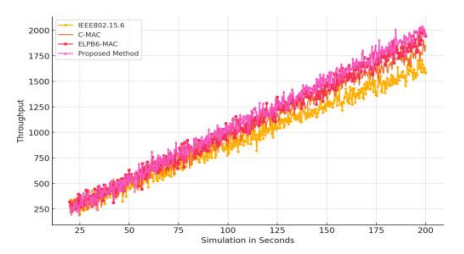
Figure 8: The throughput versus duration of simulation (with 50 WBANS and 5 APs)

Figure 9: The throughput versus duration of simulation (with 100 WBANS and 10 APs).
Analysis of Energy Consumption
Figures 10 and 11 show the energy use during the course of the simulation. The results show that as the number of APs increases, there is a corresponding decrease in energy consumption. The WBAN’s PD is where the algorithm establishes the link to the AP. To ensure that the important packets arrive at the APs on time, they are effectively buffered and scheduled. As a result, WBAN’s energy consumption drops by about 3000 for 200 seconds. The suggested methodology outperforms the current models when it was compared with other methods that are currently in use.

Figure 10: Utilization of energy in relation to simulation duration (50 WBANS and 5 APs)

Figure 11: Utilization of energy in relation to simulation duration (100 WBANS and 10 APs).
5. CONCLUSIONS
A traffic-aware load distribution approach for dependable transmission of information over WBAN was presented in this paper. In order to determine which PD should be the next node to forward the messages, we first calculated the load at each PD. The suggested framework guarantees storing important packets in buffers. This lowers the likelihood that crucial packets will be dropped, which improves our model’s performance. Additionally, we recommended arranging messages at each PD using a stochastic prioritization method. In order to successfully deliver crucial packets at APs over a period of time this technique gave priority to the important packets it acquired from both its personal WBAN and other distant WBANs.
Through the results of simulations, the suggested approach was juxtaposed with contemporary algorithms already in use, and it was found to perform better than its predecessors. This article may be extended in the future to examine WBAN performance with transitory connection quality amongst PDs and APs. We have assumed that WBANs, PDs, and APs are stationary in this paper. As a result, future extensions of the WBANs’ mobility may also be taken into account.
CONFLICT OF INTEREST
The authors declare no conflict of interest.
ACKNOWLEDGEMENTS
Funding Information: This research does not have any research funding
Author Contribution: All authors contributed to the research. The first draft of the manuscript was written by Md. Taslim Arefin. The other author reviewed and approved the final manuscript.
Data Availability Statement: The extracted data set will be available upon request to the corresponding author via email.
REFERENCES
[1] Samanta, A., Bera, S., Misra, S.: Link-Quality-Aware Resource Allocation With Load Balance in Wireless Body Area Networks. In: IEEE Systems Journal. 12. (2015). 10.1109/JSYST.2015.2458586.
[2] Mohanty, Rasmita Kumari, Satya Prakash Sahoo, and Manas Ranjan Kabat. “Sustainable remote patient monitoring in wireless body area networks with Multi-hop routing and scheduling: a four-fold objective based optimization approach.” Wireless Networks 29.5 (2023): 2337-2351.
[3] Samal, Tusharkanta, and Manas Ranjan Kabat. “A prioritized traffic scheduling with load balancing in wireless body area networks.” Journal of King Saud university-computer and information sciences 34.8 (2022): 5448-5455.
[4] Zuhra, F. T., Bakar, K. B. A., Arain, A. A., Almustafa, K. M., Saba, T., Haseeb, K., Islam, N. (2019). LLTP-QoS: low latency traffic prioritization and QoS-aware routing in wireless body sensor networks. IEEE Access, 7, 152777-152787.
[5] Forestieri, Sara D., Taylor M. Helgestad, Andrew T. Lambe, Lindsay Renbaum-Wolff, Daniel A. Lack, Paola Massoli, Eben S. Cross et al. “Measurement and modeling of the multiwavelength optical properties of uncoated flame-generated soot.” Atmospheric Chemistry and Physics 18, no. 16 (2018): 12141-12159.
[6] Mohammed, K. I., A. A. Zaidan, B. B. Zaidan, Osamah Shihab Albahri, M. A. Alsalem, Ahmed Shihab Albahri, Ali Hadi, and M. Hashim. “Real-time remote-health monitoring systems: a review on patients prioritisation for multiple-chronic diseases, taxonomy analysis, concerns and solution procedure.” Journal of medical systems 43 (2019): 1-21.
[7] Saba, Tanzila, Khalid Haseeb, Imran Ahmed, and Amjad Rehman. “Secure and energy-efficient framework using Internet of Medical Things for e-healthcare.” Journal of Infection and Public Health 13, no. 10 (2020): 1567-1575.
[8] Pramanik, Pijush Kanti Dutta, Anand Nayyar, and Gaurav Pareek. “WBAN: Driving e-healthcare beyond telemedicine to remote health monitoring: Architecture and protocols.” In Telemedicine technologies, pp. 89-119. Academic Press, 2019.
[9] Ahmad, Naveed, Basit Shahzad, Muhammad Arif, Diana Izdrui, Ioan Ungurean, and Oana Geman. “An Energy‐Efficient Framework for WBAN in Health Care Domain.” Journal of Sensors 2022, no. 1 (2022): 5823461.
[10] Habib, Carol, Abdallah Makhoul, Rony Darazi, and Raphaël Couturier. “Health risk assessment and decision-making for patient monitoring and decision-support using wireless body sensor networks.” Information fusion 47 (2019): 10-22.
[11] Singh, Prabh Deep, Gaurav Dhiman, and Rohit Sharma. “Internet of things for sustaining a smart and secure healthcare system.” Sustainable computing: informatics and systems 33 (2022): 100622.
[12] Fourati, Hend, Hanen Idoudi, and Leila Azouz Saidane. “Overview of four emerging mechanisms for e-health communications.” International Journal of Systems, Control and Communications 7, no. 4 2016): 337-359.
[13] Samanta, Amit, and Sudip Misra. “Dynamic connectivity establishment and cooperative scheduling for QoS-aware wireless body area networks.” IEEE Transactions on Mobile Computing 17, no. 12 (2018): 2775-2788.
[14] Qu, Yating, Guoqiang Zheng, Huahong Ma, Xintong Wang, Baofeng Ji, and Honghai Wu. “A survey of routing protocols in WBAN for healthcare applications.” Sensors 19, no. 7 (2019): 1638.
[15] Akbar, Muhammad Sajjad, Zawar Hussain, Michael Sheng, and Rajan Shankaran. “Wireless body area sensor networks: Survey of mac and routing protocols for patient monitoring under IEEE 802.15. 4 and IEEE 802.15. 6.” Sensors 22, no. 21 (2022): 8279.
[16] Mehmood, Gulzar, Muhammad Zahid Khan, Sohail Abbas, Mohammad Faisal, and Haseeb Ur Rahman. “An energy-efficient and cooperative fault-tolerant communication approach for wireless body area network.” IEEE Access 8 (2020): 69134-69147.
[17] Askari, Zeinab, Jamshid Abouei, Muhammad Jaseemuddin, and Alagan Anpalagan. “Energy-efficient and real-time NOMA scheduling in IoMT-based three-tier WBANs.” IEEE Internet of Things Journal 8, no. 18 (2021): 13975-13990.
[18] Samanta, Amit, Zheng Chang, and Zhu Han. “Latency-oblivious distributed task scheduling for mobile edge computing.” In 2018 IEEE Global Communications Conference (GLOBECOM), pp. 1- 7. IEEE, 2018.
[19] Kathe, K. S., and Umesh A. Deshpande. “A thermal aware routing algorithm for a wireless body area network.” Wireless Personal Communications 105, no. 4 (2019): 1353-1380.
[20] Samal, Tusharkanta, and Manas Ranjan Kabat. “A prioritized traffic scheduling with load balancing in wireless body area networks.” Journal of King Saud university-computer and information sciences 34, no. 8 (2022): 5448-5455.
[21] Olatinwo, Damilola D., Adnan M. Abu-Mahfouz, Gerhard P. Hancke, and Hermanus C. Myburgh. “Energy Efficient Multi-Channel Hybrid MAC Protocol for IoT Enabled WBAN Systems.” IEEE Sensors Journal (2023).
[22] Selvaprabhu, Poongundran, Sunil Chinnadurai, Ilavarasan Tamilarasan, Rajeshkumar Venkatesan, and Vinoth Babu Kumaravelu. “Priority‐Based Resource Allocation and Energy Harvesting for WBAN Smart Health.” Wireless Communications and Mobile Computing 2022, no. 1 (2022): 8294149.
[23] Kim, Beom-Su, Babar Shah, and Ki-Il Kim. “Adaptive scheduling and power control for multiobjective optimization in IEEE 802.15. 6 based personalized wireless body area networks.” IEEE Transactions on Mobile Computing 22, no. 11 (2022): 6251-6268.
[24] Samal, Tusharkanta, and Manas Ranjan Kabat. “Energy-efficient time-sharing multichannel mac protocol for wireless body area networks.” Arabian Journal for Science and Engineering 47, no. 2 (2022): 1791-1804.
[25] Sangeetha, R., and Usha Devi Gandhi. “Priority Based Energy Efficient MAC Protocol by Varying Data Rate for Wireless Body Area Network.” Computer Systems Science & Engineering 48, no. 2 (2024).
[26] Vahedian, B., and P. Mahmoudi-Nasr. “Toward energy-efficient communication protocol in wban: A dynamic scheduling policy approach.” International Journal of Engineering 35, no. 1 (2022): 191- 200.
[27] Sahoo, Anita, Rakesh Kumar Lenka, Tusharkanta Samal, and Bivasa Ranjan Parida. “Honey-bee based load balanced packet scheduling MAC protocol for IoT-enabled healthcare system.” In 2022 International Conference on Emerging Smart Computing and Informatics (ESCI), pp. 1-7. IEEE, 2022.
[28] Yi, Changyan, Zhen Zhao, Jun Cai, Ricardo Lobato de Faria, and Gong Michael Zhang. “Priorityaware pricing-based capacity sharing scheme for beyond-wireless body area networks.” Computer Networks 98 (2016): 29-43.
[29] Comiter, Marcus Z and Crouse, Michael B and Kung, HT and Paulson, JA. “A structured deep neural network for data-driven localization in high frequency wireless networks.” In: International Journal of Computer Networks & Communications (IJCNC) 9 (2017): 21-39.
[30] McDermott, Christopher D and Petrovski, Andrei. “Investigation of computational intelligence techniques for intrusion detection in wireless sensor networks.” In: International Journal of Computer Networks and Communications (IJCNC) 9 (2017): 45-56.
AUTHORS

Md. Taslim Arefin is a PhD researcher in the department of Computer Science and Engineering at Jahangirnagar University, Bangladesh. He obtained his MSc in Electrical Engineering from Blekinge Institute of Technology (BTH), Sweden. He completed his Bachelor Degree in Computer Engineering from American International University-Bangladesh (AIUB). He is currently serving as a faculty member in the department of ICE at Daffodil International University, Bangladesh. His research interest includes Wireless sensor networks, IoT, Cloud Computing, Machine learning, Data Communication etc.

Dr. Md Abul Kalam Azad is currently serving at Jahangirnagar University (JU) as Professor in the department of Computer Science and Engineering (CSE). He obtained his Bachelor Degree in CSE at Jahangirnagar University (JU). In He pursued his MSc degree in IT at Royal Institute of Technology (KTH), Sweden. Mr. Azad got an opportunity to pursue PhD degree at University of Ulsan, South Korea in 2023. In the meantime, he completed his 2nd PhD in Computer Science and Engineering from Jahangirnagar University. His research interest includes Computer and Wireless Networks, Cognitive Radio Networks, Cloud Technologies and Protocols, Data Communication and Networking, Data Science and Big Data etc.

 International Journal of Computer Networks & Communications (IJCNC)