
IJCNC 01
Intelligent Efficient Routing and Localization in the Underwater Wireless Sensor Network to Improve Network Lifetime
Vinayprasad M S and Jayaram M N
Department of Electronics and Communication Engineering, JSS Science and
Technology University, Mysore
ABSTRACT
The inefficiency of the localization process mostly causes delays and operational difficulties in wireless sensor network (WSN) topologies. When localization is suboptimal, the time required for path creation significantly increases, leading to reduced network lifetime and diminished routing efficiency. To address these critical issues, our research focuses on developing a novel procedure that optimizes routing and localization. In this context, localization is the initial step for reaching sensor terminals, followed by activating the routing mechanism. To tackle these issues in Underwater Wireless Sensor Networks (UWSN), the proposed work presents the Elman Bat-based Hello Routing (EBbHR). The primary objective of our research is to locate wireless sensor nodes within the designed UWSN effectively. The process is initiated to achieve this by creating the necessary wireless sensor hubs within the MATLAB Simulink environment. Subsequently, the novel EBbHR function is activated to facilitate the precise localization of all sensor hubs, thereby enhancing the overall data transmission. The success of the designed EBbHR is assessed by considering UWSN factors, and a comparison with current approaches is carried out to show the advancements made by the model.
KEYWORDS
Wireless Sensor Networks, Localization, Underwater Wireless Sensor Networks, Sensor node, Routing protocol
1. INTRODUCTION
The placement of devices (that detect things like current velocity, salinity, pH level, pressure, and various chemicals) under the water and subsequently physically collecting those sensors to access and evaluate the data they have acquired makes up a significant amount of ocean science [1]. The method in question does not allow instantaneous examination of the data, a feature that is an essential component of event prediction [2]. Moreover, the necessity for UWSN is brought about by the implementation of continual tracking of the ocean floor [3]. The communication of UWSN has gained a growing amount of interest due to several academic armies and industrial reasons [4]. Particularly difficult is transmitting data from nodes that originate to sink networks when nodes with mobility are involved. Reducing the network energy absorption is the main motive [5]. Aside from that, the mobility of nodes is taken care of. Proactive procedures, reactive processes, and geographical algorithms comprise the three groups that make up the protocols for routing [6]. Neither the preventative nor table-driven approach will incur a significant expense to establish the routs, which may occur periodically or each time the architecture is altered [7]. Reactive procedures are better suited for dynamic communications; nonetheless, they are notorious for causing substantial lag and necessitating the root cause to commence with the inundation controlling packages to build the pathways [8]. Packets are delivered to the target from origin rather than the network’s final address [9]. Applications for UWSN are both demanding and challenging. Underwater networks encounter numerous challenges, including limited bandwidth, extremely poor data transfer, limited battery life, corrosion and contamination failures, and node movement in three-dimensional space, which makes fixed topology networks impractical. Furthermore, in order to compensate for the shortcomings of the channel, more complex signal processing techniques are required at the receiver since acoustic communications need more power than radio communications on land. Developing a routing system for the intricacy of an underwater setting is one of these challenges [40]. The geographical region of the target is responsible for this [10]. Four distinct scenarios can play out depending on the number of source nodes [11]. Every node part of the routed pipe can send messages in the appropriate direction [12]. In thick networks, many nodes may be involved in data transmission [13]. It is vital to manage the relaying according to the size of the nodes to conserve energy [14]. It is impossible to determine the total number of network nodes due to migration [15]. The self adaptation method allows every node to speculate on the relative size of the surrounding area, along with transfer transmissions appropriately. Negative positioning, disturbance from the surroundings, and Doppler shifting frequencies all impact the connection’s throughput, data transfer, dependability of data communication, and the electrical power usage of UWNS [16]. In addition, the responsibility of transmitting the data to its ultimate location thus is becoming difficult [17]. As a result, routing preparation becomes necessary to ensure that data transmission from each node to its ultimate target in the network’s hierarchy occurs [18]. Interaction between each node wastes energy due to the slow speed at which information may spread over deep waters. It is additionally difficult to understand and subject to alteration. UWSNs are constructed differently than other types of wireless broadband network detectors due to their constraints on their ability to have high power consumption levels and transmit Latency [19]. Most UWSN research concerns physical levels; however, the localization level (guiding processes, for example) is a more recent study zone. Undertaking further improvements in a process that uses underwater wireless sensor networks to locate sensors (UWSNs) requires an analysis of the presenting metrics of the current direction standards for UWSNs. Underwater habitats are unsuitable for radio frequency (RF) broadcasts due to their restricted propagation. Maintaining localization and network connectivity becomes challenging as a result [39]. Besides, the UWSNs ought to be able to create extremely safe and effective network connections despite the challenging conditions they face. To preserve network resilience and effectively manage potentially complicated topology changes when faced with many disruptions, routing systems for underwater networks need to be adaptable [20]. Routing algorithms will typically select the path used when transferring data from source hubs below the outer layer to the target nodes above the surface. Within the academic neighborhood, there has been a discernible uptick in excitement regarding UWSN. The quantity of publications and papers that academicians have published is quite amazing. Most publications concentrate on one aspect of the procedure, including the energy each node consumes or its placement on a map. The key contribution of this research is described as follows; the required number of sensor hubs is initially created in the UWSN framework. Consequently, a novel EBbHR has been designed with the required functional parameters. Hereafter, the localization process was initiated to find the connected sensor terminals. Moreover, the path was created, and the data was broadcasted with the help of hello routing protocol features. Finally, the parameters of the UWSN have been calculated and compared with other recent studies to justify the robustness of the proposed work. The core novelty of this research lies in integrating and modifying the Elman neural network and hello routing protocol with the bat optimization algorithm. The optimization capabilities of the bat with the Elman neural network improved the localization and helped identify the optimal forwarder for the routing protocol for efficient transmission in the network. The proposed model can adapt to changing underwater conditions, such as signal strength and noise level variations, improving the accuracy of localization and routing decisions over time.
The remaining section of the document was organized as follows: The related works are covered in Section 2. Section 3 describes the problem statement and the current methodology in Section 4. Details regarding experimental studies are provided in Section 5. A conclusion and a consideration of upcoming work were included in Section 6.
2. RELATED WORKS
A few recent studies are discussed as follows:
S. Ismail et al. [21] have introduced the classification procedure to classify the protocol’s effectiveness based on the path selection rate. A significant amount of the light pulse is absorbed after it has scattered. Acoustic transmission is the approach that is utilized the vast majority of the time for submerged sensors. Acoustics are mechanical vibrations that can transfer across massive distances and remain unaffected by the environment in which they are sent. However, it has recorded high Latency. The metaheuristic-based clustering Multihop routing was introduced by Prakash Mohan [22]; considering the traditional routing approaches, it has afforded the optimal routing outcome. When contrasted with electromagnetic radiation and optical motions, the attenuation experienced by acoustical waves is far smaller. Acoustic waves are the only viable option for sensors to interact with one another within the ocean’s depths. But, it has shown a poor packet delivery ratio. Yang Yang et al. [23] have introduced chimp-based gaming optimization procedures for the robust routing of the ocean network. Despite this, the pace of the propagation of the sound waves is incredibly slow, and high-frequency auditory waves especially suffer from significant attenuation. Here, the sound waves were analyzed to predict the wave velocity ranges. Based on the recorded velocity range, the data rate for the specific UWSN has been afforded. However, it has recorded less network lifetime. To optimize energy resource usage in the WSN environment, Sathish Kaveripakam et al. [24] have introduced the energy-balanced clustered routing procedure for reliable underwater sensor routing to enrich the data sharing range. Here, the energy was balanced by analyzing the node status of each WSN hub. However, due to the restricted localization procedure, high transmission loss has been recorded. This tended to reduce network lifetime. Moreover, the UWSNs have just come into existence, which has shed fresh perspectives on the development of innovations that can assist in exploring the deep oceans for valuable resources, including natural gas and petroleum. Here, Zhixin Liu et al. [25] have introduced the guiding network for the UWSN, and these guiding features are effectively utilized to locate the sensor node before the initialization of the data transmission process. However, a high path creation time has been reported.
Localization supports governing and maintaining ocean sustainability. So Tanveer Ahmad et al. [34] designed a new hierarchical localization approach. Surface buoys deploy the anchor nodes. A new threshold is generated at the midpoint between the nodes for general localization. The anchor nodes can monitor the whole area after the node deployment. It results in improved energy efficiency and precision. Factors like ocean currents, water density, and temperature variations can affect the drift of surface buoys. Yiran Wang et al. [35] proposed a localization scheme with a velocity prediction process to mitigate the larger energy usage and localization error. The velocities of the nodes are predicted using the Doppler algorithm, and the coincidence iterative-based localization process is carried out. The results indicate that the model provided better velocity measurement and precise localization. However, the iterative localization may increase the communication overhead. Synchronous localization is very complex for large-scale UWSNs. Therefore, Mingru Dong et al. [36] proposed an asynchronous localization module with the mobility detection process. It monitors the communication between the anchor and normal nodes and subsequently predicts and updates their current and future positions. The localization process is repeated until all the nodes are upgraded. It provides an accurate localization result.
However, sometimes inaccuracies in location data may lead to suboptimal routing decisions.
Deep Reinforced Learning (DRL) is used by Chengyi Zhou et al. [37] for UWSN localization to increase resilience and accuracy. The main issue is that the splitting of the surroundings required by current DRL-based approaches results in a trade-off between search speed and localization accuracy. In response to this difficulty, we first formulate the localization issue as a Markov decision with continuous conditions and response spaces. Then solve the localization problem by introducing a continuous supervision DRL approach. This approach tests the localization problems in supervised, unsupervised, and semi-supervised settings. However, the learning requires fine-tuned parameters for better results.
Table 1. Comparison of related works.
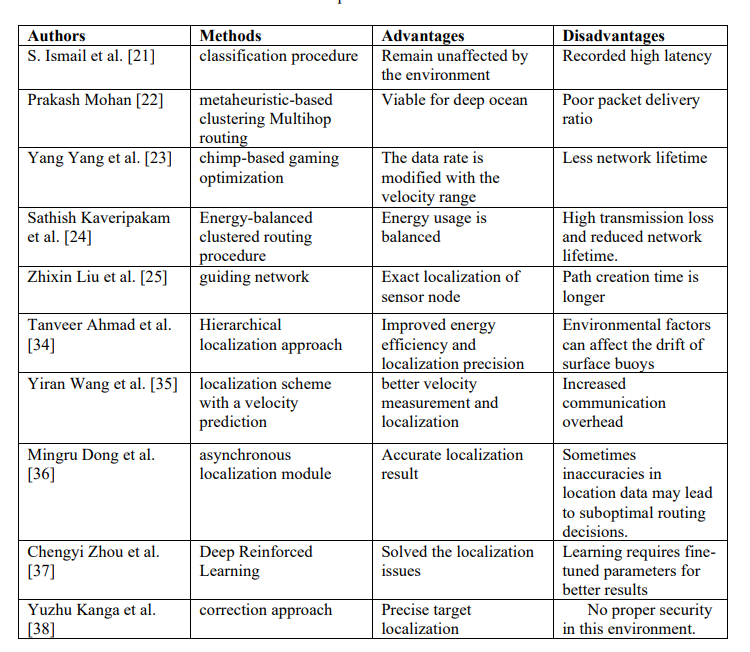
Strict time coordination between the target and the underwater nodes is challenging. Thus, in clock synchronization for connecting nodes and target and sound ray bending, a correction approach for underwater target localization is suggested by Yuzhu Kanga et al. [38]. Suppose the node’s grazing angle is known. In that case, the approach may determine the precise vertical distance between the point of interest and the target, which will enhance the precision of target localization. However, there is no proper security in this environment. The overall comparison of the related works is shown in Table 1.
3. SYSTEM MODEL WITH PROBLEM STATEMENT
The main cause of overtime in the WSN architecture is due to the poor localization procedure. In the WSN framework, the path creation time requirement is very high if the localization is not appropriate. Hence, the high path creation time might reduce the network lifetime and routing efficiency. Taking these concerns into account, the current work attempts to apply a novel technique appropriate for effective routing and localization. The WSN framework with poor localization is described in Figure 1.
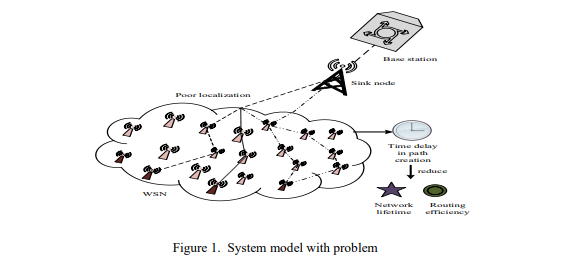
Figure 1. System model with problem
The nodes deployed in the UWSN take random locations and initiate the communication by broadcasting HELLO messages. Each node receives HELLO messages from its neighbors. The proposed method processes these messages for localization. To increase the accuracy of the localization, the weights, biases, and hyperparameters of the Elman neural structure are optimized by the bat’s fitness function. The bat fitness function is modeled based on the bat’s foraging behavior. In this algorithm, the search space is a region with many potential prey sources. The algorithm typically finds the food with the highest or ideal quality in the search space. Every bat’s assessed level of fitness has an impact on how it moves. Using this behavior of the bat, the location information of the nodes is identified. Once the nodes are localized, the routing is performed using this information. In the present protocol, the optimal forwarder nodes are selected to create the shortest path based on the node’s distance, energy level, and link quality. Nodes periodically update their routing tables using the optimized localization information.
4. PROPOSED METHODOLOGY
A novel Elman Bat-based Hello routing (EBbHR) protocol was introduced in this research article. The main aim of this article is to locate the available WSN hubs in the designed UWSN. The required wireless sensor hubs were created in the MATLAB Simulink environment at the primary phase. Henceforth, the novel EBbHR function was activated to locate all sensor hubs and improve the data transmission process. Finally, the effectiveness of the developed model was assessed, considering the UWSN characteristics. Furthermore, the comparison result has given the proposed model’s improvement percentage over the current methodology. The designed model is exposed in Figure 2.

Figure 2. Proposed methodology
4.1. Node Initialization
In the first phase, several wireless sensor nodes are created in a simulated UWSN environment using MATLAB Simulink. These nodes are strategically placed within the network. Initially, the network environment’s required nodes are initialized. The node initialization is expressed in Eqn. (1).
C = Cn{n =1,2,3,……h} (1)
C is the underwater network and h denotes the number of nodes. In this example, 10 onshore sink nodes are placed at the water’s surface to gather the information provided by sensor hubs. Furthermore, some sensor nodes are on the surface, while others are beneath the water body. From top to bottom, sensor nodes are positioned at various locations. The performance of the network determined which data packets were sent. The information collected from one node is sent to another using a dependable link. Data packets arrive at any sink node, indicating the successful routing. The sinks have an acoustic communication capability, enabling them to interact with each other with greater bandwidth and less delay.
4.2. Localization Process
The EBbHR protocol actively searches for the sensor hubs within the UWSN. The following equation can be used to locate sensor hubs in a UWSN using wireless communication using the EBbHR protocol. This equation calculates the Euclidean distance between the two sensor hubs. The EBbHR protocol can then use this information to update its knowledge of the sensor hub locations. The distance between each sensor hub and the anchor node is determined during the localization phase using the following Eqn. (2):

Where ( p1, q1, r1) are denoted as initial sensor hub, ( p2, q2, r2) are denoted as a second sensor hub. d h is the distance between the two sensor hubs. This equation calculates the Euclidean distance between two sensor hubs in the UWSN distance calculation is fundamental for determining the relative positions of sensor hubs in the network. It provides the necessary spatial data that will be fed into the Elman neural network for further processing and localization. The EBbHR function uses the Elman neural network to localize the sensor hubs. Recurrent neural networks that can recognize temporal patterns include the Elman neural network. The Elman neural networks are trained using a dataset of hello messages and sensor node locations. After training, the Elman neural network can anticipate a sensor node’s location by analyzing the hello messages it gets. The Elman neural network is trained using Eqn. (3) as follows [32]:

Where, St is denoted as Elman neural network at the time period t, l denotes the learning parameter, H{t−1} as a hidden state of the Elman neural network at period time t−1, Xt as input of Elman neural network at time period t, Wh is denoted as weight matrix, bh is denoted as bias vector, Z p indicates the target values, f is the activation function factor. The state of the Elman neural network is updated based on this equation by considering the learning parameter, the previous hidden state, and the current input. This state update is crucial for the network to learn and adapt to temporal patterns in the received data, enabling it to make accurate predictions about the sensor hub locations. After being trained, the Elman neural network can be used to anticipate a sensor hub’s location by analyzing the hello messages it gets. The following Eqn. (4) is used to predict the location of a sensor hub:
L = f (Wl [Ht]+bl) (4)
Where Lt represents the predicted location of the sensor hub at time t, Ht is denoted as a hidden state of a neural network at time t, Wl is the weight matrix, and f is the activation function factor. This equation outputs the predicted location of the sensor hub based on the current hidden state of the Elman neural network. The activation function is applied to the weighted sum of the hidden state and bias to produce the final location estimate. This prediction is essential for the localization process as it determines where the sensor hub is located at a given time.
4.3. Analyzing Target Node Status
Once the path is selected, it checks the target node’s availability to send the data packets. The availability of nodes is analyzed by the Eqns. (5) and (6).

Here Sn is the target node availability, which represents the tracking variable and Sn-1is the previous (source) node. Cn1x is the forwarding node selection function. This equation updates the availability status of a target node based on its previous availability and an adjustment factor. The tracking variable helps to smooth the availability status over time, giving more weight to recent observations. The packets are routed to the destination hub if the node is available. If the target nodes need to obtain more data from a distinct source, the packet transferring function is performed based on the target’s first request priority.
4.4. Finding the Shortest Routing Path
To determine the best route from the source hub to the destination hub, the EBbHR function applies the bat algorithm. The echolocation techniques used by bats served as the model for the bat algorithm, a kind of swarm intelligence system. The bat algorithm considers the sensor hub’s energy usage, the parameters of the underwater channel, and the distance between them. Using a bat echolocation simulation, the bat algorithm determines the shortest path. The bats are attracted to the best position found so far, so they will tend to fly towards the shortest path. In addition, the bats reject one another, which keeps them from becoming trapped in local optima. The following Eqns. (7) (8) (9) are used to update the position of a bat in the bat algorithm [31]:

Where yt is denoted as frequency factor of the bat at period t, ymin, ymax are the minimum and maximum frequencies, zt is denoted as velocity at time t, zmin and zmax are the minimum and maximum velocities, xt is demonstrated as the position at time t, xt−1 is denoted as the position at time t-1, yt is denoted as frequency wavelength of the bat’s ultrasonic pulse at time t, x* is the best position is find out so far, At is the noise loudness of the bat at time period t, Et is a random vector. The random vector is used to add randomness to the bat’s search. The likelihood of the bats being stuck in local optima is decreased by the introduction of randomized components in Eqns. (7) and (8), which guarantee that the bats exploration phase to a broad range of potential solutions. By modifying the bat’s position in accordance with both its current velocity and the best-known position, Eqn. (9) integrates exploration and exploitation. This equilibrium enables the algorithm to adjust solutions when areas of the search space that show promise are found.
4.5. Data Request Scheduling
Every node has an identical kind and number of sensors. Before transmitting a data packet to the target node, the source dynamically assigns it a priority number. When packets arrive, the destination node looks at their source address and priority digit before sorting them in order. Following the assignment of priorities, the packets were scheduled for transmission according to their initial priority number. The suggested routing protocol managed the data transmission, with the data being sent to the target node based on the priority of the first request.
4.6. Data Transmission Process
The sensor hubs can send data to the onshore sink nodes after setting the routing paths. The data packets from the sensor hubs are routed to the onshore sink nodes via the routing pathways. When a base station receives data regarding an incident that the source hub has detected, data transmission takes place. The closest accessible hub is located by the source hub using the EBbHR protocol. The data packets are combined into a single packet by the source hub. The source hub sends the combined data packet to the subsequent hop. Upon receiving the combined data packet, the subsequent hop transfers it to the subsequent hop until it reaches the base station. The base station divides the aggregated data packet into its individual data packets after receiving it. Eqn. (10) can be utilized to get the transmission time.

Where T is the total amount of time needed to send each data packet from the hub at source to the hub at destination, ti is the time required to transmit the data packet between two consecutive hubs, hd and is the distance between the two consecutive hubs.

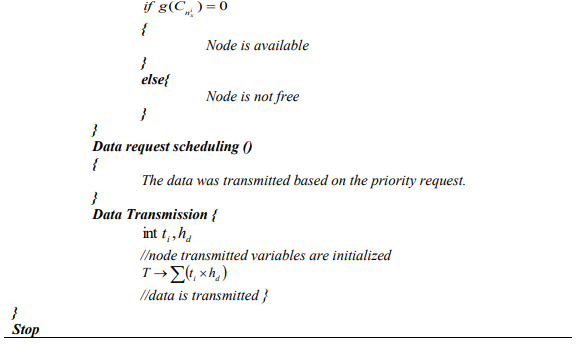
The process of the designed EBbHR is detailed in the proposed methodology section. Based on the preceding processes, the MATLAB tool coding was run, and the results were verified. All mathematical function parameters were encoded in pseudocode format in Algorithm 1.
5. RESULTS AND DISCUSSION
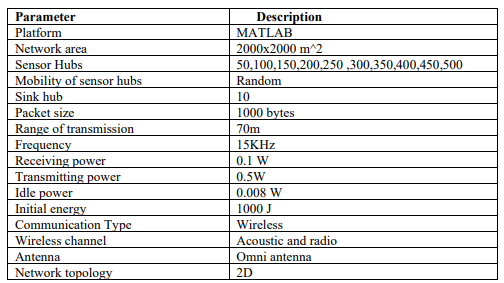
The suggested EBbHR is created and run using MATLAB environment. The network environment is initially established with the necessary nodes. The performance parameters of a novel EBbHR for energy-efficient routing are also assessed and contrasted with those of existing widely used approaches. Table 2 lists the simulation settings needed to implement the suggested system.
Table 2. Simulation parameters
5.1. Case Study
To study the working range of the proposed EBbHR, it is tested with different numbers of hubs. Here, the proposed routing protocol is tested with 50 and 100 hubs. The simulation result obtained is described as follows.
Node initialization: Creating wireless sensor nodes within is a simulated Underwater Wireless Sensor Network (UWSN) environment are a critical step in the initial phase. These wireless sensor hubs are pivotal in the network’s functionality as they act as central data collection, processing, and communication points. The data gathered from the sensor hub is obtained by using the sink node outside the water body. Here, 50 and 100 sensor hubs are used to test an effective routing protocol system for the investigation of EBbHR. The locations of the various hubs were also estimated. Radio and acoustic links are used to transfer data between the sensor hubs.
Localization and Path finding: Locating the linked sensor terminals is the goal of the localization procedure. This frequently entails figuring out how far apart sensor nodes and hubs are in underwater networks. The EBbHR function uses the bat algorithm to determine the best route from the source hub to the destination hub. The bat algorithm is an example of a swarm intelligence system that draws inspiration from bat echolocation. The bat algorithm considers the sensor hubs’ energy consumption, the underwater channel’s features, and the distance between the hubs. The bat algorithm determines the shortest path by mimicking a bat’s echolocation technique. Since the bats are drawn to the best spot they have located thus far, they will often fly in the direction of the shortest path. The simulation of path building is shown in Figure 3.

Figure 3. Shortest path selection and localization (50 nodes)

Figure 4. Transmission request from one to another Node

Figure 5. Transmission of Data packet
Transmission request: Once the path is chosen, the current state of the intended nodes is checked before sending the packets. The source notifies the target hub to send data. Figure 4 depicts the hubs’ requesting approach. Data transmission: The data packet transmission can begin after the destination node accepts the information based on the priority request after the source hub has been requested. Figure 5 displays the data transfer simulation result.
5.2. Performance Analysis
Metrics such as throughput, path formation time, packet delivery ratio (PDR), Latency, energy consumption, transmission loss, and network longevity are used to calculate the efficiency of the current EBbHR. It is then compared with existing methods such as whale-based green underwater network (W-GUN) [26], cluster-based multilevel routing (CbMR) [27], efficient routing based on reliable multipath (ERRM) [28], optimized Depth based Routing protocol (ODRP) [29], timebased Reliable link (TBRL) [30], Cluster based Depth Routing (CDR), Adaptive Depth Routing (ADR) and Collision Prevented Depth Routing (CPDR) [33]. The comparisons of each metric are described in the below subsections.
5.2.1. Network Lifetime
The amount of time that a network can function effectively before its nodes run out of energy is known as the network lifespan.Here network lifetime of the existing protocols such as CDR, ADR, and CPDR for the varying nodes such as 100, 200, 300, 400, and 500 are 721sec,735 sec,814 sec, 869 sec, and 889 sec;720 sec,730 sec,809 sec,863 sec, and 884 sec; 714 sec,750 sec,804 sec,859 sec, and 898 sec. Meanwhile, the proposed routing protocol gained a network lifetime of 1850.79 sec, 2374.47 sec, 2784.54 sec, 2816.8759 sec, and 2984.53 sec for the varying 100 to 500 nodes. The low energy consumption extended the network’s lifespan Figure 6.

Figure 6. Network Lifetime Comparison
5.2.2. Latency
Latency is the amount of time a data packet takes to get across its initial location to its target over a network. The eqn. (10) is used to compute Latency.
L = (Time at Destination)−(Time at Source) (10)
The Latency of the proposed EBbHR protocol for various nodes is depicted in Figure 7.

Figure 7. Latency Comparison
The existing methods, such as TBRL and CbMR, scored the delay as 369.4ms and 610 ms for 100 nodes, 319.6ms and 512ms for 200 nodes, 240.1ms and 436ms for 300 nodes, 198.6ms and 338ms for 400 nodes, and 159.4ms and 253ms for 500 nodes. The proposed replica attained the delay rate of 162.64ms, 122.88ms, 95.20ms, 83.33ms, and 72.51ms for 100, 200, 300, 400 and 500 nodes. The EBbHR transferred the data in a short time, which shows efficiency.
5.2.3. Energy Consumption
The entire amount of energy that nodes utilize to send and receive data is measured by energy consumption. Usually, it is expressed in joules (J). It is computed using Eqn. (11).

Here, Etx energy consumed by a node when it transmits data Erx is denoted as energy consumed
by a node when the data is data.
The comparison of the energy consumption for the different techniques is shown in Figure 8.

Figure 8. Comparison of Energy Consumption
Here, the prevailing methods, such as W-GUN, TBRL, and ODRP, have gained the energy consumption value of 229 J, 164 J and 659 J for 100 nodes, 398 J, 362 J, and 1110 J for 200 nodes, 659 J, 1110 J and 1431 J for 300 nodes, 449 J, 748 J and 1784 J for 400 nodes and 5018 J, 927 J and 2224 J for 500 nodes. In contrast, the proposed technique consumes an energy rate of 73.54 J for 100 nodes, 171.34 J for 200 nodes, 250.95 J for 300 nodes, 303.416 J for 400 nodes, and 350.855 J for 500 nodes. Compared to other current techniques, EBbHR consumes low energy for all nodes.
5.2.4. Throughput
Throughput (TP) measures the amount of data successfully transmitted over the network within a given time frame. Throughput is calculated by the following Eqn. (12).

Figure 9 describe the comparison of the throughput. With 500 nodes, the model W-GUN achieved a throughput rate of 188 Kbps. The TBRL protocol gained 269 Kbps for 500 nodes, while the other current framework, ERRM, earned 299 Kbps. Simultaneously, the throughput rate of the designed protocol for 100 nodes was 326 Kbps, 200 nodes was 390 Kbps, 300 nodes was 440 Kbps, 400 nodes was 608 Kbps, and 500 nodes was 696 Kbps according to the suggested technique. This comparison demonstrates that the throughput of the suggested strategy is greater compared to any of the alternative techniques.

Figure 9. Comparison of Throughput
5.2.5. Packet Delivery Ratio
The percentage of the information packets that are delivered successfully to the destination to the overall amount of data packets sent by the source is known as the packet delivery ratio, or PDR. Most often, a percentage is used to express it. The eqn. (13) below is used to calculate it.


Figure 10. Comparison of PDR
The existing designs, such as TBRL and ODRP, scored the PDR of 50% and 73.82% for 100 nodes, 70% and 75.8% for 200 nodes, 81% and 84.82% for 300 nodes, 85% and 91.9% for 400 nodes and 89% and 96 % for 500 nodes. In comparison, the presented routing protocol gained a packet delivery ratio of 77.76% for 100 nodes, 82.68% for 200 nodes, 92.70% for 300 nodes, 94.31% for 400 nodes, and 98.9% for 500 nodes. Here, the PDR of EBbHR is higher than that of the other prevailing techniques. The comparison is shown in Figure 10.
5.2.6. Transmission Loss
The quantity of data lost while transmission as a result of interference or other circumstances is measured by transmission loss (TL). It is calculated by the following Eqn. (14).
TL = (Total Sent Packets)−(Delivered Packets) (14)
The comparison of transmission loss with the existing protocol TBRL is shown in Figure 11. Compared to the TBRL method, the proposed EBbHR achieved a very low transmission loss rate at each varying frequency. The proposed EBbHR attains the transmission loss of 100 dB, 150 dB, 250 dB, 350 dB, 450 dB, 600 dB, 800 dB, 1150 dB, 1400 dB, and 1750dB for the different frequencies such as 500 Hz, 1500 Hz, 2500 Hz, 3500 Hz, 4500 Hz, 5500 Hz, 6500 Hz, 7500 Hz, 8500 Hz, and 9500 Hz.
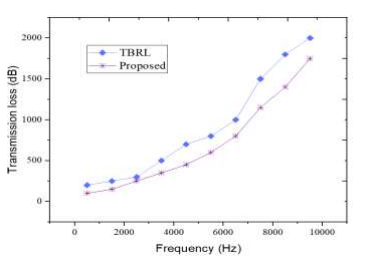
Figure 11. Transmission loss comparison
5.2.7. Path Creation Time
The time required by a routing protocol to create a path connecting the source and destination nodes is known as the path creation time. Figure 12 illustrates how long the recommended optimized protocol takes for different numbers of started nodes to obtain a short path. The path creation time comparison is shown in Figure 13. The proposed EBbHR attained the path in 122.68ms for 50 nodes, 117.61ms for 100 nodes, 97.60ms for 150 nodes, 76.79ms for 200 nodes, 60.37ms for 250 nodes, 58.34ms for 300 nodes, 44.86ms for 350 nodes, 31.41ms for 400 nodes, 30.33ms for 450 nodes, and 27.89ms for 500 nodes. However, the path creation time of the EBbHR is less than that of the existing method TBRL.

Figure 12. Path creation time in EBbHR
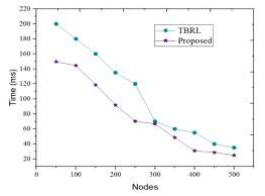
Figure 13. Path creation time comparison
In addition to the above comparative analysis, the proposed routing model is related to other recent techniques to highlight performance improvement. The recent localization techniques considered for the comparison are Modified Coot with Fusion Model (MVFM) [41], Rewardbased Hop Localization Protocol (RHLP) [42], Route Focusing based Protocol (RFbP) [43], Qlearning based Routing Protocol (QbRP) [44] and Location-based Modified Opportunistic Protocol (LMOP) [45]. These methods were tested in the same environment in the MATLAB platform, and efficiency metrics were evaluated. The performance comparison with these methods is shown in Table 3.
Compared to the prevalent UWSN localization and routing techniques, the suggested EBbHR validated an extremely efficient result. The suggested system has much lower energy consumption and latency values; in contrast, it has a much higher PDR, network lifetime, and throughput value than the other popular routing techniques. As a result, the strategy that has been provided is quite effective for UWSN communication. UWSN can be more dependable, effective, and adaptable by using the EBbHR. The evaluation of overall metrics demonstrated that the developed framework produced the best outcomes for all measures. As a result, the given framework is enough for effective routing in an underwater network environment. It further enhances network routing and data transmission capabilities.
Table 3. Comparison with recent methods

The innovative EBbHR achieved maximum Throughput and PDR of 696 Kbps and 98.9%, respectively. Furthermore, it requires less energy and has a short latency. Furthermore, the ideal routing path is immediately developed with a short distance, making transmitting data easy. The EBbHR process focuses on the exact localization of sensor hubs employed within the created UWSN, improving network efficiency and reliability. Precise localization compresses the time required for path creation and minimizes delays, improving routing efficiency and network performance. The integration of bat optimization with the Elman neural architecture for routing identified the optimal path for data transmission. It leads to better routing decisions and enhances the overall network performance. By enhancing the localization process and optimizing the routing mechanism, the EBbHR model reduces the network’s overall energy consumption.
Training ENNs can be time-consuming, which is problematic for real-time applications. Adjusting to new patterns in the underwater environment might introduce significant latency. The underwater environment is highly dynamic and harsh, with varying conditions such as water currents, temperature gradients, and salinity levels. These factors can cause frequent disruptions, requiring constant recalibration and retraining of the neural network, leading to increased latency and reduced reliability.
6. CONCLUSION
In this research article, a novel Elman Bat-based Hello routing (EBbHR) protocol was introduced to address the challenges of routing and Localization in UWSN. The study’s primary goals were to find accessible sensor hubs at the UWSN and streamline the data transfer procedure. The proposed work involved creating wireless sensor hubs in a MATLAB Simulink environment and activating the EBbHR function for sensor hub localization. The performance of the designed approach was evaluated using UWSN parameters, and a comparison with existing methods was conducted to assess the improvement achieved by the proposed model. The performance of the EBbHR protocol demonstrated outstanding results across various metrics. It was highly effective in UWSN routing and localization, significantly enhancing network routing and data transmission capabilities. Notably, the EBbHR protocol achieved a maximum throughput of 696 Kbps and a PDR of 98.9 %, indicating high data transfer efficiency. Additionally, the protocol consumed less energy and exhibited low Latency, further contributing to its efficiency. One of the key strengths of the EBbHR protocol is its ability to establish an ideal routing path with a short distance, making data transmission more efficient and reliable. This is a crucial advantage in UWSNs, where the underwater environment can pose significant challenges to communication. In the future, the research will be extended to propose a stable, highly scalable, energy-efficient, and, most importantly, secure routing method for acoustic sensors with smart localization strategies to function exceptionally well in real-time challenging underwater conditions of all kinds, taking into consideration the challenges that must be addressed for UWSN to function efficiently.
CONFLICTS OF INTEREST
The authors declare no conflict of interest.
REFERENCES
[1] Shah, Sayyed Mudassar, et al., (2023) “Advancements in Neighboring-Based Energy-Efficient Routing Protocol (NBEER) for Underwater Wireless Sensor Networks”, Sensors, Vol. 23, No. 13, pp 6025.
[2] Ahmad, Irfan, et al., (2022) “Cooperative energy-efficient routing protocol for underwater wireless sensor networks”, Sensors, Vol. 22, No. 18, pp 6945.
[3] Sathish, Kaveripakam, et al., (2023) “Underwater Wireless Sensor Networks Performance Comparison Utilizing Telnet and Superframe”, Sensors, Vol. 23, No. 10, pp 4844.
[4] Sathish, Kaveripakam, et al., (2023) “Underwater Wireless Sensor Networks Performance Comparison Utilizing Telnet and Superframe”, Sensors, Vol. 23, No. 10, pp 4844.
[5] Mhemed, Rogaia, et al., (2022) “Void avoiding opportunistic routing protocols for underwater wireless sensor networks: A survey”, Sensors, Vol. 22, No. 23, pp 9525.
[6] Nain, Mamta, et al., (2022) “A range-based node localization scheme with hybrid optimization for underwater wireless sensor network”, International Journal of Communication Systems, Vol. 35, No. 10, pp e5147.
[7] Wang, Biao, et al., (2023) “Adaptive Power-Controlled Depth-Based Routing Protocol for Underwater Wireless Sensor Networks”, Journal of Marine Science and Engineering, Vol. 11, No. 8, pp 1567.
[8] Datta, Amrita, and Mou Dasgupta, (2023) “Energy efficient topology control in Underwater Wireless Sensor Networks”, Computers and Electrical Engineering, Vol. 105, pp 108485.
[9] Yadav, Preeti, and Subhash Chandra Sharma, (2023) “A systematic review of localization in WSN: Machine learning and optimization‐based approaches”, International Journal of Communication Systems, Vol. 36, No. 4, pp e5397.
[10] Wang, Shengchu, Xianbo Jiang, and Henk Wymeersch, (2022) “Cooperative localization in wireless sensor networks with AOA measurements”, IEEE Transactions on Wireless Communications, Vol. 21, No. 8, pp 6760-6773.
[11] Wang, Ruo-Bin, et al., (2022) “Improved DV-Hop based on parallel and compact whale optimization algorithm for localization in wireless sensor networks”, Wireless Networks, Vol. 28, No. 8, pp 3411-
3428.
[12] Shi, Lei, et al., (2022) “Privacy-Preserving Distributed Iterative Localization for Wireless Sensor Networks”, IEEE Transactions on Industrial Electronics.
[13] Bochem, Arne, and Hang Zhang, (2022) “Robustness enhanced sensor assisted Monte Carlo localization for wireless sensor networks and the internet of things”, IEEE Access, Vol. 10, pp 33408-33420.
[14] Liang, Qingwei, et al., (2022) “Multi-group gorilla troops optimizer with multi-strategies for 3D node localization of wireless sensor networks”, Sensors, Vol. 22, No. 11, pp 4275.
[15] Alomari, Abdullah, (2022) “Meta-heuristic-based guidance model for node localization in wireless sensor networks”, Computers and Electrical Engineering, Vol. 104, pp 108437.
[16] Aroba, Oluwasegun Julius, Nalindren Naicker, and Timothy T. Adeliyi, (2023) “Node localization in wireless sensor networks using a hyper-heuristic DEEC-Gaussian gradient distance algorithm”, Scientific African, Vol. 19, pp e01560.
[17] Achroufene, Achour, (2023) “RSSI-based geometric localization in wireless sensor networks”, The
Journal of Supercomputing, Vol. 79, No. 5, pp 5615-5642.
[18] Yu, Quanzhou, et al., (2023) “Cooperative Multi-Rigid-Body Localization in Wireless Sensor Networks Using Range and Doppler Measurements”, IEEE Internet of Things Journal.
[19] Kagi, Shivakumar, and Basavaraj S. Mathapati, (2022) “Localization in wireless sensor network using machine learning optimal trained deep neural network by parametric analysis”, Measurement: Sensors, Vol. 24, pp 100427.
[20] Wajgi, Dipak W., and Jitendra V. Tembhurne, (2023) “Localization in wireless sensor networks and wireless multimedia sensor networks using clustering techniques”, Multimedia Tools and Applications, pp 1-51.
[21] Ismail, A. S., et al., (2022) “Routing protocols classification for underwater wireless sensor networks based on localization and mobility”, Wireless Networks, Vol. 28, No. 2, pp 797-826.
[22] Mohan, Prakash, et al., (2022) “Improved metaheuristics-based clustering with multihop routing protocol for underwater wireless sensor networks”, Sensors, Vol. 22, No. 4, pp 1618.
[23] Yang, Yang, et al., (2022) “Nodes clustering and multihop routing protocol optimization using hybrid chimp optimization and hunger games search algorithms for sustainable energy efficient underwater wireless sensor networks”, Sustainable Computing: Informatics and Systems, Vol. 35, pp 100731.
[24] Kaveripakam, Sathish, and Ravikumar Chinthaginjala, (2023) “Energy balanced reliable and effective clustering for underwater wireless sensor networks”, Alexandria Engineering Journal, Vol. 77, pp 41- 62.
[25] Liu, Zhixin, et al., (2022) “Energy-efficient guiding-network-based routing for underwater wireless sensor networks”, IEEE Internet of Things Journal, Vol. 9, No. 21, pp 21702-21711.
[26] Rathore RS, Sangwan S, Mazumdar S, Kaiwartya O, Adhikari K, Kharel R, Song H., (2020) “WGUN: Whale optimization for energy and delay-centric green underwater networks”, Sensors, Vol. 20, No. 5, pp 1377.
[27] Khan W, Wang H, Anwar MS, Ayaz M, Ahmad S, Ullah I, (2019) “A multi-layer Cluster based energy efficient routing scheme for UWSNs”, IEEE Access, Vol. 7, pp 77398-410.
[28] Ahmed M, Salleh M, Channa MI, Rohani MF, (2018) “RMEER: reliable multipath energy efficient routing protocol for underwater wireless sensor network”, International Journal of Electrical and Computer Engineering (IJECE), Vol. 8, No. 6, pp 4366-73. [29] Zahra N, Khawatmi S, Fawaz Y, (2021) “Energy Efficient Routing Protocol in UWSNs using ACO Algorithm”, International Research Journal of Engineering and Technology (IRJET), Vol. 8, No. 5.
[30] Ali T, Irfan M, Shaf A, Saeed Alwadie A, Sajid A, Awais M, Aamir M, (2020) “A secure communication in IoT enabled underwater and wireless sensor network for smart cities”, Sensors, Vol. 20, No. 15, pp 4309.
[31] Chakri A, Khelif R, Benouaret M, Yang XS, (2017) “New directional bat algorithm for continuous optimization problems”, Expert Systems with Applications, Vol. 69, pp 159-75.
[32] Sun WZ, Wang JS, (2017) “Elman neural network soft-sensor model of conversion velocity in polymerization process optimized by chaos whale optimization algorithm”, IEEE Access, Vol. 5, pp 13062-76.
[33] Sher A, Khan A, Javaid N, Ahmed SH, Aalsalem MY, Khan WZ, (2018) “Void hole avoidance for reliable data delivery in IoT enabled underwater wireless sensor networks”, Sensors, Vol. 18, No. 10, pp 3271.
[34] Ahmad T, Li XJ, Cherukuri AK, Kim KI, (2023) “Hierarchical localization algorithm for sustainable ocean health in large-scale underwater wireless sensor networks”, Sustainable Computing: Informatics and Systems, Vol. 39, pp 100902.
[35] Wang Y, Song S, Guo X, Liu J, Ye Q, Cui J, (2023) “An efficient localization scheme with velocity prediction for large-scale underwater acoustic sensor networks”, IEEE Internet of Things Journal.
[36] Dong M, Li H, Yin R, Qin Y, Hu Y, (2021) “Scalable asynchronous localization algorithm with mobility prediction for underwater wireless sensor networks”, Chaos, Solitons & Fractals, Vol. 143, pp 110588.
[37] Zhou C, Liu M, Zhang S, Zheng R, Dong S, Liu Z, (2023) “Asynchronous Localization for Underwater Acoustic Sensor Networks: A Continuous Control Deep Reinforcement Learning Approach”, IEEE Internet of Things Journal.
[38] Kang Y, Shen X, Yan Y, Wang H, Chang J, Liu C, (2021) “Sound Ray Correction Method for Deepsea Target Localization in Asynchronous Underwater Acoustic Sensor Networks”, In 2021 IEEE International Conference on Signal Processing, Communications and Computing (ICSPCC), IEEE.
[39] Sathish K, Venkata RC, Anbazhagan R, Pau G., (2023) “Review of localization and clustering in USV and AUV for underwater wireless sensor networks”, In Telecom, Vol. 4, No. 1, pp 43-64. MDPI.
[40] Gupta S, Singh NP, (2024) “Underwater wireless sensor networks: a review of routing protocols, taxonomy, and future directions”, The Journal of Supercomputing, Vol. 80, No. 4, pp 5163-96.
[41] Shenbagharaman A, Paramasivan B, (2024) “Trilateration method based node localization and energy efficient routing using rsa for under water wireless sensor network”, Sustainable Computing: Informatics and Systems, Vol. 41, pp 100952.
[42] Kaur R, Goyal S, (2024) “Flexible localization protocol for underwater wireless sensor networks using hybrid reward evaluation scheme”, Peer-to-Peer Networking and Applications, pp 1-6.
[43] Rajshekhar SA, Biradar A, (2024) “An Efficient Framework for Localization Based Optimized Opportunistic Routing Protocol in Underwater Acoustic Sensor Networks”, SN Computer Science, Vol. 5, No. 5, pp 520.
[44] Guo W, Zhu M, Yang B, Wu Y, Li X, (2023) “Design of a Self-Organizing Routing Protocol for Underwater Wireless Sensor Networks Based on Location and Energy Information”, Journal of Marine Science and Engineering, Vol. 11, No. 8, pp 1620.
[45] Nandyala CS, Kim HW, Cho HS, (2023) “QTAR: A Q-learning-based topology-aware routing protocol for underwater wireless sensor networks”, Computer Networks, Vol. 222, pp 109562.
[46] Faiza Al-Salti, N. Alzeidi, Khaled Day, Bassel Arafeh and Abderezak Touzene (2017), “Grid-Based Priority Routing Protocol for UWSNS” International Journal of Computer Networks & Communications (IJCNC), Vol. 9, No. 6.
[47] Gulista Khan and R.K. Dwivedi (2018), “Energy Efficient Routing Algorithm for Void Avoidance in UWSN Using Residual Energy and Depth Variance” International Journal of Computer Networks & Communications (IJCNC), Vol. 10, No. 4.
[48] Hasana, Maoyejatun, and Hossen Asiful Mustafa, (2024) “An Anti-Jamming Technique by Jammer Localization for Multi-Channel Wireless Sensor Networks”, International Journal of Computer Networks & Communications (IJCNC), Vol. 16.
AUTHORS

Vinayprasad M S is currently working as an Assistant Professor in the Department of Electronics and Communication Engineering, JSS Science and Technology, Mysuru. He completed his M. Tech in Networking and Internet Engineering from SJCE in the year 2014. He is currently pursuing his Ph.D. at JSS Science and Technology University. His research area of interest includes Networking, Storage Networking, Communication and Internet of Things.

Dr. Jayaram M N is currently an Associate Professor at the Sri Jayachamarajendra College Engineering, he has teaching experience of more than 31 years in the areas of mobile and optical Communication. He obtained his PhD in University of Mysore and ME in IISC, Bangalore and participated in several high profile conferences. His researcharea of interest includes underground communication, microwave and antennas, RF and Optical Communication.

 International Journal of Computer Networks & Communications (IJCNC)