
IJCNC 07
MODIFIED ROUTE REQUEST BROADCASTING FOR IMPROVING MULTIPATH ROUTING SCHEME
PERFORMANCE IN MANET
Priyanka Pandey1 and Raghuraj Singh2
1,2Department of Computer Science and Engineering, Harcourt Butler Technical
University, Kanpur, India.
ABSTRACT
Mobile Ad Hoc Network (MANET) is growing in popularity with the advent of 5G wireless network and Internet of Things. In this type of peer to peer network, nodes are self-configurable and communicate among themselves wirelessly. Typically, these nodes are powered by batteries and move continuously within the specified region. In order to provide efficient communication between these devices, several routing protocols have been designed. However, most of the schemes focus on construction ofshortestroute. With this approach, it is not always possible to provide reliable and efficient path in highly dynamic environment to carry out data transmission process. In this paper, a novel Adaptive and Stable Multipath Routing Scheme (ASTMRS) has been proposed in which only peer nodes with good fitness values are allowed to process route request packet. This fitness value is estimated based on node mobility, residual energy and distance metrics. Further, each node updates its next hop information on the basis of node degree and received signal power. Simulation has been conducted under various network scenarios such as packet rate and pause time. Under different scenarios, an average improvement of 15.82% and 14.38% has been seen in packet delivery ratio(PDR) and throughput respectively; other performance metrics such as normalized routing load (NRL) and delay have been reduced to 15.58% and 13.95% respectively against AOMDV. Similarly, as compared to AODV, the scheme shows 15.96% and 15.78% improvement in terms of PDR and throughput respectively. Moreover, NRL and delay are reduced by33.04% and 38.92% respectively against AODV.
KEYWORDS
Multipath, Routing, MANET, AOMDV, RWP, Reactive
1. INTRODUCTION
MANET [1] is a wireless network which provides an instant and peer to peer communication. Lightweight mobile devices such as PDA’s, palmtop, laptop etc. is very popular in a realm of wireless ad hoc network. In MANET, mobile devices move continuously and communicate among themselves through wireless channel. Two nodes that are nearest to the communication range of each other can directly transmit data whereas devices that are not inside the transmission range of one another require intermediary nodes for performing routing operation. However, due to continuous node movements and limited battery power, providing efficient routing operation is one of the major challenging tasks in this environment. In order to cope with this issue, there is a need to examine conditions of quality of participating nodes and links during route searching procedure.
Quality of nodes can be measured through factors such as distance and node mobility. Similarly, during route establishment process, examination of node battery capacity can help in providing
stable route. Routing protocols such as DSR [2], AODV [3], AOMDV [4], TORA [5] etc. focus on making shortest path on the basis of mainly hop count metric during route discovery process. Among these protocols, DSR and AOMDV are popular multipath routing protocols. In case of route failure, these protocols do not require initiation of re-route discovery process instead backup routes are utilized for data transferring. However, they suffer to achieve high performance due to avoidance of consideration of link and node qualities at the time of final path establishment.
To address this problem, this paper presents an Adaptive and Stable Multipath Routing Scheme (ASTMRS) which is a modified version of existing AOMDV to minimize the frequent occurrences of route breakage. The scheme considers important parameters such as residual energy, node speed and distance to estimate node quality and link quality during route discovery operation. It allows only those peer nodes to process route request packets which have good link and node conditions.Incorporation of aforementioned factors during route establishment process makes the path more stable and thus reduces the chances of frequent route breakage. Moreover, each node updates its list of neighbours on the basis of signal quality and node degree factors. This strategy helps in selection of efficient neighbour nodes that further contributing in construction of overall stable route. Simulation results show that PDR and throughput performance has been improved significantly. Furthermore, as compared to other schemes such as AODV and AOMDV, the proposed approach ASTMRS requires less number of control packets during whole routing process and transmits data packets with less delay. From the simulation results it can be concluded that the proposed approach provides more efficient and stable path to perform routing operation.
The rest of this paper is structured as mentioned: Section 2 describes related work; Section 3 illustrates the methodology adopted for construction of stable routes by selecting efficient peer nodes. In Section 4, performance and comparative analysis of proposed scheme with other scheme has been discussed and in the last section conclusion with future direction has been given.
2. LITERATURE REVIEW
MANET contains set of mobile nodes that move continuously in the network. In this environment, data forwarding from source to destination is one of the major challenging issues. In order to perform smooth data packets transmission, several routing protocols i.e. DSR, AODV, and AOMDV etc. have been proposed. The main objective of these routing protocols is to recognize a reliable path that can transmit data more efficiently. There are number of routing schemes have been anticipated to improve the stability of route. This section discusses about the works related to the improvement of routing protocol performance.
In [6]WesamAlmobaideenet. al. proposed improved SPDA in which stability of an intermediate node is examined by comparing the number of times each node has been appeared in different routes and the last time the nodes has been participated in the routing operation. Apart from this, as soon as the destination node receives the first route request packet, it sends an RREP message to the source to start data transfer right away. When it receives another RREQ packet, the hop count metrics is compared with previous one. If newly received RREQ packet has less hop count, the data packets are transferred through second route. Findings indicate that the suggested method is able to transmit data packet with less overhead and takes minimum time. However, in less dynamic environment, throughput has not much improvement.
P. Periyasamyet. al. [7] proposed LR-EE-AOMDV multipath scheme which finds multiple reliable links and energy efficient multiple routes on the basis of factors such as estimators of path link (PLQE )and node (PNEE ) qualities and path length. PLQE is determined using cumulative Expected Transmission Count (ETX) and PNEE is determined using Cumulative Expected Transmission Energy (CETE) and path length is the total hop count of a route. Findings indicate improvement in PDR, routing overhead and throughput performance. However, there is slight increase in delay with higher network flow.
Stability Enhanced AOMDV [8] considers received signal strength parameter to find more stable route. It examines signal quality after traversing certain range. During route discovery operation, an intermediate node forwards an RREQ packet further only when the received signal strength is above certain threshold. The scheme show significant improvement in performance in terms of throughput, PDR and NRL. However, delay is higher.
Y. Harold Robinson et. al [9] proposed FD-AOMDV for increasing the scalability. It utilizes the factors such as average remaining energy of a group of routes and node connectivity. During route discovery, the scheme removes nodes that have more routing overhead and less battery backup. Simulation has been conducted on varying pause time, node speed and number of nodes. Results show improvement in performance. However, slight improvement in delay is seen while varying number of paths.
Peng Li et. al. [10] proposed an improved routing protocol. On receiving RREQ packets, the protocol examines queue length of an intermediate node, if it is above threshold, then the scheme estimates residual energy and updates it in RREQ packet field. Moreover, during receiving hello message from the sender, it examines residual energy and queue length. If a criterion is satisfied, the neighbour node list is updated. Simulation results show performance improvement in terms of route discovery occurrence, delay and amount of energy exhausted nodes. However, there is no improvement in routing overhead performance.
Multi Objective AOMDV (MO-AOMDV) [11] focuses on selection of route based on node and link quality. After receiving RREQ packets from multiple paths, the destination node selects final route on the basis of residual energy and hop count metrics. If during data transmission congestion occurs at any point, the scheme reduces the speed of data transfer. Simulation results show improved PDR and network lifetime. However, delay has not been analyzed.
The AEQAOMDV [12] constructs the route on the basis of fitness value. This value is estimated using average node residual energy and buffer queue length. Final route is selected on the basis of highest fitness value. The protocol is able to minimize delay and route discovery frequency, and maximizing PDR. However, there is slight improvement in routing overhead performance.
Pravin R. Satav [13] presented an energy efficient route selection approach in which energy level parameter is considered. During route discovery operation, current energy level of an intermediate node is estimated to compute overall energy of trajectory. The scheme considers the path with highest energy level as final route to start data transmission process. Results show that the scheme maximizes overall network lifetime. However, PDR, delay and throughput performance metrics have not considered for analysis.
Fitness Function AOMDV [14] (FF AOMDV) focuses on establishment of stable route for data transmission process. The scheme selects the neighbour nodes on the basis of their energy efficiency. In this scheme, link quality is estimated using signal strength, delay and queue length metrics. During route discovery operation, these metrics are considered and the best route is chosen from multiple routes. Results show that the scheme achieves higher throughout and PDR, and minimizes delay and energy consumption. However, routing overhead is not considered while analyzing results.
Anuradha Banarjeeet. al. [15] presented an approach based on expected residual lifetime (ERLAOMDV). During route discovery operation the protocol examines expected residual lifetime and completion time of communication session and stores the first three optimum routes for data transmission. Simulation results show improved PDR, throughput and reduction in frequency of link breakage and delay. However, routing overhead is not considered for performance analysis.
Binuja Philomina Marydasanet. al. [16] presented a reliable and stable TA-AOMDV protocol that constructs an efficient route by considering two metrics i.e. Destination Region Selection (DRS) and Weighted Closeness and Connectivity (WCC) metrics. Results show improved PDR, NRL, throughput and delay in highly dynamic environment. However, it does not work well in less dense network.
Energy based AOMDV (E-AOMDV) [17] aims to increase network lifetime by considering energy level of intermediate nodes. During route discovering, each intermediate node has to go through a check to become a next hop. Through this approach, load balancing among neighbouring nodes can also be achieved. Simulation results show improved performance in terms of PDR, throughput and NRL. However, delay is not considered for analysis.
Mani Bushan Dsouzaet. al. [18] proposed an Energy and Link Quality Aware AOMDV (ELQAOMDV) to improve routing performance. During route discovery operation, the scheme estimates Expected Transmission Count (ETX) metrics to measure link quality and current residual energy and average residual energy of a path. Based on these factors, it selects the final route. Results show improved PDR, throughput, delay and NRL. However, there is slight improvement in PDR as the number of nodes increases.
The work proposed in [19] estimates reward factor using node lifetime and signal power metrics during route discovery operation. Moreover, local information is updated on the basis of distance metrics. Findings indicate improvement in PDR, delay and throughput. However, there is slight improvement in NRL performance. Summary of related works has also been represented in the
Table 1.
Table 1.Summary of Related Work


In the literature review, many works have been suggested to provide stable route . In these works, apart from hop count and sequence number, other metrics such as node lifetime, residual energy, signal quality, ETX, DRS etc. have been considered. Nevertheless, in some schemes, there is either a greater delay [7-8] or very little improvement [6], [9]. The delay metrics have not been taken into account for analysis in [11], [17]. The entire performance of routing is impacted by ignorance of this measure. Furthermore, excessive uses of control packets cause a reduction in channel utilisation. In [10] and [12] no or slight reduction in routing overhead is seen. While in [14] and [15] this important metrics has not been considered during analysis. In some works, PDR [18] and NRL [19] have shown very less improvement. This work’s main objective is to lower the frequency of route breaking while taking into account the shortcomings of earlier efforts. During the route creation process, the scheme takes residual energy, node speed, and distance into consideration. The effectiveness of the scheme has been validated through simulation. Following the simulation, all performance indicators that have been taken into consideration showed improvement, particularly in terms of throughput and PDR. Additionally, other metrics like routing overhead, NRL, and delay have also improved.
3. PROPOSED WORK
This paper presents an Adaptive and Stable Multipath Routing Scheme (ASTMRS) for MANET. The objective of work is to discover a route which can provide an efficient communication between pair of nodes. Selection of stable path increases the throughput and PDR and decreases the delay, NRL and control overhead. During route discovery operation, whenever an RREQ packet arrives at an intermediate node, the node goes through a check. If it satisfies a selection criterion, then only the intermediate node can send the packet to its next hops. Furthermore, each node updates its neighbour table list on the basis of node degree and link quality.
3.1. Parameters and Notations
To avoid frequent route breakage, the scheme selects only those intermediate nodes that have good fitness value. This fitness value is estimated using factors such as node speed, residual energy and distance. Moreover, during local connection update, each node considers any node as its next hop which has sufficient number of neighbours and strong link quality between the next hop and itself. The notations used in the proposed approach have been mentioned in Table 2.
Table 2.Notations Used

The brief description about the parameters utilized while performing route discovery process have been mentioned below.
3.1.1. Node Speed
A node’s likelihood of experiencing frequent connection failure increases with its speed. Therefore, nodes that are moving with low speed should be chosen as a part of a route for forwarding packets. This is one of the parameters which have been taken into account to evaluate an intermediate node’s fitness value throughout the route creation process.
3.1.2. Distance
Distance between two nodes is calculated using Euclidean [20] formula. Let s1, t1 be the coordinates of node n1and s2, t2 be the coordinates of node n2.Then the distance NDISbetween two nodes can be calculated using Equation 1.
𝑁𝐷𝐼𝑆 = √(𝑠2 − 𝑠1) 2 + (𝑡2 − 𝑡1) 2 (1)
This is one of the important factors in determining link quality between two nodes during route set up process.
3.1.3. Residual Energy (NREN)
In MANET, nodes have limited battery power. During whole routing operation nodes consumes power. There are four states of energy consumption i.e. nodes consume energy during transferring and receiving data packets, and during idle and sleep modes
In sleep mode, no communication is possible and nodes consume very less power as compared to other modes. During routeconstruction, residual energy of a node must be taken into account to make route more reliable and stable. It is estimated using Equation 2.
𝑁𝑅𝐸𝑁 = 𝑁𝐼 – 𝑁𝐶𝑂𝑁 (2)
Where 𝑁𝐼 is initial energy and 𝑁𝐶𝑂𝑁 is total energy consumed in different modes i.e. transfer, receive, idle and sleep mode.
3.1.4.Signal Strength
This metric is used to estimate link quality between two nodes. In the proposed approach, each node calculates received signal power while receiving hello packet to estimate link quality between sender and itself.
3.1.5. Node Connectivity Information
In AOMDV when any node receives a hello packet, it adds sender’s node id and expiration time information in its neighbour list. In the proposed approach, each node examines signal quality and number of nodes in sender’s vicinity to make sender as its next hop. This strategy ensures that each node forwards packets towards efficient neighbours.
3.2. Route Discovery Operation
ASTMRS is an on demand multipath on demand routing protocol and has similar working as AOMDV. If a source node needs to deliver a data packet to a target node but doesn’t have any routing information for that node in the table, route discovery is started. The source node broadcasts route request packet to its peer nodes to find the best path for data transmission. In this work, two more fields have been added to route request packet. The modified RREQ packet format is shown in Figure 1.

Figure 1 .Modified Route Request Packet Format
Apart from basic fields such as source sequence number (SSN), Source IP, Destination Sequence Number (DSN), hop count, flag fields (J, R,G, D,U) etc., two additional fields in RREQ packet i. e. S position and T position have been incorporated to determine distance between pair of nodes. Figure 2 shows the block diagram of operation performed during route discovery process. An intermediate node must undergo a check whenever it gets the route request packet. The scheme examines fitness value of each node to allow it to further forward the RREQ packet. This fitness value is estimated by considering important factors such as node speed, distance and residual energy. Further, weights 𝑚1,𝑚2and 𝑚3have been assigned to each factor such that 𝑚1 + 𝑚2 + 𝑚3 = 1. Thus, when an intermediate node receives an RREQ packet, it estimates fitness value 𝐹𝑉𝑜 using Equation 3.
𝐹𝑉𝑜 = 𝑚1 ∗ 1/𝑆𝑃 + 𝑚2 ∗ 1/𝑁𝐷𝐼𝑆 + 𝑚3 ∗ 𝑁𝑅𝐸𝑁 (3)
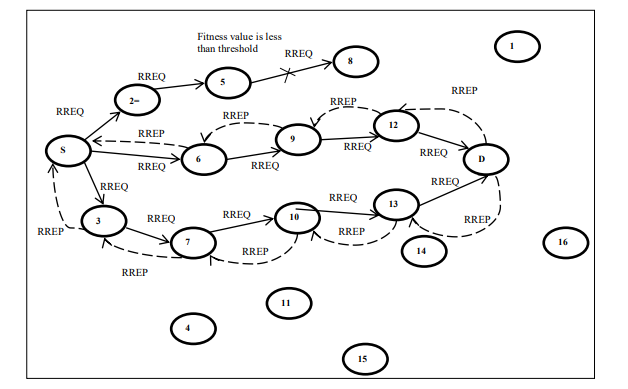
Figure 2 .Route Discovery Operation
Detailed operation of an intermediate node after receiving route request packet has been mentioned in Figure 3.
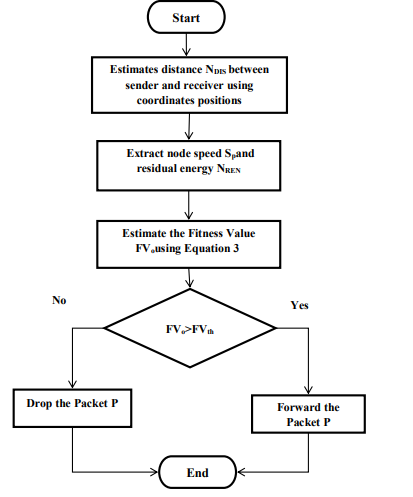
Figure 3 .Route Request Packet Broadcasting
The technique uses the s and t coordinates to estimate the distance between the sender and recipient when an intermediate node receives an RREQ packet. Following that, it examines speed and residual energy of receiving node. Based on these factors, a fitness value 𝐹𝑉𝑜 is calculated using equation 3. If the estimated 𝐹𝑉𝑜 is less than threshold𝐹𝑉𝑡ℎ, it means the node is not reliable to participate in routing operation and thus the scheme discards that node by discarding the packet. If value of 𝐹𝑉𝑜 is above threshold, the node is allowed to become a part of route and thus forwards the route request packet.
3.3. Local Connectivity Operation
Whenever a node receives a hello packet from a sender, it first examines the sender’s information in its neighbour table, if the information is not available, the receiving node directly adds the information such as sender’s ID, expiration time etc. in its neighbour table. If information is already in the table, the receiving node updates expiration time of existing neighbour only if a sender has sufficient number of nodes and strong link quality between sender and itself. The whole sequence of steps performed by a node after receiving hello packet has been mentioned in the Algorithm 1.

When a node receives hello packet from existing sender, it checks the quality of link and number of nodes in its vicinity. If the sender node has sufficient number of neighbours and good link quality, the receiving node updates the neighbour table by increasing the expiration time. If the criterion is not satisfied, the hello packet is dropped and consequently expiration time of the sender is not updated.
4. PERFORMANCE EVALUATION
In order to comprehensively assess the performance of proposed scheme, several simulation runs have been conducted under different network environment. This section describes the simulation parameters considered during implementation and further brief definition of considered performance metrics has been presented. Finally, results of proposed scheme has been analyzed and represented through graphs.
4.1. Simulation Environment
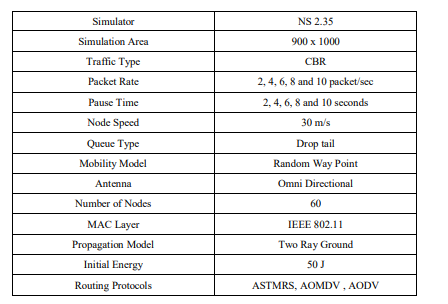
The performance of proposed ASTMRS has been evaluated using NS2.35 [21]. Network simulator is discrete event simulator which is widely used in research area related to networking. In the proposed work, a total of 60 nodes are dispersed at random over a 900 x 1000 region. The propagation model is the two-ray ground model [22], [25], whereas the mobility pattern is determined by the random waypoint mobility model [23-24]. This model is based on two parameters maximum speed and pause time. Maximum speed of the node in this approach is considered as 30m/s. Packet size is of 512 bytes. The main simulation parameters taken into account for implementation are shown in Table 3.
Table 3. Simulation Parameters
4.2. Performance metrics:
The proposed approach has been evaluated by considering following performance metrics.
4.2.1. Packet Delivery Ratio
It can be defined as the fraction of total amount of packets received by the goal node to the total
number of data packets generated at initiator node.
4.2.2. Throughput
This metric depicts total number of bits received at destination within a certain period of time.
4.2.3. Delay
It is the average amount of time a packet needs to travel from its source to its destination.
4.2.4. Routing Overhead
It is total amount of control packets required to perform whole routing operation. It should be less
used.
4.2.5. Normalized Routing Load
It indicates how many control packets in total are needed to send a single data packet.
4.3. Simulation Results and Analysis
This part addresses the performance of the proposed ASTMRS and presents the simulated results received after implementation on varying packet rate and pause time. Network Animator (NAM) views of proposed approach ASTMRS or snapshots obtained during simulation are shown in Figure 4 and Figure 5.

Figure 4. Screenshot 1 taken during simulation

Figure 5. Screenshot 2 taken during simulation
Results obtained after simulation have been represented through graphs i.e. from Figure 6 to Figure 17.
4.3.1. Packet Delivery Ratio (PDR)
Figure 6 and Figure 7 show performance in terms of PDR on varying packet rate and pause time respectively

Figure 6. PDR Vs Packet Rate
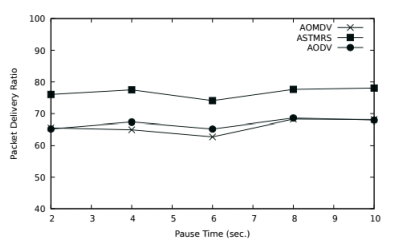
Figure 7. PDR Vs Pause Time
From the graphs, it is clear that the PDR of the proposed approach ASTMRS is significantly improved in contrast with AOMDV and AODV. On varying packet rate, it is 15.42% and 17.33% more as compared to AOMDV and AODV respectively. Similarly while varying pause time, thePDR of proposed approach has shown 16.23% and 14.60% improvement against AOMDV and AODV respectively. The algorithm is able to achieve this good result because during route request broadcasting it considers residual energy, node mobility and distance for estimating fitness value of an intermediate node. Therefore, during data packet transmission only efficient nodes are participating which consequently increases the PDR performance of routing protocol.
4.3.2. Packet Loss Ratio (PLR)
The performance in terms of PLR has been represented in Figure 8 and Figure 9.
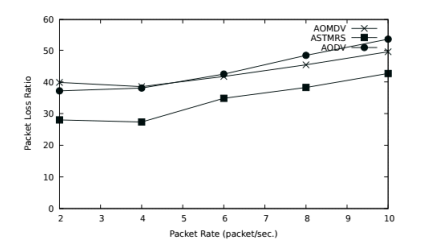
Figure 8. PLR Vs Packet Rate

Figure 9. PLR Vs Pause Time
On varying packet rate, PLR of the proposed approach is reduced to 20.44% and 22.12% against AOMDV and AODV respectively. Similarly, on varying pause time, it is reduced to 31.46% and 29.51% as compared to AOMDV and AODV respectively. This is because, the scheme focuses on construction of stable route which results in reduction in occurrence of frequent route breakage and thus showing overall PLR performance improvement in different network conditions.
4.3.3. Normalized Routing Load (NRL)
Normalized routing load is one of the important performance metrics. Reduction in NRL increases channel utilization. The performance in terms of NRL has been evaluated under different conditions and has been represented in Figure 10 and Figure 11.
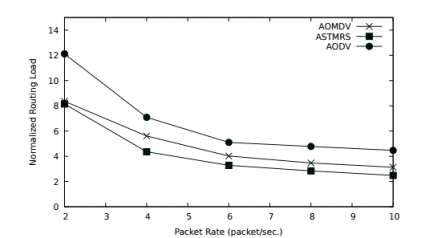
Figure 10. NRL Vs Packet Rate

Figure 11. NRL Vs Pause Time
On varying packet rate, it has been observed that the scheme requires 14.22% and 37.10% less control packets against AOMDV and AODV in transmitting single data packet. Similarly, on varying pause time, NRL of the proposed approach has been reduced to 16.95% and 28.99% against AOMDV and AODV respectively. This is because; the scheme considers only efficient nodes to broadcast RREQ packet further. Moreover, during receiving hello packet, it updates its neighbour table on the basis of node degree and link quality.
4.3.4. Control Overhead (CO)
Performance of the proposed approach ASTMRS in terms of control overhead on varying packet rate and pause time has been represented in Figure 12 and Figure 13.

Figure 12. CO Vs Packet Rate

Figure 13. CO Vs Pause Time
From the simulation results, it is clear that on varying packet rate, there is 8.76% and 27.30% reduction in total number of control packets required by ASTMRS as compared to AOMDV and AODV respectively. Similarly, on varying pause time, total 4.64% and 18.59% of reduction hasbeen seen in required number of control packets against AOMDV and AODV. This is because; the scheme does not allow inefficient nodes to broadcasts RREQ packet further which results in overall reduction in control packets.
4.3.5. Throughput
Figure 14 and Figure 15 represent throughput performance of the proposed approach.
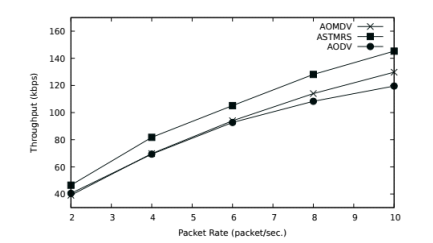
Figure 14. Throughput Vs Packet Rate

Figure 15. Throughput Vs Pause Time
From the graphs, it is clear that the proposed approach achieves higher throughput as compared to existing scheme in different network conditions. On varying packet rate, the ASTMRS achieves 13.45% and 17.58% more throughput over AOMDV and AODV respectively. On varying pause time, there is 15.32% and 13.98% increment obtained in throughput performance by the scheme in comparison to existing AOMDV and AODV respectively. This is because, on receiving hello packet from existing sender, the node updates its neighbour table on the basis of signal quality and node degree. Consideration of signal quality ensures good amount of data packet transmission without any loss and ultimately increases overall throughput performance.
4.3.6. End to End Delay
Performance in terms of end to end delay has been represented in Figure 16 and Figure 17 on varying packet rate and pause time respectively.
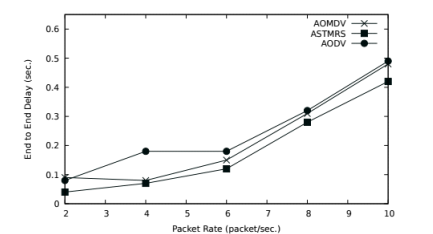
Figure 16. End to end delay Vs Packet Rate

Figure 17. End to end delay Vs Pause Time
After simulation, it has been observed that on varying packet rate, the proposed approach ASTMRS takes 13.63% and 24% less time against AOMDV and AODV. Similarly, on varyingpause time, 14.28% and 53.84% reduction is seen in delay as compared to existing AOMDV and AODV schemes. Results are good because, the proposed approach selects an efficient route which minimizes unnecessary delay required during re-route discovery process.
5. CONCLUSION
In this work, an adaptive and stable multipath routing scheme has been proposed in which during route request broadcasting phase, nodes with good fitness values are allowed to further broadcast RREQ packets. This fitness value is estimated on the basis of factors such as node speed, distance and residual energy. Each node selects its neighbour nodes on the basis of received signal power and node degree. The performance of the proposed approach has been evaluated using network simulator which shows significant improvement in performance specifically in terms of packet delivery ratio. Other performance metrics such as throughput, normalized routing load and delay have also shown sufficient improvement.
In future, we will try to incorporate some other factors such as energy efficiency and security to extend this protocol. Moreover, the scheme can be further implemented in complex environment such as an IoT system to improve routing efficiency.
CONFLICT OF INTEREST
The authors declare no conflict of interest.
REFERENCES
[1] Loo, J., LloretMauri, J., & Hamilton Ortiz, J. (2011). Mobile ad hoc networks: current status and future trends.
[2] Johnson, D. B., Maltz, D. A., &Broch, J. (2001). DSR: The dynamic source routing protocol for multi-hop wireless ad hoc networks. Ad hoc networking, 5(1), 139-172.
[3] Royer, E. M., & Perkins, C. E. (2000, September). An implementation study of the AODV routing protocol. In 2000 IEEE Wireless Communications and Networking Conference. Conference Record (Cat. No. 00TH8540) (Vol. 3, pp. 1003-1008).IEEE.
[4] Yuan, Y., Chen, H., &Jia, M. (2005, October). An optimized ad-hoc on-demand multipath distance vector (AOMDV) routing protocol. In 2005 Asia-Pacific Conference on Communications (pp. 569- 573).IEEE.
[5] Gupta, A. K., Sadawarti, H., &Verma, A. K. (2010). Performance analysis of AODV, DSR & TORA routing protocols. International Journal of Engineering and Technology, 2(2), 226.
[6] Almobaideen, W., Al-Khateeb, D., Sleit, A., Qatawneh, M., Qadadeh, K., Al-Khdour, R., &Hafeeza, H. A. (2013). Improved stability based partially disjoint AOMDV.
[7] Periyasamy, P., &Karthikeyan, E. (2017). Link reliable energy efficient AOMDV routing protocol for mobile ad hoc networks. International Journal of Ad Hoc and Ubiquitous Computing, 26(2), 92-103.
[8] Bhavsar, C., &Belani, S. (2016). Stability enhanced AOMDV protocol for MANETs. International Journal of Computer Applications, 148(5).
[9] Robinson, Y. H., Julie, E. G., Saravanan, K., Kumar, R., & Son, L. H. (2019). FD-AOMDV: faulttolerant disjoint ad-hoc on-demand multipath distance vector routing algorithm in mobile ad-hoc networks. Journal of Ambient Intelligence and Humanized Computing, 10, 4455-4472.
[10] Li, P., Guo, L., & Wang, F. (2021). A multipath routing protocol with load balancing and energy constraining based on AOMDV in ad hoc network. Mobile Networks and Applications, 26, 1871- 1880.
[11] Saxena, M., Dutta, S., K. Singh, B., &Neogy, S. (2023). Multi-objective based route selection approach using AOMDV in MANET. SN Computer Science, 4(5), 581.
[12] Yang, X., Li, M., Wang, P., & Hu, Y. (2019). An adaptive‐aware energy and queue improvement of AOMDV. International Journal of Communication Systems, 32(14), e4054.[13] Satav, P. R., &Jawandhiya, P. M. (2018, August). An energy efficient route selection in MANET with AOMDV Routing Algorithm. In 2018 International Conference on Research in Intelligent and Computing in Engineering (RICE) (pp. 1-5). IEEE.
[14] Alotaibi, N. D., &Assiri, E. I. (2021). Enhancing MANET by balanced and energy efficient multipath routing with robust transmission mechanism with using FF-AOMDV. Communications and Network, 13(4), 131-142.
[15] Banerjee, A., &Chowdhury, S. (2019). Expected residual lifetime based ad hoc on-demand multipath routing protocol (ERL-AOMDV) in mobile ad hoc networks. International Journal of Information
Technology, 11, 727-733.
[16] Marydasan, B. P., &Nadarajan, R. (2022). Topology Change Aware on Demand Routing Protocol for Improving Reliability and Stability of MANET. International Journal of Intelligent Engineering & Systems, 15(4).
[17] Sharma, B., Chugh, S., & Jain, V. (2014, April). Energy efficient load balancing approach to improve AOMDV routing in MANET.In 2014 fourth international conference on communication systems and network technologies (pp. 187-192).IEEE.
[18] Dsouza, M. B., &Manjaiah, D. H. (2019). Energy and Link Quality Aware Multipath Routing Protocol for MANET.International Journal of Engineering Research & Technology (IJERT) ISSN: 2278-0181.
[19] Pandey, P., & Singh, R. (2023, March). An Intelligent and Adaptive Multipath Routing Scheme for Mobile Ad Hoc Network. In 2023 6th International Conference on Information Systems and Computer Networks (ISCON) (pp. 1-5). IEEE.
[20] Danielsson, P. E. (1980). Euclidean distance mapping. Computer Graphics and image processing, 14(3), 227-248.
[21] Issariyakul, T., Hossain, E., Issariyakul, T., &Hossain, E. (2009). Introduction to network simulator 2 (NS2) (pp. 1-18).Springer US.
[22] Stepanov, I., Herrscher, D., &Rothermel, K. (2005, September). On the impact of radio propagation models on MANET simulation results. In Proceedings of 7th international conference on mobile and wireless communications networks (MWCN 2005), Marrakech, Morocco.
[23] Hyytiä, E., &Virtamo, J. (2007). Random waypoint mobility model in cellular networks. Wireless Networks, 13(2), 177-188.
[24] Cooper, N., &Meghanathan, N. (2010). Impact of mobility models on multi-path routing in mobile ad hoc networks. International Journal Of Computer Networks & Communications (IJCNC), 2(1), 185- 194.
[25] Peng, J. (2015). Radio propagation models in wireless networks of unmanned aerial vehicles. Int. J. Comput. Netw.Commun., 7(3), 119-126.
AUTHORS

PriyankaPandey, received her B. Tech. and M. Tech. degree in Computer Science and Engineering from Dr. A.P.J. Abdul Kalam Technical University, Lucknow. She has completed Ph.D. in Computer Science and Engineering from Harcourt Butler Technical University, Kanpur, India. Her research area is Mobile Ad hoc Network and she has published research papers in reputed journals and conferences.

RaghurajSingh, received his Ph.D. degree from U. P. Technical University, Lucknow, India in 2006 and M. S. from BITS, Pilani, India in 1997. He has received B. Tech. in Computer Science and Engineering from Harcourt Butler Technological Institute, Kanpur, India in 1990. He is currently working as Professor at Computer Science and Engineering, Harcourt Butler Technical University, Kanpur, India. His research interest includes Software Engineering, Human-Computer Interaction and Mobile Ad hoc Networks. D

 International Journal of Computer Networks & Communications (IJCNC)