
IJCNC02
RENDEZVOUS SEQUENCE GENERATION ALGORITHM FOR COGNITIVE RADIO NETWORKS IN POST-DISASTER SCENARIO
Junhyung Kim
Department of Software and Convergence, Yeungnam University College, Daegu, Korea
ABSTRACT
Recent natural disasters have inflicted tremendous damage on humanity, with their scale progressively increasing and leading to numerous casualties. Events such as earthquakes can trigger secondary disasters, such as tsunamis, further complicating the situation by destroying communication infrastructures. This destruction impedes the dissemination of information about secondary disasters and complicates postdisaster rescue efforts. Consequently, there is an urgent demand for technologies capable of substituting for these destroyed communication infrastructures. This paper proposes a technique for generating rendezvous sequences to swiftly reconnect communication infrastructures in post-disaster scenarios. We compare the time required for rendezvous using the proposed technique against existing methods and analyze the average time taken to establish links with the rendezvous technique, discussing its significance. This research presents a novel approach enabling rapid recovery of destroyed communication infrastructures in disaster environments through Cognitive Radio Network (CRN) technology, showcasing the potential to significantly improve disaster response and recovery efforts. The proposed method reduces the time for the rendezvous compared to existing methods, suggesting that it can enhance the efficiency of rescue operations in postdisaster scenarios and contribute to life-saving efforts.
KEYWORDS
Cognitive Radio Networks, Rendezvous Sequence, Post-disaster Scenario
1. INTRODUCTION
Globally, natural disasters such as heatwaves, droughts, floods, and wildfires pose significant challenges, causing severe harm to humanity through considerable casualties and economic losses. For instance, in 2022, floods in Pakistan resulted in at least 17,000 fatalities, while Hurricane Ian in the United States led to estimated damages of around 100 billion dollars. These disasters not only have immediate impacts but also lead to secondary crises, like tsunamis following earthquakes, which further devastate local communication infrastructures. Such destruction severely hinders rescue efforts and the delivery of vital information regarding impending secondary hazards.
In the aftermath of these events, one of the paramount challenges is the swift re-establishment of communication networks to support effective rescue and recovery operations. This necessity brings Cognitive Radio Networks (CRNs) to the forefront, showcasing their critical role in such scenarios. CRNs, with their dynamic spectrum access capabilities, present a robust solution for reconfiguring communication links where traditional networks have failed. This paper addresses these post-disaster communication challenges by proposing an algorithm that utilizes rendezvous technology within CRNs. Our approach aims to rapidly reconstruct communication infrastructures in disaster-affected areas, thereby significantly improving the coordination and efficiency of disaster response efforts. Through this work, we highlight the invaluable role of CRNs in overcoming the communication barriers faced in post-disaster scenarios, offering a path towards more resilient disaster recovery processes.
2. RELATED WORKS
2.1. Cognitive Radio Networks
Cognitive Radio Networks (CRN) have emerged as an innovative solution to the spectrum scarcity problem in wireless communication systems [1], [2], [3]. Traditionally, the wireless frequency spectrum has been a finite and heavily regulated resource, leading to inefficient spectrum utilization. CRNs introduce intelligence and adaptability into wireless devices, enabling dynamic access to underutilized spectrum bands and enhancing overall spectrum efficiency [4] [5]. At the heart of CRN is the concept of Dynamic Spectrum Access (DSA), which allows cognitive wireless devices to opportunistically access available spectrum bands [6]. This dynamic approach ensures efficient utilization of spectrum resources, especially in areas where the Primary Users (PUs or licensed users) do not fully exploit the spectrum.
Spectrum sensing is a fundamental component of CRN, where cognitive radios continuously monitor the frequency spectrum [7]. Through sensing, these wireless devices can detect channels that are empty or underutilized, adjusting in real-time to the wireless environment. The cognitive cycle comprises three main phases: sensing, decision-making, and reconfiguration. Cognitive radios scan the spectrum conditions, determine based on observed data, and dynamically configure transmission parameters to optimize performance. This adaptive cycle guarantees efficient spectrum utilization in dynamic and unpredictable environments.
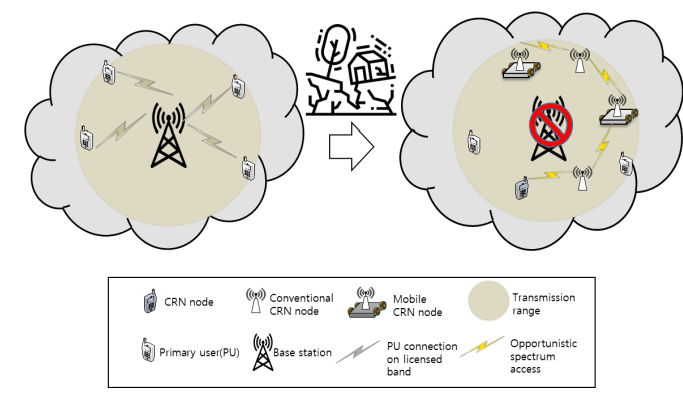
Figure 1. Cognitive Radio Networks in post-disaster Scenarios
Secondary Users (SU), or unlicensed devices, serve a pivotal role in CRNs. These devices utilize the spectrum opportunistically without inducing harmful interference to PU. The adaptability of SU is a key feature in maximizing spectrum utilization. There are several challenges to overcome in CRN research [8]. The first is the challenge of spectral sensing. Accurate spectrum sensing encounters challenges such as noise, fading, and hidden terminal issues. Ongoing research investigates advanced sensing techniques, including cooperative sensing and machine learning algorithms, to improve the reliability of spectrum sensing in CRNs [9]. The second is related to Interference Mitigation. To mitigate interference to PU, CRNs utilize sophisticated interference management techniques. Dynamic power control, spectrum sensing databases, and communication protocols that prioritize PU are implemented to maintain coexistence and
minimize disruption [10]. The third challenge is Rendezvous Mechanisms. Efficient rendezvous mechanisms are critical for cognitive radios to initiate communication. Various strategies, including time-based, frequency-based, and hybrid approaches, are examined to facilitate reliable communication initiation among SUs [11].
There are numerous application domains for Cognitive Radio Networks (CRN), each showcasing its versatility and potential. The primary area is wireless communication. CRNs are instrumental across a spectrum of wireless communication frameworks, encompassing cellular networks, ad hoc networks, and the Internet of Things (IoT). Their adaptability makes them exceptionally suitable for diverse communication environments [12]. Another critical application is in Public Safety and Emergency Communication. Here, CRNs bolster public safety communications by dynamically allocating spectrum resources to emergency services in times of critical need. This flexibility is pivotal in ensuring uninterrupted communication, especially when conventional networks face congestion or are otherwise compromised [13].
CRNs epitomize a transformative shift in wireless communication, embodying a dynamic and intelligent methodology for spectrum utilization. Fueled by continuous advancements in spectrum sensing, interference management, and rendezvous mechanisms, CRNs stand at the forefront, poised to significantly influence the burgeoning demand for wireless services and sculpt the future landscape of communication systems.
2.2. Rendezvous
CRNs have been introduced as an innovative approach to mitigate the increasing demand for wireless communication and the scarcity of available spectrum resources [14]. In CRNs, Secondary Users (SUs) opportunistically access underutilized spectrum bands, dynamically adapting to the changing wireless environment [15]. A core challenge in CRN operations is the establishment of rendezvous points where cognitive radios can efficiently converge and exchange control information to commence communication. The rendezvous concept is pivotal within CRNs, facilitating seamless identification and linkage among cognitive radio devices. In the absence of effective rendezvous mechanisms, cognitive radios might face difficulties in synchronizing and establishing communication links, which could result in suboptimal spectrum utilization.
A broad spectrum of rendezvous mechanisms has been developed and explored [16], each presenting distinct benefits and drawbacks. A segment of these mechanisms depends on temporal synchronization, identified as time-based rendezvous mechanisms. In such methodologies, cognitive radio apparatuses are orchestrated to embark on communication at predetermined time intervals. Although time-based strategies facilitate the streamlining of coordination, they may confront challenges in achieving precise synchronization, particularly in fluctuating and indeterminate wireless contexts.
Conversely, a different rendezvous strategy concentrates on frequency synchronization, in which a mutual channel is designated for rendezvous, permitting cognitive radios to engage in communication upon harmonizing to the same frequency. Frequency-based schemes provide merits in straightforwardness and diminished synchronization necessities, yet they might grapple with interference complications and the hidden terminal issue.
Hybrid methodologies integrate aspects of both time and frequency synchronization, end eavoring to capitalize on the strengths inherent in each strategy to furnish a more adaptable and resilient solution. Hybrid rendezvous mechanisms strive to alleviate the shortcomings linked with solely time-based or frequency-based approaches.
Notwithstanding the variety of rendezvous mechanisms, numerous challenges persist within CRNs, encompassing synchronization difficulties, the hidden terminal conundrum, and the imperative for proficient spectrum sensing. The research community is vigorously seeking innovative resolutions to surmount these obstacles and enhance the dependability and scalability of cognitive radio networks. Recent progress in this domain involves the investigation of machine learning-driven rendezvous strategies, cooperative sensing approaches, and decentralized algorithms. These advancements seek to boost rendezvous efficiency in dynamic and intricate wireless landscapes, thus augmenting the overall efficacy of CRNs [17].
Instituting efficacious rendezvous mechanisms constitutes a pivotal element for the triumph of cognitive radio networks. Time-based, frequency-based, and hybrid modalities proffer distinct advantages, with current research endeavors aimed at rectifying prevalent issues and propelling forward innovative technologies. As CRNs undergo further advancement, the formulation of sturdy rendezvous mechanisms will assume a critical function in guaranteeing the efficient and dependable employment of spectrum resources, thereby fulfilling the escalating requisites of wireless communication.
2.3. Rendezvous Issue
Rendezvous mechanisms face numerous challenges that require comprehensive solutions, including dynamic frequency conditions and energy efficiency. The formulation of rendezvous algorithms must address these concerns. The primary challenge is the dynamic frequency landscape, characterized by frequent shifts in frequency bands. Such volatility complicates the coordination among wireless devices for effective rendezvous, emphasizing the need for algorithms capable of adapting to these changes swiftly.
Another significant concern is the delay in rendezvous. Certain algorithms, especially those with difficulties in maintaining precise time synchronization, may experience delays, disrupting the coordinated timing necessary for effective device rendezvous and thereby impairing efficient frequency use.
Energy consumption presents a third hurdle. The process of rendezvous, encompassing message transmission and frequency scanning, incurs energy usage. Excessive energy consumption can diminish battery lifespan and curtail the operational longevity of wireless devices. Thus, algorithms must incorporate strategies for efficient energy utilization, though this is an area where some algorithms may fall short.
Lastly, the challenge of adaptability in dynamic environments is notable. Several algorithms do not adequately adjust to the rapid shifts in the frequency landscape, which can compromise the efficiency of the rendezvous process and result in suboptimal frequency resource utilization.
To surmount these obstacles, rendezvous strategies need to be adaptable to fluctuating frequency environments and incorporate efficient energy management. The development of practical and efficacious rendezvous algorithms that account for these critical factors is essential for the seamless operation of cognitive radio networks.
2.4. Problems
Recent patterns in natural disasters reveal a sequence where a primary event, such as an earthquake or flood, precipitates secondary calamities, including aftershocks or tsunamis. Following a primary disaster, the urgent dissemination of information regarding imminent secondary disasters to the inhabitants of the affected zones becomes paramount. This necessitates the rapid reconstitution of communication links to replace the network infrastructure obliterated by the primary disaster. The deployment of CRN Nodes and Mobile CRN Nodes is critical for the swift re-establishment of communication facilities. Within the disaster-stricken areas, CRN Nodes, Mobile CRN Nodes, and traditional nodes are tactically positioned. CRN Nodes and Mobile CRN Nodes within reachable distances strive to forge communication links through a designated Rendezvous sequence. This document introduces an algorithm for crafting Rendezvous sequences for use by CRN nodes, with the objective of minimizing the time and
energy expenditure involved in Rendezvous processes.
3. PROPOSED SCHEME
For two nodes in a CRN to rendezvous without prior knowledge of each other’s information, they must visit channels according to a specified channel hopping algorithm. Various techniques have been introduced to generate channel hopping sequences for successful rendezvous within a given time frame. This paper aims to introduce methods for generating sequences and rendezvous techniques to establish communication paths between two nodes without mutual information, particularly in disaster scenarios.
In disaster situations, communication infrastructure is often destroyed, making it impossible to exchange disaster-related information. This leads to difficulties in providing information about secondary disasters that may occur after the initial catastrophe. Given the potential for secondary disasters at any time following the primary event, rapid information dissemination becomes crucial. Moreover, after the conclusion of the disaster situation, there is a need for swift reconfiguration of communication infrastructure for relief activities. Therefore, the proposed algorithm is essential for the rapid restructuring of communication infrastructure.
3.1. Definition
The proposed system is operational within the CRN framework and is engineered to become active during disaster scenarios. The channels of this system represent the available frequency bands or spectra suitable for communication within the cognitive wireless network. The symbol N represents the aggregate count of accessible channels, with the sequence of these channels being indicated as {CH1, CH2, CH3, …, CHN}.
Within this architecture, a “slot” is characterized as a brief duration in the frequency spectrum that is efficiently employed in the Rendezvous process to enhance time division optimization. The term “time lag,” symbolized by k, delineates the temporal discrepancy in intervals that nodes allocate for the rendezvous. The time lag k is articulated as a non-negative integer, quantified by the tally of time slots. A “node” is delineated as a communicative apparatus endowed with the capability to perform wireless data transmission and reception via an interface predicated on CR technology.
As previously elucidated, PU denotes the licensed proprietors of the frequency band channel, whereas SU signifies the node that provisionally exploit the frequency band in the absence of PU’s active engagement. The Time to Rendezvous (TTR) metric gauges the span of time slots dedicated to data transmission and reception during the rendezvous phase. Maximum Time to Rendezvous (MTTR) corresponds to the total number of time slots required for communication between two nodes attempting to establish a link. Average Time to Rendezvous (ATTR) is defined as the average number of time slots needed for a successful rendezvous.
3.2. Sequence Generation Algorithm
In this section, we aim to explain the proposed algorithm, specifically addressing the aspects related to generating sequences for channel configuration. The proposed algorithm constitutes a method for swiftly reconstructing the network infrastructure in disaster-stricken areas, focusing on sequence generation for channel setup. Two nodes desiring communication attempt Rendezvous using sequences generated by the proposed algorithm to establish a communication link. Nodes follow the suggested sequence, visiting channels to attempt Rendezvous. They wait for a predefined period on each channel, anticipating signals from the desired peer node for communication. If no signal is detected on a particular channel within the specified waiting time, nodes transition to the next channel according to the sequence to initiate Rendezvous again. This iterative process continues until both nodes successfully receive and exchange signals on the same channel, concluding with the establishment of a communication link for data transmission through the identified channel that the two nodes discovered for communication.
The initial phase of sequence generation involves the collection of channel information. Nodes at disaster sites commence by sensing the spectrum of the current frequency band to gather information on the channels. This sensing process enables the acquisition of data regarding channels that are currently in use and those that are not. Nodes determine the availability of each channel by detecting the presence or absence of signals from other nodes on those channels. The information collected is essential for the creation of the rendezvous sequence and is, therefore, organized and maintained in a separate list. Utilizing this list, the Rendezvous Sequence is generated.
In this process, each node operates according to its assigned role. The Mobile Node assumes the responsibility of relaying data in the newly formed network. Nodes assigned to the relaying task attempt rendezvous through the proposed algorithm to connect with more nodes.
The algorithm generation method for the Mobile Node is as follows. Each node secures a list of available channels and generates a Hopping sequence. The Hopping sequence is generated as follows based on the proposed algorithm. Initially, the algorithm creates channel sets by incrementally adding channels one by one up to the total number of available channels. The purpose of creating a channel set is to facilitate uniform visits to channels during rendezvous times.
The detailed method for creating channel sets is as follows: Initially, the first channel from the available channel list is selected to establish the first channel set. Subsequently, the first and second channels are combined to form the second channel set. The process continues by incorporating the first, second, and third channels to create the third channel set. This procedure is repeated until the final channel in the channel list is included. Thus, if there are n available channels, a total of n channel sets will be generated.
For instance, if N = n, the channel sets are formed as follows: {CH1}, {CH1, CH2}, {CH1, CH2, CH3}, …, {CH1, CH2, …, CHn}. The generated channel sets are then outputted in reverse order as
follows:
{CH1, CH2, …, CHn}, {CH1, CH2, …, CHn-1}, …, {CH1, CH2}, {CH1}
Next, the front part of the outputted channel sets is connected by sequentially appending the
channels from the channel list. If N=n, the channel sets are modified as follows:
{CH1, CH1, CH2, …, CHn}, {CH2,CH1, CH2,…, CHn-1}, {CH3, CH1, CH2, …, CHn-2}, …, {CHn,
Now, the entire set of channel sets is concatenated into one. When N=n, connecting the complete
channel set results in the following sequence:
{CH1, CH1, CH2, …, CHn, CH2,CH1, CH2, …, CHn-1, CH3, CH1, CH2, …, CHn-2, …, CHn, CH1}
The following step involves the creation of a Guard set designed to prevent Rendezvous failures. The methodology for constructing this Guard set is derived from the approach proposed in HSGRSP [18]. Instances of rendezvous failures have been observed in previously suggested rendezvous sequence generation algorithms. This algorithm is introduced as a preventive measure against such occurrences. To create the Guard sequence, the number of collected channels is a prerequisite. Simply form a set by repeating the first channel of the channel list as many times as the number of channels. If N=n, and the first channel in the channel list is CH1, the Guard sequence would be as follows:
{CH1, CH1, CH1, …, CHn}
The final step is to merge the two previously generated channel sets. In the case where N=n, the
resulting merged channel set is as follows:
{CH1, CH1, CH2, …, CHn, CH2,CH1, CH2, …, CHn-1, CH3, CH1, CH2, …, CHn-2, …, CHn, CH1,
CH1, CH1, CH1, …, CHn}
The sequence generation process up to this point is exemplified below. Assuming an available channel count of N=3, the sequence creation process is outlined in Table 1.
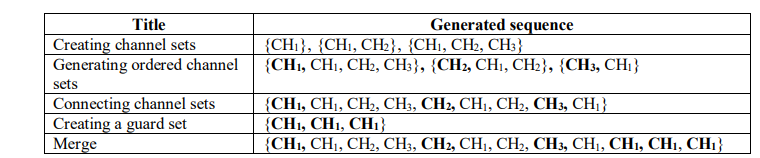
Table 1. Sequence Generation Step.
4. PERFORMANCE EVALUATION
This section aims to evaluate the proposed algorithm focusing on TTR as the key performance metric. The performance is compared with existing methods available in the current literature, specifically SBR [19], CRSEQ [20], and HS-GRSP. The evaluation is carried out through simulations in a simulation environment assuming about 30 CRN Rendezvous channels. PU can occupy each channel at given times. It is assumed that all SU are within communication range. Each node visits the channels according to the proposed rendezvous sequence. At this time, if two nodes successfully send packets on the same channel, a link for data transmission is established. It is assumed that the wireless communication devices of the two nodes wishing to communicate are powered on, and their batteries are sufficiently charged. Additionally, the ambient noise
levels are considered negligible and do not interfere with the communication process. These assumptions were made in conducting the experiment. The simulation parameters are detailed in Table 2 for reference.

Table 1. Simulation parameters .
The simulation was iteratively conducted for a number of repetitions equal to the length of the rendezvous sequence. During the experiments, the value of k was incrementally increased in accordance with the length of the rendezvous, executing the tests accordingly. In instances where N equals n, the experiment was carried out by incrementing k by one for each value up to n. However, for some algorithms, an attempt to increase k while performing the rendezvous led to issues with achieving a rendezvous. Consequently, the experiment was adjusted to repeat the rendezvous sequence twice, ensuring the rendezvous was successfully established.
We will assess the performance of the proposed algorithm based on the Average Time to Rendezvous (ATTR) and Maximum Time to Rendezvous (MTTR) metrics. The TTR is already used as a performance metric in thousands of rendezvous-related research papers [21], [22].

Figure 2. . An example of Rendezvous (N=3, k=2)
Figure 2 demonstrates how the proposed algorithm successfully achieves a rendezvous. Nodes A and B generate rendezvous sequences according to the proposed algorithm, assuming N=3. Node A begins channel searching for the rendezvous according to the generated sequence. Assuming k=2 for Node B, it starts its channel search for the rendezvous two slots later. As illustrated, following the proposed rendezvous sequence, both nodes visit the channel and successfully rendezvous in the fifth slot.
4.1. TTR Performance
We compared the performance of the proposed algorithm in terms of TTR. TTR is the time it takes for two CR nodes to rendezvous. TTR is measured in the number of time slots elapsed from the start time to the rendezvous. The MTTR is the maximum TTR required to achieve a rendezvous. In the graph, N represents the number of available channels.
Figure 3 presents the experimental results for the MTTR, which signifies the longest duration required to achieve a rendezvous. Both the HS-GRSP and the proposed algorithm exhibit the lowest MTTR values, indicating that the proposed algorithm can achieve rendezvous more rapidly compared to other algorithms. In Figure 3, the MTTR for CRSEQ is observed to be the highest, suggesting it may take the longest time to achieve a rendezvous.
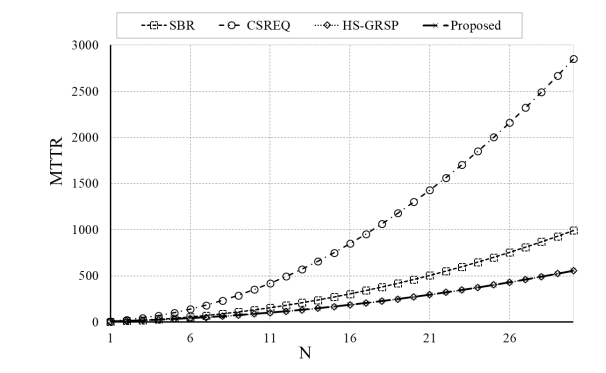
Figure 3. MTTR
Figure 4 illustrates the ATTR. It can be observed from Figure 4 that CRSEQ exhibits the highest ATTR, whereas the proposed algorithm demonstrates the lowest ATTR. This indicates that the proposed algorithm requires the shortest average time to achieve a rendezvous. Therefore, attempting rendezvous using the proposed algorithm can lead to faster average rendezvous times compared to other algorithms. This implies a potential reduction in the amount of battery consumed by CRN nodes during communication.
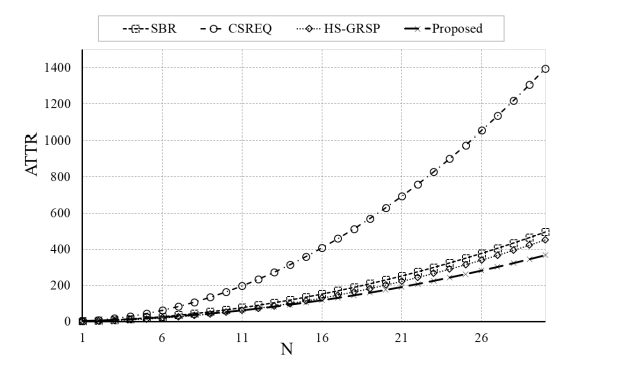
Figure 4. ATTR

Figure 5 Rendezvous Attempt Count
Figure 5 displays the number of attempts required to achieve a rendezvous. The Rendezvous Attempt Count represents the number of times two communicating nodes try to find each other on a common channel to initiate communication. This metric signifies the average number of attempts needed for nodes within a wireless communication network to locate each other and begin communication, serving as a crucial indicator of the performance of rendezvous algorithms. An efficient rendezvous algorithm aims to minimize this number, facilitating nodes to quickly discover each other and commence communication. As shown in Figure 5, the proposed algorithm exhibits the lowest number of rendezvous attempts. This indicates that using the proposed algorithm can reduce the number of attempts needed for CRN nodes to achieve a rendezvous, thereby potentially decreasing the battery consumption of CRN nodes.
The proposed algorithm demonstrated superior performance in terms of MTTR, ATTR, and Rendezvous Attempt Count compared to other algorithms, showcasing its strengths. The significance of these results lies in the ability of CRN nodes attempting rendezvous to achieve success more rapidly than with other algorithms. This outcome also suggests the potential for conserving battery life in the nodes attempting rendezvous, which stands as another advantage. However, this paper did not conduct experiments on actual battery usage, which remains an area for future research.
The proposed algorithm reduces the time required for rendezvous and ensures successful rendezvous within the suggested sequence length. When applied in actual post-disaster scenario CRN environments, this algorithm is expected to enhance the reliability of network configurations. Furthermore, it can be utilized as a method for establishing efficient networks.
5. CONCLUSION
In this study, we introduce a novel rendezvous sequence generation algorithm aimed at swiftly establishing networks in post-disaster scenarios following an event. The sequences generated by the proposed algorithm are utilized by CRN nodes for channel visits during the rendezvous process. Following the sequence, CRN nodes systematically visit channels. Through simulations, we compared the proposed algorithm with existing algorithms and observed that the generated sequences outperform those of existing rendezvous sequence generation algorithms in terms of MTTR and ATTR. We also evaluated the number of rendezvous attempts. A decrease in attempt count signifies fewer communication attempts, indicating that the proposed algorithm is more efficient at preserving the battery life of CRN nodes deployed in post-disaster scenarios compared to other algorithms. This efficiency is attributed to the fact that our algorithm requires fewer channel visits to achieve a rendezvous, thereby reducing the energy consumed during channel visits.
The proposed algorithm accelerates the rendezvous process in post-disaster scenarios; however, numerous considerations, such as the quality and reliability of channel connections, must be further addressed. There is a need for additional research to discuss how these areas can be enhanced.
CONFLICTS OF INTEREST
The authors declare no conflict of interest.
ACKNOWLEDGEMENTS
This work was supported by Yeungnam University College Research Grants in 2020.
REFERENCES
[1] S. Talekar, S. Banait, and M. Patil, (2023) “Improved Q-Reinforcement Learning Based Optimal Channel Selection in Cognitive Radio Networks”, International Journal of Computer Networks & Communications (IJCNC), Vol. 15, No. 3, pp. 1-14.
[2] I. F. Akyildiz, W.-Y. Lee, M. C. Vuran, and S. Mohanty, (2006) “NeXt generation dynamic spectrum access cognitive radio wireless networks: A survey”, Computer Networks, Vol. 50, No. 13, pp2127–2159.
[3] I. F. Akyildiz, W.-Y. Lee, and K. R. Chowdhury, (2009) “CRAHNs: Cognitive radio ad hoc networks”, Ad Hoc Networks, Vol. 7, No. 5, pp810–836.
[4] C. Singhal and T. Thanikaiselvan (2022), “Cross Layering Using Reinforcement Learning in Cognitive Radio-Based Industrial Internet of Ad-Hoc Sensor Network”, in International Journal of Computer Networks & Communications (IJCNC), Vol. 14, No. 4.
[5] S. Talekar, S. Banait, and M. Patil (2023), “Improved Q-Reinforcement Learning Based Optimal Channel Selection in Cognitive Radio Networks”, in International Journal of Computer Networks & Communications (IJCNC), Vol. 15, No. 3.
[6] C. Xin, M. Song, L. Ma, and G. Hsieh (2010), “On Random Dynamic Spectrum Access for Cognitive Radio Networks”, Proc. of GLOBECOM 2010.
[7] K. Kockaya and I. Develi (2020), “Spectrum sensing in cognitive radio networks: Threshold optimization and analysis”, EURASIP Journal on Wireless Communications and Networking, Vol. 255.
[8] M. Ranasinghe and M. N. Halgamuge, (2019) “Effective Solutions for Challenges in Cognitive Radio Networks”, in Next-Generation Wireless Networks Meet Advanced Machine Learning Applications, pp100-122.
[9] Y. Arjoune and N. Kaabouch, (2019) “A Comprehensive Survey on Spectrum Sensing in Cognitive Radio Networks: Recent Advances, New Challenges, and Future Research Directions”, Sensors.
[10] M. Boutin, C. L. Despins, T. A. Denidni, (2011) “Uncertainty area-based interference mitigation for
cognitive radio”, EURASIP Journal on Wireless Communications and Networking, Vol. 2011, No.175.
[11] E. Ortiz Guerra, V. A. Reguera, R. D. Souza, E. G. Fernández, and M. E. Pellenz, (2015) “Systematic construction of common channel hopping rendezvous strategies in cognitive radio networks”, EURASIP Journal on Wireless Communications and Networking, Vol. 2015, No. 134.
[12] H. Yu and Y. B. Zikria, (2020) “Cognitive Radio Networks for Internet of Things and Wireless Sensor Networks”, Sensors, Vol. 20, No. 18.
[13] G. Ghosh, P. Das, and S. Chatterjee, (2014) “Cognitive Radio and Dynamic Spectrum Access – A Study”, International Journal of Next-Generation Networks, Vol. 6, No. 1, pp43-60.
[14] S. Aslam and K. G. Lee, (2011) “Fair, efficient, and power-optimized spectrum sharing scheme for
cognitive radio networks”, EURASIP Journal on Wireless Communications and Networking, Vol. 2011, No. 201.
[15] A. Upadhye, P. Saravanan, S. S. Chandra, and S. Gurugopinath, (2021) “A Survey on Machine Learning Algorithms for Applications in Cognitive Radio Networks”, in Proc. of the 2021 IEEE International Conference on Electronics, Computing and Communication Technologies (CONECCT).
[16] Ahmed, E., Gani, A., Abolfazli, S., Yao, L. J., & Khan, S. U, (2016) “Channel Assignment Algorithms in Cognitive Radio Networks: Taxonomy, Open Issues, and Challenges”, IEEE Communications Surveys & Tutorials, Vol.18, Mo. 1.
[17] K. Wang, L. Chen, K. Bian, W. Wang, and P. Zhou, (2019) “On Cooperative Channel Rendezvous in Cognitive Radio Networks”, IEEE Access, Vol. 7, pp. 57500-57515, doi: 10.1109/ACCESS.2019.2914148.[18] J. Kim, G. Park, and K. Han, (2014) “A Rendezvous Scheme for Self-Organizing Cognitive Radio Sensor Networks”, International Journal of Distributed Sensor Networks, Vol. 10.
[19] L. A. DaSilva and I. Guerreiro, (2008) “Sequence-Based Rendezvous for Dynamic Spectrum Access”, in IEEE Symposium on New Frontiers in Dynamic Spectrum Access Networks, pp1-7.
[20] J. Shin, D. Yang, and C. Kim, (2010) “A Channel Rendezvous Scheme for Cognitive Radio Networks”, IEEE Communications, Vol. 14, No. 10, pp954-956.
[21] R. Paul, J. Jang, and Y.-J. Choi, (2022) “Channel-Hopping Sequence and Rendezvous MAC for Cognitive Radio Networks”, Sensors, Vol. 22, No. 16.
[22] E. O. Guerra, J. C. Perez Garcia, V. A. Reguera, T. M. T. Nguyen, and G. Pujolle, (2019) “A Novel
Multi-Radio Rendezvous Scheme for Cognitive Radio Networks”, in 12th IFIP Wireless and Mobile Networking Conference (WMNC), Paris, France.
AUTHOR

Dr. Junhyung Kim received his Ph.D. degree in Computer Science and Engineering from Kyungpook National University, Daegu, Korea, in 2015. He worked as an Assistant Manager for Techbile Co.Ltd. from 2004 to 2007, Daegu, Korea. Subsequently, he also worked as a Deputy General Manager at Geo Consulting & Information Co., Ltd. from 2015 to 2016. Since 2016, he has been an Assistant Professor at the Yeungnam University College of Science and Technology, Daegu, Korea. His research interests include computer networks, cognitive radio networks, and wireless sensor networks.

 International Journal of Computer Networks & Communications (IJCNC)