
IJCNC – 07
A TOPOLOGY CONTROL ALGORITHM TAKING INTO
ACCOUNT ENERGY AND QUALITY OF
TRANSMISSION FOR SOFTWARE-DEFINED
WIRELESS SENSOR NETWORK
Hong Thi Chu Hai1, Le Huu Binh2 and Le Duc Huy3
1Faculty of Management Information System, Banking Academy of Vietnam,
Hanoi, Vietnam
2Faculty of Information Technology, University of Sciences, Hue University, Vietnam
3Faculty of Information Technology, Ha Noi University of Business and
Technology, Vietnam
ABSTRACT
The efficient use of energy in wireless sensor networks is critical for extending node lifetime. The network topology is one of the factors that have a significant impact on the energy usage at the nodes and the quality of transmission (QoT) in the network. We propose a topology control algorithm for software defined wireless sensor networks (SDWSNs) in this paper. Our method is to formulate topology control algorithm as a nonlinear programming (NP) problem with the objective to optimizing two metrics, maximum communication range, and desired degree. This NP problem is solved at the SDWSN controller by employing the genetic algorithm (GA) to determine the best topology. The simulation results show that the proposed algorithm outperforms the Max Power algorithm in terms of average node degree and energy expansion ratio.
KEYWORDS
SDWN, topology control, genetic algorithm, nonlinear programming
INTRODUCTION
Wireless Sensor Networks (WSNs) are increasingly being used in a variety of fields, particularly during this period of rapid growth in internet of things applications. The WSNs can be controlled in three ways: centralized control, decentralized control, and distributed control [1]. The centralized control model includes a node in the network that stores global information. This node controls the data transmission from sensor nodes to the base station (BS). The decentralized control model divides all sensor nodes into clusters, with one node acting as the cluster leader in each. Data is sent from sensor nodes to the BS via the cluster head node. For the distributed control model, the sensor nodes play the same role. Control functions are distributed among the nodes.
To boost the performance of WSNs, some published research has examined architectures, models, as well as control protocols in the network, where topology control algorithms are an interesting topic, attracting many research groups recently [2]-[9], [19]. For this topic, the authors of [6] have proposed an energy efficient topology control algorithm namely RL-CRC (Reinforcement Learning-based Communication Range Control). The RL-CRC algorithm uses reinforcement learning to adaptively adjust the communication range of each node in WSN. To do this, the authors have proposed a reward function that includes two metrics, the node degree and the communication range. This reward function is used for nodes to tune its communication range to obtain the optimal topology. According to the simulation results, RL-CRC consumes much less energy than traditional methods while retaining about the same average communication range and node degree. In [7], the authors have proposed a topology control algorithm for ad-hoc networks namely LTRT (Local Tree-based Reliable Topology). It has been demonstrated theoretically that the LTRT algorithm ensures k-edge connection while maintaining the properties of the local minimal spanning tree. The efficiency of LTRT and its superiority over other localized algorithms have been demonstrated by simulation results. In [8], a topology control algorithm named FLSS (Fault-tolerant Local Spanning Sub-graph) has been proposed for wireless ad-hoc networks. The FLSS algorithm minimizes the maximum transmission power used in the network. According to simulation results, FLSS not only has better power efficiency than existing fault-tolerant topology control algorithms, but it also leads to higher network capacity. Topology control using fuzzy logic was also implemented in [9]. In this work, a novel Fuzzy logic-based Topology Control (FTC) algorithm is proposed with the main objective is to improve the network connectivity. The method of the FTC algorithm is to adaptively change communication range in order to achieve any desired average node degree. The performance of algorithm FTC is compared with other well-known algorithms by simulation method.
Recently, the SDN-based centralized control model has been applied to the WSNs [1], [10], [11]. depicts the basic principle of this model. The sensor nodes are either directly or indirectly connected to the SDN controller via the open- flow protocol. Control functions in the network, such as routing, signaling, topology control, and so on, are concentrated at the SDN controller. The SDWSN model has been used to improve control protocols in the WSN network, most notably routing protocols [12], [13], topology control [14], [15], and clustering protocol [16], [17]. For the topic of topology control using SDN, the authors in [15] proposed a

Figure 1.An example of software-defined wireless sensor networks (SDWSN)
decentralized topology control algorithm with the goal of improving the efficiency of energy use. The algorithm is named EEHTC (Energy-Efficient Hierarchical Topology Control) dividing the control into two layers. One is to control the topology in the lower layer with conventional sensor nodes. The second is to control the topology in the upper layer for software control sensor nodes. When comparing with other algorithms, the EEHTC algorithm increases the existence time of nodes and reduces energy consumption. In [18], the authors have proposed a SDN-based manageable topology formation for flying ad hoc networks (FANET) to reduce the mobility negative effects of UAVs on the communication and improve the network performance. Simulation results have shown that the proposed solution gives high efficiency in terms of packet loss within the required delay limit.
We discovered from the published research projects that topology control is a successful method for enhancing network performance, particularly in terms of enhancing energy efficiency. There are many various ways to implement topology control algorithms, however adopting SDWSN as one of them provides numerous benefits. This is due to the algorithm being run at the SDN controller in accordance with the centralized control principle, which makes it easy to optimize performance metrics. In this paper, we suggest a new topology control algorithm for SDWSNs. Using a nonlinear programming (NP) problem, we develop the topology control algorithm with the objective of optimizing the maximal communication range and desired degree. At the SDWSN controller, this NP problem is resolved by using the genetic algorithm (GA) to select the optimal topology.
The next sections of this paper are organized as follows. Section 3 presents our proposed routing algorithm. Some simulation results and discussion are presented in section 3. Finally, concluding remarks and promising future study items are given in Section 4.
2. OUR PROPOSED ALGORITHM
2.1. Concepts and Metrics
In this section, we express the concepts and metrics that will be used for the objective function and the constraints in our proposed algorithm in the next sub-section.
2.1.1.Connected Node
A sensor node I is referred to as the connected node if and only if there is at least one route from it to BS. Returning to the example as shown in node 8 is not a connected node because there is no route from it to BS. The connected node is represented by all the remaining nodes.
2.1.2.Desired- Proximity Degree Node
A Desired-proximity degree node is defined as a node whose degree is within the range [k-, k+], where k is the desired degree and is a given positive integer. Let i be a variable indicating whether node I is a k-proximity degree node or not, return 1 if it is true and 0 otherwise. Then i is determined by

where i is the degree of the node I, defined as the number of its neighbours.
2.2. Our Proposed Algorithm
In this section, we present the SDN-based QoT and Energy efficient Topology Control (SQETC) algorithm, proposed for SDWSNs. The main goal of the SQETC algorithm is to create a topology that maximizes energy efficiency at nodes while also providing the best QoT in the network. In an SDWSN topology, the degree of the nodes has the greatest influence on the energy consumption. We, therefore, use the metric i as defined in (1) to optimize energy use. In addition, the communication range of each node is used to optimize the QoT in the network. Thence we define a fitness function as follows:

where is a floating parameter in the range [0, 1] which is used to control the importance of metrics. The SQETC algorithm can be formulated as a nonlinear programming (NP) problem as follows:
Minimize (F) (3)
subject to the following constraints:

where rmin and rmax are the minimum and maximum communication range of each node, respectively. Equations (4) is the constraints of the communication range of sensor nodes. Equations (5) is the constraints of network connectivity, where ci is a variable indicating whether the node I is the connected node or not, determined by.

By solving the NP problem with the objective function (3), the constraints (4) and (5), we find the solution R = {ri|i = 1 .. N} which is the optimal communication range of nodes so that the resulting topology has the mean degree of nodes close to the desired degree.
Algorithm 1. The pseudo code of the SQETC algorithm
(1)The SDN controller collects information about the location and
communication range of each node through control packets;
(2)Formulate the NP problem according to (3), (4), and (5);
(3)Solve the NP problem in step (2);
(4)for (each node i N)
(5)Adjust the communication range of the node i based on the solution
(6)found in step (3);
(7)endfor;
(8)Create the topology based on adjusted communication ranges of all
nodes;
Algorithm 1 presents the pseudo-code of the SQETC algorithm. Each node sends a control packet to the SDN controller containing information about its current location and communication range whenever the topology network needs to be updated. Based on this information, the SDN controller formulates the NP problem according to (3), (4) ,and (5). This NP problem is solved at the SDN Controller by an approximate optimization algorithm. In this work, we use a genetic algorithm (GA) to solve it, which returns the communication range of each node. Based on this result, the node adjusts its communication range to obtain the optimal topology.
3. PERFORMANCE EVALUATION
3.1. Simulation Scenarios
The performance of the SQETC algorithm was evaluated by simulation method using Matlab software. We use the GA algorithm in the Matlab optimization tool to solve the NP problem that is proposed in subsection 2.2. The SQETC algorithm is compared with the network topology case using maximum power, named MaxPower. The MaxPower is the default case in wireless networks in general, and WSN in particular. In this case, the nodes always operate with the widest possible communication area. A wireless connection is formed when two nodes are within range of each other. The network topology is comprised of all nodes and wireless connections. Evaluation metrics include average node degree, energy consumption rate, and path loss. Tables 1 and 2 show how the simulation scenarios are configured. Despite the randomness of the GA optimization algorithm, each scenario is run 50 times to ensure the objectivity of the simulation results. The findings presented in this paper are based on an average of 50 simulations.
Table 1.Technical parameters of simulation scenarios

Table 2.GA algorithm parameters used to solve the NP problem of the SQETC algorithm

3.2. Simulation Results
Figure 1 compares the network topology obtained using SQETC and MaxPower algorithms. In this case, the number of sensor nodes is 40 and the desired degree of each node is 4. We can observe that, in the case of MaxPower (result in Figure 1a), the topology consists of many wireless links between nodes. The maximum, minimum and mean of node degrees are 11, 3 and 6, respectively. This topology is inefficient because the degree difference between the nodes is quite large, easily leading to bottleneck congestion at some nodes when data transmission. In addition, because the topology has many wireless links, the nodes have to spend a lot of energy to maintain the links. For the case of using SQETC algorithm (results in Figure 1b), the obtained topology has a balanced degree of nodes. The maximum, minimum and mean of node degrees are 5, 2 and 3.67, respectively. Thus, the average node degree is very close to the desired degree (k = 4), this topology is more optimal than the topology of the MaxPower algorithm.

Figure 1.SDWSN topology comparison when using algorithms (a) MaxPower and (b) SQETC in case the number of nodes is 40, desired degree is 4.

Figure 2.SDWSN topology comparison when using algorithms (a) MaxPower and (b) SQETC in case the number of nodes is 50, desired degree is 4.
The obtained results are also quite similar for the simulation scenario where the number of sensor nodes is 50, this is clearly shown in Figure 3. In the case of MaxPower (result in Figure 3a), The maximum, minium and mean of node degrees are 12, 3 and 7.36, respectively. Thus, the node degree difference is also very large. In case the SQETC algorithm is used, the resulting topology has a more balanced node degree and is closer to the desired degree. Specifically, the mean degree is 3.85. These results have shown that the topology obtained using the SQETC algorithm is more optimal than in the case of MaxPower.
Next, we examine the average node degree versus the number of nodes. The results are shown in Figure 4 and Figure 5 for the cases where the desired degree is 4 and 5, respectively. We can observe that, in the default case (MaxPower), the larger the number of nodes, the higher the average node degree. This is obvious because when the number of nodes is large, the node density is thicker. Because the MaxPower algorithm configures the topology using the maximum communication range, each node will have many neighbors. For the SQETC algorithm, the average node degree is close to the desired degree even when the number of nodes is large. Specifically, considering the case of the desired degree of 4, the topology obtained by the SQETCalgorithm has an average degree of 3.71 (Figure 4). In the case of a desired degree of 5, the average node degree of the topology is 4.82 if the SETC algorithm is used.

Figure 3.Compare average node degree of algorithms SQETC and MaxPower when desired degree is 4
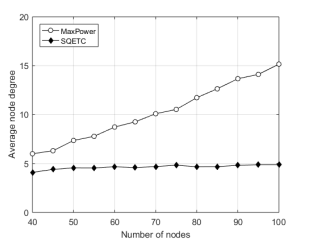
Figure 4.Compare the average node degree of algorithms SQETC and MaxPower when the desired degree is 5
Since the topology obtained by the SQETC algorithm has an average degree closer to the desired degree than in the case of MaxPower, the SQETC algorithm provides better energy efficiency. This is evident in the results obtained in Figures 6 and 7. Energy efficiency is analyzed through the metric of energy expansion ratio (EER), which is determined by [7]:

where Eave is the average transmission power of all nodes and Emax is the maximum transmission power to reach the maximum communication range (250 [m] in simulation scenarios).
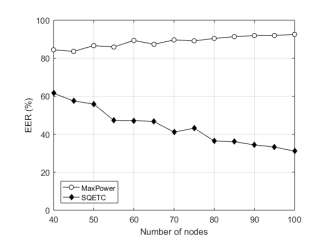
Figure 5. Compare energy expended ratio of algorithms SQETC and MaxPower when desired degree is 4

Figure 6.Compare energy expended ratio of algorithms SQETC and MaxPower when desired degree is 5
The results obtained in Figure 6 and Figure 7 show that, the EER in the case of using the SQETC algorithm is much lower than that of the MaxPower algorithm. Considering the case of total nodes is 50, the EER for the case of MaxPower is 86.64%. Meanwhile, if using the SQETC algorithm, the EER is only 48.22% and 55.90% respectively for the cases where the desired node degree is 4 and 5. For the cases where the number of nodes is larger, the EER is lower when the number of nodes is higher. Thus, the SQETC algorithm brings high energy efficiency, especially with WSNs where the nodes are highly distributed.
4. CONCLUSIONS
Topology control in SDWSN is a research topic that has attracted the attention of many research groups recently. An optimized network topology improves network performance. In this paper, we propose a new topology control algorithm for SDWSNs. Our approach is to model topology control as an NP problem with the goal to optimizing two metrics: maximum communication range and desired degree. This NP problem is solved at the SDWSN controller by employing the GA algorithm. In terms of average node degree and energy efficiency, the simulation results show that the proposed algorithm outperforms the MaxPower case.
Although our proposed algorithm improved SDWSN performance, in the case of rapidly moving nodes, the network topology must be updated regularly. As a result, the computational complexity at the SDN controller grows. This is a limitation of the proposed algorithm. We will continue to research solutions to this problem in the future.
CONFLICTS OF INTEREST
The authors declare no conflict of interest
REFERENCES
[1] Mostafaei H. and Menth M., “Software-defined wireless sensor networks: A survey”, Journal of Network and Computer Applications, vol.119, 2018, pp. 42-56.
[2] B. Devika, P.N. Sudha, “Power optimization in MANET using topology management”, Engineering Science and Technology, an International Journal, Vol. 23, no. 3, 2020, pp.565-575.
[3] Q. Guan, F. R. Yu, S. Jiang, V. C. M. Leung and H. Mehrvar, “Topology control in mobile Ad Hoc networks with cooperative communications”, IEEE Wireless Communications, vol. 19, no. 2, pp. 74-79, April 2012, doi: 10.1109/MWC.2012.6189416.
[4] K. Genda, “Topology control method adopting optimal topology with minimum cumulative energy consumption over update interval in MANETs,” 2020 IEEE 17th Annual Consumer Communications Networking Conference (CCNC), 2020, pp. 1-6, doi: 10.1109/CCNC46108 .2020.9045688.
[5] H. Nishiyama, T. Ngo, N. Ansari and N. Kato, “On Minimizing the Impact of Mobility on Topology Control in Mobile Ad Hoc Networks,” IEEE Transactions on Wireless Communications, vol. 11, no. 3, pp. 1158-1166, March 2012.
[6] Le, Thien Moh, Sangman. (2017), “An Energy-Efficient Topology Control Algorithm Based on Reinforcement Learning for Wireless Sensor Networks”, International Journal of Control and Automation, 10. 233-244. 10.14257/ijca.2017.10.5.22.
[7] K. Miyao, H. Nakayama, N. Ansari and N. Kato, “LTRT: An efficient and reliable topology control algorithm for ad-hoc networks”, IEEE Transactions on Wireless Communications, vol. 8, no. 12, pp. 6050-6058, December 2009, doi:10.1109/TWC.2009.12.090073.
[8] N. Li and J. C. Hou, “Localized fault-tolerant topology control in wireless ad hoc networks”, IEEE Transactions on Parallel and Distributed Systems, vol. 17, no. pp. 307-320, April 2006, doi: 10.1109/TPDS.2006.51.
[9] Huang, Yuanjiang Mart´ınez, Jos´e-Fern´an Hern´andez, Vicente Sendra, Juana, “A Novel Topology Control Approach to Maintain the Node Degree in Dynamic Wireless Sensor Networks, Sensors (Basel, Switzerland), vol. 14. 4672-4688.10.3390/s140304672.
[10] Kgotlaetsile M. M., Babedi B. L. Reza M., Adnan M. A., “Software defined wireless sensor networks application opportunities for efficient network management: A survey”, Computers & Electrical Engineering, Vol. 66, 2018, pp. 274-287.
[11] Letswamotse B., Malekian R., Chen C. and Modieginyane K., “Software Defined Wireless Sensor Networks (SDWSN): A Review on Efficient Resources”, Applications and Technologies. Journal of Internet Technology, vol.19, pp.1303-1313.
[12] S. Wang, A. Hawbani, X. Wang, O. Busaileh and L. Ping, “Heuristic Routing for Software Defined Wireless Sensor Network,” 2018 World Symposium on Digital Intelligence for Systems and Machines (DISA), 2018, pp. 39-44, doi: 10.1109/DISA.2018.8490625.
[13] S.V. Manisekaran, R. Venkatesan, “An analysis of software-defined routing approach for wireless sensor networks”, Computers & Electrical Engineering, vol. 56, 2016, pp. 456-467, https://doi.org/10.1016/j.compeleceng.2016.06.017.
[14] R. Huang et al., “A New Topology Control Algorithm in Software Defined Wireless Rechargeable Sensor Networks”, IEEE Access, vol. 9, pp. 101003-101012, 2021, doi: 10.1109/ACCESS.2021.3096793.
[15] Z. Geng et al., “An Energy-Efficient Hierarchical Topology Control Algorithm in Software-Defined Wireless Sensor Network”, 13th International Conference on Wireless Communications and Signal Processing (WCSP), 2021, pp. 1-6.
[16] Qingzhi Liu, Long Cheng, Renan Alves, Tanir Ozcelebi, Fernando Kuipers, Guixian Xu, Johan Lukkien, Shanzhi Chen, “Cluster-based flow control in hybrid software-defined wireless sensor networks”, Computer Networks, vol. 187, 2021, 107788.
[17] Cao, B., Deng, S., Qin, H. et al., “A novel method of mobility-based clustering protocol in software defined sensor network”, EURASIP Journal on Wireless Communications and Networking, 99 (2021). https://doi.org/10.1186/s13638-021-01927-1
[18] Faezeh Pasandideh, Tulio Dapper e Silva, Antonio Arlis Santos da Silva, Edison Pignaton de Freitas, “Topology management for flying ad hoc networks based on particle swarm optimization and software-defined networking”, Wireless Networks, Vol. 28, no.1, 2022, pp. 257-272.
[19] Aminuddin Zabi, Touseef Yousuf, and Aparna Manikonda, “A New Method for Controlling and Maintaining Topology in Wireless Sensor Networks”, International Journal on Computer Networks and Communication, vol. 6, no.4, 2014, pp.97-104.
AUTHORS
Hong Thi Hai Chu has over 20 years of teaching experience and has participated in various IT projects such as Developing a student attendance system using fingerprint and face recognition, a Course schedule and classroom management system, anOnline exam organization and management system, Enterprise resource management system providing clean water on GIS platform, etc. She holds a Bachelor’s degree in Mathematics and Computer Science from the Hanoi National University of Education, a Master’s degree in Information Technology from the Hanoi University of Engineering and Technology, and a Ph.D in Information System Management from the National Economics University, Vietnam. In addition to teaching and participating in projects, she is also the head, editor, and member of many sectoral, and grassroots-level research projects. Her research focuses on topics such as Next Generation Technology (NGN), Data management, Data Security, Education systems, Enterprise information systems, and Applications of geographic information systems in daily life.
Le Huu Binh received his BE degree in Telecommunications and Electronics from Da Nang University of Technology, Vietnam, his MSc degree in Computer Sciences from Hue University of Sciences, Vietnam, and his PhD degree in Informatics from Vietnam Academy of Science and Technology (GUST) in 2001, 2007, and 2020, respectively. He worked as a senior engineer with the Transmission and Switching Exchange of the Hue Telecommunications Centre, Thua Thien Hue of the Vietnam Posts and Telecommunications Group (VNPT) from 2001 to 2009. From 2010 to 2021, he worked at the Hue Industrial College (HUEIC), Vietnam, where he was the dean of the Faculty of Information Technology and Telecommunications. Since the beginning of 2022, he has been with the Faculty of Information Technology, University of Sciences (HUSC), Hue University, Hue City, Vietnam, where he is now a lecturer. His current research interests are next-generation wireless network technology, software- defined networking, the application of machine learning, and artificial intelligence in network technology.
Huy D. Le was born in Bac Ninh province, Vietnam in 1990. He received a B.E. degree in Information Technology from the Hanoi University of Business and Technology, in 2012 and an M.A. degree in Computer Science from the Thai Nguyen University of Information And Communication Technology, in 2015. He is currently studying for his Ph.D. at the Graduate University of Sciences and Technology; Vietnam Academy of Science and Technology. His research interests include computer network and network security

 International Journal of Computer Networks & Communications (IJCNC)