
IJCNC 02
Real-World Multimedia Streaming for Software Defined Vehicular Ad Hoc Networks
Varun P. Sarvade1 and ShrirangAmbaji Kulkarni2
Department of Computer Science and Engineering, B. G. M. Institute of Technology,
Mudhol, Karnataka, India.
2Department of Computer Science and Engineering, The National Institute of
Engineering, Mysuru, Karnataka, India
ABSTRACT
Multimedia services with required Quality of Service (QoS) is one of the most critical challenges in Software Defined Network (SDN) based Vehicular Ad-Hoc Networks (VANETs). It forms an essential part of the Intelligent Transport System (ITS), where infotainment services play an essential role. Streaming multimedia is one of the most popular applications and has a high demand for VANET infotainment services. The major issues for multimedia streaming on VANET are scalability, mobility of vehicles, frequent connection failures, frequent change in network topology, and distributed architecture with heterogeneous devices. To overcome these problems and provide a better QoS, we propose using a hybridarchitecture with a combination of VANET and SDN called Software-Defined Vehicular Networks (SDVN). This work presents a modified POX controller-based SDN framework for VANETs, especially for multimedia streaming applications in realistic traffic patterns. The proposed work has a real-world setup developed using Simulation of Urban Mobility (SUMO), where iPerf generates multimedia traffic. Also, streaming standard-definition YouTube videos in real-time between the vehicular nodes was done. The modified POX controller could take advantage of the centralised perspective of the network for action determination, and the integrated spanning tree algorithm reduced the redundancy. Despite the dynamic nature of the testing environments, the proposed Modified POX Controller consistently outperformed VANET, with up to 21 to 42% better packet delivery ratio for higher data transfer rates. The overall improvement in QoS parameters also accompanies an improvement in the consumers Quality of Experience (QoE) factors.
KEYWORDS
Vehicular Ad-Hoc Network, Software Defined Network, Video Streaming, Quality of Service Metrics, Quality of Experience Metrics
1. INTRODUCTION
An intelligent transportation system (ITS) is a set of modern applications to provide innovative services concerning transport. It also provides the end-users with better information and innovative services. ITS has different technologies like vehicle navigation, vehicle identification/detection, vehicle number plate identification and wireless communications. ITS services in moving vehicles are improving with advancements in wireless technology. Different wireless technologies like IEEE 802.11 protocols [1], dedicated short-range communications (DSRC) and LTE communication provide multimedia streaming as part of ITS services. Along with vehicular communications technology, ITS requires supporting infrastructures like RSUs (Road-Side Units) and cellular communication towers [1].
The presence of technology in vehicles is increasing rapidly for assisting the operators and passengers. The state of art technologies in vehicles include high-end display panels with voice control, an entertainment system with Bluetooth, Wi-Fi and Hotspots connections, High-Speed 4G services, Digital Instrument Panel, Heads-up Display, and Self-Parking. The next-generation vehicles are thus well equipped for interconnectivity to form a network (i.e., VANET) for information sharing as part of ITS [2].
The presence of technology in vehicles is increasing rapidly for assisting the operators and passengers. The state of art technologies in vehicles include high-end display panels with voice control, an entertainment system with Bluetooth, Wi-Fi and Hotspots connections, High-Speed 4G services, Digital Instrument Panel, Heads-up Display, and Self-Parking. The next-generation vehicles are thus well equipped for interconnectivity to form a network (i.e., VANET) for information sharing as part of ITS [2].
The below section discusses the communication planes of SDVN architecture:
Data Plane All forwarding devices/switches like vehicles, RSUs and base stations are inter connected as part of the data plane. These switches forward the packets according to the instructions provided by the centralised SDN controller [3].

Figure 1. Simplified representation of SDVN Architecture
Control Plane: It is the brain of the network. It consists of a centralised SDN controller. This controller is responsible for generation of rules, pre-processing of data, and allocation of resources. This controller develops a packet flow rule table and distributes it to all the packet forwarding devices via southbound APIs. These switches continuously update the controller with live information like switch status, vehicle location and speed at which it travels. The SDN Controller uses this information for updating the routing table for efficient routing decisions in the vehicular network [3].
Application Plane: It consists of applications for packet routing and data traffic management. These applications define the policies to be followed by the control plane for generation of routing rules. The policies are sent to the controller via northbound APIs. Ultimately, the behaviour of forwarding devices is controlled by the application plane[3].
1.1. Motivation
The expectation is that the ITS will grow with SDN-based network architecture in the future.Compared with traditional network architecture, the control and data planes are separate. The data plane is part of forwarding devices like switches and routers. In contrast, the control plane is present in a centralised controller. In SDN, the network manager can easily manage and control the entire network using this centralised controller and this controller, in turn, communicates with its connected nodes using the OpenFlow protocol [4].
Keeping in mind the prior discussion, developing effective SDN controllers is of strong interest as they contribute significantly in improving the routing efficiency, throughput, and packet delivery ratio while also considering the vehicle’s mobility. In addition, better SDN controllers should provide a more reliable multimedia streaming service and better quality of experience to the end-user.
1.2. Problem Statement
Traditional architectures have challenges in implementing and maintaining video stream traffic, especially in the case of high-speed networks like VANET. The policies deployed in pure vehicular networks are inefficient in providing service guarantees. Also, it is not possible to have a global view of the flow and providing a global policy for QoS optimization [5][6] is very difficult. This problem further deteriorates when the network scaling with heterogeneous devices happens [7]. Furthermore, the need for Internet bandwidth in vehicular networks is increasing daily, which is further complicated when we visualize real-world multimedia streaming applications.
1.3. Paper contribution
The recent developments in software-defined networks have much promise for vehicular networks. In the present work, the standard POX controller is modified and further customised to handle real-world multimedia traffic with the desired quality of service parameters. Furthermore, this paper tries to answer two main research gaps:
● Does the integration of SDN and VANET enhance the performance of vehicular networks in terms of multimedia traffic?
● Validate if the proposed customization improves the QoS as well as the QoE for realworld multimedia traffic solutions.
The authors have simulated realistic scenarios with manually modelled roads and real-world map roads in this work. The proposed framework provides a better QoS. It improves the QoE for the end-user, which can be achieved by integrating SDN with VANET and using a modified POX controller for policy implementation under realistic traffic scenarios. The modified POX controller includes a spanning tree component, which avoids flooding by removing loops and prevents flooding in the network before the creation of the spanning tree. This spanning tree component can handle the vehicular network’s dynamic scenarios. Thus if a particular vehicular network connection is broken or unavailable, the proposed algorithm identifies an alternative connection. The modified POX controller immediately creates a new tree enabling an alternative route for multimedia streaming with a visible improvement in overall performance.
2. RELATED WORK
With all the advantages, it is difficult to deploy ITS because of challenges like standardisation interoperability, communication link establishment, complexity in implementation, and inefficiency in determining the exact location of vehicles [3]. The initial research [8] in this area focused on multimedia transmission in pure VANET using NS2 and SUMO [9] tools for testing their proposed routing protocol to provide uninterrupted streaming services. Their routing policy was based on Link Quality and achieved a packet delivery ratio of 84% to 97.8%, which was better than conventional protocols. They also further observed delays in the range of 0.01 to 0.04 seconds. Similarly, Javier Bustos Jiménez et al. [10] developed NS3 [11], VLC and Linux container-based framework called Boxing Experience to understand the relationship between QoS and QoE parameters. They observed that slow client connection was directly proportional to the NS3 hard time limit attribute.
The research work of authors ParichatPanwaree et al.[12] contributed to improving the QoS for multimedia streaming in SDN using the Mininet emulator [13] to stream video in SDN. They observed a delay of 1.5 to 2 ms and 19 to 38% of packet losses, whereas the authors Stefano Petrangeli et al.improved the QoE.[14] by developing a framework that collected feedback from clients to make better decisions. They were able to reduce video freezes by 75%. Other than video freezes, another QoE parameter called Mean Opinion Score was considered by authors Mingfu Li et al. [15]. They obtained a 3 to 4 Mean Opinion Score for wired video streaming and a score of 2 to 3 for wireless streaming. The SDN was also tested by transmitting a YouTube video by authors Rajarshi Bhattacharyya et al. [16] using a reinforcement learning-based framework called QFlow and achieved a Mean Opinion Score of 5 over 85% of the time.
Many researchers have tried and succeeded in integrating SDN and VANET to form SDVN.For example,SoufianToufga et al. [2] have developed SDVN to improve QoS in intelligent transport services. They developed the framework using three different controllers at each level based on their functionality. As a result, they achieved a packet delivery ratio of 98%, and the Average Round Trip Time was less than 87 ms.Similarly, authors D.K.N Venkatramana et al. [17] have developed an Open Daylight controller based SDVN framework for multimedia streaming. They have used Mininetwifi [18] and SUMO [9] to simulate and measure QoS parameters. During simulation, the developed framework performed better than conventional protocols like Centralised Routing Protocol (CRP) [19]. The authors Thun et al. [20] have used OpenNet [21], which is a combination of NS3[11] and Mininet [13], with POX SDN Controller, on one road map with an approximate length of 3 km. The authors experimentally demonstrated that theirproposed framework provides better QoS than VANET as the number of cars increases [22].
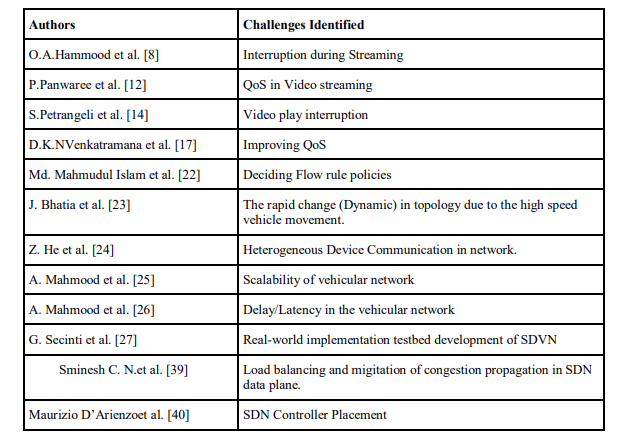
Hence it is observed through the analysis of various papers that the improvement in various QoS parameters will also improve the end-users multimedia streaming experience in VANETs by integrating it with SDN. Moreover, introducing a centralised controller makes policy implementation easy, and SDN also improves the scalability of the entire network. However, there is a research gap in multimedia stream optimization of SDN controllers. Hence, in this paper, we have modified the open source POX controller to enhance the QoS and QoE parameters of multimedia streaming. Table 1 illustrates the related studies and challenges determined
Table 1. Related Work Challenges Identified
3. THE PROPOSED WORK
3.1. Assumptions
The proposed work has made the following assumptions:
● The vehicles are in motion, and the map is familiar to all the nodes of the network.
● Each vehicle has a unique ID.
● All vehicles have omnidirectional antennas for transmission of data packets and control messages.
● Vehicle batteries are always fully charged. Assuming that batteries are always fully charged allows for more accurate comparisons between different vehicles or scenarios. This ensures that all simulations begin with the same initial conditions
3.2. Modified POX Controller
POX is a python based updated version of NOX, shown in Figure 2. It is a simple SDN controller popularly used in research as a prototyping tool. It can easily integrate with Mininet-Wifi for SDVN network simulation. POX has stock functions in the form of a python program like forwarding L1 and L2 learning, which can be invoked at the start [28]. In this simulation, the configuration of the POX controller is such that OpenFlow switches act as a type of L2 learning switch. It acts like pyswitch in NOX, but the implementation is very different. This switch learns the L2 addresses and installs the flow based on an exact match for as many fields as possible.
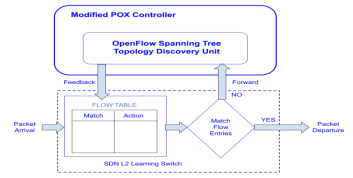
Figure 2. Block Diagram of Modified POX Controller
Hence different connections will result in different flows being installed. The POX Controller is configured to implement the OpenFlow Spanning Tree. The discovery component is used to build a holistic view of the network topology and construct the spanning tree. We also disable flooding on nodes that are not part of the tree
Algorithm 1. Algorithm for Network Setup before Simulation

Algorithm 1 is used to set up the simulation network. Then, the Modified POX SDN Controller, number of roadside units, number of cars, number of roads, map dimensions, interconnections between cars and RSUs, and simulation period are initialized.
3.3. Multimedia Traffic Generation
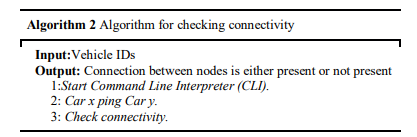
As discussed in the last section, once the simulation environment setup is complete, the connectivity between the vehicular nodes can be checked using the ping command. Algorithm 2 describes the steps in checking connectivity between various car nodes using the ping command.
Algorithm 2.Algorithm for checking connectivity
As the connection between the vehicle nodes is established and checked, the multimedia traffic generated using the iPerf tool [29]. As the streaming begins, we start collecting the UDP performance data with data rates varying from 1 to 1000Mbps. The packet length has been fixed to 1024 bytes. Algorithm 3 describes the generation of multimedia traffic between car nodes using the iPerf tool for 300 seconds. QoS values obtained during simulation are stored in a text file for further analysis
Algorithm 3.Algorithm for Custom MultimediaTraffic Generation

3.4. YouTube Video Stream in SDVN
The YouTube video streaming in SDVN is shown in Figure 3, where we want to stream video from car ‘a’ to car ‘b’.

Figure 3. Block Diagram representation of Video streaming in an SDVN
The car ‘a’ and car ‘b’ both require a video streaming application like VLC. First, car ‘a’ transmits the video stream packets to their nearest RSU-i; from this, RSU packets are transmitted to the base station, where it forwards the packet according to entries made in the flow table based on the destination [30][31].
If the path to the required destination is unknown, then the SDN controller is consulted for action. If the SDN controller knows the path to the required destination, it updates the flow table in SDN switches accordingly [32][33].
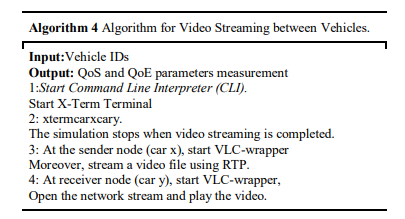
The video stream packets can now reach the destination node car ‘b’ through RSU-j as informed by the SDN controller. It must be noted that the base station consults the SDN controller only when it does not have any information about the destination. Algorithm 4 describes the steps involved in streaming the video file between the cars using Real-Time Protocol (RTP) with the help of a VLC wrapper [34].
Algorithm 4. Algorithm for Video Streaming between Vehicles
4. SIMULATION
4.1. Simulation Objective
The prime objective of the proposed work is to combine SDN with VANET, forming a hybrid SDV network. Also, to evaluate the quality of video streaming by measuring QoS metrics like Throughput, Delay, and Packet Delivery Ratio and QoE parameters like Peak Signal to Noise Ratio, Structural Similarity Index Measure and Video Quality Model under different traffic scenarios with the help of tools like iPerf, X-Term and VLC-Wrapper, for VANET and Modified POX controllers.
4.2. Performance Metrics
Following performance metrics are considered for evaluation [35][36][37][38]:
Throughput : It is the max. transmission data rate between any given source node and any give destination node. We have used the iPerf tool to measure this parameter.
End-To-End Delay: It is the time required for data packets to reach the destination node from the source node in the network. We have used the iPerf tool to measure this parameter.
Packet Delivery Ratio[PDR]: It is the ratio of the data packets received to the data packets transmitted. We have used the iPerf tool to measure this parameter.
Peak Signal to Noise Ratio [PSNR]: It is the ratio signal’s max. power and the corrupting noise’s max. power affecting its representation.
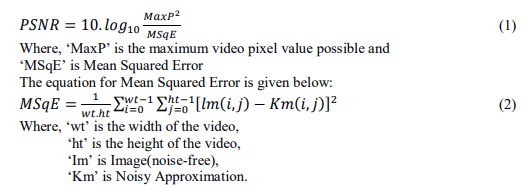
Structural Similarity Index Measure [SSIM]: It is used to measure the similarity between two images based on luminance (lm), contrast (ct) and structure (st). The SSIM measure between two same-sized images is given by

Video Quality Model (VQM):It is a DCT-based video quality metric based on colour transformation, DCT transform of blocks, conversion of DCT coefficient to local contrast(LC), conversion of LC to just noticeable difference, weighted pooling of mean and maximum distortions. In general, VQM is represented by the equation:
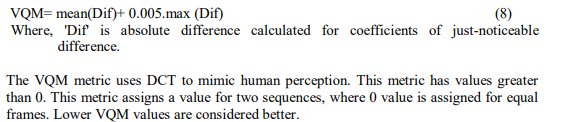
4.3. Simulation Tools
For simulation, Ubuntu operating system version 16 was used. SUMO version 1.1 and MininetWifi [18 were used for generating traffic movement and implementing network architecture. The iPerf, MSU-VQMT and ping utility tools were used for performance measurement and VLCwrapper for video streaming. GNU Plot is used to represent the results in graphical format.
4.4. Simulation Scenarios
4.4.1. Network scheme
The First network scheme was developed using Mininet-Wifi Graph with manually drawn roads and placed RSUs on the grid. The primary purpose of the first scenario is to measure the QoS and QoE parameters in dense traffic, as shown in figure 4a.For the second scenario, SUMO simulates the network using a real-world map. The primary purpose of the second scenario is to measure the QoS and QoE parameters in real-world traffic, as shown in Figure 4b.

Figure 4a. Manually developed Traffic Scenario

Figure 4b. Real World Map
4.4.2. Parameters for Simulation
The parameters considered for simulation are specified in table 2.
Table 2. Scenario Simulation Parameters

5. SIMULATION RESULTS AND ANALYSIS
5.1. Video streaming using X-Term and VLC
Figure 5 shows the screenshots of video streaming using the VLC media player. A video of size 5.9MB with 320 x 180 pixels resolution and 24 frames per second was successfully streamed between Car 3 and Car 5.

Figure 5. Screenshot of Video Streaming between Car 3 (Source) and Car 5(Destination) using VLC Media Player
5.2. First Scenario
In this scenario, the vehicular nodes are in close proximity, leading to a dense traffic scenario. We evaluate the performance of VANET and SDVN with a modified POX controller for a 500m x 500m grid. Tables 1 and 2 show the obtained results, and the parameters are plotted using the GNU plot.
Table 3. QoS Parameters Performance Comparison for Manual Traffic Scenario.
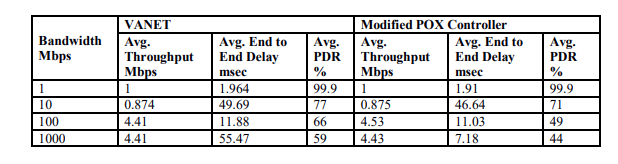
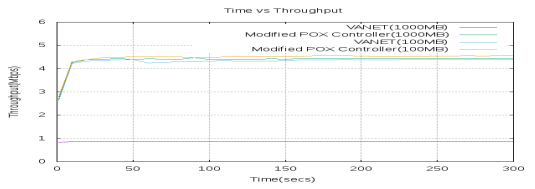
Figure 6.Time Vs Throughput for 500m x 500m Manual Traffic Scenario
In this scenario, cars and RSUs are very near each other; hence all the cars are always in range. Figure 6 and Table 3 show that the throughput values for VANET and SDVN implemented using Modified POX controllers are identical except for bandwidth 1000Mbps, where the throughput of Modified POX is 80% better than VANET. This behaviour is observed because the Modified POX controller saves time by reusing the components to select routes and identify the topology. As shown in Figure 7, the PDR of VANET is better than the Modified POX controller for bandwidths 10, 100 and 1000 Mbps. The VANET has a 7% to 26% better packet delivery ratio than the Modified POX controller. This is because the throughput of VANET was less than POX, resulting in less packet loss, and thus the VANET was able to perform better than Modified POX marginally.

Figure 7.Time Vs PDR for 500m x 500m Manual Traffic Scenario
As shown in Figure 8, The End-To-End Delay of both VANET and Modified POX are identical except for a bandwidth 1000Mbps, where the VANET has an 87% higher delay than the Modified POX controller.

Figure 8.Time Vs Delay for 500m x 500m Manual Traffic Scenario
Table 4. QoE Parameters Performance Comparison for Manual Traffic Scenario

Figures 9, 10, 11 and Table 4 show that the PSNR, SSIM and VQM values obtained for the Modified POX are better than VANET. This behaviour is observed because the OpenFlow controller is highly optimised for such scenarios. In addition, the Modified POX controller has marginally improved performance because of the usage of spanning-tree, which prevents the flooding of packets.
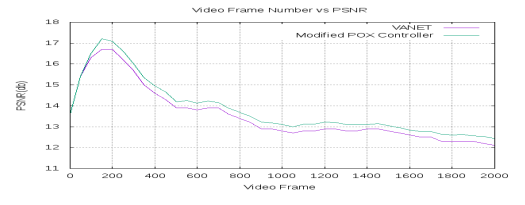
Figure 9. Video Frame VS PSNR(dB) for 500 m x 500 m Manual Traffic Scenario

Figure 10. Video Frame VS SSIM for 500m x 500m Manual Traffic Scenario

Figure 11. Video Frame VS SSIM for 500 m x 500 m Manual Traffic Scenario.
An improvement of 3% to 10% for various QoE parameters was observed. The Modified POX controller also saves time by reusing the components for route selection and topology discovery.
5.3. Second Scenario
In this scenario, we evaluate the behaviour of VANET, and SDVN implemented using a Modified POX controller for a Real-world map. Table 5 shows the result obtained, and the parameters are plotted using the GNU plot.
Table 5. Simulation results Obtained For Real World Scenario.
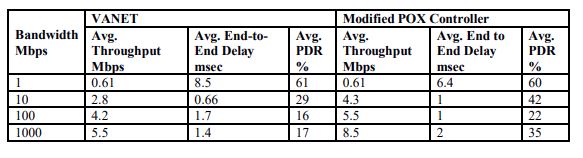
The cars and RSUs are placed on a real-world map in this scenario. The cars are in range for nominal amount of time. As shown in Figure 12 and Table 5, the throughputs for bandwidth 1Mbps are identical for both VANET and Modified POX controllers, but for 10, 100, and 1000Mbps, the Modified POX is 24 to 38% better than the VANET.
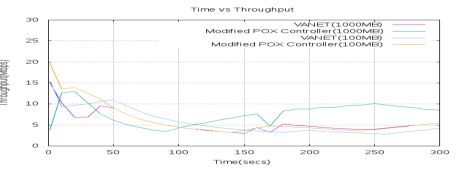
Figure 12. Time Vs Throughput for Real World Map.
As shown in Figure 13, the packet delivery ratio of VANET and Modified POX controller is identical for 1Mbps bandwidth, but for 10, 100 and 1000Mbps, the Modified POX is 27 to 51% better than VANET.
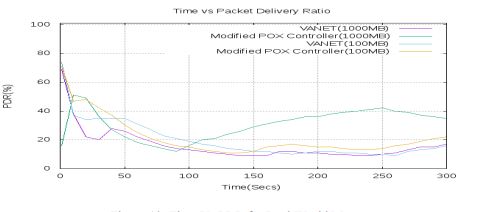
Figure 13. Time Vs PDR for Real World Map.
As shown in Figure 14, the End-To-End Delay of the VANET is slightly higher than the Modified POX controller, i.e., up to 24% higher.
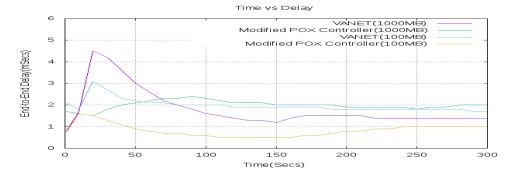
Figure 14. Time Vs Delay for Real World Map.
Table 6. Performance Comparison of SDN Controllers for Real World Map.

In this scenario, since the cars and Road Side Units are placed on a real-world map and QoE results obtained are more realistic. As shown in Figures 15, 16, 17 and Table 6, the PSNR, SSIM and VQM values for the Modified POX Controller are better than that of VANET. This behaviour is observed because the POX controller is highly suitable for realistic traffic scenarios. This scenario also observed an improvement of 3% to 10% for various QoE parameters.

Figure 15 .Video Frame VS PSNR for Real World Map.
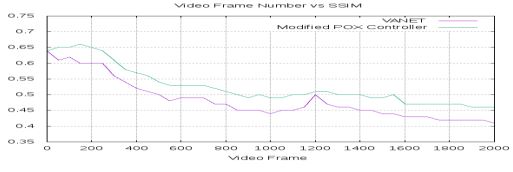
Figure 16 .Video Frame VS PSNR for Real World Map.

Figure 17 .Video Frame VS VQM for Real World Map.
5.4. Simulation Results Discussion
From all the scenarios, it is observed that the throughput of Modified POX was 38% to 87% better than the VANET, the End-To-End Delay of VANET was 24% to 97% higher than that of Modified POX, and the packet delivery ratio of Modified POX was up to 21 to 42% better than VANET. Here we have successfully streamed a standard definition video of size 5.9MB with 320 x 180 pixels resolution and 24 frames per second between two car nodes. The result proves that even in a dynamic network such as VANET, we can have better QoE with higher bandwidth data transfer rates. The obtained results are critical for developing commercial video streaming applications where QoE is vital. From all the above simulations, it is observed that the Modified POX Controller provides a consistent marginal improvement of 3% to 10% over the VANET. These results show the importance of POX controllers in an SDVN architecture, especially for video streaming applications with better Quality of Experience. Even though the POX controller performs better than the VANET in most scenarios, there is still a large area for improving the End-To-End Delay for a better video stream. These results play an essential role in understanding the behavior of POX controllers in SDVN architecture, especially for Non-Safety applications like video streaming, where higher data rates are required, and the results of this simulation show improvement in QoS and QoE with scalable network architecture.
6. CONCLUSION
In this paper, we have successfully integrated SDN and VANET, along with developing the Modified POX controller with a Spanning Tree Algorithm. We have compared the performance of the VANET and Modified POX controller for different vehicular network scenarios using QoS and QoE parameters like throughput, delay, packet delivery ratio, PSNR, SSIM and VQM for video streaming. From the simulation using Mininet-Wifi, we have observed that both VANET and SDVN perform almost similarly for low bandwidth (data rates). However, as we increase the bandwidth using the iPerf tool, the Modified POX controller outperforms the VANET.
We also observe that Standard Definition (SD) video streaming has fewer video freezes when compared with Full-High Definition (HD) video streaming. From simulations, we could show that Software-Defined Vehicular Networks can be implemented and used for Non-Safety applications like video streaming and the Modified POX controller is much better suited for such applications.
FUTURE WORK
In future, we would like to improve the performance of the POX controller further so that video freezes for Full-HD videos can also be reduced.
CONFLICTS OF INTEREST
The authors declare no conflict of interest.
REFERENCES
[1] SA Kulkarni, G RaghavendraRao, “Modeling security issues for multipath routing in vehicular networks for IEEE 802.11 p”, International Conference on Emerging Trends in Communication, Control, Signal Processing and Computing Applications (C2SPCA), Oct-2013, pp 1-4.
[2] SoufianToufga, Philippe Owezarski, Slim Abdellatif, Thierry villemur, “An SDN hybrid architecture for vehicular networks: Application to Intelligent Transport System”, 9th Eu European Congress on Embedded Real-Time Software And Systems (ERTS), Jan -2018.
[3] Matthew N. O. Sadiku, Nishu Gupta, Kirtikumar K. Patel, and Sarhan M. Musa “An Overview of Intelligent Transportation Systems in the Context of Internet of Vehicles”, Internet of Vehicles and its Applications in Autonomous Driving, Springer, 2021.
[4] Nick McKeown, Tom Anderson, HariBalakrishnan, Guru Parulkar Larry Peterson, Jennifer Rexford,Scott Shenker Jonathan Turner “OpenFlow: Enabling Innovation in Campus Networks”, ACM SIGCOMM Computer Communication Review, April-2008, pp. 69-74.
[5] Uday Mane, SA Kulkarni, “QoSrealisation for routing protocol on VANETs using combinatorial optimization”,Fourth international conference on computing, communications and networking technologies (ICCCNT), July 2014, pp 1-5.
[6] SA Kulkarni, G RaghavendraRao, “Quality of Service Issues for AODV Applied to Vehicular Networks”, Advances in Computer Science and Engineering, Pushpa Publishing House, Vol 10, Issue2, May – 2013.
[7] BandiSumanth, “Designing an Openflow Controller for data delivery with end-to-end QoS over Software-Defined Networks”, Master of Technology Thesis, Indian Institute of Technology, Kharagpur, May 2016.
[8] O.A. Hammood, N. Nizam, M. Nafaa, W.A. Hammood, “RESP: Relay Suitability-based Routing Protocol for Video Streaming in Vehicular Ad Hoc Networks”, International Journal of Computer Communications and Control, Feb-2019.
[9] SUMO at https://www.eclipse.org/sumo/
[10] Bustos-Jimenez, Javier, Rodrigo Alonso, CamilaFaundez, Hugo Meric, “Boxing experience:Measuring QoS and QoE of multimedia streaming using NS3, LXC and VLC”, Local Computer Networks Workshops (LCN Workshops), IEEE Conference, Sept – 2014, pp. 658–662.
[11] NS3 at https://www.nsnam.org/.
[12] ParichatPanwaree, JongWon Kim, ChaoditAswakul, “Packet Delay and Loss Performance of Streaming Video over Emulated and Real OpenFlow Networks”, 29th International Technical Conference on Circuit/Systems Computers and Communications (ITC-CSCC), July 2014, pp. 777
[13] Mininet at: https://github.com/mininet/mininet/wiki/Introduction-tomininet
[14] Stefano Petrangeli, Tim Wauters, Rafael Huysegems, Tom Bostoen, Filip De Turck, “Network-based Dynamic Prioritization of HTTP Adaptive Streams to Avoid Video Freezes”, IFIP/IEEE International Symposium on Integrated Network Management (IM), IEEE, May-2015.
[15] Mingfu Li, Chien-Lin Yeh, Shao-Yu Lu, “Real-Time QoE Monitoring System for Video Streaming Services with Adaptive Media Playout”,International Journal of Digital Multimedia Broadcasting,Hindawi,Feb-2018.
[16] R. Bhattacharyya, A. Bura, D. Rengarajan, M. Rumuly, S. Shakkottai, D. Kalathil, R. K. Mok, A.Dhamdhere, “Qflow: A reinforcement learning approach to high QoE video streaming over wireless networks”, July-2019. [Online].Available:https://www.caida.org/publications/papers/2019/qflow/qflow.pdf.
[17] DharaniKumariNoojiVenkatramana, ShylajaBanagiriSrikantaiah, JayalakshmiMoodabidri, “SCGRP:SDN enabled connectivity-aware geographical routing protocol of VANETs for the urban environment”, IET Network., July 2017, pp. 102-111.
[18] Ramon R. Fontes, Samira Afzal, Samuel H. B. Brito, Mateus A. S. Santos, Christian Esteve Rothenberg “Mininet-WiFi: Emulating Software-Defined Wireless Networks”, 11th International Conference on Network and Service Management (CNSM), IEEE, Nov-2015, pp. 384-389.
[19] Kaushik R. Chowdhury and Ian F. Akyildiz, “CRP: A Routing Protocol for Cognitive Radio Ad Hoc Networks”, IEEE Journal on Selected Areas in Communications, May-2011.pp 794 – 804.
[20] SomalyThun, ChaiyachetSaivichit, “Performance Improvement of Vehicular Ad Hoc Network Environment by Cooperation between SDN/OpenFlow Controller and IEEE 802.11p”, Journal of Telecommunication, Electronic and Computer Engineering, 2017, pp. 2-6.
REFERENCES
1] SA Kulkarni, G RaghavendraRao, “Modeling security issues for multipath routing in vehicular networks for IEEE 802.11 p”,International Conference on Emerging Trends in Communication,Control Signal Processing and Computing Applications (C2SPCA), Oct-2013, pp 1-4.
[2] SoufianToufga, Philippe Owezarski, Slim Abdellatif, Thierry villemur, “An SDN hybrid architecture for vehicular networks: Application to Intelligent Transport System”, 9th Eu European Congress on Embedded Real-Time Software And Systems (ERTS), Jan -2018.
[3] Matthew N. O. Sadiku, Nishu Gupta, Kirtikumar K. Patel, and Sarhan M. Musa “An Overview of Intelligent Transportation Systems in the Context of Internet of Vehicles”, Internet of Vehicles and its Applications in Autonomous Driving, Springer, 2021.
[4] Nick McKeown, Tom Anderson, HariBalakrishnan, Guru Parulkar Larry Peterson, Jennifer Rexford,Scott Shenker Jonathan Turner “OpenFlow: Enabling Innovation in Campus Networks”, ACMSIGCOMM Computer Communication Review, April-2008, pp. 69-74.
[5] Uday Mane, SA Kulkarni, “QoSrealisation for routing protocol on VANETs using combinatorial optimization”, Fourth international conference on computing, communications and networking technologies (ICCCNT), July 2014, pp 1-5.
[6] SA Kulkarni, G RaghavendraRao, “Quality of Service Issues for AODV Applied to Vehicular Networks”, Advances in Computer Science and Engineering, Pushpa Publishing House, Vol 10, Issue 2,May – 2013.
[7] BandiSumanth, “Designing an Openflow Controller for data delivery with end-to-end QoS over Software-Defined Networks”, Master of Technology Thesis, Indian Institute of Technology,Kharagpur, May 2016.
[8] O.A. Hammood, N. Nizam, M. Nafaa, W.A. Hammood, “RESP: Relay Suitability-based Routing Protocol for Video Streaming in Vehicular Ad Hoc Networks”, International Journal of Computer Communications and Control, Feb-2019.
[9] SUMO at https://www.eclipse.org/sumo/
[10] Bustos-Jimenez, Javier, Rodrigo Alonso, CamilaFaundez, Hugo Meric, “Boxing experience:Measuring QoS and QoE of multimedia streaming using NS3, LXC and VLC”, Local Computer Networks Workshops (LCN Workshops), IEEE Conference, Sept – 2014, pp. 658–662.
[11] NS3 at https://www.nsnam.org/.
[12] ParichatPanwaree, JongWon Kim, ChaoditAswakul, “Packet Delay and Loss Performance of Streaming Video over Emulated and Real OpenFlow Networks”, 29th International Technical Conference on Circuit/Systems Computers and Communications (ITC-CSCC), July 2014, pp.2-6
13] Mininet at: https://github.com/mininet/mininet/wiki/Introduction-tomininet
[14] Stefano Petrangeli, Tim Wauters, Rafael Huysegems, Tom Bostoen, Filip De Turck, “Network-based Dynamic Prioritization of HTTP Adaptive Streams to Avoid Video Freezes”, IFIP/IEEE International Symposium on Integrated Network Management (IM), IEEE, May-2015.
[15] Mingfu Li, Chien-Lin Yeh, Shao-Yu Lu, “Real-Time QoE Monitoring System for Video Streaming Services with Adaptive Media Playout”, International Journal of Digital Multimedia Broadcasting,Hindawi, Feb-2018.
[16] R. Bhattacharyya, A. Bura, D. Rengarajan, M. Rumuly, S. Shakkottai, D. Kalathil, R. K. Mok, A.Dhamdhere, “Qflow: A reinforcement learning approach to high QoE video streaming over wireless networks”, July-2019.[Online].Available:https://www.caida.org/publications/papers/2019/qflow/qflow.pdf.
[17] Dharani Kumari Nooji Venkatramana, Shylaja Banagiri Srikantaiah, Jayalakshmi Moodabidri, “SCGRP: SDN enabled connectivity-aware geographical routing protocol of VANETs for the urban environment”,IET Network., July 2017, pp. 102-111.
[18] Ramon R. Fontes, Samira Afzal, Samuel H. B. Brito, Mateus A. S. Santos, Christian EsteveRothenberg “Mininet-WiFi: Emulating Software-Defined Wireless Networks”, 11th International Conference on Network and Service Management (CNSM), IEEE, Nov-2015, pp. 384-389.
[19] Kaushik R. Chowdhury and Ian F. Akyildiz, “CRP: A Routing Protocol for Cognitive Radio AdHoc Networks”, IEEE Journal on Selected Areas in Communications, May-2011.pp 794 – 804.
[20] SomalyThun, ChaiyachetSaivichit, “Performance Improvement of Vehicular Ad Hoc Network Environment by Cooperation between SDN/OpenFlow Controller and IEEE 802.11p”, Journal of Telecommunication, Electronic and Computer Engineering, 2017, pp. 2-6.
[21] M. Chan, C. Chen, J. Huang, T. Kuo, L. Yen and C. Tseng, “OpenNet: A simulator for softwaredefined wireless local area network”, IEEE Wireless Communications and Networking Conference (WCNC), 2014, pp. 3332-3336.
[22] Md. Mahmudul Islam, Muhammad ToahaRaza Khan, Malik Muhammad Saad, Dongkyun Kim “Software-defined vehicular network (SDVN): A survey on architecture and routing”, Journal of Systems Architecture, Elsevier, Dec-2020.
[23] Jmal, Rihab, Fourati, Lamia, “Implementing shortest path routing mechanism using Openflow POX controller”, International Symposium on Networks, Computers and Communications (ISNCC), June 2014, pp. 1-6.
[24] “iPerf Project”, [Online]. Available: https://iperf.fr/
[25] Varun.P.Sarvade, Dr S.A.Kulkarni, “Performance Analysis of IEEE 802.11ac for Vehicular Networks using Realistic Traffic Scenarios”, International Conference on Advances in Computing,Communications and Informatics (ICACCI), IEEE, Sept-2017, pp.137-141.
[26] “MSU Video Quality Measurement Tool (VQMT) User Manual” Documentation, [Online]. Available: http://www.compression.ru/video/quality_measure/src/MSU_VQMT_Documentation.pdf
[27] Maria Torres Vega, Antonio Liotta, “Cognitive Real-Time QoE Management in Video Streaming Services”, 30th International Teletraffic Congress, IEEE, Sep-2018, pp-123-128.
[28] M. T. Vega, D. C. Mocanu, J. Famaey, S. Stavrou and A. Liotta, “Deep Learning for Quality Assessment in Live Video Streaming”, IEEE Signal Processing Letters, June – 2017, pp. 736-740.
[29] Bomin Mao, ZubairMd, Fadlullah, Fengxiao Tang, Nei Kato, Osamu Akashi, Takeru Inoue, KimihiroMizutani, “Routing or Computing? The Paradigm Shift Towards Intelligent Computer Network Packet Transmission Based on Deep Learning”, IEEE Transactions on Computers, vol. 66, no.11,Nov – 2017, pp. 1946-1960.
[30] T. A. Tang, L. Mhamdi, D. McLernon, S. A. R. Zaidi and M. Ghogho, “Deep learning approach for Network Intrusion Detection in Software Defined Networking” International Conference on Wireless Networks and Mobile Communications (WINCOM), IEEE, Feb-2016, pp. 258-263.
[31] Q. Niyaz, W. Sun, and A. Y. Javaid, “A deep learning-based DDoS detection system in software defined networking (SDN)”, Nov-2016. [Online]. Available: http://arxiv.org/abs/1611.07400
[32] Pablo Piol, Otoniel Lopez, Miguel Martnez, Jos Oliver, Manuel P. Malumbres, “Modeling Video Streaming over VANETs”, ACM Workshop on Performance monitoring and measurement of heterogeneous wireless and wired networks, ACM, Oct-2012.
[33] Slamet Indriyanto, Muhammad Najib Dwi Satria, Andira Rizky Sulaeman, Rifqy Hakimi, Eueung Mulyana, “Performance Analysis of VANET Simulation on Software Defined Network”,3rd International Conference on Wireless and Telematics, IEEE, July- 2017.
[34] Kuldip Singh Atwal, Ajay Guleria, Mostafa Bassiouni, “SDN based Mobility Management and QoS Support for Vehicular Ad-hoc Networks Communications”, International Conference on Computing, Networking and Communications (ICNC): Mobile Computing and Vehicle, IEEE, pp. 659-664.
[35] Wei Huang, Lianghui Ding, De Meng, Jenq-Neng Hwang, YilingXu, and Wenjun Zhang, “QoEBased Resource Allocation for Heterogeneous Multi-Radio Communication in Software-Defined Vehicle Networks”, Special Section on High Mobility 5G LTE-V: Challenges and Solutions, IEEE,Feb-2018, pp.3387-3399.
[36] Mahdi Asefi, Jon W. Mark, and Xuemin (Sherman) Shen, “A Mobility-Aware and Quality-Driven Retransmission Limit Adaptation Scheme for Video Streaming over VANETs”, IEEE Transactions on Wireless Communications, VOL. 11, NO. 5, MAY 2012, pp.1817-1827.
[37] MostafaAsgharpoorSalkuyeh and BahmanAbolhassani, “An Adaptive Multipath Geographic Routing for Video Transmission in Urban VANETs”, IEEE Transactions on Intelligent Transportation Systems, IEEE, 2016, pp 1-10.
[38] Hyunwoo Nam, Kyung-Hwa Kim, Jong Yul Kim and Henning Schulzrinne, “Towards QoE-aware Video Streaming using SDN”, IEEE Global Communications Conference, IEEE, Dec-2014. Sminesh C. N., Grace Mary Kanaga E. And Ranjitha K., “A Proactive Flow Admission And ReRouting Scheme For LoadBalancing And Mitigation Of Congestion Propagation In SDN Data Plane” Internation Journal Of ComputerNetworks And Communications(IJCNC) Vol.10,No. 6, Nov-2018.
[39] Maurizio D’Arienzo, Manfredi Napolitano and Simon Pietro Romano, “Controller Placement Problem resiliency evaluation in SDN-based architectures”, Internation Journal of Computer Networks and Communications(IJCNC), Vol.14, No.5, Sep. 2022
AUTHOR

Mr.Varun P. Sarvade is currently working as an Assistant Professor in the Computer Science Department of BGM Institute of Technology, Mudhol, India, with an experience of 10 years. In addition, he has three years of research experience in Computer Networks and Deep Learning. He has also worked as Assistant System Engineer in Tata Consultancy Services, Chennai, India. His area of interest includes Digital Electronics, Microcontrollers, Computer Networks and Machine Learning.

Dr.Shrirang A. Kulkarni is currently working as an Associate Professor with the Department of Computer Science and Engineering at the National Institute of Engineering, Mysore, India. He has also worked as Postdoctoral Fellow with the School of Global Health Management and Informatics, University of Central Florida. He earned his PhD in Computer and Information Science from Visvesvaraya Technological University in 2012. He has more than 40 publications in peer-reviewed journals and conference proceedings. His current research includes developing new algorithms for analysing healthcare data using machine learning. He is also a senior Association for Computing Machinery (ACM) member

 International Journal of Computer Networks & Communications (IJCNC)