
IJCNC 05
Investigation of Ant Colony Optimization Algorithm for Efficient Energy Utilization in Wireless Sensor Network
Shanmugavalli R1 and Subashini P2
1Department of Computer Science, Avinashilingam Institute for Home Science and Higher Education for Women, Coimbatore, Tamil Nadu, India
2Department of Computer Science, Centre for Machine Learning and Intelligence, Avinashilingam Institute for Home Science and Higher Education for Women, Coimbatore, Tamil Nadu, India
Abstract
Maintaining the energy conservation is considered as an important approach to increase the lifetime of WSN. In fact, an energy reduction mechanism is considered as the main concept to enhance the lifespan of the network. In this paper, the performance analysis/evaluation of optimization technique, specifically, Ant Colony Optimization (ACO) and modified ACO (m-ACO) in the routing method are investigated. This network analysis is done by 100 iterations and differentiated with 50, 75 and 100 numbers of nodes. Finally, experimental results illustrate that the performance of m-ACO algorithm obtained the obvious performance, which is comparatively better than ACO algorithm, because it improves the routing efficiency by pheromone evaporation control and energy threshold value. It demonstrates that m-ACO algorithm gives better results than ACO in terms of throughput (1.41%), transmission delay (1.43%), packet delivery ratio (1.41%), energy consumption (2.05%), and the packet loss (9.70%). The convergence rate is analysed for ACO and m-ACO algorithms with respect to 100 number of iterations for WSNs.
Keywords
Nature Inspired Computational (NIC) Algorithms, Energy Efficiency, Route Discovery, Convergence Rate and Wireless Sensor Network (WSN)
1. Introduction
This WSN is one of the emerging technologies which helped to gather highly meaningful information from various sources. In WSN, greater amount of sensor nodes are incorporated wirelessly and deployed in the problem area. Further, every sensor is an intermediator which supports successful data transmission by creating network connection between source and destination. The sensor node is an electronic device that contains four types of elements, namely, sensing unit, processing unit, communication unit and power unit. The sensing unit collects the required information and converts the analogue signal into digital signal. Moreover, the processing unit controls all other functionalities of the sensor node, using the microcontroller as well as microprocessor, and it maintains a tiny memory. The communication unit is responsible for transmitting and receiving the data packets in wireless sensor network. Energy unit distributes the power to all other components of sensor node which is considered an important part in WSN. Figure 1 illustrates the components of wireless sensor node. Energy utilization is an essential factor in WSN, because, every wireless sensor node contains tiny batteries for energy utilization
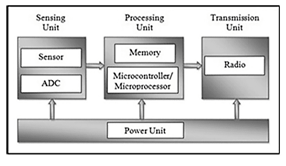
Figure 1.Components of Wireless Sensor
Many researchers solve these problems using different optimization techniques such as protocol optimization, route selection method, algorithms-based optimization, route discovery mechanism, node deployment methodology, etc. The route discovery mechanism mostly helps to minimize the nodes energy usage as well as improve the lifespan of WSN by selecting an efficient route [1][2]. Routing is a process to select the appropriate route to transmit the data from sender to receiver in WSN. Routing is divided into two types, namely, single-hop routing and Multi-hop routing. In single-hop communication, source and destination are directly communicated without using any intermediate nodes in single-hop communication. In multi-hop routing, the source node communicates that destination with the help of intermediate nodes. The sensor node is unable to communicate other nodes larger than radio range of a single node. The multi-hop routing is mostly used in WSN because it extends the network coverage and improves the connectivity
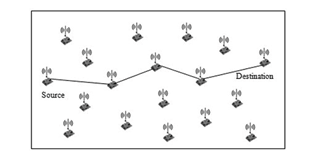
Figure 2. Multi-hop Routing in WSNs
Figure 2. illustrates the multi-hop routing in WSN scenario. This network contains a source and destination node to transmit the data packets. In this scenario, line indicates the path between source to destination with the intermediate nodes. In this path, all the sensor nodes, except source and destination, are considered as intermediate nodes which help successful data transmission. In this case, the network takes four hops to reach the destination in wireless sensor network
This case investigates the comparative analysis of ACO and m-ACO algorithms to minimize the energy utilization and improve the WSN performance by route discovery mechanism. ACO algorithm is widely applied for scientific and complicated optimization problems like Traveling Salesman Problem (TSP), Quadrative assignment problem, Vehicle routing, Binary knapsack problem, Network routing and QoS (Quality of Service) [3]. Moreover, ACO algorithm is a major inspiration for developing several energy-efficient routing algorithms [4]. Further, ACO algorithm can identify the most optimal path to destination as well as reduce energy usage and increase network lifetime [5]. ACO algorithm is considered as a good solution to enhance the lifetime of WSN [6]. As per this analysis, m-ACO extends the performance more than traditional ACO such as stability and energy load balancing, and eventually, enhanced the network lifespan and minimized the energy utilization [7]. This conventional mechanism uses threshold value toeach node in WSN for energy balancing and controls death nodes. Furthermore, the pheromone evaporation rate is increased to avoid the frequently used path when the node’s energy is less than threshold. In this case, the results were differentiated by the metric of residual energy with different threshold values. This paper focuses on the comparison analysis of ACO and m-ACO algorithm in 100 iteration as well as differentiates with three increased number of nodes, namely, 50, 75 and 100. Therefore, the performance of both algorithms is investigated with various performance metrics, namely, energy consumption, packet delivery ratio, throughput, transmission delay, packet loss and the convergence rate. It inspires to conduct this work. The potential literature works of ACO and m-ACO in route discovery are cited. The major contribution of this work is analyses of various number of nodes, scenarios, and performance metrics.
The formation of the paper is organized as follows: Section II briefly discusses the literature study of this paper. Section III briefly discusses the comparative analysis of ACO algorithm, modified Ant Colony Optimization (m-ACO) and route selection process. Section IV presents the result and analysis of this comparative study. Finally, Section V concludes this paper and describes the future work.
2.Literature Review
There are more routing approaches based on NIC algorithms as well as optimization techniques to solve these energy-based routing challenges which illustrates in Table1. The authors have carried out a lot of optimization using the protocols and meta-heuristic algorithms which applied in many ways to WSN.
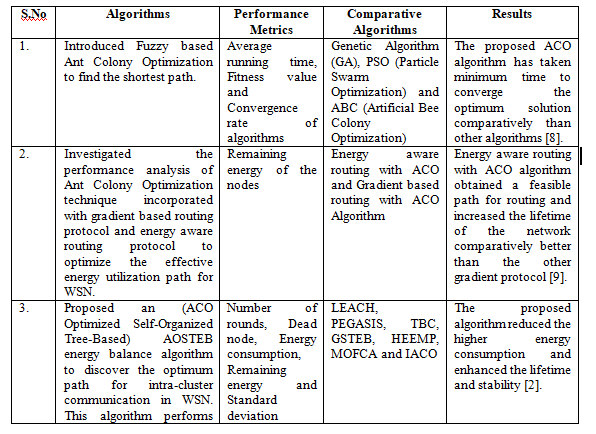
Table 1 Simulation Parameters
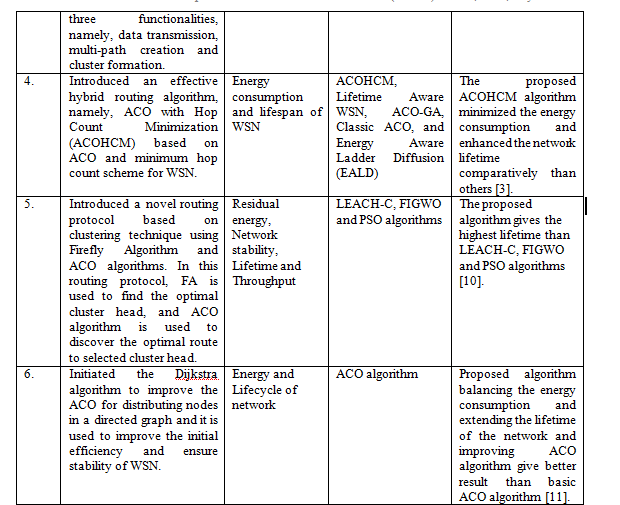
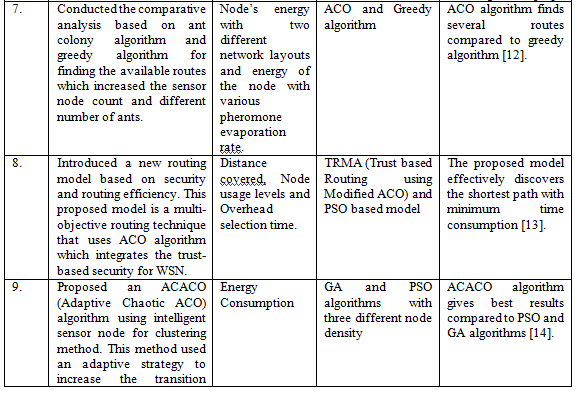
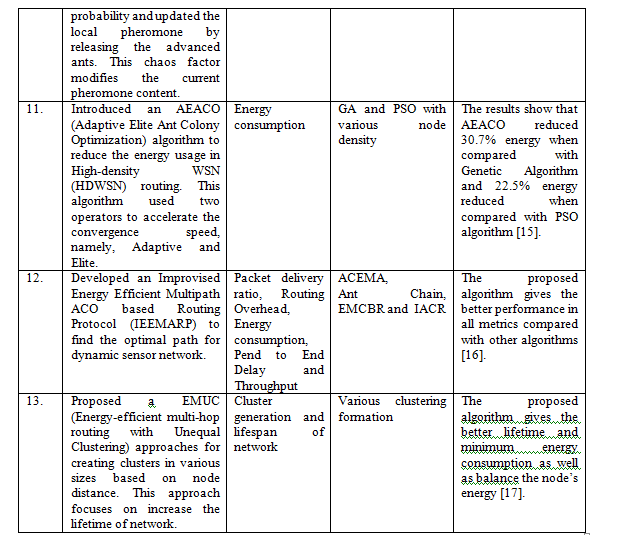
In this literature study, ACO algorithm was used to various routing problems to increase the network lifetime in WSN. Moreover, it was applied in different approaches, namely, fuzzy-based technique, routing mechanism, clustering methods, hybrid technique and optimization. In this investigation, the optimized and hybrid ACO algorithms give better performance when compared with ACO algorithm. However, sill some network problems are not completely solved in wireless sensor network. The results were taken in different performance metrics according to the problem. The next section briefly describes ACO and m-ACO algorithm and this comparison analysis.
3. Route Discovery Method using ACO and m-ACO Algorithms
3.1 Route Discovery using ACO Algorithm
The ACO algorithm is a heuristic approach and it applied to multiple computational problems for finding the optimum solutions by graphs. In this algorithm, the artificial ant is categorized into two types, namely, forward and backward ants. These ants support to find optimum route to reach the target in WSN. Concurrently, each node maintains a unique routing table for storing information on the neighbour nodes. They are, distance between node, neighbour node ID, nodes balance energy and the pheromone concentration of the path. Following that, this process will continue to occur till it reaches its destination.
In all the available routes, high level of pheromone concentration is considered the best route during the route discovery process. The ACO algorithm followed the probability selection method which is expressed from zero to one. Here, zero indicates non-occurrence and one indicates the probability of occurrence. In ACO algorithm, the probability selection is used for an ant selecting the neighbour nodes which represent the next hop node and the hop count. Moreover, the following equation (Equation (1)) is used to compute the probability selection of next hop selection [7].

In this equation, Pij is the probability of next hop from node i to j which is considered the hop count and i is represent the current node of route discovery and j is the next node. In this selection, the decision was made based on pheromone levels and heuristic data. T_ij denoted the pheromone concentration in the route of i and j. δ_ij described the heuristic energy of route node i and j. Moreover, ∝ and β indicate the various weight factors, and the pheromone concentration controlling weight indicated ∝. The weight of inspiration energy is indicated by β. The next hop node set is denoted by N_i. Those ants can select only next hop nodes of iis stored except the passed nodes.
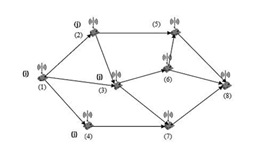
Figure 3. Example Scenario of WSNs
Example network scenario is created to explain the working process of ACO algorithm which is shown in Figure 3. This scenario totally contains eight nodes, and the nodes numbers is represented there. The node 1 (1) is the sender and node 8 (8) is the receiver node in the scenario. The purpose of this scenario is to select the optimum path in the meanwhile. Here, the i mentioned in equation 1 indicate the source node (Node (1)). Moreover, j indicates the neighbour nodes of i(Node (2), Node (3) and Node (4)) which is considered as next hop. In this case, node i chooses the following node j which is based on probability selection using equation 1. For example, if node3 is probably chosen as the next hop of node 1, it will change the position of i and j.
The next time node (3) is considered as the i node and neighbour nodes are considered as j such as node (6) and node (7). The same process is repeated till they find their destination which is indicated inFigures4 (a) and (b). In Figure 4 (b), the i node finds its destination as the node (8). Finally, data is transmitted from sender node (Node (1)) to target node (Node (8)).

Figure 4. Next hop selection in WSNscenario
The following equations describe how to compute the probability selection of next hop node in WSN.
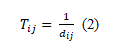
The pheromone concentration or pheromone initialization of the route from node i to j is calculated by Equation (2) The interspaces of the nodes between node i to node j is represented in d_ij. The heuristic energy of the node i and j is calculated by using Equation (3).

where, y indicates the present energy of the node j and the overall energy of the node set is denoted by ∑_(〖nϵN〗_i)▒E_n . Here, if node j has a higher remaining energy, it has more possibility to be chosen. Every artificial ant records the information about passed path in its memory. This information supports the ant in returning to the starting point along the same route and updating the pheromone level in the path. Pheromone evaporation is an important factor in ACO algorithm which is to avoid increasing pheromone concentrations on the path. If there is no evaporation, the paths chosen by the first ants would be overly appealing to the following ones. In this algorithm, the pheromone evaporation is used to avoid increasing the pheromone concentration rate. The pheromone evaporation rate is computed by Equation (4).

where, ρ represents the evaporation rate of pheromone concentration and this range is 0≤ρ≤1. In this way, the backward ants produce some quantity of pheromone into the path from node i to j which is calculated by using Equation (5)
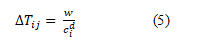
where, the weight factor is denoted in and it controls the pheromone concentration of the path (
,
). In this case, the cost of the link from node
to node
is denoted by
. The Equation (6) is used to compute pheromone discharge level in the path
i to j
.

All the nodes participated in route selection process in wireless sensor network when using ACO algorithm. Figure 5. illustrates the route discovery process with ACO algorithm in WSNs. Thus, the node with the minimum residual energy is involved in communication, and hence these terminals can easily go to the death stage.
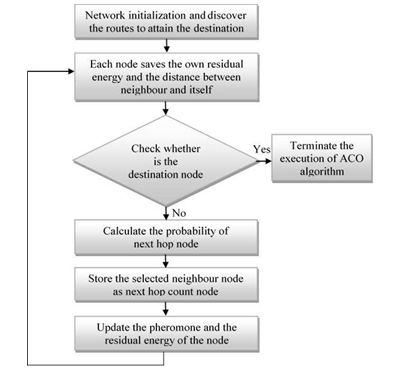
Figure 5. Flowchart of ACO algorithm
Also, it considers the best route with the high-level pheromone rate as the optimal route used frequently for data transmission. Therefore, it creates some network issues in wireless sensor network. There is link breakage, energy load unbalancing, and too much energy utilization in the nodes as well as decrease in the network lifespan. This paper introduces a new approach (m-ACO) solving these problems based on the threshold value, pheromone evaporation rate and the remaining energy of the nodes. Further, modified ACO (m-ACO) algorithm and their functionalities are explained below.
3.2 Route Discovery using M-ACO Algorithm
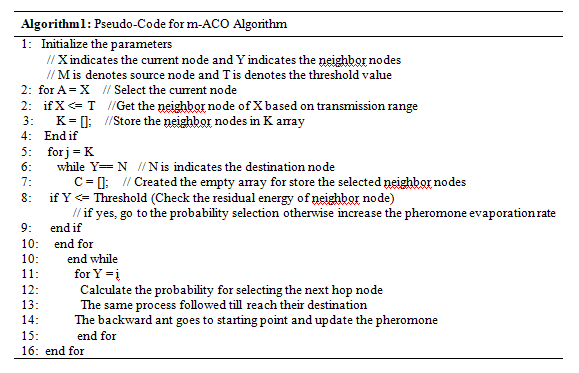
M-ACO algorithm followed the same routing methodology of ACO algorithm. Moreover, m-ACO algorithm pseudo-code is explained in Algorithm 1. The node energy will be decreased rapidly in the path when the pheromone level is high, because of the same nodes being used frequently. Thus, the energy optimized technique is used in this algorithm for minimizing too much of energy utilization and energy load balancing in wireless sensor network. Then, the threshold value is applied to each node of the network to avoid the death nodes and follow uniform energy consumption. Therefore, m-ACO algorithm also prolongs the lifespan of the network. In this algorithm, ant can be seen selecting the optimal path with high residual energy, and as if it has minimum pheromone rate in that path.Additionally, it includes the pheromone evaporation rate in a different way for reducing the high-level pheromone of the path. The packet structure of ant is illustrated in Figure 6 which contains the information of routing.
In this format, Type represents the ant type like forward ant and backward ant, and Src_Add illustrates source address. It contains the source node ID. Moreover, serial number of ants is illustrated in Seq.No and Visit_Node store the nodes ID that the number of nodes visited in each node. The Dest_Add indicates the destination address and the ant each time checks whether it is destination. Time represents the ant travelling time from source to destination.

Figure 6.Packet structure of ant
The following Figure 7 illustrates the table format of sensor node. It stores the neighbor node information in the route discovery process. Nodes ID is stored in ID and the neighbor nodes’ names stored in Neighbor ID format. Distance is represented by the distance between one node to neighbor nodes. The node’s residual energy is stored in Res_Energy column. Then the amount of pheromone contained in each path is stored in Pheromone_Rate7.

Figure 7.The table format of neighbour node
The energy optimization of m-ACO algorithm depends on various energy levels, namely, initial energy, remaining energy, and current energy of the nodes. The Equations (7) and (8)are used and compute the energy usage which is used to find various energy levels [4][5][7]. The transmission energy is calculated by using Equation (7), and received energy is calculated by Equation (8). The structure of these energy models of WSN is described in Figure 8. The parameters and values of energy consumption formula are presented in Table2.
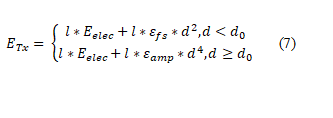
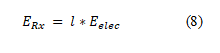
where,
E_Tx : Energy consumption for data transmission.
E_Rx : Energy Consumption for data receiving.
l : Data bits.
E_elec : Circuit energy loss.
ε_fs : Free space model.
ε_amp : Multipath Fading model.
d : Distance between nodes.
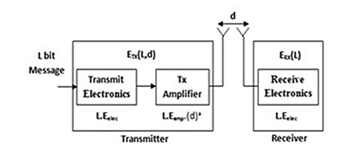
Figure 8.. Energy analysis of radio energy model
The following Equation (9) is used to compute the probability of next hop node selection, for node is the probability that ants will choose node j as the next hop from node i. The target of this probability selection is maximum of
.

where, Pij represents the probability selection of next hop node from i to j. Tij represents the pheromone concentration value in the path of i and j.δij indicates the heuristic energy of the route. ∑(〖nϵN〗_i)▒[T_ij ]^∝ is the pheromone level of between current node and the neighbour node in the path and ∑(〖nϵN〗_i)▒[δ_ij ]^β denoted the reciprocal energy of the nodes. After that, µ is indicates the weight factor of energy of the node j. Therefore, α and βindicate the weight factors of pheromone and distance of the nodes in this equation. Eijand Einitindicate the balance energy of node j and the earliest energy of node j, respectively.

The Equation(10) and Equation (11) are the pheromone updating formula. The ρ indicates the pheromone evaporation rate and ΔTij indicates the pheromone secreted rate in the route of node i to j respectively. The pheromone evaporation rate is updated as 0<ρ<1 which is used to control the high level of pheromone concentration. In this, H denotes the total number of intermediate nodes through which node i has traversed. The distance between the candidate node j and the target node b is given by d_jb. E_j and E_init indicate the energy of node j and remaining energy ratio respectively.
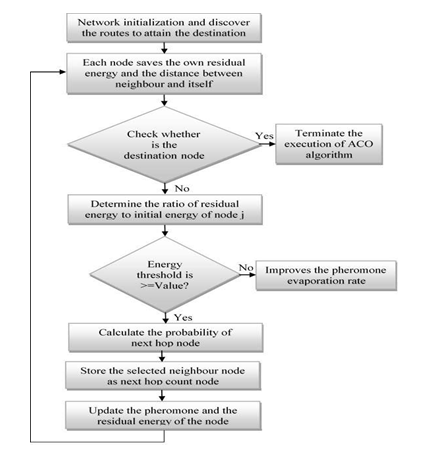
Figure 9. Flowchart of m-ACO algorithm
This algorithm controls the death node improves the network lifespan and minimizes the energy consumption. Figure 9 illustrates the flowchart of m-ACO algorithm working process. Nodes energy is substantially decreased in the current path of data transmission. Thus, there are chances of death node occurring in high level when the same path is used frequently. Moreover, the pheromone evaporation technique is introduced to solve this problem and avoid the current path of data communication. The pheromone evaporation rate is increased substantially when the energy of the node decreases to its threshold value. This method is used for avoiding the same path being used frequently and avoid death nodes of this network. In this case, m-ACO algorithm found the more available paths for probable selection when increase the node density.Moreover,the pheromone evaporation rate is increased and decreased based on the nodes energy of the route which also reduced the frequent path. However,it works effectively when usinglarge number of nodescomparatively than minimum node density.
4 . Results and Analysis
The experimental scenario is created to investigate the performance of ACO and m-ACO algorithms using WSN parameters. Moreover, the experimental scenario and the results are briefly discussed in the following section.
4.1 Simulation Parameters
In this experimental analysis, there is randomly deployed three different node density on the targeted region, and the size of the region is 1500*1500 meters. For this analysis, 50,75 and 100 number of nodes are selected, and every node in this network is deployed at various individual places on the targeted region. Moreover, these nodes are interconnected wirelessly with 500 transmission range to create the connection between them. This study not only focuses on 500 meters, it is inclusive of 200 to 300 meters range. This range is used for the evaluation of the performance efficiency of this transmission range. Further, the experimental scenario is created using wireless network parameters to data transmission. Table 3 illustrates the parameters that create WSN scenarios.
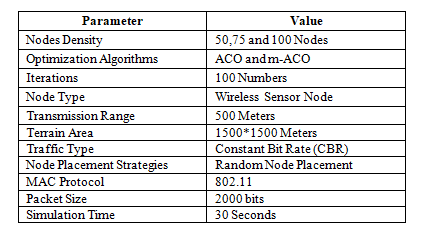
Table 3. Simulation Parameters
The following Figure 10 illustrates the experimental scenario with 50 number of nodes for this experimental analysis. In this scenario, the green color circles are represented in source and destination nodes. In this case, Node 1 is the source node, which is highlighted with green color, and node 2 is the destination which is represented with red color. Network transmission range represents the communication range of one node to another node and the range is 500 meters. A node communicates with the other node with more than 500 meters apart with the help of intermediate node. Therefore, intermediate nodes are indicated by blue color dots. Moreover, the X-axis and Y-axis represent the region of data communication.
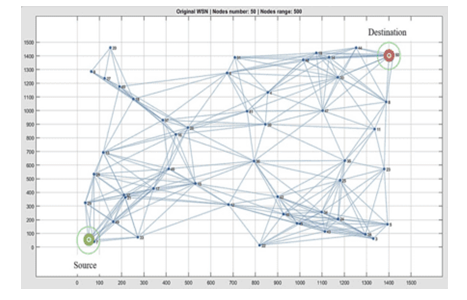
Figure 10.Experimental scenario of 50 nodes
The following experimental scenario (Figure 11) was differentiated with 75 number of nodes with random deployment. In this scenario, the intermediate node is placed randomly, but source and destination nodes followed the same region of 50 number of nodes.
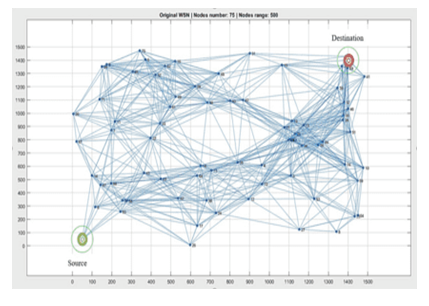
Figure 11.Experimental scenario of 75 nodes
The following figure represents the experimental scenario of 100 number of nodes (Figure 12). This scenario also followed the random node placement strategies for the intermediate nodes, but source and destination nodes followed the same region of all above experimental scenario.
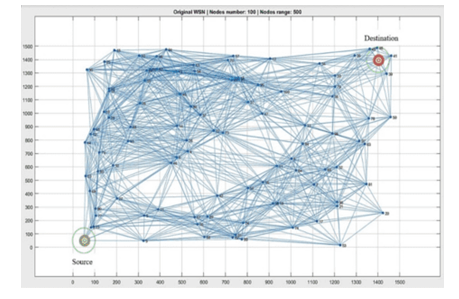
Figure 12.Experimental scenario of 100 nodes
The following Figure 13 represents the routing selection of ACO and m-ACO algorithms in the created WSN scenario. This figure shows the optimal route between source and destination which is represented with green and red color. Further, the violet color circles illustrate the intermediate nodes from black color lines. In this case, both algorithms find a greater number of optimal routes to destination source to destination. This scenario mainly focused on the optimal path of data transmission indicated with
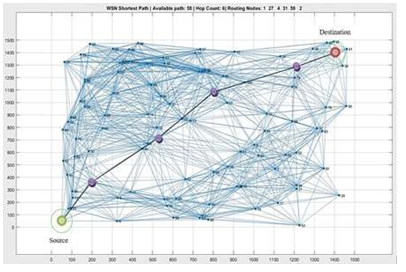
Figure 13.Route selection scenario in WSN
4.2 Discussion
The comparative analysis of ACO and m-ACO algorithms is carried out by 100 numbers of iterations with various node density. In this validation, three different node density, namely, 50, 75, and 100 nodes are used. This study uses 100 number of iterations to evaluate the performance of algorithms in each iteration. Moreover, the average performance is also analysed in both algorithms based on the performance of each 10 iteration. The following sections describe the performance of both algorithms with different node density. In this evaluation, the network performance is analysed by various metrics such as throughput, packet loss, transmission delay, packet delivery ratio, energy consumption and convergence rate. The following figure 14 described the performance of ACO and m-ACO algorithm.
4.2.1 Throughput
The number of data packets are successfully transmitted from source to destination in the given amount of time. The average throughput performance of ACO and m-ACO algorithms are illustrated in Figure 14 (a). The throughput performance is decreased in some iterations and improved at the end of the iteration when using ACO algorithm with 50 number of nodes. In ACO using 75 number of nodes, it is effectively prolonged till the 90th iteration is reached when compared with initial performance. Nevertheless, throughput decrease comparatively than ACO with 50 nodes end of the simulation but reached the best result in the overall performance. The analysis of ACO with 100 numbers of nodes is observed to gradually improve until 70th iteration is reached after which there is decrease until the last iteration. In the analysis of ACO algorithm, the best throughput value is obtained when placing 100 nodes than others and reaches the nearest best value of 70th iteration. In m-ACO algorithm, it was observed that it initially increased, and then decreased and increased a few times until reaching the 90th iteration when placed 50 nodes. However, the best throughput is obtained when reaching the 100th iteration comparatively than other algorithm with three increased number of nodes. Moreover, m-ACO algorithm has the most similar performance till 50th iteration when deployed 75 number of nodes. After 50th iteration, there is effective enhancement in most of the iterations, and the nearest best performance is obtained when 100 iteration is reached. In m-ACO with using 100 nodes, before 50th iteration the results effectively improved. There is the highest performance of this experimental analysis in 30th iteration. Moreover, after 50th iteration, it is slower than the previous performance and again effectively improved at the end of the iteration.
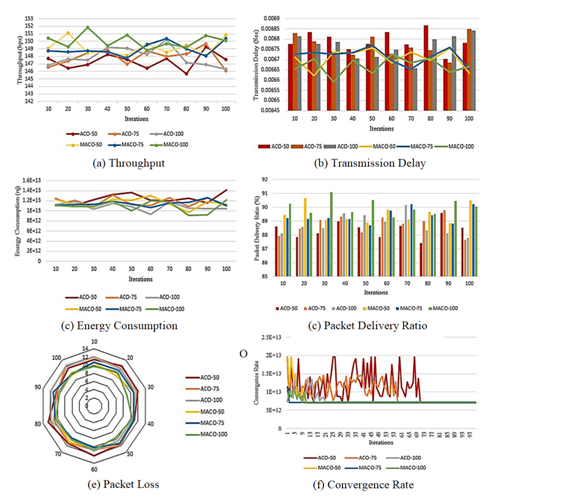
Figure 14 The performance analysis of ACO and m-ACO algorithms with various metrics
4.2.2 Transmission Delay
Transmission delay refers to the amount of time taken for a packet to travel from the source node to the destination node. The following figure (Figure 14 (b)) demonstrates the performance analysis of ACO and m-ACO algorithms with three different increased number of nodes. This delay time is measured by seconds, and the minimum time is considered as the best value. The performance of transmission delay deeply increased, but after a few runs, it decreased before 50th iteration when using ACO algorithm with 50 nodes. However, it gradually increased from 50th iteration but finally reached the best performance of this algorithm when 90th iteration was reached. ACO algorithm with 75 nodes shows highest delay in the early stage, and gradually decreased when reached 40th iteration, Therefore, poor performance is seen in 50th iteration, but after that, iteration gives better performance and reached the highest best value. Moreover, ACO with 100 nodes deeply decreased but after 50th iteration it gradually increased until 100 iteration. However, this algorithm achieved the nearest optimum results in 70th iteration. In the analysis of ACO algorithm with three different increased number of nodes, the average minimum delay obtained from 100 nodes comparatively than 50 and 75 nodes. At the same time, m-ACO algorithm obtained the maximum best solution in 20th iteration when using 50 number of nodes. After that, it gradually increased until it reached 90th iteration but became deeply slower in a few iterations. But, finally, better solution was gained compared to others in 100th iteration. When using m-ACO with 75 number of nodes, the similar performance was seen in first few iterations,and then it increased in 50th iteration. After that, it decreased deeply, but after 70th iteration delay time is seen, highly increased and obtained the minimum delay when reached 100 iterations. Finally, delay was exhibiting poor performance in a few iterations when using m-ACO algorithm with 100 number of nodes. However, it obviously reached better performance in most of the iterations, and particularly, this algorithm obtained lowest delay of this experimental analysis in 30th iteration.
4.2.3 Energy Consumption
Energy consumption represented the quantity of energy consumed to data transmission process until the data transmission is completed. This is measured by nanojoules, and the minimum value of this is considered the best value which described in Figure 14 (c).In the initial stage, minimum energy is consumed, but gradually it increased after 20th iteration when using ACO algorithm with 50 nodes. After that, it consumed minimum energy until it reached a few iterations. Suddenly it increased when it reached the end of the iteration. This analysis shows stable performance in higher number of iterations but increased few iterations in between when using ACO algorithm using 75 number of nodes. Using ACO algorithm with deployed 100 number of nodes shows minimum energy consumption in the beginning. After a few iterations, minimum consumption is seen comparatively. However, energy consumption effectively decreased in 60th iteration. After that, stable performance is seen, but it consumes minimum energy compared to previous node density. In m-ACO algorithm with 50 number of nodes, it gradually decreased in the beginning, but after a few iterations it gradually increased until it reached the 60th iteration. After that, it highly decreased, nevertheless consuming more energy than previous iteration when reached end of the iteration. In this case, similar energy consumption is seen from beginning to 80th iteration. It slowly increased when using m-ACO algorithm with 75 number of nodes. However, it obtained the similar performance of initial stage but it shows more stable consumption in each iteration. Finally, it obtained stable performance but consumed minimum energy when reaching 50th iteration in m-ACO with 100 number of nodes. After 50th iteration, the maximum energy consumption is seen, but it effectively decreased in 80th and 90th iterations. Moreover, the maximum energy of data transmission is seen at the end of the iteration. In this analysis, m-ACO algorithm obtained the minimum energy for data transmission comparatively than ACO algorithm and other node density.
4.2.4 Packet Delivery Ratio
Packet delivery ratio describes the difference between the amount of data packets successfully obtained at the receiver and the amount of data packets generated by sender node. This performance analysis of ACO and m-ACO algorithm are illustrated in Figure 14 (d) which differentiated with various node density like 50, 75 and 100. In this analysis, packet delivery ratio shows that it slightly decreased in the first few iterations but improved when using ACO algorithm with 50 nodes. After 50thiteration, it gradually increased and nevertheless slowed down when it reached 100 iteration. However, the highest best performance of this algorithm is obtained from 90th iteration. When using ACO algorithm with deployed 75 nodes, it progressively increased but the performance decreased when it reached 50th iteration. After this iteration slightly increased in a few iterations and then decreased when it reached the end of the iteration. However, ACO with 75 nodes enhanced that performance comparatively than 50 node density. The performance of packet delivery ratio effectively prolonged and nevertheless obtained less performance when it reached 70th iteration in ACO with 100 nodes. Moreover, it gradually decreased from 70th iteration to end of the iteration but enhanced the average percentage when compared with other node density. In m-ACO using 50 number of nodes, it highly increased in the starting, but after 20th iteration, the ratio progressively decreased. However, the performance decreased continuously compared with previous iteration, but reached better results of this algorithm in the ending iteration. When using m-ACO algorithm deploying 75 number of nodes, the packet delivery ratio obtained the most similar results until 50th iteration. After that, the highest best performance of this node density was reached in 70th iteration. It slowed down again in a few iterations. Finally, the nearest best performance was obtained in 100 iteration but it was comparatively better than 50 nodes. In m-ACO with placing 100 nodes, packet delivery percentage improved in most of the iterations comparatively than ACO and all the other node density. This performance went down in a few iterations but obtained overall best performance of this experimental analysis.
4.2.5 Packet Loss
This parameter indicates the total number of data packets lost till end of the data transmission in network. The packet loss is created for some network problem. The following figure (Figure 14 (e)) represents the performance analysis of ACO and m-ACO algorithm with three increased number of nodes. In this analysis, the minimum loss percentage was obtained from initial stage, but gradually increased after a few iterations when using ACO algorithm with 50 numbers of nodes. However, the highest loss rate in most of the iterations nevertheless reduced in the end of the iteration when compared with other node density in ACO with 75 nodes. Although increasing in the beginning, it gives lowerloss rate in the next few iterations and suddenly increased in the ending. In ACO algorithm with 100 nodes, the performance of packet loss gradually decreased the beginning to until it reached the 70th iteration. After the 70th iteration, maximum percentage of loss was seen until the end of the iteration. The analysis of ACO algorithm obtained the minimum loss percentage when placed 100 number of nodes comparatively than 50 and 75 nodes. Initially, it gives best performance comparatively than ACO when using m-ACO algorithm with 50 number of nodes. It gives maximum loss rate in a few iterations but provides the same amount of highest best value obtained in some iterations. When using m-ACO with 75 number of nodes, the loss percentage is more stable in the first few iterations, but after 50th iteration, the minimum values were obtained until 80th iteration comparatively than previous iterations. Finally, the nearest best performance of less percentage of this node density was obtained when the 100 iteration was reached. The maximum best performance is achieved in most of the iteration when using m-ACO algorithm with 100 number of nodes. Moreover, the highest best performance of this experimental analysis is obtained from m-ACO with 100 nodes in 30th iteration. However, it gives the minimum of loss percentage compared with ACO algorithm and other node density.
4.2.6 Convergence Rate
The convergence rate of an algorithm describes the number of iterations it takes to converge to the optimal solution. The following figure (Figure 14 (f)) describes the convergence rate of ACO and m-ACO algorithms with respect to 100 iteration. In this experimental analysis, ACO algorithm converged in after 70th iteration when deploying 50 numbers of node. But the same algorithm converged in the 60th iteration when placed 75 number of nodes. After that, this algorithm converged into the 20th iteration itself when placing 100 nodes. In ACO algorithm, it quickly converged when using 100 nodes comparatively than 50, and 75 nodes and take more iteration to converge the solution when using 50 nodes. The performance of m-ACO algorithm, converged in 11th iteration when deployed 50 number of nodes comparatively than ACO algorithm. In m-ACO algorithm, the convergence rate for 75 and 100 number of nodes was converged on before it reached the 5th iteration and the 11th iterations respectively. In m-ACO comparison, 75 number of nodes quickly converged the optimum solution comparatively than 50 and 100 nodes. After that, takes more time to converge the solution when deployed the 100 nodes than 50 nodes. However, m-ACO algorithm with 100 nodes find the better solution even though taking much time to converge the solution comparatively than 50 and 75 number of nodes.
The analysis of ACO and m-ACO algorithms effectively improved the performance of WSN when increasing the node density, because, it leads to increase route counts for data transmission. Therefore, m-ACO algorithm minimized the energy utilization, and also effectively prolongs the lifetime of the network than traditional ACO algorithm. This is because, m-ACO algorithm provides an energy limitation by threshold value to each node which maintains the alive node and increases the nodes lifetime nodes in this network. Moreover, it includes the pheromone evaporation technique which support to avoid current path when the energy of a node on that path falls below the threshold. In this case, m-ACO algorithm selects the next optimum path. This algorithm is analysed more performance metrics with various perspective when compared literature study. Moreover, this study is accomplished with large simulation parameters when compared with literature survey. Finally, m-ACO algorithm obtained the best performance in all the metrics comparatively than ACO when there is increase in the node density.
5.Conclusion and Future Work
The route discovery experimental analysis is conducted by ACO and m-ACO algorithm to minimize the over energy consumption and increase the lifetime of the network in WSN. Moreover, the optimum route selection improves the network performance and balances the energy in each node. In this analysis, m-ACO algorithm is modified using energy threshold value and increasing pheromone evaporation rate. The threshold value is applied in each node to maintain uniform energy level in each node and lively network. Further, pheromone evaporation rate controls the routing management as well as avoids the same path being used frequently. In the comparative analysis, m-ACO algorithm shows better performance in all performance metrics when compared with ACO algorithm. Moreover, enhanced network performance is seen in both algorithms when increasing the node density compared to minimum nodes. Finally, it is concluded that m-ACO algorithm with 100 number of nodes maximizes the network lifetime, enhances the performance, and keeps the lively network better than ACO algorithm and other node density. It can be further extended to incorporate other ACO variants as well as different optimization algorithm and other performance metrics to conduct better investigation of this study.
Conflicts of Interest
The authors declare no conflict of interest.
References
[1 ]Maya M. Warrier, & Ajay Kumar, (2016) “An energy efficient approach for routing in wireless sensor networks”, Procedia Technology, Vol. 25, pp. 520-527.DOI:10.1016/j.protcy.2026.08.140
[2] Arora V.K, Sharma V, & Sachdeva, (2019) “ACO optimized self-organized tree-based energy balance algorithm for wireless sensor network”, Journal of Ambient Intelligence and Humanized Computing, Vol. 10, pp. 4963-4975. DOI:10.1007/s12652-019-01186-5
[3] Ailian Jiang, & Lihong Zheng, (2018) “An effective hybrid routing algorithm in WSN: ant colony optimization in combination with hop count minimization”, Sensors (Basel), Vol. 18, No. 4, pp. 1-17.
[4] Xinlu Li, Brian Keegan, & Fredrick Mtenzi, (2018) “Energy efficient hybrid routing protocol based on the artificial fish swarm algorithm and ant colony optimization for WSNs”, Sensors, Vol. 18, No. 10, pp. 1-18. DOI:10.3390/s18103351
[5] Xingxing Xiao, & Haining Huang, (2020) “A clustering routing algorithm based on improved ant colony optimization algorithms for underwater wireless sensor networks”, Algorithms, Vol. 13, No. 10, pp. 1-17. DOI:10.3390/a13100250
[6] Rajeev Kumar, & Dilip Kumar, (2016) “Hybrid swarm intelligence energy efficient clustered routing algorithm for wireless sensor networks”, Journal of Sensors, Vol. 2016, pp. 1-19. DOI:10.1155/2016/5836913
[7] Peng Li, HuqingNie, Lingfeng Qiu, &Ruchuan Wang, (2017) “Energy optimization of ant colony optimization algorithm in wireless sensor network”, International Journal of Distributed Sensor Networks, Vol. 13, No. 4, pp. 1-8. DOI:10.1177/1550147717704831
[8] Debora Di Caprio, AliEbrahimnejad, Hamidreza Alrezaamiri, & Francisco J.Santos-Arteaga, (2022) “A novel ant colony algorithm for solving shortest path problems with fuzzy arc weights”, Alexandria Engineering Journal, Vol. 61, No. 5, pp. 3403-3415. DOI:10.1016/j.aej.2021.08.058
[9] Rajevv Arya, &S.C.Sharma, (2015) “Analysis and optimization of energy of sensor node using ACO in wireless sensor network”, Procedia Computer Science, Vol. 45, No. 2015, pp. 681-686, 2015. DOI:10.1016/j.procs.2015.03.132
[10] Zongshan Wang, Hongwei Ding, Bo Li, Liyong Bao, Zhijun Yang, &Qianlin Liu, (2022) “Energy Efficient Cluster Based Routing Protocol for WSN Using Firefly Algorithm and Ant Colony Optimization”, Wireless Personal Communications, Vol. 125, pp. 2167–2200. DOI:10.1007/s11277-022-09651-9
[11] Tan Zhi, & Zhang Hui, (2015) “An improved ant colony routing algorithm for WSNs”, Journal of Sensors, Vol. 2015, pp. 1-4. DOI:10.1155/2015/438290
[12] Nandhini G, J Anitha, & Keerthi Mohan, (2020) “A comprehensive analysis of ACO for wireless sensor network routing, International journal of engineering and advanced technology (IJEAT), Vol. 9, No. 6, pp. 547-551.
[13] Jainulabudeen A, & Mohamed Surputheen M, (2019) “Trust based secure and energy efficient routing using ACO for WSN,” International Journal of Recent Technology and Engineering (IJRTE), Vol. 8, No. 4, pp. 7278-7282. DOI:10.35940/ijrte.D5285.118419
[14] Wenxian jia, Menghan Liu, & Jie Zhou, (2021) “Adaptive chaotic ant colony optimization for energy optimization in smart sensor networks, Vol. 2021, pp. 1-13. DOI: 10.1155/2021/5051863
[15] Jing Xiao, Chaoqun Li,& Jie Zhou, (2021) “Minimization of energy consumption for routing in high-density wireless sensor networks based on adaptive elite ant colony optimization”, Green Wireless Sensor Network, Vol. 2021, pp. 1-12. DOI:10.1155/2021/5590951
[16] Nayyar A and Singh R, (2020) “IEEMARP- a novel energy efficient multipath routing protocol based on ant Colony optimization (ACO) for dynamic sensor networks”, Multimed Tools Appl Vol. 79, pp. 35221–35252 DOI:10.1007/s11042-019-7627-z
[17] Younes El Assari, Samia Al Fallah, Jihane El Aasri, Mounir Arioua and Ahmed El Oualkadi, (2020) “Energy-efficient multi-hop routing with unequal clustering approach for wireless sensor network”, International Journal of Computer Networks & Communications (IJCNC), Vol. 12, No. 3, pp. 55-73. DOI:10.512/ijcnc.2020.12304

Authors
Ms. R. Shanmugavalli, Research Scholar in Department of Computer Science, Centre for Machine Learning and Intelligence at Avinashilingam Institute for Home Science and Higher Education for Women, Tamil Nadu, India. The author has published 1 Journal, 1 International Conference and 1 Book Chapter. The Research area of interest is Wireless Sensor Network. She is currently teaching few machine learning courses to UG and PG students in various departments.

Professor P. Subashini is working for Department of Computer Science, Avinashilingam University for Women, Tamil Nadu India, from 1994. She is the coordinator of the Centre for Machine Learning and Intelligence sanctioned by Department of Science and Technology. Her research has spanned a large number of disciplines like Image analysis, Pattern recognition, Neural networks, and Computational Intelligence. She has authored and co-authored 4 Books, 5 Book chapters, 1 Monograph, 150 research papers both at international and national levels. she received ten sponsored research projects worth more than 2.54 crores from various government funding agencies. She also extended her contribution towards various international collaborations with universities from USA, Germany and Morocco.

 International Journal of Computer Networks & Communications (IJCNC)