
IJCNC 03
Prasanna Kumar G and Dr. Shankaraiah N
Department of Computer Science and Engineering, Sri Jayachamarajendra College of
Engineering, Mysru, Karnataka, India
ABSTRACT
Nowadays, there is a rapid increase in the population throughout the globe and causing more urbanization in the landscape. Advanced medical monitoring and disaster relief require more reliable, long-range communication, feasible, and high connectivity with increased accuracy. The Internet of Things (IoT) has revolutionized the way we interact with technology and has led to the emergence of a new class of interconnected devices. These devices rely on efficient and reliable networking to communicate with each other and with the outside world. The proposed work presents an IoT-based mobile adaptive routing algorithm (IOT-MARA) that is designed to work in a ubiquitous network, where a large number of devices are connected and can move around. The proposed algorithm is an adaptive algorithm that can adjust its routing decisions based on the current state of the network and the devices that are connected to it. The algorithm considers the mobility of devices and the dynamic nature of the network to select the most efficient path for data to travel. It also aims to minimize network congestion and improve overall network performance. Simulations are used to evaluate the IOT-MARA algorithm and the results show that it outperforms existing routing algorithms in terms of network throughput, delay, and energy consumption. The proposed algorithm is helpful in the field of ubiquitous networking because it addresses the challenges of mobility and dynamic network conditions during a fire mishap scenario. This research has implications for the design and deployment of Ubiquitous Networks for the development of future communication systems.
KEYWORDS
Wearable Wireless Sensor Secure System, Ubiquitous networks, IoT-based mobile adaptive routing
algorithm, Emergency management unit.
INTRODUCTION
Wearable wireless sensor systems (WRWSSS) have shown rapid development in recent years in the application of the Internet of Things (IoT) [1-3]. The firefighter’s biggest enemy in the event of a large-scale fire is not only the fire itself, but also toxic, smoke, harmful gases, and high temperature, which is very difficult for human detection. The fire-fighters may fall into a coma when they came into contact with these dangers. During this time, they may not be able to call for any help and the situation may reach too unexpected. Therefore, it is necessary to have a system to provide early warning to people to save their lives [4]. The needed ubiquitous network for this purpose will not only collect environmental and human information, but it should also provide an early warning signal. In this regard, WRWSSS has the best choice for the purpose.
A traditional WRWSSS structure in a fire scenario is combined with the people movement rule and unreachable range distribution. The ubiquitous network consists of several fire fighters, connectors, and a Base Station [5]. The connector and firefighters both have controller nodes and general sensor nodes. The physiological information, such as blood pressure, electrocardiogram
(ECG), and heart rate of the nodes is monitored using general sensor nodes. The general sensor node information is collected by the controller node [6]. Figure 1 shows the ubiquitous network transmission divided into three processes: 1) the collected data by the controller node is sent to the destination node, 2) the exchange of the data between the controller node and sensor nodes, 3) communication is performed by the connector with the Base Station.

Figure 1. Fire Rescue Scenario Network Structure
In the present study, we constructed a WRWSSS and developed the trust value of the Internet of Things-based mobile adaptive routing algorithm (IoT-MARA) to communicate between controller nodes for fire scenarios. The contributions are as follows:
- The fire scenario routing requirements were analyzed and a suitable structure for WRWSSS was developed with IoT-MARA [16]. The developed algorithm has two stages; route identification and maintenance.
- In the stage of route identification, the different request zones were designed by adopting different transmission distances [17]. To handle routing holes, the processing method was also designed. The algorithm called location-aided routing for multiple request zones (LAR- MRZ) is developed using these two schemes.
- In the stage of routine maintenance, trust values are established using lines and nodes. The stability of the node is calculated according to the state of node movement and neighbour node model, and the stability of the link is calculated based on the link maintenance time between nodes and the quality of wireless propagation [18].
ALGORITHM FOR ROUTING IDENTIFICATION
Route identification and node prediction are done based on location-aided routing, but it has
several issues.
- The zone request design is not reasonably processed, and the number of multiple requests in the same routing location divides into circular and rectangular shapes [19]. Initially, it is suitable for middle distance route discovery, and further route discovery for short-distance [20]. But both techniques are not a good choice for the discovery of long-distance.
- The routing holes are not considered in the general scenario, but they are considered in the scenario of fire due to flame exceeding when the unreachable range occurs [21]. In the present work, we have developed an algorithm to address these problems. For a request zone, this algorithm finds a reasonable range and gives the technique for dealing with the routing holes [22]. The notation used in the LAR-MRZ algorithm is shown in Table 1.
2.1. Selection of Request zone
The different request distances such as short, medium, and long are adapted by designing the three-request zone mode, and Algorithm 1 shows the process of selection [23-27]. Figure 2 shows the comparison of three request zones and the distance ratio idea is represented in equation 1 when , less distance between the source and destination nodes, when , expansion of the source node when larger distance between the source and destination [28].
———-
Figure 2. Three request zones comparison in ubiquitous network.
Where is represented the node at the middle part of the expected zone, is described the node at the source side and is identified as the expected zone radius.
———-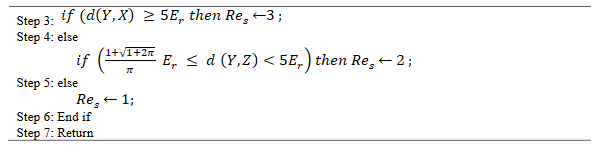
Table 1. Abbreviations.
2.2. Handling of Routing Hole
As the flame increases in a fire scenario, the discovery of route repetitions, route setting time, and route overhead create the routing holes [29]. For long-distance transmission, the proposed strategy of the triangular zone is enhancing the probability of routing holes. To solve the routing holes two methods are proposed such as local processing and global processing. Global processing is used when local processing is failed. Even if global processing failed, the ubiquitous network is flooded and the worst-case scenario occurs [30]. Figure 3 shows the basic idea of local processing algorithm. The process of routing holes is represented in Algorithm 2. Where ‘w’ is represented as neighbour node of node ‘v’, is described as data packet request to the nodes and ‘m’ is represented the number of nodes in the zone [31].


 International Journal of Computer Networks & Communications (IJCNC)