
IJCNC 01
PERFORMANCE EVALUATION OF ERGR-EMHC ROUTING PROTOCOL USING LSWTS AND 3DUL LOCALIZATION SCHEMES IN UWSNS
Faiza Al-Salti1, N. Alzeidi2, Khaled Day2, Abderezak Touzene2
1Department of Informatics and Cyber Security, Sultan Qaboos Comprehensive Cancer
Care and Research Centre, Oman
2Department of Computer Science, Sultan Qaboos University, Oman
ABSTRACT
This paper studies the impact of different localization schemes on the performance of location-base drouting for UWSNs. Particularly, LSWTS and 3DUL localization schemes available in the literature a reused to study their effects on the performance of the ERGR-EMHC routing protocol. First, we assess the performance of two localization schemes by measuring their localization coverage, accuracy, control packets overhead, and required localization time. We then study the performance of the ERGR-EMHC protocol using location information provided by the selected localization schemes. The results are compared with the performance of the routing protocol when using exact nodes’ locations. The obtaine dresults show that LSWTS outperforms 3DUL in terms of localization accuracy by 83% and localization overhead by 70%. In addition, the results indicate that the localization error has a significant impact on the performance of the routing protocol. For instance, ERGR-EMHC with LSWTS is better in delivering data packets by an average of 175% compared to 3DUL
KEYWORDS
Underwater wireless sensor networks (UWSNs), localization, ranging localization methods, localization error, location-based routing
1. INTRODUCTION
Location-based routing protocols are widely used in Underwater Wireless Sensor Networks(UWSNs). They do not require the dissemination of route discovery packets; instead, they use location information of neighboring nodes to forward packets [1]. Consequently, less over head and high scalability can be achieved with such schemes. However, the nature of the underwater environment induces several challenges in localizing nodes. Examples of these challenges are[2], [3](iii) GPS does not work well underwater due to the high attenuation of radio waves in such environments. Thus, several localization schemes have been developed specifically for UWSNs to address these issues (e.g.,[4], [5], [6], [7],[8],[9]).Nevertheless, the developed routing protocols have been assessed with the assumption that all nodes can obtain their locations accurately (e.g.,[10], [11], [12], [13], [14]. This assumption might not be valid as some nodes might get inaccurate locations as well as some others might fail to get their locations completely. This is due to the errors in distance estimation and to thein ability of some nodes to receive sufficient information required for location estimation.
Various research papers found that localization inaccuracies worsen the performance of location based routing protocols in WSNs. B. Peng et al.[15] and M. Kadi et al.[16] have studied the impact of localization error on energy consumption. They have proposed error models and they have verified the need to cope with the localization inaccuracies while designing location-based routing protocols. The authors in [15] have further proposed a routing protocol called Least Expected Distance (LED) protocol, which selects the next forwarder that optimizes energy consumption in the presence of location errors. Shah et al.[17] have analyzed the impact of location errors on energy consumption and packet delivery ratio (PDR) of location-based routing schemes that use greedy forwarding mechanisms. Their results have shown that the performanced e grades significantly with location errors of more than 20% of the transmission range. Son eta l.[18] have studied the impact of location errors resulting from node mobility on energy consumption and PDR. They have proposed two mobility-prediction algorithms to mitigate the effects of location errors. Their simulation results have revealed an improvement of about 27%in PDR and 37% in energy consumption.
To the best of our knowledge, however, no work has studied the impact of localization scheme son the performance of location-based routing in UWSNs. Therefore, this paper aims to analyze the impact of different localization schemes on the performance of the Efficient and Reliable Grid-based Routing by Exploiting Minimum Hop Count(ERGR-EMHC) routing protocol proposed i[14]. The obtained results are expected to give some insights on how to generalize he impact on other location-based routing protocols in UWSNs. More precisely, the contributions of this paper are to:
- Compare the performance of two localization schemes proposed for UWSNs, namely the Localization Scheme Without Time Synchronization (LSWTS) [5] and the Three Dimensional Underwater Localization (3DUL) [6]. We assess their performance, in terms of localization coverage, accuracy, control messages overhead, and required time. The 3DUL and LSWTS localization schemes are selected for the following reasons. First, time synchronization between nodes which is one of the most challenges in UWSNs is not required. Second, there is a detailed description of the protocols sufficient for implementing them. Third, the two schemes use two different and commonly used methods for distance measurements (i.e., the dive and raise method and the projection method). Furthermore, the 3DUL is enhanced by adding an error threshold as a confidence value and assesses the associated performance gains.
- Study the performance of the ERGR-EMHC [14]protocol using location information provided by 3DUL, LSWTS and enhanced 3DUL. The results are compared with the performance of the protocol when using the exact locations obtained from the simulator(we called it built-in localization method).
- The paper basically aims to answer the following research questions:
- How the performance (in terms of localization coverage, localization error, localization time, and localization overhead)of the 3DUL and LSWTS can be improved by adding error threshold?
- What is the performance of ERGR-EMHC when using 3DUL, LSWTS and enhanced 3DUL compared to using the built-in localization scheme?
The rest of the paper is organized as follows. Section 2 presents a brief overview of the ERGREMHC routing protocol. It also provides a summary of localization devices, different classifications of localization schemes as well as an overview of the 3DUL, LSWTS and enhanced 3DUL localization schemes. Section 3 compares the performance of the selected localization schemes against each other according to some specific metrics. The impact of these schemes on the performance of the ERGR-EMHC routing protocol is investigated in section 4.Finally, section 5 concludes the paper.
2. PRELIMINARIES
2.1. Overview of the ERGR-EMHC Protocol
The ERGR-EMHC [14] is a grid-based routing protocol, in which the network is viewed as a collection of cells forming a 3D grid, and the forwarding is performed in a cell-by-cell manner until the packet reaches the sink nodes at the surface level. The protocol classifies the neighboring cells into two groups according to their minimum hop count to the closest sink cell. Furthermore, it adopts an election algorithm to elect a cell-head node in each cell. The election is based on the nodes’ remaining energy and the distances to the center of the nodes’ hosting cells. Data packets are forwarded using selected nodes. The number of hops of each packet can be dynamically selected by the source nodes. To solve the void problem, the protocol uses negative acknowledgments and retransmissions. Refer to [14] for more details on this protocol.
2.2. Localization Devices
To implement a localization scheme in UWSNs, four different types of nodes can be used.
- Surface buoys: These devices placed on the water surface and know their locations most likely through GPS receivers
- Underwater anchor nodes: nodes with known locations deployed underwater. These devices along with anchor devices are used to localize other nodes.
- Ordinary nodes: nodes deployed underwater to be located.
- Reference nodes: nodes with known location. A reference node could be a surface buoy, an anchor node or an ordinary node after being located and they are used to localize other nodes with unknown locations.
2.3. Classification of Localization Schemes
Generally, the localization schemes can be classified based on three criteria as follows:
- Range measurement: the localization schemes can be classified as range-based, rangefree and hybrid. Range-based schemes (e.g., LSWTS [5], DNR [19], 3DUL [6], SLMP [7]) use range information to estimate nodes’ location. Range-free schemes (e.g., ALS [20], 3D-MALS [8]), in contrast, are affected by nodes’ connectivity. Hybrid schemes (e.g., TP-TSFLA [9]) combine both range-based and range-free techniques to estimate locations coordinates.
- Multi/single stage: as the localization process progresses, ordinary nodes can determine their locations. These nodes can be used as reference nodes that help localize other nodes, which in turn improves the localization time and coverage. Such schemes are called multi-stage schemes (e.g., 3DUL [6], SLMP [7]). However, localization errors in such schemes accumulate in each stage due to the possible errors that occur in the distance estimation. On the other hand, some of the localization schemes prevent such nods from helping in localizing other nodes. Such schemes are called single-stage localization schemes (e.g., LSWTS [5], DNR [19], ALS [20]). The main weaknesses of such schemes are the high delay, and the need for more anchor nodes to achieve high coverage.
- Active/silent localization: In active localization schemes (e.g., 3DUL [6], ALS [20]), ordinary nodes also exchange packets to complete the localization process. In silent localization schemes (e.g., LSWTS [5], DNR [19], SLMP [7]), on the contrary, ordinary nodes passively listen to the localization packets transmitted by anchor nodes.
2.4. The LSWTS Localization Scheme
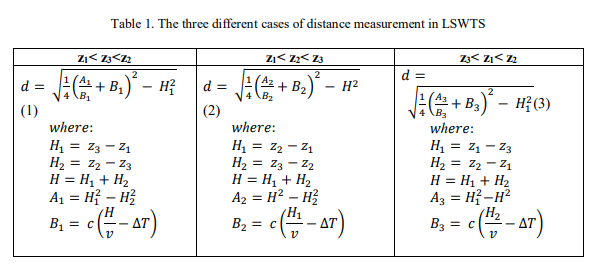
LSWTS [5] is a range-based, single-stage and silent localization scheme. It assumes the availability of two types of devices; mobile beacons and static sensor nodes. Beacon nodes dive and rise vertically at constant speed, v, known by every sensor node. They gather their location coordinates from GPS when rising at the surface. While diving, they broadcast localization messages at fixed intervals. A sensor node upon receiving two messages from a beacon node at different depths (say z1 and z2) calculates its distance d to that beacon. The calculation depends on the depth of the beacon relative to the depth of the sensor node (say z3), and there are three different cases as given in Table 1, where c is the speed of the sound underwater (assumed constant and equal to 1500 m/s). After computing the distance from three beacon nodes, the sensor node estimates its position using trilateration (refer to [3] for a more detailed explanation of this method).
————

 International Journal of Computer Networks & Communications (IJCNC)