
IJCNC 06
ADAPTIVE BANDWIDTH MANAGEMENT MODEL FOR WIRELESS MOBILE AD-HOC NETWORK
Nibedita Jagadev1,Binod Kumar Pattanayak1,Ahmadkhader habboush2, Bassam Mohammad Elzaghmouri3, Mahmoud Ali Al Shugran2
1Department of Computer Science and Engineering, Siksha’O’ Anusandhan Deemed to be University, Odisha, India.
2Department of Computer Networks, Faculty of Computer Science and Information Technology, Jerash University, Jerash, Jordan
3Department of Computer Science, Faculty of Computer Science and Information Technology, Jerash University, Jerash, Jordan
ABSTRACT
The quality of service (QoS) component in a mobile ad-hoc network has an active role in the current network scenario. In a dynamic mobile ad hoc network, ensuring optimum QoS with a scarce network resource is a significant challenge. To achieve QoS, it is essential to adopt some effective and efficient mechanisms. We have proposed an adaptive bandwidth manager model (ABMM) which uses a bandwidthsharing concept along with the flexible bandwidth reservation algorithm (FBRA) for an effective, quick and authentic data transfer. During real-time data transfer, to make communication effective, we make use of bandwidth-sharing network design problems and the concept of reserving bandwidth in high-performance networks. In our proposed model we are concentrating on the maximum utilization of resources, and using the scheduling concept to provide the minimum required bandwidth guarantee to QoS flows. Our goal is to reduce the delay in data transfer and enhance the throughput while properly utilizing the system resources. Our simulation result also shows that our model improves the network performance.
KEYWORDS
Quality of service (QoS), Ad-Hoc Networks, Available bandwidth estimation, Bandwidth Reservation Demand, bandwidth estimator, AODV
1. INTRODUCTION
Ad hoc network consists of self-governing, autonomous wireless mobile nodes. The absence of fixed infrastructure and topology change due to node mobility makes communication more difficult. Hence multi-hop communication satisfying the QoS demands for this type of network is a challenging task [1]. So the development of wireless communication networks and satisfying the demand for transmission of multimedia traffic in MANET is becoming a crucial task nowadays in such networks. The uniqueness of a Mobile multi-hop wireless network is that it needs to focus on certain difficulties such as random link characteristics, node mobility, inadequate battery span, and so on [2]. In these years, research on QoS support also has gathered more and more prominence in MANET. This incorporates matters related to QoS MAC protocols, QoS signalling, QoS model, QoS routing, etc.
In this work, we have proposed a simple, distributed, and stateless network model with BRD (bandwidth reservation demand) to dynamically manage the accepted real-time traffic. In our model in-between nodes do not keep track of traffic information. Therefore the network overhead will be less. Topology change and link failure don’t affect its performance which makes our model simple, robust, and scalable. The bandwidth management approach along with sourcebased admission control ensures facilitates the throughput and manages the delay requirements of the real-time traffic.
The performance evaluation of the proposed QoS model in varied network flows has been demonstrated. A well-organized QoS model can provide a robust communication channel, improved QoS performance with a resource reservation facility, and minimum end-to-end delay [3]. Our model focuses on the bandwidth parameter, which is a basic parameter for admission control, flow management, congestion control, etc. There are two types of traffic flows. The first one is the QoS flow which incorporates multimedia data, videos, real-time traffic, etc. This type of flow needs guaranteed bandwidth reservation. The second one is the best-effort traffic which is not restricted by any kind of bandwidth guarantee. The proposed QoS model can distinguish the flows into classes and offers adequate bandwidth and fewer delay guarantees to high-priority flows [4].
Existing work emphasizes QoS routing which finds the shortest path to meet the preferred requirements of a flow. Here we have considered a combination of QoS flow and the best effort flow. To enhance the quality of service (QoS) guarantee two common procedures used are admission control and resource reservation. With the arrival of new flows the intelligent agent at the source node searches for the availability of required resource by the new flow. If the required basic resources are accessible then the transmission begins along the reserved path linking the source and destination. In this work, we are focusing on the available bandwidth which is the performance requirement of a flow.
In our model we are concentrating on the maximum utilization of resources, so using the scheduling concept minimum required bandwidth guarantee has been given to QoS flows and a fair portion of residual bandwidth is shared among all other flows. Section 2 explains the background study on different QoS models. The network strategy and proposed Bandwidth Management System are described in Section 3-4. Section 5 describes network analysis and problem formulation. Section 6-7 describes the result discussion and conclusion.
2. RELATED WORK
In a wireless ad-hoc network, considerable research has been carried out to provide QoS service amenities. Significant relevant sources for the presented studies have included different issues related to QoS support of MANET. Bandwidth management for optimized resource utilization has received significant attention in recent times. The QoS model for MANET has extended the conventional Internet models to make them suitable for MANET. To provide QoS assurance different basic architectures are proposed such as integrated services (IntServer) [5], Differentiated services (Diffserv) [6], INSIGNIA [7], and a stateless network model [8].
Maintenance of per-flow information amplifies with the high traffic input in the case of IntServ in which a large database and a high managing cost on routers. The principle of DiffServ is to use the priority scheme to eradicate the complexity of executing and arranging IntServ and RSVP on web. Due to the dynamic nature and inadequate resources of MANET, so providing QoS services is intricate in case of instantaneous-varying conditions. Agbaria et al. [9] have proposed a novel bandwidth approach in which the bandwidth allocation and requirements are considered only for 2-hop neighbors. The proposed approach is incorporated into AODV protocol and it gives low latency and advanced reliability. This work doesn’t support communication beyond 2-hop neighbors. A QoS routing protocol focused on an on-demand protocol M-QoS –AODV which integrates a channel assignment scheme and route discovery process to support QoS service in MANET [10]. This protocol gives reduced delay performance by using a deterministic method than AODV and M-AODV-R protocols. The performance can be improved by reusing the channel. An Adaptive bandwidth management protocol (LANMAR) has been emphasized on a large-scale network by incorporating MBNs structure to boost network performance by Xu et al. [11].
A flexible QoS model (FQMM) has been framed by Xiao et al [12]. In FQMM a hybrid per-flow and per-class provisioning provide better throughput performance in small to medium-size MANET. But this model is unable to handle more complex network scenarios. Youn and Hong [13] have developed a novel admission control protocol DACP that can calculate available bandwidth in each node and at the MAC layer so that it can allow the new flow on a per-hop basis. DACP reduces control overhead and provides the end-to-end resource. A dynamic bandwidth management system has been suggested by Shah et al.[14] to control the data traffic. This scheme can provide a share of channel time to each flow according to its requirement using the max-min fairness algorithm. By using this model the flows can get the lowest amount of requested bandwidth from the available network bandwidth. To regulate the best-effort traffic and accept more numbers of QOS flow a cross-layer protocol DRBT was put forward by Khalfallah et al.[15]. This protocol decreases the throughput of the best effort flow to guarantee maximal use of radio link but this protocol can’t handle the carrier sensing mechanism and can’t deal with mobility.
DCDR (Dynamic Congestion Detection and Control Routing) [16,17] dynamically deals with congestion detection and a warning is sent to the neighboring nodes. After receiving the message the neighbors become alert and search for some other alternate path to the destination. Here the shortcoming is if the network traffic is high then the packet loss although reduced but still there. According to Al-Dhief et al. [2], the Cost and Bandwidth constraints can be optimized with GA in a multi-state computational grid network. A node location is predicted by using a hybrid model with the help of path diversion so that routing performance can be enhanced instead of larger packet overhead [18,19].
3. BANDWIDTH MANAGEMENT SYSTEM
One of the shared resources which get accessed by various neighboring nodes in a wireless network is Bandwidth. So, always there is a requirement for bandwidth management which can coordinate among the nodes who share the wireless channel.
In MANET the traffic characteristic and the network topology change recurrently because of its dynamic nature. So before admission of any new flow, one-time admission control in the source node by the centralized Bandwidth Manager is required. The bandwidth manager registers each flow before the commencement of its transmission. Each flow has been assigned a minimum bandwidth requirement of Bmin(f) and a maximum bandwidth requirement of Bmax(f) [14].
According to the requirement of any flow, the exact share of bandwidth is to be allotted to that flow at the establishment of the connection. If the Bandwidth Manager is unable to provide a fair amount of bandwidth then it refuses to admit the new flow. Therefore the Bandwidth Manager at the source node along with the admission control carries out dynamic bandwidth management to locate the amount of accessible bandwidth in the network.
4. ARCHITECTURE OF ADAPTIVE BANDWIDTH MANAGEMENT MODEL (ABMM)
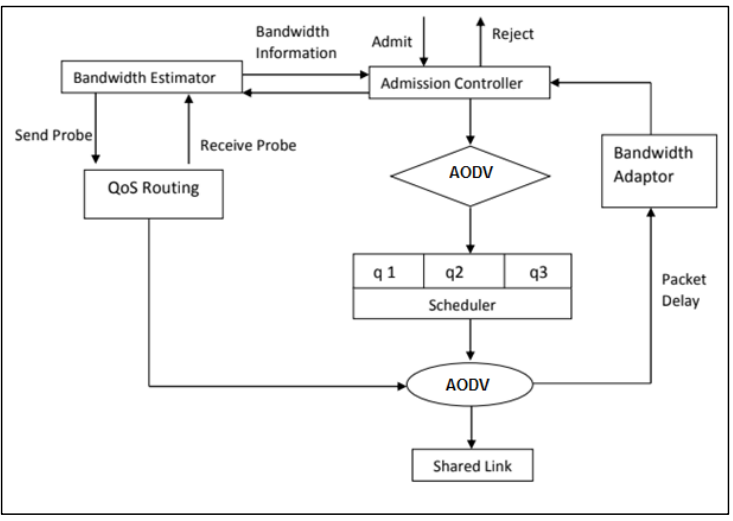
Figure 1. Architecture of Adaptive Bandwidth Management Model
The Adaptive Bandwidth Management Model (ABMM) includes various modules for the regulation of the traffic flow at the source node. The proposed novel architecture of ABMM consists of four basic components, to be precise, total bandwidth estimator, admission controller (intelligent agent), classifier, and the adaptation module.
The bandwidth estimator collects information about available bandwidth from the intermediate nodes with the help of control packets. The intermediate nodes do not maintain any information regarding the session only provide information about available bandwidth. Available bandwidth means the difference between the actual bandwidth and the exhaust of bandwidth usage of other flows. With the updated information from the intermediate nodes, the bandwidth estimator can efficiently detect locally available bandwidth before a new call admission. The admission controller decides based on the retrieved information from the bandwidth estimator to accept or reject any new flow. Then the classifier differentiates the flows and the scheduler schedules them according to their priority.
The adaptation module has a great deal of importance for our QoS architecture. In MANET, although admission control is performed to provide guaranteed bandwidth reservation due to the mobility and dynamic nature of the network to avoid congestion and provide a satisfactory quality of service the adaptive bandwidth management component is essential. Once a real-time session is accepted it is vital to preserving the service quality and this is the foremost task of the bandwidth adaptation module. The transmission delay for each flow is determined by the rate controller. The admission controller will assign the maximum needed bandwidth to a flow when a flow is introduced. In case of network congestion the adaptation module renegotiates with the existing flows and reallocation of the flows takes place.
When there is more demand for bandwidth with the increase in the number of flows the BM will ask the low-priority flows to release the maximum bandwidth assigned to them and work with their minimum need, so that it can be assigned to the flows having higher priority. If still the existing resources are not adequate for the new flow then the BM will pause some of the least priority flows to release resources. In this way, the BM can avoid the reservation of the flows having the least priority. Here we are using a bandwidth-sharing network design. Bandwidth sharing can provide considerable cost reduction in comparison to other bandwidth reservation algorithms. For working on ABMM, we have proposed the bandwidth reservation algorithm which computes the reservation options with maximum efficiency and earliest completion time.
4.1. Algorithm
Input –Flow (data packet, size, start time, end time)
Output –Bandwidth Management (less delay, throughput, routing)
Input flow into the Admission Controller
4.2. Proposed algorithm for Bandwidth Estimator
Input: QoS routing information
Output: Keeps updated information about network such as ; bandwidth availability
For all the incoming flow
Get the bandwidth available
If
The bandwidth available is less than required minimum
Repeat step 1 and 2 for each new session
Step1.Send probe / control packet
Step2.Receives the information about bandwidth availability
Else
Assign the available bandwidth
Step 3.End
4.3. Proposed algorithm for Bandwidth Adaptor
Input: Flow ()
Output: Adequate bandwidth availability
Step 1.Assign min. Bandwidth to low priority flow
Step 2.Check the adequacy of bandwidth
If “no”
choose some low priority flow to be “paused “
else
send notification to the admission controller about availability
Step 3.End
5. NETWORK ANALYSIS AND PROBLEM FORMULATION
Here we are considering a set of nodes as ‘N’ and a set of links as “L” to represent a scheduling network scenario. We have represented BRD (Bandwidth Reservation Demand) as R(NS, ND, Bmax, M,ts,tf,p) where NS is the source node, ND is the destination node, Bmax is the maximum bandwidth available, M total size of data to be transferred in Mbps, within a period of starting time and finishing time tf with the flow priority p. In figure 2, we are illustrating a simplified topology T’ with a high-performance scheduling network. In T’=(A,B,C.D) are the nodes and L=L1,L2,L3,L4,L5are the connecting links. The values on the corresponding link signify the availability of bandwidth. At a certain point in time, the source node receives a request with Bandwidth Request Demand as M(A, D,400MBs, 1200MB,0, 10s)
5.1. Scenario1: Scheduling of a flow on available Bandwidth without considering the priority
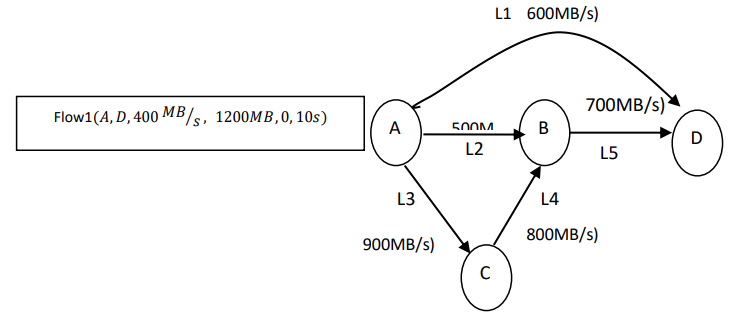
Figure 2. Topology of scheduling Network


Figure 3. Available bandwidth on each link
We have defined the longest time slot as the period during which the link bandwidth of a considered path remains unaltered. According to the availability of bandwidth, 4-time slots are found in figure 3 i.e. (0,3s),(3,5s),(5,7s),(7,10s). A time window may consist of one or many time slots.
The minimum time required to transfer data of size M is tmin which is calculated as MBmax. The minimum bandwidth required for a FR to transfer ‘M’ amount of data in a time period of (tf-ts) is M(tf-ts).
Example: For a FR (A,D,400MBs, 1200MB,0, 10s), the minimum bandwidth is required 1200(10- 0)=120MB/s.
Figure 3 represents the time windows of the scheduling network within (0,10s). The BRA algorithm can select a path with a substantial amount of required bandwidth and the least time duration for transmission of a message from the source node to the destination node
There are more than one-time window during (0, 10 s) which is (0s, 3s), (0s, 5s), (0, 7s), (3s, 10s), (5s, 7s), (5, 10s), (7s, 10s). With the given network topology, as the Bandwidth Reservation Demand is MA,D,400MBs, 1200MB,0, 10s. The minimum bandwidth is 120 MB/s. So no edge will be removed from the edge set on the basis of minimum bandwidth. So the edge has to be removed on the basis of the minimum required time. The minimum time required to transfer 1200MB of data at a rate of 400MBs is 3s. So (0s, 5s), (0, 7s), (3s, 10s), (5s, 7s), (5, 10s) is removed as the time duration is more than 3s. From the remaining time windows, L1 has the largest available bandwidth i.e. 500MB/s in the time slot (0s, 3s). So the link L1 will be considered for the scheduling which will accomplish the flow within the minimum time. The advantage of bandwidth sharing is discussed in the 2nd scenario by considering different kinds of flows such as Real-time flow, multimedia flow, and best-effort flow.
5.2. Scenario 2: Scheduling of a flow on available Bandwidth considering the priority of the flow
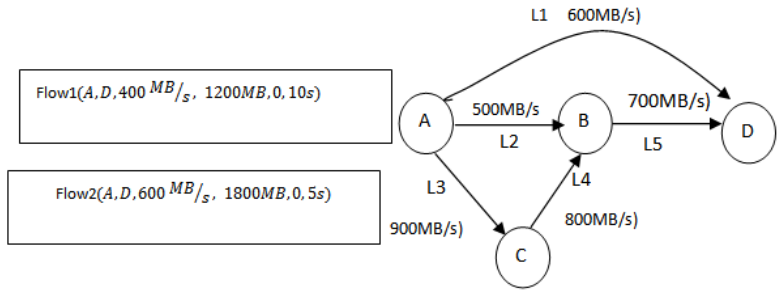
Figure 4. Topology of scheduling Network with a Real time flow
In the second scenario in figure 4 we have considered the priority of the flow. In addition to the first scenario suppose we have received real-time data. Always real-time data has the highest priority over multimedia and best-effort flows. So we have to rearrange the sequence of the flow in order that the real-time data can get the maximum bandwidth if the available bandwidth is not adequate. Rescheduling can be done by withdrawing the allocated bandwidth from the existing low-priority incomplete flows.
For an instance suppose a real-time BRD (A,D,600MBs, 1800MB,0, 5s) arrived. From fig.4 it can be observed the available bandwidth of the different links. The time window during (0, 10 s) which is (0s, 3s), (0s, 5s), (0, 7s), (3s, 10s), (5s, 7s), (5, 10s), (7s, 10s). The minimum bandwidth required for the new real-time flow is 1800/ (5-0) = 360 MB/s. The minimum time required to transfer 1800MB of data at a rate of 600MBs is 3s. If we will consider a link from the available bandwidth, on the basis of minimum bandwidth only L5 is eligible. But as it’s a real-time flow always it will be assigned with the maximum possible bandwidth i.e. 600MB/s.

Figure 5. Available bandwidth on each link during a new real time flow
Hence all previous BRDs which are using link L1 will release the maximum assigned bandwidth and will use their minimum required bandwidth. If still the existing resources are not adequate for the new real-time flow then the BM will pause some of the least priority flows to release resources.
6. PERFORMANCE ANALYSIS
Here the devised QoS model is evaluated using simulation. The network attainment is compared with or without our developed model. The primary output considered for performance evaluation is throughput i.e. the packets delivered and the secondary is end–to–end delay calculation.
The proposed FBRA technique is implemented by using MATLAB simulator with a network range of 1000*1000 m size and mobile nodes varied from 50 to 500 in steps of 50. The time frame for the scheduling is stipulated from 0 to 200 s. Due to the mobility of the nodes, the proposed ABMM model uses the random waypoint as a mobility model. In this simulation, we will examine the performance of the proposed method with different flows with unlike bandwidth demands and a varied number of nodes.
For our analysis, we have considered that several BRD’s are assembled through this period. Bmax is the bandwidth value between 1 to 100 mbps and 20J initial energy. The total data to be transferred through the qualified link varies according to the BRD. The priority of the flow is considered between1 to 3. The real-time flow is given the highest priority which is 1, the multimedia flow and best-effort flow is given priority 2 and the 3 respectively.
Here we have considered the mobility of the node to be constant during a particular scheduling period. The real-time flow is emulated using CBR traffic. While we consider the QoS scheme the network becomes more heavily congested than its non-QoS counterpart. So, to improve the performance some of the low-priority flows may get discarded to maintain the service quality.
From figure 6 and 8, we can observe that with the amplification of flow in the network, the data packet delivery fraction is decreased and end-to-end delay is increased with general scheduling algorithms like FIFO, priority queue algorithm, and weighted fair queue (WFQ) algorithm. We can deduce from the graph that our proposed algorithm gives improved results in comparison to general scheduling algorithms.
6.1. Performance Analysis of Delay
Table 1 lists the simulation results of the average end-to-end delay for the number of data packets sent or the number of flows. As shown in Table 1, the delay increases with the increase in the number of data packets sent from the source node. However, the proposed ABMM Model reduces the delay than the other existing techniques due to the adaptive resource-sharing technique.
Table 1. Performance matrix comparison for end to-end delay


Figure 7. End to-end delay Comparison with Load
Figure 6 shows the plot of delay versus load for the three techniques. Through the proposed FBRA technique, the data packets from the source node to the destination node are effectively transmitted with less time consumption. By selecting the best neighboring node with the highest residual bandwidth, the optimal route path is determined in order to successfully route the data packets to the destination from the source node in MANET with minimal time. Hence, the endto-end delay also gets reduced.
Due to the focus on scheduling and reservation of bandwidth different flows in our model have been assigned to different priority queues which can be served with different possibilities. Here the low-priority flows are served with a lower probability than the high-priority flows. Figure 6 depicts that with the surge of network load, the delay observed by FIFO will be highest as there is no concept of priority given to any of the flows. We can observe from the graph that in the case of priority and WFQ the resources cannot be utilized properly but in the FBRA the end-to-end delay dropped prominently due to the concept of resource sharing.
Before beginning the communication the pair of communicating processes establishes a connection which results in less delay. For a particular time frame, we consider the topology to be static. From the graph obtained we can conclude that our derived algorithm FBRA gives improved results than FIFO, Priority, and WFQ algorithms.
6.2. Performance Analysis of Packet Delivery Ratio
The packet delivery ratio is measured in terms of percentage (%). A higher value of packet delivery ratio ensures better performance of the system. Table 2 lists the values of the packet delivery ratio for the number of data packets sent in MANET for four different techniques. The number of data packets sent is varied from 10 to 60 in step 10. As shown in Table 2, the proposed model provides better results in packet delivery ratio than the other existing techniques first in first out (FIFO), Priority Queue (PQ), and weighted fair queue (WFQ) algorithm.
Table 2. Performance matrix comparison for Packet Delivery Ratio
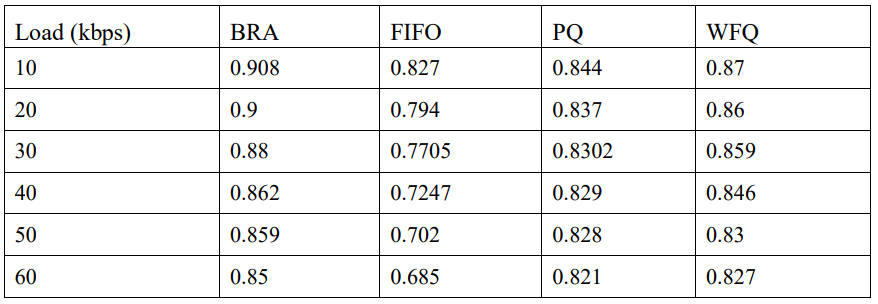
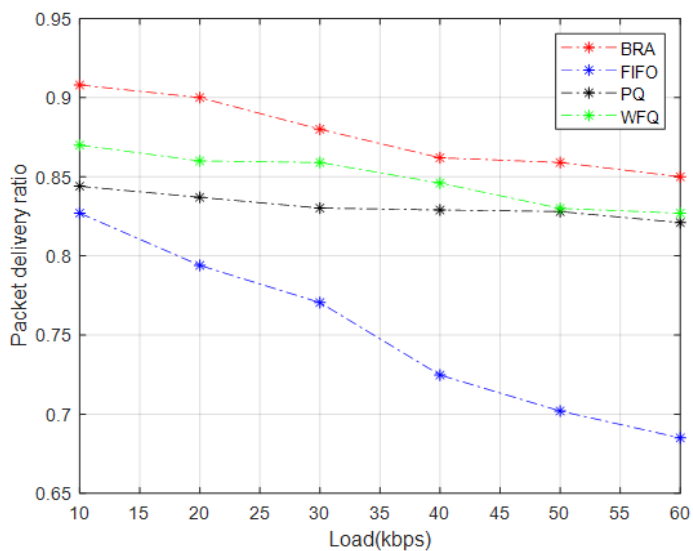
Figure 7. Packet Delivery Ratio Comparison with Load
Figure 7 shows the plot of the packet delivery ratio versus the number of packets sent or load for the proposed ABMM model and the existing techniques as FIFO, PQ, and WFQ. It reveals that the proposed FBRA technique provides a better improvement in the packet delivery ratio than the other existing techniques. This is because the proposed ABMM technique uses FBRA algorithm for finding the resource-optimized route path from the source node to the destination node. This is done by selecting less delay and high residual bandwidth mobile nodes among the large quantity of mobile nodes between the source and the destination node and then routing using the resource-optimized route path. Hence, the chances of data loss get minimized while routing the data packets and the packet delivery ratio at the destination node is improved. The packet delivery ratio is improved in the proposed ABMM model up to 37% on average compared to the FIFO protocol and 27% compared to the WFQ protocol.
In our model, various traffic flows have been considered with varied priorities by the scheduler so the flows perform with different packet loss rates. Figure 7 describes the performance of the Packet Delivery Ratio with the change in network load. The proposed algorithm presents enhanced packet delivery results as compared to other algorithms since the priorities of the considered flows are different. The higher priority flow results in lower packet loss as they are assigned with the required bandwidth.
6.3. Performance Analysis of Bandwidth Utilization Rate
The bandwidth utilization rate is defined as the ratio of the amount of bandwidth consumed to the total available bandwidth while routing the data packets from source to destination node. The Bandwidth Utilization Rate BUR is mathematically expressed

The bandwidth utilization rate is measured in terms of percentage (%). The lower value of the bandwidth utilization rate ensures better performance of the technique.
Table 3 lists the values of the % bandwidth utilization rate for the number of data packets sent in MANET. The number of data packets sent varied from 10 to 60 in step 10. While routing the data packets between the source node and the destination node, the bandwidth utilization rate is increased by using the proposed FBRA technique than the existing techniques.
Table 3. Performance matrix comparison for bandwidth utilization (%)


Figure 8. Bandwidth utilization Comparison with Load
Figure 8 shows the plot of bandwidth utilization rate versus number of packets sent using the four techniques. It is observed that the proposed FBRA technique ensures a better enhancement in the bandwidth utilization rate than the other existing techniques. This is because, the proposed FBRA technique selects the links with maximum bandwidth and less delay for transmitting the data packets in a resource optimized route path. This helps to increase the bandwidth utilization rate for routing the data packets between the source and the destination node.
Fig 8 explains the effect on bandwidth utilization while there is a change in network load. The above graph gives an idea about proper utilization of bandwidth as compared to FIFO, priority and WFQ algorithm. The bandwidth manager reschedules the bandwidth and distributes it among the flows depending on the priority.
6.4. Performance Analysis of Routing Stability
The routing stability is defined as the ratio of number of mobile nodes with high bandwidth that are addressed to the total number of mobile nodes in MANET. The Routing Stability ‟RS‟ is mathematically expressed as

The routing stability is measured in terms of percentage (%). The high value of routing stability provides better performance of the technique.
Table 4. Routing Stability (%) Comparison with Load
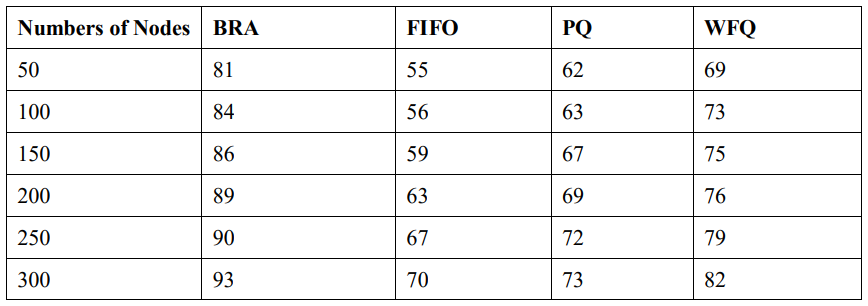

Figure 9. Routing Stability (%) Comparison with Load
Table 4 list the values of the percentage of routing stability in the four techniques. It can be observed that it increases gradually with the increase in the number of mobile nodes. The improvement in FBRA technique is better than the existing FIFO, PQ, and WFQ methods. Due to the effective resource optimization, the proposed FBRA technique attains stable routing for transmitting the data packets more than the other existing techniques.
Figure 9 shows the plot of routing stability versus the number of mobile nodes for the proposed ABMM model and the existing techniques such as FIFO, PQ, and WFQ and it is observed that the proposed technique ensures better improvement in the routing stability than the other existing techniques. This is due to the application of FBRA algorithm in the proposed ABMM model. The selection of a mobile node with higher remaining bandwidth is achieved to ensure the resourceoptimized route path between mobile nodes. The detection of resource-optimized route paths ensures the stability for routing the data packets.
7. CONCLUSION
We have proposed a bandwidth reservation model for the proper utilization of resources in MANETs. In this work, a novel bandwidth reservation model with a bandwidth management mechanism for the proper utilization of resources in MANETs has been proposed. The proposed algorithm combines channel rescheduling with routing and can considerably boost the network throughput, which is used to control congestion. In this technique, the source node forwards the data packet to the destination node through the intermediate nodes. Based on the percentage of channel utilization and queue length, the nodes are verified for congestion status. After the reception of the data packet, the destination node checks for the status of routing nodes in the defined route. Along with other essential fields, the estimated bandwidth is also copied to an acknowledgment packet and fed back to the sender. Since the acknowledgment packet transmits the remaining bandwidth status based on the estimated rate from the intermediate nodes, this technique is better than the traditional congestion control technique. Based on the various analyses, it has been shown that the proposed scheme is suitable to control congestion for realtime and multimedia applications. The proposed FBRA technique is developed for ensuring routing stability with the reduction of resource utilization among the mobile nodes. Here, the endto-end delay and the bandwidth utilization rate are reduced for routing the data packets. The data packets are then transmitted through the resource-optimized route path from the source node to the destination node which leads to improved routing stability in MANET. Simulation results revealed that the proposed FBRA technique has provided higher routing stability, lesser energy consumption, lesser bandwidth utilization rate, higher packet delivery ratio and higher throughput than the existing techniques. Hence, stable routing between mobile nodes is achieved with the reduction of resource (bandwidth) utilization while using the ABMM model. The future scope is we will implement the algorithm along with the bandwidth management model in large-scale networks with some Meta heuristic approach.
REFERENCES
[1] Jagadev, N., Pattanayak, B. K., Singh, D., &Sahoo, S., 2018. A survey on bandwidth management in manet. International Journal of Engineering & Technology, 7(3.4), 38-41.
[2] Al-Dhief, F. T., Sabri, N., Fouad, S., Latiff, N. A., &Albader, M. A. A., 2019. A review of forest fire surveillance technologies: Mobile ad-hoc network routing protocols perspective. Journal of King Saud University-Computer and Information Sciences. 31(2), 135-146.
[3] Rath, M., &Pattanayak, B. K. ,2021. Performance evaluation of optimised protocol in MANET. International Journal of Information and Computer Security, 14(3-4), 318-326.
[4] Panda, N., &Pattanayak, B. K. ,2020. ACO-based secure routing protocols in MANETs. In New Paradigm in Decision Science and Management,195-206.
[5] Braden, R., Clark, D., Shenker, S., 1994. Integrated services in the internet architecture: an overview. RFC1633.
[6] Black, D., & Jones, P.,2015. Differentiated services (DiffServ) and real-time communication. RFC 7657, ISSN 2070-1721.
[7] Lee, S. B., Ahn, G. S., Zhang, X., & Campbell, A. T.,2000. INSIGNIA: An IP-based quality of service framework for mobile ad hoc networks. Journal of Parallel and distributed Computing, 60(4), 374-406.
[8] Ahn, G. S., Campbell, A. T., Veres, A., & Sun, L. H., 2002. SWAN: Service differentiation in stateless wireless ad hoc networks. In Proceedings. Twenty-First Annual Joint Conferences of the IEEE Computer and Communications. IEEE, Societies. 2, 457-466.
[9] Agbaria, A., Gershinsky, G., Naaman, N., Shagin, K., 2009. A bandwidth management approach for quality of service support in mobile ad hoc networks. In 2009 IEEE International Conference on Pervasive Computing and Communications. IEEE, 1-5.
[10] Zhou, J., Liu, L., Deng, Y.,Huang, S.,2014. A QoS routing protocol with bandwidth allocation in multichannel ad hoc networks. Wireless personal communications, 75(1), 273-291.
[11] Xu, K., Tang, K., Bagrodia, R., Gerla, M., Bereschinsky, M., 2003. Adaptive bandwidth management and QoS provisioning in large scale ad hoc networks. In IEEE Military Communications Conference,(2),1018-1023.
[12] Xiao, H., Seah, W. K., Lo, A., & Chua, K. C. ,2000. A flexible quality of service model for mobile ad-hoc networks. In VTC2000-Spring. 2000 IEEE 51st Vehicular Technology Conference Proceedings, (1), 445-449. International Journal of Computer Networks & Communications (IJCNC) Vol.15, No.1, January 2023 102
[13] Youn, J., Pack, S., Hong, Y. G., 2011. Distributed admission control protocol for end-to-end QoS assurance in ad hoc wireless networks. EURASIP Journal on Wireless Communications and Networking, (1), 1-18.
[14] Shah, S. H., Chen, K., &Nahrstedt, K., 2005. Dynamic bandwidth management in single-hop ad hoc wireless networks. Mobile Networks and Applications, 10(1), 199-217.
[15] Khalfallah, S., Sarr, C., &Lassous, I. G., 2007. Dynamic bandwidth management for multihop wireless ad hoc networks. In 2007 IEEE 65th Vehicular Technology Conference-VTC2007-Spring, 198-202.
[16] Senthilkumaran, T., Sankaranarayanan, V. ,2013. Dynamic congestion detection and control routing in ad hoc networks. Journal of King Saud University-Computer and Information Sciences, 25(1), 25- 34.
[17] Talau, M., &Wille, E. C. G. (2013). Available network bandwidth schema to improve performance in TCP protocols. International Journal of Computer Networks & Communications, 5(5), 45.
[18] Farheen, N. S., & Jain, A., 2020. Improved Routing in MANET with Optimized Multipath routing fine-tuned with Hybrid modelling. Journal of King Saud University-Computer and Information Sciences.
[19] Baliyan, A., &Pareek, V. (2014). MULTIPATH QOS AWARE ROUTING PROTOCOL FOR ADHOC NETWORK. International Journal of Computer Networks & Communications, 6(2), 17.
AUTHORS

Nibedita Jagadev is currently pursuing a Ph.D. degree and working as an Assistant Professor in the Department of Computer Science and Engineering, Siksha’O’ Anusandhan Deemed to be University, Odisha, India. Her research interests include Mobile Adhoc Networks, Big Data analytics, cloud computing, Machine Learning
Email:nibeditajagadev@soa.ac.in
Dr. Binod Kumar Pattanayak, working as a Professor in Department of Computer Science and Engineering, Siksha’O’ Anusandhan Deemed to be University, Odisha, India. His research interests include computer networking, Big Data Analytics, IoT, Compiler Design and Software Engineering.
Email:binodpattanayak@soa.ac.in

Dr. Ahmad Habboush, working as a Professor Department of networks, Faculty of Computer Science and Information Technology, Jerash University, Jerash, Jordan. His research interests include Mobile Adhoc Network, cloud computing.
Email:ahmad_ram2001@jpu.edu.jo

Dr Bassam Mohammad Elzaghmouri, working as a Associate in Department of Computer Science, Faculty of Computer Science and Information Technology, Jerash University, Jerash, Jordan. His research interests include computer networking, System Modeling; also he is interested in electrical networks and computer systems.
Email:b.el-zaghmouri@jpu.edu.jo

Dr. Mahmoud Ali Al Shugran is an associate professor at the Department of computer science/networking in the Faculty of Computer Science and Information Technology, Jerash University. Mahmoud’s research focuses on Wireless and Mobile Networks, routing protocols design, Internet of Things and IoT Security. Mahmoud is the author of several articles and coauthor of other articles in the area of interest. He is currently working on designing a new position-based routing protocol for VANET.
Email:m.shquran@jpu.edu.jo

 International Journal of Computer Networks & Communications (IJCNC)